Best Audi Repair Shops Near You: Dealer vs. Independent
For most Audi repairs, choose the dealer only for warranty-covered work, security coding, software updates, or factory-paid recalls. For brakes, suspension, cooling leaks, and many fault-code diagnoses, a strong independent is usually the better value. Pick wrong, and you can pay 20% to 60% more than necessary, lose time on repeat visits, or create warranty disputes with poor documentation. This guide gives you a decision matrix, repair-by-repair rules, and shop-check questions so you can compare dealer and independent Audi options near you.
Audi dealer or independent shop: which is the better fit?
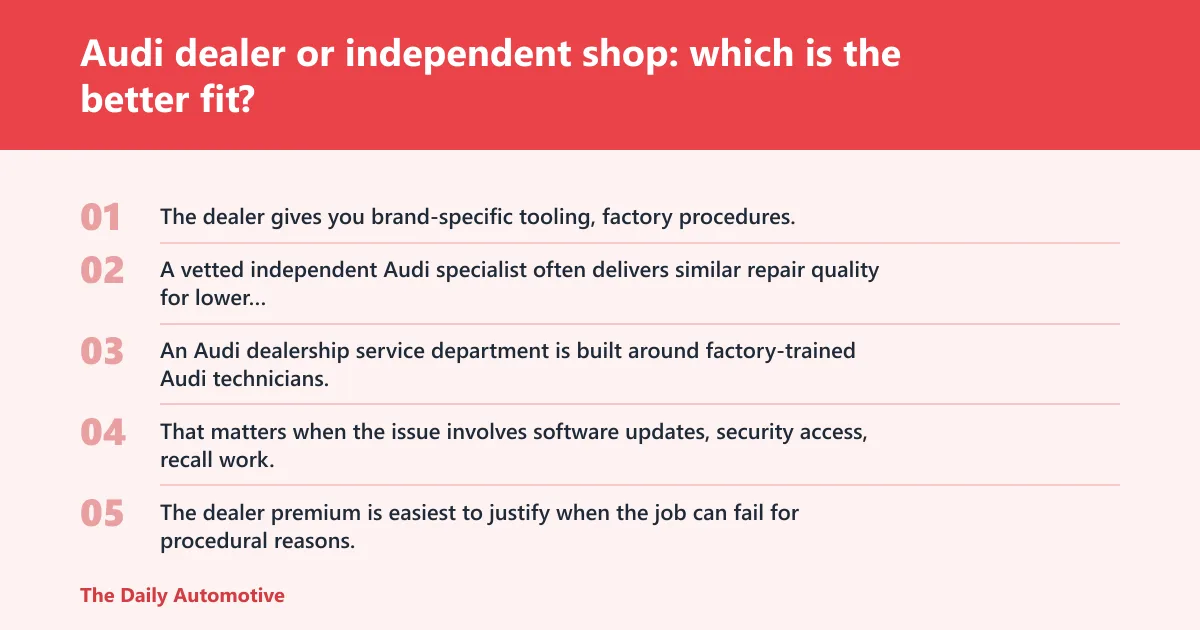
The dealer gives you brand-specific tooling, factory procedures, and direct access to Audi software support. A vetted independent Audi specialist often delivers similar repair quality for lower cost, especially on routine mechanical work, as long as the shop has the right diagnostic tools, parts sourcing, and repair records.
| Decision factor | Dealer | Independent | Winner |
|---|---|---|---|
| Routine maintenance cost | Oil changes commonly run $280-$400 | Oil changes commonly run $175-$245 | Independent |
| Warranty-sensitive work | Best fit for warranty claims, recalls, and documented factory procedures | Can be warranty-safe if specs, parts, and records are correct | Dealer |
| Electrical diagnostics and coding | Strong access to Audi diagnostics equipment and software support | Can be strong if the shop has VCDS-level tools or equivalent | Dealer |
| Major mechanical repair value | Usually higher pricing | Often somewhat less than dealers, sometimes by a meaningful margin. | Independent |
| Parts flexibility | Often prioritizes OEM parts | Can also use genuine OEM parts | Tie |
What you pay for at an Audi dealership service department
An Audi dealership service department is built around factory-trained Audi technicians, brand procedures, and the latest diagnostic equipment. That matters when the issue involves software updates, security access, recall work, or a repair that depends on Audi-specific coding and guided fault tracing.
The trade-off is price. The dealer premium is easiest to justify when the job can fail for procedural reasons, not only mechanical ones.
Where a certified independent Audi specialist usually wins on value
A certified independent Audi specialist is often the better choice for brakes, suspension, cooling system leaks, many engine services, and straightforward electrical faults. Certified independent Audi specialists often charge 30-40% less than dealers, and many can still use genuine OEM parts and offer warranty-safe service.
That value only holds if the shop has the right equipment and documentation habits. A cheap quote is not a bargain if the car returns with the same fault code.
How to judge risk, not price alone
Start with the repair category, then ask what could go wrong if the wrong tool or procedure is used. If the job touches software, security access, or a module adaptation, risk rises fast. If it is a normal wear item with clear access and no coding, the independent usually has the advantage.
Say your A4 has a brake warning and a worn rotor. A good independent can usually handle that cleanly, use OEM parts, and save money. Suppose the same car needs a control module update after a battery event; that is a different job, and the dealer is often the safer first stop.
📊 An Audi oil change can cost $280-$400 at the dealer. Source: Best Audi Repair Shops Near You: Dealer vs. Independent.
Dealer vs. independent by repair type
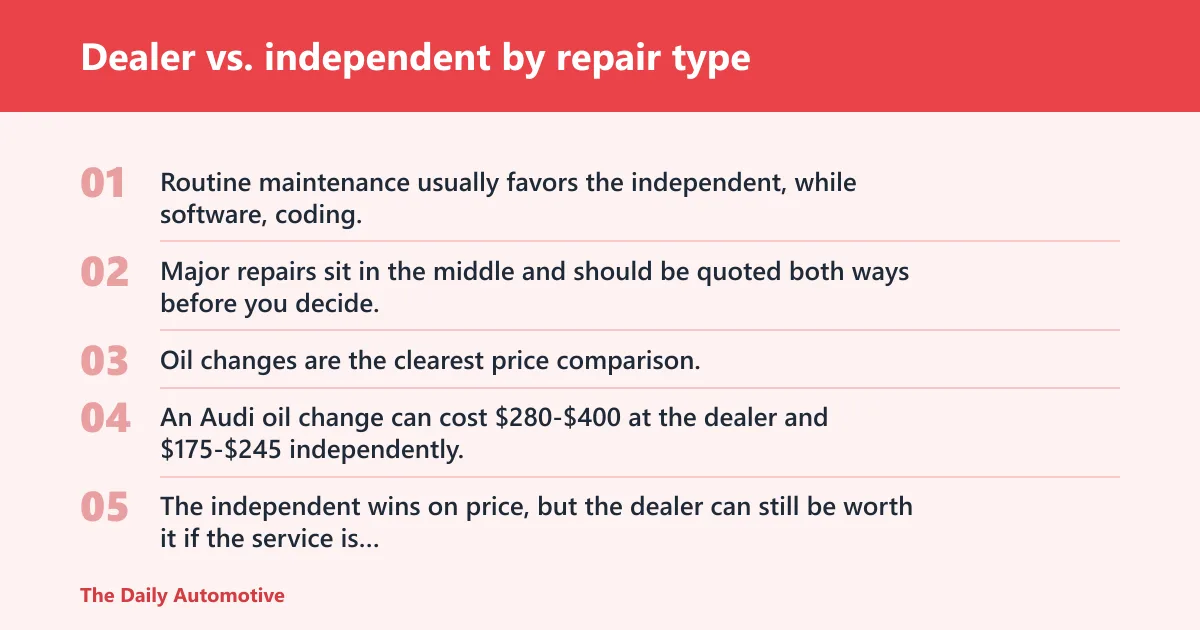
The right shop changes by repair type. Routine maintenance usually favors the independent, while software, coding, and warranty-sensitive work often favor the dealer. Major repairs sit in the middle and should be quoted both ways before you decide.
Routine maintenance and oil changes
Oil changes are the clearest price comparison. An Audi oil change can cost $280-$400 at the dealer and $175-$245 independently. The independent wins on price, but the dealer can still be worth it if the service is tied to a warranty record, a multi-point inspection you want documented in the dealer file, or a pending factory campaign.
Electrical faults, module coding, and software updates
Electrical diagnosis is where tool access matters most. A basic OBD II scanner can help catch basic fault codes before choosing a shop, but basic scanners may not fully diagnose Audi systems. For deeper work, the shop should have Audi diagnostics equipment and, in many cases, VCDS-level tools or equivalent access for adaptations, coding, and module communication.
Major mechanical repairs and warranty-sensitive work
For engines, transmissions, timing components, and anything linked to a warranty claim, the dealer has the cleanest paper trail. A strong independent can still be the smarter value for many of these jobs, but only if the shop documents parts, labor, and procedures clearly and can show prior Audi experience.
| Repair type | Likely cost range | Warranty risk | Diagnostic complexity | Best-shop choice |
|---|---|---|---|---|
| Oil change | Dealer: $280-$400; Independent: $175-$245 | Low if specs and records are followed | Low | Independent |
| Brake pads and rotors | Dealer usually higher; independent often lower | Low | Low to moderate | Independent |
| Cooling leak or hose repair | Dealer usually higher; independent often lower | Low to moderate | Moderate | Independent |
| Electrical fault diagnosis | Varies by scan time and access | Moderate if poor records or wrong parts are used | High | Dealer for complex cases |
| Module coding or software update | Dealer pricing usually higher | Higher if done without proper access | High | Dealer |
| Engine or transmission repair | Dealer usually higher; independent can be 30-40% less | Moderate to high | High | Compare both |

What certifications and tools should an Audi shop have?
An Audi shop should have a mix of baseline technician credentials and brand-specific diagnostic capability. ASE certification is a key credential to look for, but it should be treated as a baseline, not a complete answer. For European vehicles, Bosch Authorized Service Center status and factory-trained Audi technicians add useful proof of competence.
ASE certification and why it is a baseline
ASE certification shows that a technician has met a recognized industry standard. That matters, but it does not prove Audi specialization by itself. Use it as a filter for professionalism, then ask what the shop has done on Audi platforms specifically.
Bosch Authorized Service Center status for European diagnostics
Bosch Authorized Service Center status is relevant because Bosch tools and diagnostic workflows are common in European vehicle service. It does not replace Audi training, but it can be a useful sign that the shop is set up for more advanced electronic diagnosis than a general repair facility.
Audi diagnostics equipment, OEM parts, and VCDS-level access
Ask what scan tools the shop uses and what systems they can access. A basic OBD II scanner can catch some fault codes, but basic scanners may not fully diagnose Audi systems. For proper code reading, adaptations, and module work, the shop should have Audi diagnostics equipment or VCDS-level tools, plus access to genuine OEM parts when the repair calls for them.
How much does Audi service cost at the dealer vs. independent?
Routine Audi service is usually cheaper at an independent shop, while complex diagnosis can swing the bill either way depending on labor time and tool access. The cost difference is largest on standard maintenance and smaller on jobs that require deep module testing, programming, or brand-specific procedures.
Oil change price comparison: dealer versus independent
The clearest benchmark is the oil change. At the dealer, an Audi oil change can cost $280-$400. At an independent shop, the same service can cost $175-$245. That gap is large enough that routine maintenance often points to the independent unless you need dealer documentation for a specific reason.
Why complex diagnostics can change the bill fast
Diagnostic time is not only scan time. An Audi fault may require guided tests, wiring checks, adaptation work, or a software-related reset. If the first shop lacks the right equipment, you may pay twice: once for the wrong diagnosis and again for the correct repair.
How labor rates and parts sourcing affect the total
Dealer labor is usually higher because it supports factory-trained Audi technicians, brand access, and specialized equipment. Independent shops may save money by using the same OEM parts or equivalent quality parts with lower overhead. The best quote separates labor from parts so you can see where the price difference comes from.
How do you find a trustworthy Audi repair shop near me?
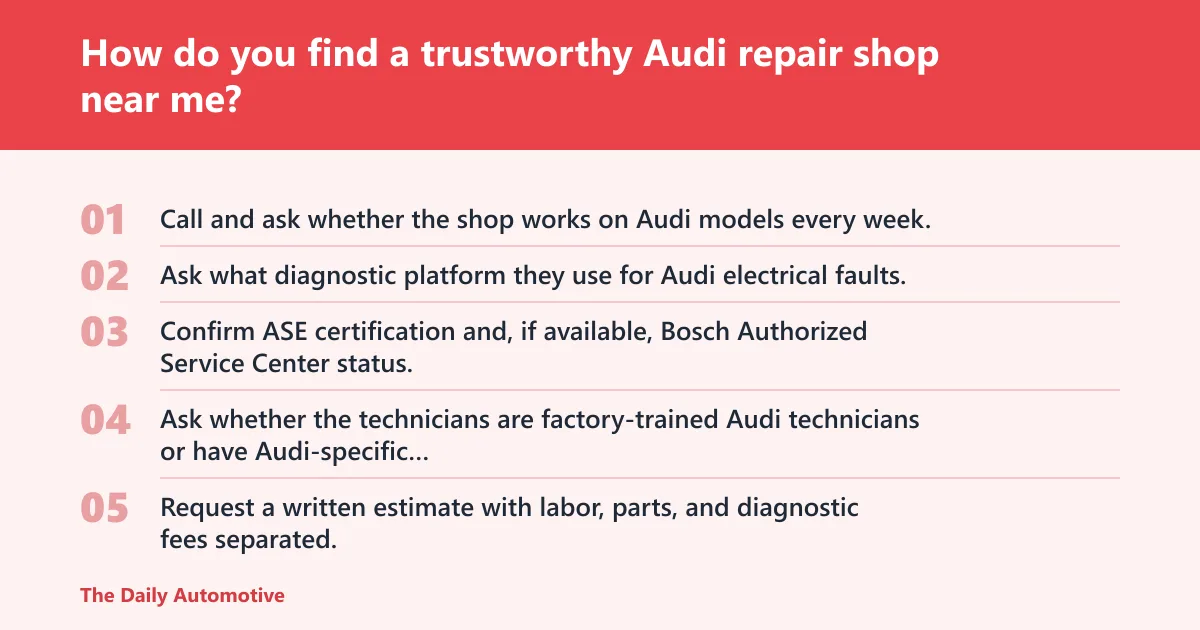
Look for Audi-specific patterns in reviews, proof of technician training, and a shop that explains diagnosis clearly. Star ratings matter, but they are not enough. A trustworthy Audi shop should show positive customer feedback, a solid local reputation, and a process for documenting parts, labor, and warranty terms.
Read reviews for Audi-specific patterns, not star ratings alone
Scan reviews for repeated comments about Audi models, electrical diagnosis, communication, and comeback repairs. Positive customer feedback and high ratings are useful, but the useful part is whether the shop repeatedly handles Audi issues without vague explanations or surprise add-ons.
Ask about factory-trained Audi technicians and warranty on labor
Ask directly whether the shop has factory-trained Audi technicians or technicians with repeated Audi-specific work. Also ask what warranty they provide on labor. A shop that stands behind labor is less likely to cut corners, and it gives you a clearer path if something comes back.
Request a written estimate with parts and labor separated
A written estimate should usually list parts, labor, diagnostic charges, and any shop fees separately. That makes dealer quotes and independent quotes easier to compare. It also helps you spot whether the shop is using OEM parts, aftermarket parts, or a mix of both.
- Call and ask whether the shop works on Audi models every week.
- Ask what diagnostic platform they use for Audi electrical faults.
- Confirm ASE certification and, if available, Bosch Authorized Service Center status.
- Ask whether the technicians are factory-trained Audi technicians or have Audi-specific training.
- Request a written estimate with labor, parts, and diagnostic fees separated.
- Check whether the estimate specifies OEM parts when needed.
Choose Audi dealership service department if… / choose certified independent Audi specialist if…
Pick the dealer when the repair is tied to warranty coverage, recall work, software updates, security access, or complex module coding. Pick a certified independent Audi specialist when the job is routine maintenance, brake work, suspension work, many cooling repairs, or a common fault-code diagnosis that does not require dealer-only access.
Dealer-first situations
Use the dealer first if the car is still under warranty and the issue may become a claim. Use the dealer for factory-paid recalls, software flashes, security-coded functions, or repairs that depend on Audi-specific procedures and direct tool access.
Independent-first situations
Use the independent first for oil changes, brake service, suspension components, coolant leaks, belts, and many straightforward engine repairs. The independent also makes sense when you want lower labor cost, OEM parts, and a technician who already sees Audi vehicles often.
Borderline cases where you should compare both quotes
Compare both quotes for engine faults, transmission concerns, charging-system issues, and intermittent electrical problems. Those repairs can move either way depending on the shop’s diagnostic depth, and the first estimate is not always the best estimate.
A common first-timer mistake is assuming the dealership is always the safest choice without comparing labor rates, turnaround time, and the shop’s experience with Audi models. A relatively new Q5 with a battery drain complaint may need coding and module checks that make a dealer a reasonable option, while an older A6 with worn front brakes is often a better fit for a vetted independent Audi specialist.
What services are better handled by an Audi dealer?
Dealer service is better for warranty-sensitive work, software updates, recall repairs, security coding, and certain module adaptations that depend on Audi systems access. If the repair depends more on software, authorization, or a factory process than on wrench work, the dealer is usually the safer choice.
That does not mean the dealer should handle every job. It means the dealer is strongest where brand access matters most and where a documentation error can create a warranty fight later.
Frequently asked questions
Is it cheaper to take my Audi to the dealer or an independent shop?
An independent shop is usually cheaper for routine work and many mechanical repairs. Certified independent Audi specialists often charge 30-40% less than dealers. The dealer can still be worth the higher price when the job needs factory software access, recall handling, or warranty documentation.
Will an independent Audi shop void my warranty?
Not automatically. Independent service does not automatically void warranty coverage if the shop follows manufacturer specs, uses proper parts, and documents the work well. Keep all invoices, part numbers, and maintenance records, because poor documentation is what usually creates a warranty dispute.
What certifications should an Audi repair shop have?
Start with ASE certification as a baseline. Then look for factory-trained Audi technicians, Bosch Authorized Service Center status, and a shop that regularly works on European vehicles. Certifications matter most when they are paired with real Audi-specific diagnostic ability and clear repair records.
How much does an Audi oil change cost at the dealer vs independent?
An Audi oil change can cost $280-$400 at the dealer and $175-$245 independently. The independent usually wins on price, but the dealer may be the better pick if you want factory documentation, a dealership record, or bundled inspection items tied to a service campaign.
What diagnostics tools does an Audi specialist need?
Audi specialists need more than a basic OBD II scanner. Basic scanners can catch some fault codes, but they may not fully diagnose Audi systems. For deeper work, the shop should have Audi diagnostics equipment, VCDS-level tools or equivalent access, and the ability to handle adaptations and coding.
Products related to this article
Sponsored / affiliate links. As an Amazon Associate I earn from qualifying purchases. I may earn additional commission from eligible campaigns.