How Much Does a U-Haul Auto Transport Cost?
A U-Haul Auto Transport usually runs about $100 to $300 for the trailer itself on a one-way move, but your total trip cost can land much higher once you add hitch setup, fuel, and coverage. Skip setup or load it badly, and a cheap rental can turn into a roadside breakdown or damage bill. This guide breaks down U-Haul trailer pricing, hidden towing costs, and when professional auto transport can cost less overall.
This guide is part of our Car Services, Rentals and Memberships: What They Cost and Which Are Worth It series.
U-Haul auto transport cost basics



The trailer rate is only the starting point. Your true cost also includes tow-vehicle prep, fuel use, tolls, taxes, and any protection you choose at checkout. On some routes, especially longer one-way moves, carrier shipping can end up closer in price than you expect.
What the rental usually covers
A U-Haul Auto Transport is a trailer rental for towing a vehicle, not a door-to-door car-shipping service. You are paying for the trailer itself, plus the rental terms tied to pickup and return. Deposits, card holds, taxes, and add-on protection can vary by location and rental type.
Why the total is more than the trailer rate
The trailer price does not remove the cost of getting the tow vehicle ready. You may need a compatible hitch, the right ball size, and a wiring adapter for trailer lights. Fuel use rises too, and tolls or a one-way return charge can change the final total.
When towing beats hiring a carrier
Towing yourself can beat carrier shipping when the route is short, the tow vehicle is already equipped, and you do not need pickup or delivery help. It loses appeal if you need last-minute gear, if the car is awkward to load, or if the route is long enough that fuel and time push the total upward.
What does U-Haul auto transport cost?
For a one-way move, the trailer itself is often the smallest line item, but not the full bill. A practical planning number is about $100 to $300 for the trailer rental, with the rest depending on equipment, fuel, tolls, and whether your rental is one-way or local.
Local rental versus one-way rental
One-way rental is usually what people mean when they ask about U-Haul auto transport. Local rental can look cheaper at first glance, but the total can still rise once you account for mileage, fuel, and extra time on the road. Local rates and return rules vary by location.
How route, demand, and pickup location affect price
Busy origin and destination markets can raise the rate. Florida routes are busy in January and again in March and April, and late May through August is the busiest time of the year overall. That demand can affect both trailer availability and the price of professional shipping.
Which fees can appear at checkout?
Expect possible add-ons for taxes, protection, and equipment if the tow vehicle is not already set up. Some locations may also show deposit or authorization terms, while others handle payment differently. Read the rental terms before you book, because policies are not universal.
True total cost worksheet
Use this worksheet as a planning tool, not as a fixed quote. It separates the trailer from the towing setup and the road costs that most comparison pages leave out. Replace the estimated lines with your local numbers before you decide.
| Line item | Example estimate | Notes |
|---|---|---|
| Trailer rental | $100 to $300 | One-way planning range for the trailer itself |
| Hitch and ball setup | Varies by vehicle and hardware | Confirm fit and rating in the owner’s manual |
| Wiring adapter | Varies by vehicle and connector type | Needed for trailer lighting when the tow vehicle lacks the right plug |
| Fuel | Varies by route and tow vehicle | Fuel use rises with weight and speed |
| Tolls | Varies by route | Can be meaningful on urban or bridge-heavy routes |
| Taxes and fees | Varies by location | May appear at checkout |
| Protection or coverage | Varies by location and option | Read what is covered before you accept it |
| Return-trip or one-way charge | Varies by rental type | One-way and local pricing are not the same thing |
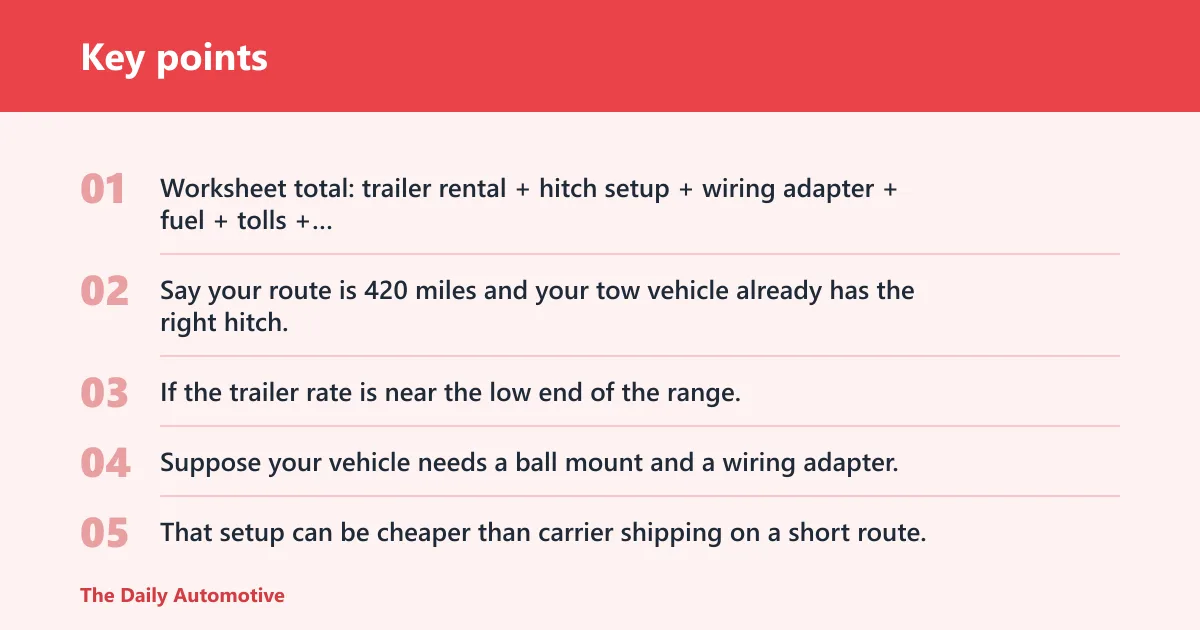
Worksheet total: trailer rental + hitch setup + wiring adapter + fuel + tolls + taxes/fees + protection + return-trip or one-way charge.
Say your route is 420 miles and your tow vehicle already has the right hitch. If the trailer rate is near the low end of the range, the rest of the bill can still climb once fuel, tolls, and protection are added. The trailer is not the whole story.
Suppose your vehicle needs a ball mount and a wiring adapter, but the car itself is otherwise ready to tow. That setup can be cheaper than carrier shipping on a short route, yet the savings can shrink fast if you are paying for a long highway run, multiple tolls, and a pricier protection option.
Three break-even distance bands
| Distance band | Typical carrier shipping | Trailer rental planning view | Decision signal |
|---|---|---|---|
| Under 500 miles | $350 to $700 | Often competitive if setup is already in place | Trailer can win if fuel and tolls stay low |
| 500 to 1,500 miles | $700 to $1,300 | Needs a careful total-cost check | Either option can win depending on route and equipment |
| Over 1,500 miles | $1,100 to $1,800 | Costs rise with fuel, time, and wear | Carrier shipping often becomes easier to justify |
Can your vehicle safely use the trailer?
Safety starts with compatibility. Your tow vehicle must be rated to handle the trailer and load, and the hitch, lighting, and tie-down points must match the setup. If any part of that chain is uncertain, check the manufacturer’s listing for your model or your owner’s manual before you book.
Tow capacity and hitch rating checks
Do not exceed the tow vehicle’s rated hitch or tow limit. Follow the vehicle and trailer manuals, use wheel chocks and proper jack stands if a lifted vehicle needs service, never exceed the vehicle’s rated roof, hitch, or tow limit, keep items out of airbag zones and the driver’s view, and check local laws.
Vehicle size and weight compatibility
Larger and heavier vehicles cost more to move, and that also affects whether a trailer is appropriate. Vehicle size and weight can add $75 to $150 more to carrier shipping quotes, which is a good reminder that the car itself can change the total no matter which method you choose.
Lighting, coupler, and tie-down requirements
The trailer needs proper lighting, a secure coupler connection, and correct tie-downs. If the tow vehicle does not have the right wiring, you may need an adapter. Requirements vary by tow vehicle and trailer, so follow the manual instead of guessing from a generic checklist.
What changes the price the most?
Distance is still the biggest driver, but it is not the only one. Operable vehicles are easier to load, peak-season demand can tighten supply, and delivery style matters. A short route with easy access can cost less than a longer move with difficult pickup or delivery points.
Distance bands and price per mile
Carrier shipping prices often fall into three rough bands: under 500 miles at $350 to $700, 500 to 1,500 miles at $700 to $1,300, and over 1,500 miles at $1,100 to $1,800. Short routes can cost more per mile than long routes because fixed costs get spread over fewer miles.
Operable versus inoperable vehicles
An operable vehicle is easier to load and unload. A car that cannot be driven onto the truck usually adds $100 to $200 to shipping quotes, and loading rules may differ by trailer type and equipment. An inoperable car is not automatically accepted for every rental or carrier job.
Peak moving months and snowbird season
Late May through August is the busiest time of the year. Florida routes are also busy in January and again in March and April. Higher demand in those windows can push prices up and make pickup times less flexible.
Door-to-door delivery versus meeting near a highway
Door-to-door service is more convenient, but meeting near a highway can save money. Remote or hard-to-access locations may carry a surcharge risk because drivers lose time reaching them. If you are comparing bids, ask whether the quote assumes an easy pickup point.
Open transport versus enclosed transport
Open-air transport is the most common shipping method, and it is the default for many moves because it costs less. Enclosed transport costs roughly 60 to 80 percent more, so it is usually reserved for vehicles that need added weather or road-debris protection.
Typical open-air price range
Open-air carrier shipping is estimated at $600 to upwards of $1,600 across the country. Cross-country transportation for a four-door sedan runs anywhere from $600 to $1,000, while a small van, pick-up truck or SUV is estimated at $800 to $1,070. HomeAdvisor’s estimate for shipping a car is $700 to $1,200.
Why enclosed transport costs more
Enclosed transport uses covered equipment, which limits capacity and usually costs more to book. That higher rate makes sense for high-value, rare, or condition-sensitive vehicles. Availability can be tighter too, so you may have fewer pickup dates or route choices.
When enclosed service is worth it
Choose enclosed shipping when the vehicle value or finish warrants it, or when route conditions make extra protection worth the premium. For an everyday car on a standard route, open transport is usually the lower-cost answer. For a collector car, the added cost can be easier to justify.
How to compare U-Haul with carrier shipping
Use the same distance band, the same vehicle type, and the same pickup and delivery assumptions for both options. That is the cleanest way to compare trailer rental against carrier shipping without mixing a do-it-yourself tow with a door-to-door quote.
Short-trip example
A short route under 500 miles is the easiest place for U-Haul auto transport to compete. Carrier shipping in that band typically runs $350 to $700, so a trailer rental can be cheaper if the tow vehicle is already set up and the route does not pile on tolls or long fuel burns.
Mid-distance example
Between 500 and 1,500 miles, the comparison gets closer. Carrier shipping commonly lands in the $700 to $1,300 band, and a trailer rental can still win if the setup cost is low and the route is straightforward. This is the band where a detailed worksheet matters most.
Long-trip example
Over 1,500 miles, carrier shipping often becomes more attractive because driving a tow rig that far adds fuel, time, and fatigue. Carrier shipping in this band typically costs $1,100 to $1,800, while your towing total keeps climbing with every mile. The convenience gap widens too.
When shipping is cheaper than towing yourself
Shipping can be cheaper when you need to rent towing equipment, buy adapters, pay toll-heavy route costs, or handle an inoperable car. It can also be the better value when you factor in the time you would spend driving the tow vehicle yourself. If the trailer setup is not already in hand, compare both options line by line.
Frequently asked questions
How much does U-Haul auto transport cost?
A U-Haul Auto Transport usually runs about $100 to $300 for the trailer itself on a one-way move. The final total can be higher after hitch equipment, wiring, fuel, tolls, taxes, and any protection are added. Local pricing can differ from one-way pricing.
How much does it cost to rent a U-Haul auto transport trailer?
The trailer rental is only one part of the bill. A practical planning range is about $100 to $300 for the trailer, but the rest depends on the tow vehicle setup, route length, and rental terms. Check your pickup location for the exact one-way or local rate.
Is U-Haul auto transport cheaper than shipping a car?
Sometimes.
What affects the cost of renting a car trailer?
Distance, vehicle size, route demand, and rental timing matter most. Peak season also raises demand.
Do I need an open or enclosed transport option?
Open transport is the common choice and usually the cheaper one. Enclosed transport costs roughly 60 to 80 percent more and makes more sense for high-value or condition-sensitive vehicles. For a standard daily driver, open transport is usually the practical pick.
What extra fees can raise auto transport costs?
Fuel, tolls, taxes, protection, and route-based surcharges can raise the total. If the car cannot be driven onto the truck, that usually adds $100 to $200 to a shipping quote. Some pickup points may also have deposit or authorization terms, which vary by location and rental type.
Products related to this article
Sponsored / affiliate links. As an Amazon Associate I earn from qualifying purchases. I may earn additional commission from eligible campaigns.