Best Car Oil Coolers for Performance: 4 Top Picks Compared
Stacked-plate oil coolers cool engine and transmission fluid faster than tube-and-fin designs, making them the top choice for performance driving — but a thermostatic sandwich plate like Mishimoto’s only opens once oil passes roughly 180°F. Running oil above 240°F breaks down its protective film and speeds up engine wear. This guide compares 4 real oil cooler kits, breaks down stacked-plate vs. tube-and-fin designs, and covers installation.
Quick Answer
A stacked-plate kit like the EVIL ENERGY 16-Row is the best all-around oil cooler for performance driving, since its layered core packs more surface area into a smaller footprint than tube-and-fin designs. If you want the cooler to stay closed until oil hits about 180°F, a thermostatic kit from Mishimoto is the better pick.
What Type of Oil Cooler Is Best for Performance?
Stacked-plate coolers are the standard choice for performance and track-driven engines because their tightly layered plates create short, broad fluid passages that pack a large cooling surface into a compact core. Tube-and-fin coolers cost less and are common on budget builds, but their exposed fins bend easily and generally need a bigger core to match a stacked-plate unit’s cooling capacity. A thermostatic sandwich plate adds a third option: it keeps oil flow bypassing the cooler entirely until the oil reaches a set temperature, which protects cold starts on a daily-driven performance car.

| Cooler Type | How It Cools | Best For |
|---|---|---|
| Stacked-plate | Layered plates create short, wide fluid passages for a large surface area in a small core | Track use, forced induction, and heavily modified engines |
| Tube-and-fin | Oil flows through tubes wrapped in thin cooling fins | Budget builds and light towing where cost matters more than size |
| Thermostatic sandwich-plate | A bypass valve routes oil around the cooler until it reaches a set temperature | Daily-driven performance cars that need cold-start protection |
If your engine is stock and unmodified, you likely won’t notice a difference from adding a cooler — it becomes worthwhile once you’re running a turbo, supercharger, or the car sees regular track days, where oil temperatures climb well past normal street driving. For a broader look at keeping an engine’s overall operating temperature in check, see our guide on how to make a Chevy 350 run cooler.
Best Car Oil Coolers for Performance: Our Top Picks
We compared four real oil cooler kits across mounting style, core design, and price to cover the most common builds: a universal stacked-plate kit for most performance cars, a premium thermostatic option, a direct-fit OEM-style replacement, and a below-regulator mount.
Best Overall Performance Oil Cooler Pick
EVIL ENERGY 16 Row Oil Cooler Kit, 10AN
A 16-row aluminum stacked-plate core rated to 116 PSI working pressure with braided nylon lines, built to cool engine, transmission, or rear differential fluid.
- Best for: Most performance builds needing a versatile, affordable stacked-plate cooler
- Why we picked it: Stacked-plate efficiency at roughly a fifth of the price of a premium thermostatic kit
- Main drawback: Universal fitment — some vehicles need extra fittings not included in the box
Compare more oil cooler options
 Best Thermostatic Mishimoto Thermostatic 16-Row Kit
|
 Best OEM-Fit MILIPARTS Oil Filter Housing Kit
|
 Best Compact Mount UltraCool RF-2G Below-Regulator Kit
|
As an Amazon Associate we earn from qualifying purchases.
EVIL ENERGY 16 Row Oil Cooler Kit — Best Overall
The EVIL ENERGY kit uses a 16-row aluminum stacked-plate core rated to 116 PSI working pressure (232 PSI burst), with braided nylon lines that handle temperatures from -40°F to 257°F. At around $102, it’s a fraction of the cost of a premium thermostatic kit while still delivering true stacked-plate cooling for engine, transmission, or rear differential oil. The tradeoff is that it’s a universal kit, so some vehicles will need extra fittings the box doesn’t include.
Mishimoto Universal Thermostatic 16-Row Kit — Best Thermostatic Pick
Mishimoto’s kit swaps in a thermostatic sandwich plate, so oil bypasses the cooler entirely until it warms up — useful on a daily driver where you don’t want the cooler working before the engine is even up to temperature. It includes preassembled -10AN braided stainless lines and both 3/4″-16 and M20-1.5 adapters for broad fitment, backed by Mishimoto’s lifetime warranty. It’s the most expensive option here, running roughly $490-$500, which only makes sense if the thermostatic control and warranty are worth the premium to you.
“Withstands high fluid pressures and reduces oil temperatures” — its thermostatic sandwich plate is built so oil reaches operating temperature before the cooler engages, keeping cold starts unaffected.
MILIPARTS Aluminum Oil Cooler Oil Filter Housing Kit — Best OEM-Fit Replacement
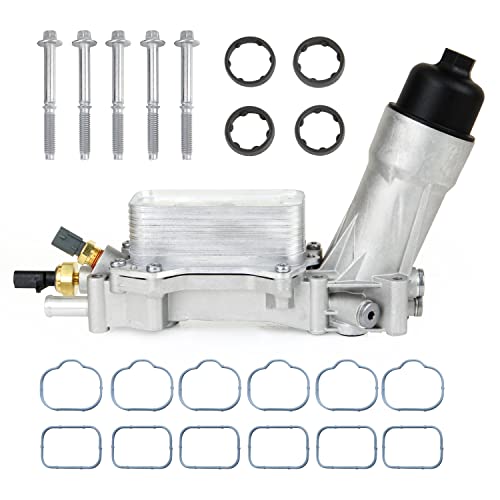
This kit is built specifically for 2011-2016 Chrysler 200, 300, Charger, Challenger, Journey, Wrangler JK, and Ram ProMaster models with the 3.6L V6, replacing the factory oil filter housing with a solid aluminum unit instead of the original plastic. The kit includes new gaskets plus both the pressure and temperature sensors, so there’s nothing extra to source separately. It’s not a universal performance upgrade the way the other three picks are — it’s best thought of as a durable, direct-fit replacement for owners of these specific models whose factory plastic housing is prone to cracking.
UltraCool RF-2G Below Regulator Mounted Oil Cooler Kit — Best Compact Mount
UltraCool’s kit mounts below the pressure regulator instead of in front of the radiator, which is useful in engine bays too tight for a front-mount core. At 5.4 x 8.5 x 10.6 inches, it’s compact enough to tuck out of the way while still providing dedicated oil cooling. It costs more than a basic tube-and-fin kit, and UltraCool recommends professional installation to get the mounting and line routing right.
What’s the Ideal Oil Temperature for a Performance Engine?
Most passenger-car engines run best with oil between 180°F and 220°F. Above roughly 240°F, oil starts to lose its protective film and breaks down faster, which is the exact problem an oil cooler is designed to prevent on a modified or track-driven engine.
📊 Race-tuned engines are often run in a 212°F–302°F oil temperature window for peak performance — well above the 180°F–220°F range typical of daily-driven passenger cars — Source: Driven Racing Oil, Understanding Engine Oil Temperature in Race Cars
Signs You Need an Oil Cooler (or Yours Is Failing)
If your car is stock and driven normally, the factory cooling system is almost always enough — an oil cooler becomes worthwhile once you add forced induction, tow regularly, or spend time on track. On the flip side, if you already have a cooler installed, watch for these warning signs that it’s failing rather than helping.
- Oil or coolant pooling under the car — a cracked cooler core or worn seal lets fluid leak, and on a cooler that also touches the coolant circuit, the two fluids can cross-contaminate each other.
- Oil temperature that won’t come down — if the gauge stays elevated even after highway driving, the cooler isn’t dissipating heat effectively anymore.
- Dark or burnt-smelling oil sooner than expected — insufficient cooling accelerates oil breakdown between changes.
- Warning lights for oil pressure or engine temperature — a clogged or leaking cooler can trigger these even when the rest of the engine is healthy.
Ignoring a failing cooler for long enough can lead to serious engine damage — if you’re already seeing symptoms like knocking or a sudden loss of power, it’s worth reading up on how to tell if a car engine is blown before assuming the cooler is the only issue.
How to Install an Oil Cooler Kit
- Choose a mounting location: Pick a spot with steady airflow, usually in front of the radiator or A/C condenser, with enough clearance to route hoses without kinking them.
- Drain the oil and remove the filter: Drain the engine oil and remove the stock filter or factory housing per the kit’s instructions before installing any new hardware.
- Install the sandwich plate or remote housing: Bolt the sandwich plate (or remote filter housing) between the block and the oil filter, using the new gaskets or O-rings included in the kit.
- Mount the cooler and route the lines: Secure the cooler core to its bracket, then route the braided lines away from the exhaust and any moving parts before tightening every fitting.
- Refill oil and check for leaks: Add fresh oil, accounting for the extra volume the lines and cooler hold, start the engine, and inspect every connection for leaks before driving.
Most kits are a manageable DIY job for someone comfortable with basic engine work, though tight fitments like the UltraCool below-regulator mount often go faster with a second set of hands. If you’re building a modified engine from the ground up, our Chevy 302 build guide covers where an oil cooler fits into a broader performance build, and our guide on when to change oil on a new car is a good next read once your cooling system is sorted.
Frequently Asked Questions
Do I Need an Oil Cooler for My Car?
Not if your engine is stock and unmodified — the factory cooling system is designed to handle normal driving. An oil cooler becomes worthwhile once you add a turbo or supercharger, tow regularly, or drive on track, where oil temperatures climb well past what daily driving produces.
What’s the Difference Between a Stacked-Plate and Tube-and-Fin Oil Cooler?
A stacked-plate cooler layers thin plates to create a large cooling surface in a compact core, making it more durable and efficient for its size. A tube-and-fin cooler routes oil through tubes wrapped in exposed fins — it’s cheaper but generally needs a larger core to match a stacked-plate unit’s cooling capacity, and the fins are more prone to bending damage.
What Is the Ideal Oil Temperature for a Performance Engine?
Most passenger-car engines run best between 180°F and 220°F. Race-tuned engines are often run hotter, in a 212°F–302°F window, but oil above roughly 240°F in a street-driven engine starts to lose its protective film and break down faster.
How Much Does It Cost to Install an Oil Cooler Kit?
Universal stacked-plate kits like the EVIL ENERGY 16-Row typically run $80-$120 for the kit itself, while premium thermostatic kits from Mishimoto run $400-$600. Add $100-$300 for professional installation if you don’t do the work yourself, depending on how accessible the mounting location is on your vehicle.
Can I Install an Oil Cooler Myself?
Yes, most universal kits are a manageable DIY job if you’re comfortable with basic engine work like changing an oil filter and routing hoses. Tight fitments, like a below-regulator mount in a crowded engine bay, are easier with a second set of hands or a lift.
Does an Oil Cooler Also Cool Transmission Fluid?
Only if it’s designed for it — many universal stacked-plate kits, including the EVIL ENERGY kit in this guide, are rated for engine, transmission, or rear differential fluid. A transmission-specific cooler and an engine oil cooler are separate components unless the kit explicitly states it can be used for both.
Conclusion
A stacked-plate kit like the EVIL ENERGY 16-Row covers most performance builds at a reasonable price, while a thermostatic Mishimoto kit is worth the premium if you want the cooler to stay out of the way until oil warms up. Owners of specific 2011-2016 Chrysler, Dodge, Jeep, or Ram 3.6L models are better served by a direct-fit housing kit like the MILIPARTS unit, and tight engine bays may call for a below-regulator mount like the UltraCool RF-2G. Whichever kit you choose, keep oil in the 180°F-220°F range for daily driving and route your lines carefully to avoid leaks.
Products related to this article
Sponsored / affiliate links. As an Amazon Associate I earn from qualifying purchases. I may earn additional commission from eligible campaigns.