Finding the Best Auto Service in Windsor: Which Shop Fits?
For finding the best auto service in Windsor, match the shop to the job: dealerships for warranty and brand-specific repairs, independent shops for routine maintenance and common fixes, and specialty garages for complex diagnostics or system-specific work. Pick the wrong provider and you can pay for extra diagnosis, repeat repairs, and a larger final bill. This guide explains how to compare Windsor repair shops, dealer service departments, and specialty garages before you book.
Use a ten point checklist to compare repair shops
Start with the repair type, not the sign out front. A brake job, an electrical fault, and a European-car software update do not belong in the same buying decision. The best Windsor auto service for you is the one with the right tools, warranty terms, parts policy, and diagnostic depth for that specific repair.
Use a 10-point shop comparison checklist
Score each shop on the same terms so price does not hide missing details. A quote that looks cheap can turn expensive once diagnostic add-ons, parts markups, or repeat visits land on the invoice. Use the checklist below before you approve any repair.
| Decision point | What to verify | Score 1-5 |
|---|---|---|
| Written estimate clarity | Labour line items, parts line items, diagnostic fee disclosure | |
| Diagnostic fee transparency | Flat fee or hourly rate, and whether it applies to repair approval | |
| OEM/aftermarket parts policy | Which parts are used, and who approves the choice | |
| Labour warranty length | Duration, coverage, and exclusions in writing | |
| ASE or equivalent certification | Technicians trained for diagnostics and modern scan-tool work | |
| Review consistency | Pattern of repeat complaints about delays, upsells, or comebacks | |
| Specialty fit | Brakes, electrical, European vehicles, or used cars | |
| Turnaround time | Realistic timing for diagnosis, parts ordering, and repair | |
| Shuttle or loaner availability | Booking rules, service-area limits, and whether it costs extra | |
| Authorization policy for extra work | Approval before added labour or parts beyond the estimate |
Separate routine maintenance from diagnosis and repair
Routine maintenance is usually simpler to compare across shops. Oil changes, tire rotations, brake pad replacement, and seasonal tire swaps often come down to price, parts policy, and convenience. Complex diagnosis is different. A repeat warning light, intermittent no-start, or battery drain issue may require scan-tool work, live data, and careful fault tracing.
Say your car needs front pads and rotors, plus a brake fluid check. An independent shop with clear parts pricing may be the best fit. If the check engine light keeps returning after two repairs, a shop with advanced diagnostic tools and technician training matters more than the lowest quote.
Are dealership service departments better than independent garages?
Neither is always better. Dealership service is often a good fit for warranty work, brand-specific software updates, and repairs that rely on factory procedures. Independent garages often make more sense for routine maintenance, brake work, exhaust repairs, tires, and older vehicles that do not need dealer-only programming.
When dealership service fits warranty and software updates
Choose the dealer when the vehicle is still under warranty or the repair depends on manufacturer software, security access, or a brand-specific technical bulletin. That matters for modules, calibration updates, and some electrical faults. A dealership may also be the safer choice when the repair could be disputed later under warranty.
When an independent shop makes more sense
An independent garage often has lower overhead and more flexibility on parts choices. That can help with brakes, suspension wear, mufflers, tires, and oil service. For a high-mileage vehicle, the right independent shop may also be better at practical repair decisions, such as fixing only the failed component rather than replacing a whole system.
Where specialty shops fit
Specialty shops are the best match when the job is narrow and technical. Brakes are one category. Electrical diagnosis is another. European vehicles often need brand-specific scan tools and software knowledge. Used cars with unknown repair history can also benefit from a shop that knows how to separate prior damage from the current fault.
What should a trustworthy estimate include?
A trustworthy estimate should show what is being charged, why it is being charged, and what happens before any extra work starts. If the estimate lumps parts, labour, and diagnostics into one vague number, you cannot compare shops or control the final bill.
Labour and parts line items
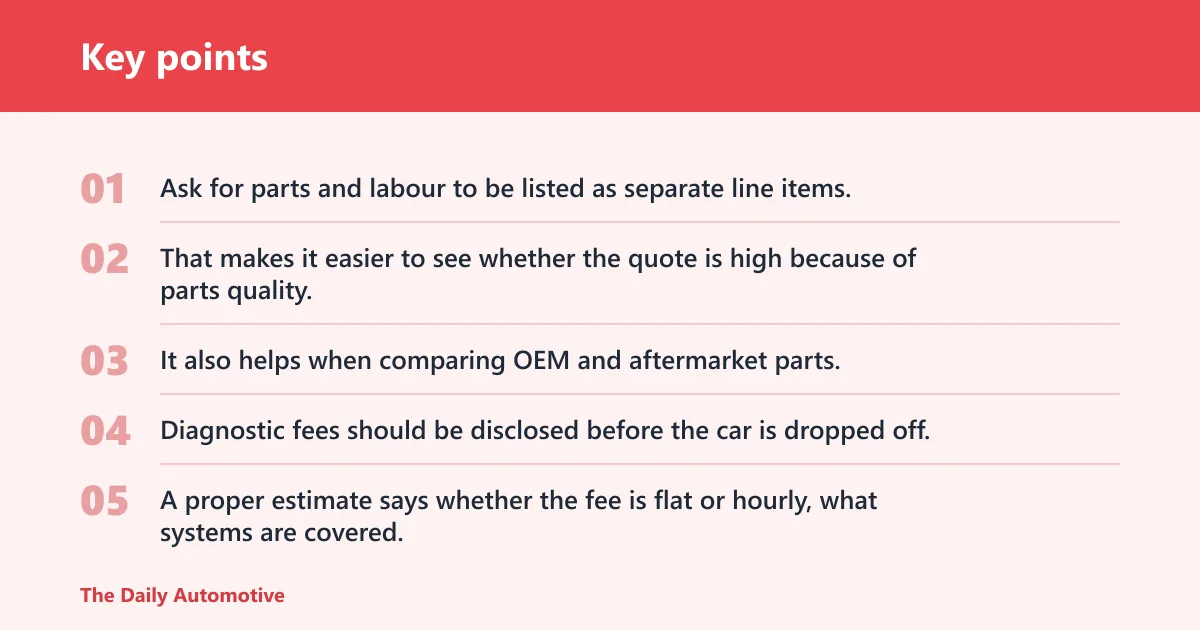
Ask for parts and labour to be listed as separate line items. That makes it easier to see whether the quote is high because of parts quality, labour time, or both. It also helps when comparing OEM and aftermarket parts, since the price gap is often in the parts line rather than the labour line.
What to look for in diagnostic charges
Diagnostic fees should be disclosed before the car is dropped off. A proper estimate says whether the fee is flat or hourly, what systems are covered, and whether the fee is credited toward the repair. That matters most for scan-tool work, battery drains, intermittent warning lights, and electrical faults.
How authorization should work before added repairs
No shop should add work without approval. The estimate should say who calls, how approval is given, and what happens if new damage appears during inspection. If the shop finds worn rear brakes while replacing a caliper, you should be told before the extra labour starts.
Picture a car that arrives for a noise complaint from the front wheel. If the estimate only says “inspect brake system,” the shop can still charge for diagnosis, pads, rotors, and fluid service only after explaining each item and getting approval. That paper trail protects you.
Which services are worth paying attention to first?
Start with the systems that affect safety, drivability, and tire life. Brake service, oil changes, wheel alignment, tire work, and TPMS resets often prevent larger repairs later. These are also the services where a good estimate and proper inspection make the biggest difference.
Brake service: pads, rotors, fluid, and warning signs
Brake service may include pads, rotors, hardware, and brake fluid, depending on wear and condition. Warning signs include noise, pulsation in the pedal, steering wheel vibration under braking, and longer stopping distances. Uneven pad wear can point to a sticking caliper or guide-pin problem, not just worn pads.
Oil change intervals and severe-duty driving
Follow the manufacturer schedule, not a generic sticker interval. Many vehicles using synthetic oil can go longer than conventional oil, but the correct interval depends on the engine and service schedule. Severe-duty driving, such as short trips, heavy traffic, towing, and frequent cold starts, usually shortens the interval.
Wheel alignment, tire service, and TPMS resets
Alignment matters after suspension work, new tires, or impacts with curbs and potholes. Common symptoms include a steering wheel that pulls to one side and uneven tire wear. Tire service should also cover balancing, rotation, seasonal changeovers, and TPMS reset when the sensor system needs relearning after a wheel swap.
- Note the symptom before you book.
- Ask whether inspection is included or billed separately.
- Confirm parts policy and warranty terms.
- Approve extra work only after a call or written message.
- Keep the final invoice with the estimate for future reference.
What separates a capable diagnostic shop from a parts replacer?
A capable diagnostic shop uses evidence before parts. That means ASE-certified technicians or equivalent training, scan-tool data, and a step-by-step fault trace. A parts replacer swaps components until the warning light goes away, which can get expensive fast if the real fault is wiring, software, or a weak ground.
ASE-certified technicians and scan-tool use
ASE certification matters because it signals formal training in diagnosis and repair procedures, not just basic maintenance. On modern vehicles, technicians need more than a code reader. They need access to scan-tool functions, live data, and current software knowledge to trace a fault instead of guessing.
OBD-II codes versus live data
OBD-II codes tell you what system reported a problem. They do not always identify the failed part. Live data can reveal sensor readings, fuel trim changes, misfire counts, or charging-system behavior that narrow the fault. That is why a code scan alone is not enough for repeat warning lights.
Electrical fault tracing and software updates
Electrical diagnosis may require voltage-drop testing, wiring inspection, module checks, and software updates. A good shop should be able to explain whether the issue is mechanical, electrical, or software-related. That distinction matters for warranty-sensitive vehicles, where the wrong repair can create more problems than it solves.
What questions should you ask before booking?
Ask about warranty terms, parts policy, and whether the shop can handle the exact work your vehicle needs. If a shop cannot explain its repair warranty or refuses to clarify authorization rules, that is a warning sign before the car ever enters the bay.
Warranty terms for parts and labour
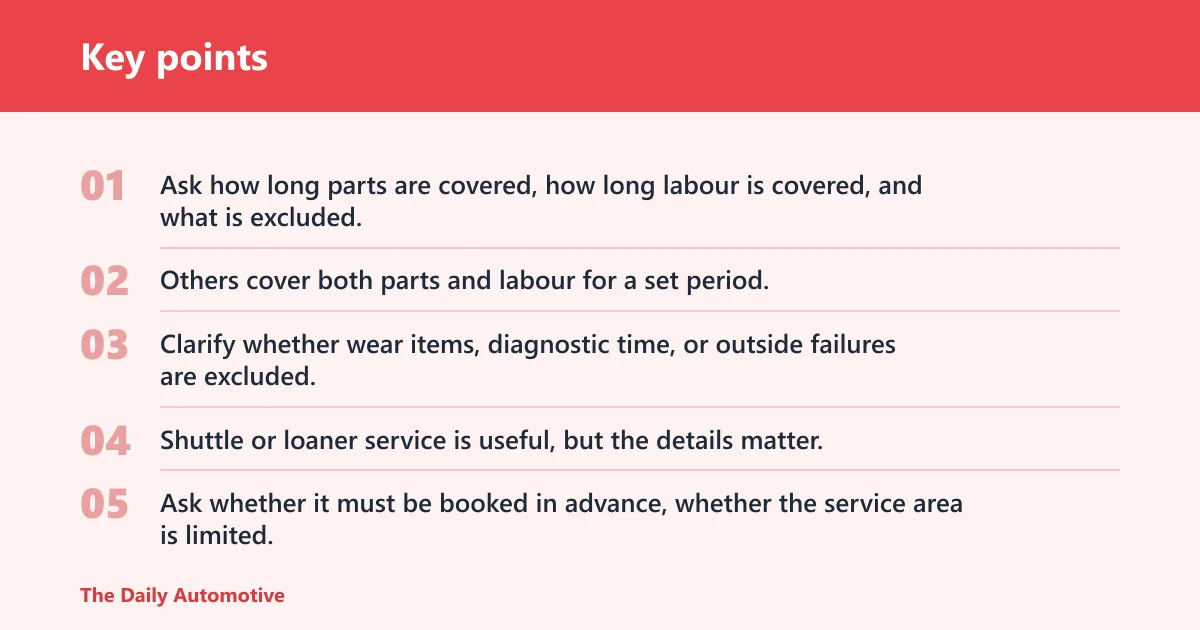
Ask how long parts are covered, how long labour is covered, and what is excluded. Some warranties cover parts only. Others cover both parts and labour for a set period. Clarify whether wear items, diagnostic time, or outside failures are excluded, since those details affect the real value of the warranty.
Shuttle or loaner availability and booking rules
Shuttle or loaner service is useful, but the details matter. Ask whether it must be booked in advance, whether the service area is limited, and whether the loaner is available only for major repairs. Convenience helps, but it should not hide a weak estimate or unclear repair plan.
OEM versus aftermarket parts and customer approval
OEM parts match the original equipment standard. Aftermarket parts vary more in quality, price, and warranty support. Either can be appropriate depending on the repair, but you should know which one is being installed and approve it before the work begins. That is especially important on warranty-sensitive vehicles.
A common first-timer mistake is approving a brake estimate without asking whether the quote uses OEM rotors or a cheaper aftermarket set. The right answer depends on the vehicle, the warranty status, and the shop’s parts policy, not on a blanket rule.
Frequently asked questions
How do I find the best auto service in Windsor?
Match the shop to the repair. Use dealerships for warranty and software-heavy work, independent garages for routine maintenance and common repairs, and specialty shops for brakes, electrical diagnosis, or European vehicles. Then compare written estimates, diagnostic fees, warranty terms, and authorization rules before you book.
What should I look for in a good auto repair shop in Windsor Ontario?
Look for clear written estimates, transparent diagnostic fees, ASE-certified or equivalent technicians, and a parts policy you can understand. Also check whether the shop explains added work before doing it, offers a practical warranty, and has the right tools for your specific repair.
How much should common car repairs cost in Windsor?
There is no single fair price for every shop. Ask for a breakdown of diagnostic fee, parts, labour, and any add-ons so you can compare like for like. A low quote that omits diagnosis or authorization details can cost more once the final invoice arrives.
How can I tell if a mechanic is trustworthy?
A trustworthy mechanic explains the problem, shows the failed part when possible, and gets approval before extra work. The estimate should be specific, the warranty terms should be clear, and the shop should not push unrelated repairs without evidence. Clear communication matters more than a polished waiting room.
Which Windsor shops are best for European or used cars?
European cars often need brand-specific scan tools, software access, and technicians familiar with the model’s service procedures. Used cars need a shop that can separate current faults from old repairs and wear items. In both cases, ask about diagnostics, parts sourcing, and warranty support before you decide.
Products related to this article
Sponsored / affiliate links. As an Amazon Associate I earn from qualifying purchases. I may earn additional commission from eligible campaigns.
 Auto Car Dent Repair Puller Head Paintless-Dent Repair Removal Kit for Slide Hammer Pulling Tab Adapter Pulling Tabs Car Aluminum-alloy Puller Head Adapter Screw Glue-tabs for Slide Hammer and
 Brake Bleeder Kit Automotive,Brake Fluid Bleeder Exchanger Machines,Brake Oil Fluid Extractor Pump,Professional Pulsating Brake Oil Fluid Bleeding Tool,Automatic Vacuum Brake Bleeder One Person