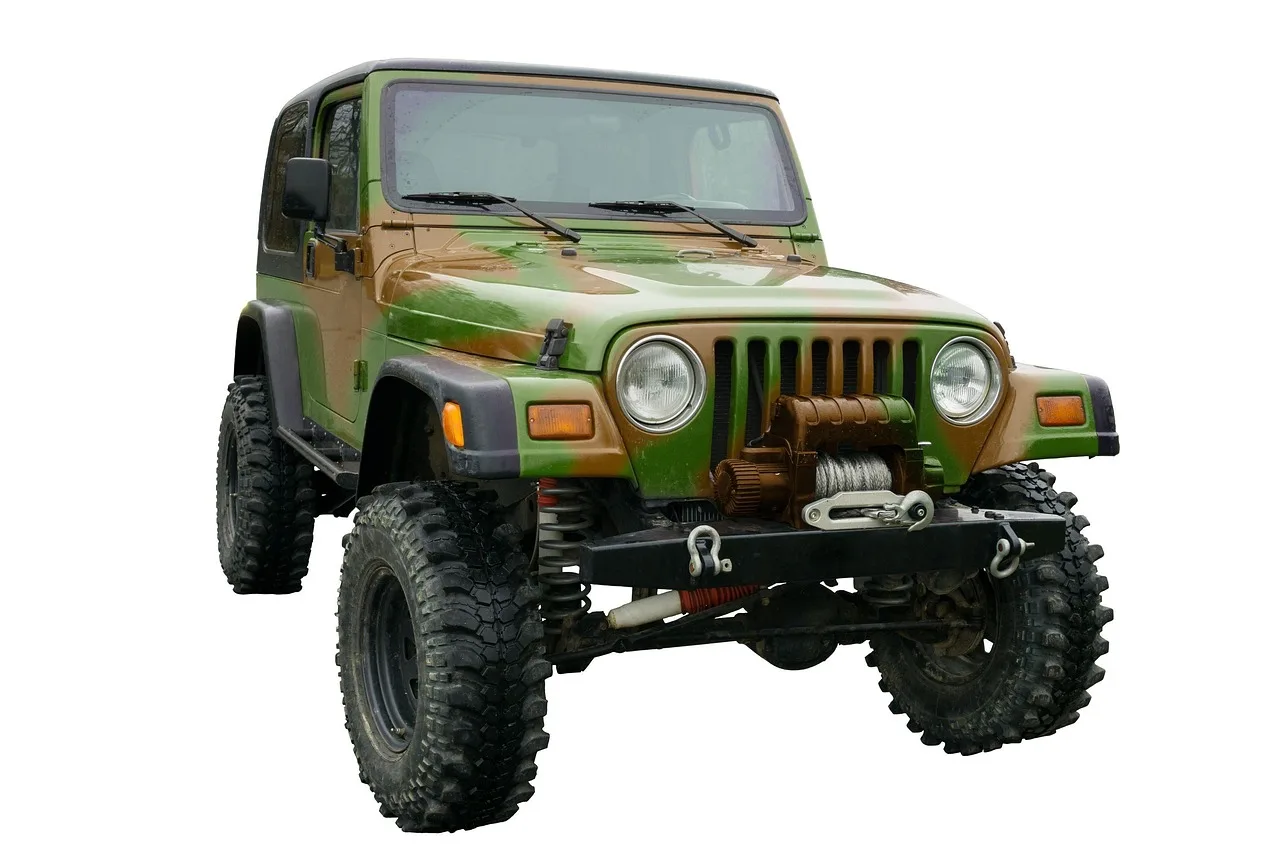
Best Car Winches for Recovery: Top Picks for Tough Pulls
For repeated heavy recovery, a commonly recommended top pick is a sealed winch in the 12,000-pound class with synthetic rope, dual remote control, and a strong thermal margin. That setup is commonly reported to handle mud extraction, buried tires, and back-to-back pulls better than a lighter 9,500-pound unit, which may run out of line speed and heat capacity sooner.
Understanding 12,000-pound winch capacity and specs


Why this winch leads the list
A 12,000-pound winch sits in the middle ground most off-road trucks and full-size SUVs need. It gives you more margin than a 9,500-pound unit, without jumping straight to the bulk and current draw that a 13,500-pound model can bring. For hard pulls, that extra margin matters more than headline speed.
Rated line pull is the number that counts, not breaking strength. That rating is usually measured on the first wrap of rope on the drum, where pull is strongest. As the drum fills, line pull drops and line speed changes, so a winch that looks fine on paper can feel weak once the rope stacks up.
Best fit: repeated heavy recovery and mud extraction
Look for a sealed housing, synthetic rope, and a remote that lets the operator stand clear of the line. Repeated self-recovery in mud is punishing because the motor works under load for longer than a quick tug on level ground. Heat, voltage drop, and poor mounting show up fast.
A common first-timer mistake is sizing only to vehicle weight. A 6,000-pound SUV stuck to the axles can demand far more than its curb weight suggests, especially if the pull is uphill, the tires are buried, or the rope is reaching higher wraps on the drum.
What to check before you buy
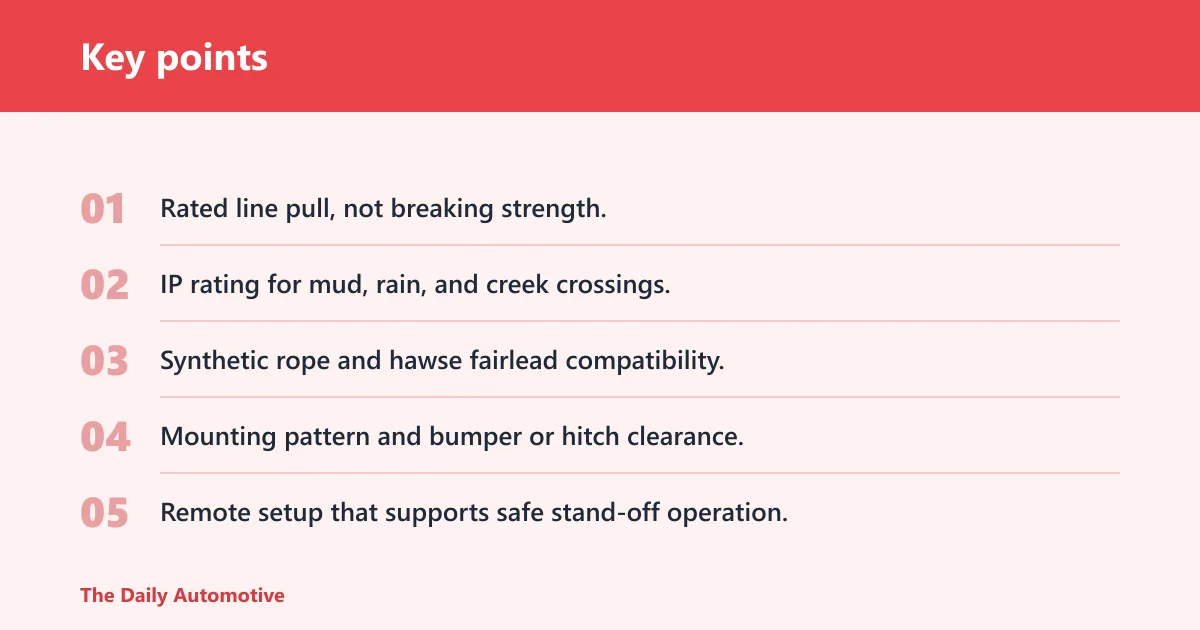
- Rated line pull, not breaking strength.
- IP rating for mud, rain, and creek crossings.
- Synthetic rope and hawse fairlead compatibility.
- Mounting pattern and bumper or hitch clearance.
- Remote setup that supports safe stand-off operation.
Quick picks by recovery need
Different recoveries call for different winches. A daily-driver Jeep on wet trails needs a different setup than a diesel truck that sees repeated self-recovery or trailer extraction. Start with the job, then narrow the field by rating.
| Recovery need | Best pick | Why it fits |
|---|---|---|
| Light SUVs and daily drivers | ZESUPER 9500 lb | Value pick for lighter rigs that still need real recovery capacity. |
| Mud and water crossings | OPENROAD Panther 3S | IP68 waterproofing suits wet terrain and frequent washdown exposure. |
| Full-size trucks and repeated pulls | ZESUPER 13000 lb | Heavy-duty pick for higher load demand and repeated hard recovery. |
| Budget-minded buyers | Rough Country PRO12000S | 12,000-pound class capacity without chasing a top-tier price bracket. |
Best for light SUVs and daily drivers
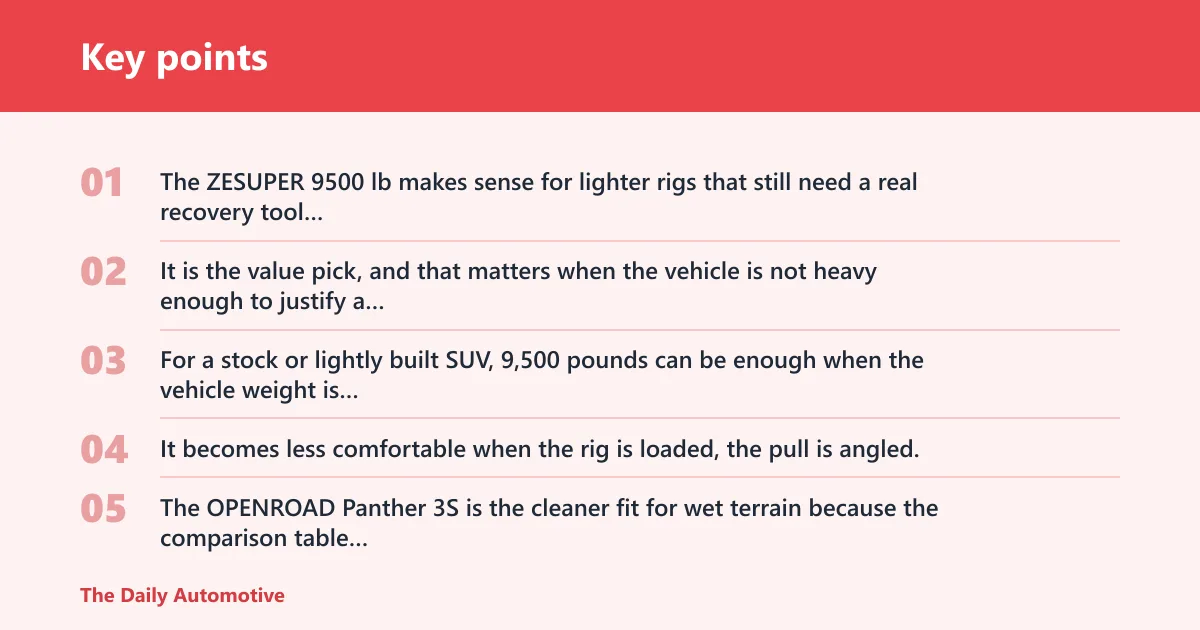
The ZESUPER 9500 lb makes sense for lighter rigs that still need a real recovery tool instead of a decorative accessory. It is the value pick, and that matters when the vehicle is not heavy enough to justify a larger, more expensive unit.
For a stock or lightly built SUV, 9,500 pounds can be enough when the vehicle weight is modest and the pull is straight, short, and on the first layer of rope. It becomes less comfortable when the rig is loaded, the pull is angled, or the trail turns into repeated self-rescues.
Best for mud and water crossings
The OPENROAD Panther 3S is the cleaner fit for wet terrain because the comparison table lists IP68 waterproofing. That gives it a better case than a basic sealed unit for creek crossings, splash-heavy trails, and frequent washdown after muddy recoveries.
Waterproofing still has limits. It helps with mud, rain, and immersion resistance, but it does not make a winch immune to a pressure washer at close range or to poor electrical connections. Control box placement and seal quality still matter.
Best for full-size trucks and repeated pulls
The ZESUPER 13000 lb is the heavy-duty pick when the work is not occasional. Full-size trucks, diesel builds, and trailer recovery often benefit from extra headroom because heat rises quickly during repeated pulls and line speed falls as the drum fills.
That higher capacity is most useful when the job is not a clean straight pull. If the rig is buried, the anchor is awkward, or the pull has to continue after the first attempt, more reserve capacity gives the winch a better chance of staying in its comfort zone.
Best budget option with tradeoffs
The Rough Country PRO12000S is a practical 12,000-pound option for buyers who want useful capacity without moving into the cost of premium sealed systems. It suits mixed trail duty, provided the buyer accepts that accessory choices and installation fitment still affect total cost.
Budget winches can look cheap until the added parts are counted. A hawse fairlead for synthetic rope, upgraded cables, mounting hardware, and possible battery support can move the final bill faster than the sticker price suggests.
What size winch do I need for my truck or SUV?
Start with vehicle weight, then add margin for angle, mud, and repeated pulls. A common rule is at least 1.5 times vehicle weight, but that is only the baseline. The first wrap on the drum pulls hardest, and pull drops as the rope builds up.
Vehicle weight, load, and first-layer pull
Rated line pull is measured at the drum’s first layer, where the winch has the best mechanical advantage. Once the rope stacks higher, the effective pull drops and the motor has to work harder. That is why a winch that “matches” curb weight can still struggle in real recovery.
Say your SUV weighs 4,500 pounds and is buried to the frame in wet mud. A 9,500-pound winch can be a sensible floor, but the same rig on a steep pull or with the rope half-spooled may need the extra reserve of a 10,000- or 12,000-pound unit.
When 9,500 lb is enough
Use 9,500 pounds for lighter SUVs, Jeeps, and trail rigs that see occasional self-recovery rather than constant heavy extraction. The WARN VR EVO 10-S is listed as a 10,000 lb winch, which places it in the same practical zone for many midweight rigs that need a bit more margin.
The 9,500-pound class is easiest to live with when the vehicle is not heavily armored, not towing, and not expected to do repeated high-load pulls. It is a better fit for lighter rigs than for a full-size diesel with bumpers, gear, and a trailer in tow.
When to step up to 12,000 lb or 13,500 lb
Move to 12,000 pounds if the vehicle is heavier, the recoveries are more frequent, or the terrain is harsher. Step up to 13,500 pounds if the rig is a full-size truck, a diesel, or a setup that regularly sees deep mud, water, or repeated self-recovery under load.
What’s the difference between 9,500 lb and 13,500 lb winches? The larger unit gives more reserve at the drum’s first wrap and usually a better chance of staying useful as the rope layers build. It still needs proper wiring and a strong mounting point, though. A bigger rating cannot fix poor installation.
Recovery winch match matrix
This matrix ties the winch to the job, not just the badge. It helps match vehicle class, terrain, recovery frequency, rope type, IP rating, and remote setup before a buyer starts comparing brand names.
| Vehicle class | Terrain | Recovery frequency | Recommended capacity | Rope type | IP rating | Remote setup |
|---|---|---|---|---|---|---|
| Light SUV / Jeep | Dry trail, light snow | Occasional | 9,500 lb | Synthetic rope | IP67 | Wired plus wireless |
| Mid-size SUV | Mud, rain, creek edge | Moderate | 10,000 lb to 12,000 lb | Synthetic rope | IP67 or IP68 | Dual-control preferred |
| Full-size truck | Deep mud, angled pulls | Frequent | 12,000 lb | Synthetic rope | IP68 preferred | Wireless with wired backup |
| Diesel truck / heavy build | Water crossings, repeated self-recovery | Frequent | 13,500 lb | Synthetic or steel depending on abrasion risk | IP68 | Dual-control, long range helpful |
Remote setup and mounting notes
Wireless and wired remotes are both useful. Wireless lets the operator stand farther from the line, which is safer during a tense pull. Wired remains valuable as a backup if batteries are dead, interference is present, or range is poor in thick terrain.
Mounting can decide compatibility before performance even matters. The OPENROAD review lists a 10-inch by 4.5-inch bolt-hole pattern, which is the kind of detail that can make or break bumper fitment. Receiver-hitch setups add another layer of clearance checks for the fairlead, control box, and cable path.
Best 9,500 lb winch for light rigs
The ZESUPER 9500 lb is the best fit for lighter off-road rigs that need useful recovery power without stepping into a heavier, more expensive class. It works best on vehicles that are not overloaded and do not spend every trip buried in mud or water.
Who should buy it?
Buy this size for light SUVs, weekend trail rigs, and smaller Jeeps that need self-recovery more than industrial duty. It is less suited to heavy steel bumpers, loaded overland builds, or repeated winching on steep recoveries.
What it does well
This class keeps weight and cost down while still giving a practical recovery tool. Synthetic rope is common on modern 12V winches because it is lighter than steel cable, floats, and is safer if it snaps.
Limits to watch
The main limitation is reserve. If the rig is stuck in deep mud, the battery is tired, or the drum is near the outer wraps, a 9,500-pound unit has less cushion. That is where voltage drop, heat buildup, and slower line speed start to matter.
Best 12,000 lb winch for mixed use
The Rough Country PRO12000S is the most balanced choice for mixed use, and the Smittybilt X2O Gen3 12K belongs in the same 12,000-pound conversation. This class suits buyers who want a stronger default than 9,500 pounds without jumping straight to the largest and heaviest setup.
Limits to watch: heat is the main enemy
Heat is the main enemy. Repeated pulls can push even a good winch into slower line speed and higher motor temperature. That is why gear ratio and motor power matter. Common examples include 218:1, 265:1, and 365:1, usually paired with 3-stage planetary gearing.
Motor output is often listed in horsepower, with common examples around 3 HP, 5.6 HP, 6 HP, and 7 HP. Higher numbers can support stronger pulling torque, but the tradeoff is often slower speed under load and more attention to heat.
Best 13,500 lb winch for heavy pulls
The OPENROAD at 13,500 lb is the clearest choice when the vehicle is heavy, the terrain is difficult, and the pulls happen over and over again. It suits full-size trucks and heavier recovery jobs better than lighter trail duty.
Limits to watch: bigger is not free
Bigger is not free. A 13,500-pound winch can bring more current draw, more mounting demand, and more space pressure around the bumper or receiver mount. It is also easy to overlook the control box, which may need a protected location to avoid damage on the trail.
Start with the job, then check rope type, waterproofing, power, gearing, and fitment. The right winch for mud and water is not always the right winch for dry rock recovery or frequent heavy pulls, and total ownership cost matters as much as the sticker.
Synthetic rope vs steel cable
Synthetic rope is lighter than steel cable, floats, and is safer if it snaps. It is also common on modern 12V winches and pairs with a hawse fairlead. Steel cable is more abrasion-resistant, cheaper to replace, and stores more kinetic energy if it fails, which is why it remains on some heavy-duty and budget models.
Use synthetic rope when weight, handling, and safer line behavior matter most. Use steel cable when abrasion, heat, or cost control matters more, and when the installation is built around that cable type.
IP67 vs IP68
IP67 can handle submersion in 1 meter of water for 30 minutes, which is enough for many mud holes, rainstorms, and brief creek crossings. IP68 offers higher immersion protection, but that still does not mean unlimited underwater use or immunity to pressure washing.
Do you need an IP67 or IP68 waterproof winch? For occasional wet trails, IP67 is a solid floor. For repeated water crossings, saltwater exposure, or frequent washdowns, IP68 is the safer target.
Motor power, gear ratio, remotes, and fitment
Gear ratio and motor output shape how the winch feels under load. A higher ratio trades speed for torque, which can help with heavy pulls, but a slow winch is frustrating when the vehicle is sinking deeper and the battery is already stressed.
Wireless and wired remotes are worth paying attention to because they change how safely the operator can stand. Remote range can also be a differentiator when the anchor point is awkward or the recovery angle forces the operator away from the bumper.
Mounting costs and accessory needs
Account for recovery straps, snatch blocks, battery upgrades, replacement rope or cable, and mounting hardware. A snatch block can change the rigging, but it does not magically double pull in every case; actual force depends on geometry, anchor quality, and the ratings of every component in the system.
Can I mount a winch on a receiver hitch instead of a bumper? Yes, if the carrier and hitch are rated for the load and the fit clears the fairlead and control box. Receiver setups are useful for occasional use, but bumper mounts are usually better for frequent recovery because they are more stable and easier to package.
Decision checklist
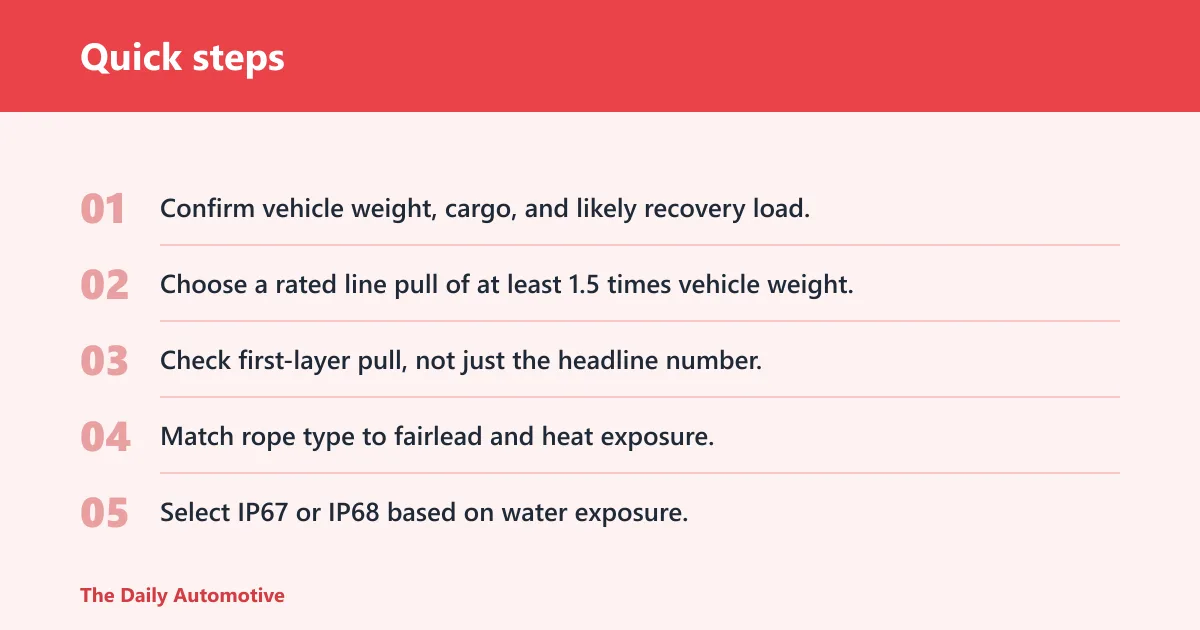
- Confirm vehicle weight, cargo, and likely recovery load.
- Choose a rated line pull of at least 1.5 times vehicle weight.
- Check first-layer pull, not just the headline number.
- Match rope type to fairlead and heat exposure.
- Select IP67 or IP68 based on water exposure.
- Verify bolt pattern, bumper space, and control-box clearance.
- Budget for wiring, battery support, and recovery accessories.
Do-not-buy warning
Do not buy an undersized or non-waterproof setup if the vehicle will see mud, rain, or creek crossings. A weak winch may stall under load, overheat on repeated pulls, or leave the vehicle stranded halfway out. A poor mount or incompatible rope/fairlead setup can turn a good spec sheet into a bad recovery tool.
Frequently asked questions
Is synthetic rope better than steel cable for recovery?
For most off-road buyers, yes. Synthetic rope is lighter, floats, and is safer if it snaps, but it needs a compatible hawse fairlead and better care around heat and abrasion. Steel cable still has a place when toughness against scraping matters more than easy handling.
What is the best 12V electric winch for off-road recovery?
The best choice depends on the job. For most mixed-use trucks and SUVs, a sealed 12,000-pound class winch is the strongest all-around pick. For lighter rigs, a 9,500-pound unit is often enough. For repeated heavy pulls, step to 13,500 pounds.
Do I need an IP67 or IP68 waterproof winch?
IP67 is enough for many muddy trails and brief water exposure, since it can handle submersion in 1 meter of water for 30 minutes. Choose IP68 if the winch will see frequent crossings, deeper splash exposure, or repeated washdown, but do not treat either rating as total protection.
What’s the difference between 9,500 lb and 13,500 lb winches?
The 13,500-pound unit gives more reserve for heavy rigs, harder angles, and repeated pulls. It also tends to demand more space, more power attention, and more careful installation. A 9,500-pound winch is lighter and cheaper, but it has less margin once the drum fills.
How important is a wireless remote on a recovery winch?
Very important, especially on difficult pulls. Wireless lets the operator stand farther from the line and see the anchor angle more clearly, while a wired remote remains useful as backup. The best setup gives both options, so the recovery is safer and more flexible.
Products related to this article
Sponsored / affiliate links. As an Amazon Associate I earn from qualifying purchases. I may earn additional commission from eligible campaigns.
 Car Dent Repairing Tool Sheet Metal Puller Auto Body Dent Repair Kit Automobile Dent Removal Tool Lifter Paintless Glue Puller Manual Expander for Car Dent Repairing
 Heavy Duty Steel Car Ramp Set - 8 Inch Lift Height - 8,000 lbs Capacity - Reflective Safety Stickers for Truck and SUV Repair, 2 Pack - Red