
Can a Car Accident Ruin Your Life? Effects and Deadlines
A car accident can upend your life if injuries, bills, and deadlines are ignored. Get medical care and legal advice right away, because filing limits can be relatively short and may depend on the state. Missed symptoms can turn into lasting injury, and missed deadlines can wipe out compensation. This guide covers health risks, financial fallout, documentation, and the legal deadlines that can make or break a claim.
Can a car accident ruin your life?


A car accident usually does not ruin life on impact. It becomes life-altering when injuries are missed, records are thin, and deadlines expire. The difference between a manageable claim and a lasting problem often comes down to speed: medical care, evidence preservation, and checking the filing window in your state.
When a crash stays manageable
A crash is more likely to stay manageable when injuries are minor, symptoms improve with prompt care, and fault evidence is preserved early. That means you get checked, keep repair and medical records, and avoid gaps that insurers can use against you. Even then, follow-up matters.
When injuries and bills start compounding
The long-term problem usually starts when pain is dismissed, treatment is delayed, or work is missed for weeks. Then direct medical costs, lost pay, repair costs, attorney fees, and insurance premium increases can stack up at the same time. A small injury can also turn into a claim dispute if diagnosis is late.
A simple decision tree for severity, fault, and timing
Use this quick split: if you have no symptoms, minimal damage, and a clean paper trail, the crash may be easier to resolve. If pain appears later, the car is heavily damaged, or fault is disputed, treat the case as time-sensitive. If you are unsure about deadlines, assume they are running now.
- Minor injury, clear fault, prompt treatment: likely manageable, but still document everything.
- Delayed pain, uncertain fault, or missed work: more likely to turn costly without fast follow-up.
- Severe injury, hospitalization, or permanent limits: get legal and medical help immediately.
- Uninsured driver, passenger injury, or government vehicle involved: special rules may apply.
What physical effects can follow a crash?
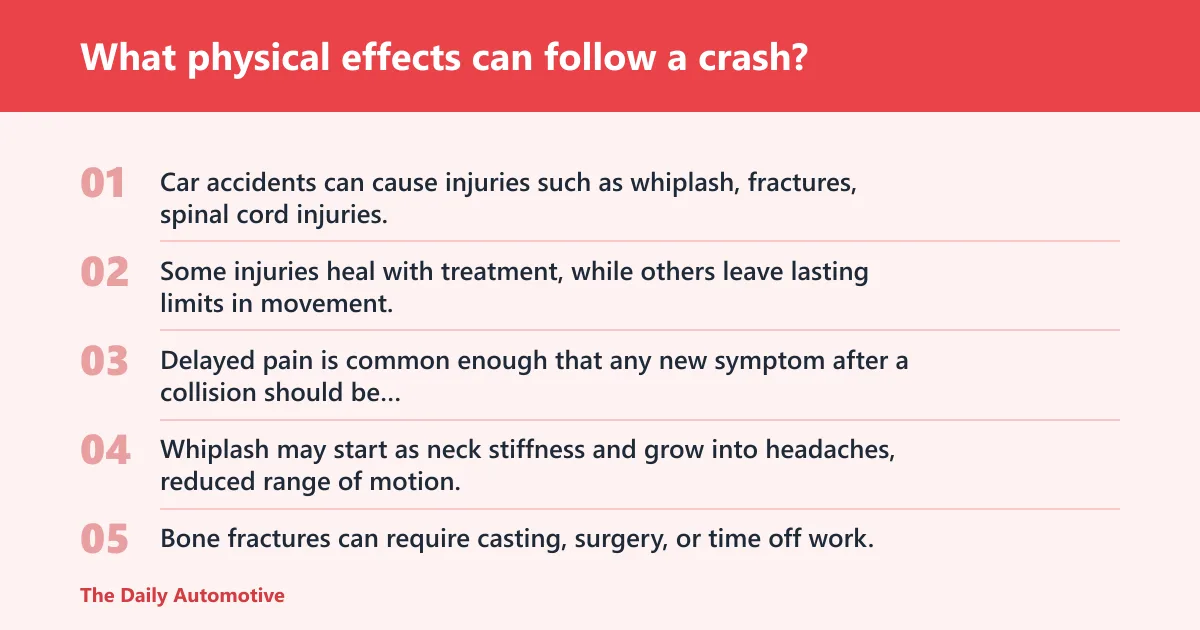
Car accidents can cause injuries such as whiplash, fractures, spinal cord injuries, and head trauma. Some injuries heal with treatment, while others leave lasting limits in movement, strength, balance, or thinking. Delayed pain is common enough that any new symptom after a collision should be documented and checked medically.
Whiplash, fractures, spinal cord injury, and head trauma
Whiplash may start as neck stiffness and grow into headaches, reduced range of motion, or pain that lasts beyond a few days. Bone fractures can require casting, surgery, or time off work. Spinal cord injury and head trauma can be far more serious, with effects that may be permanent.
Temporary symptoms versus lasting disability
Some crash injuries are temporary. Others change daily routines for months or for life. The key issue is not the label at the scene; it is how the body responds afterward. A bruise that fades is different from numbness, weakness, memory trouble, or pain that keeps returning.
Why delayed pain still needs medical documentation
Delayed pain matters because insurers often question symptoms that appear after the wreck. Medical records create the timeline. If shoulder pain starts the next morning, or a headache turns into vomiting two days later, that change should be noted in a visit, not left undocumented.
Suppose a driver feels “fine” after a low-speed rear-end collision in a parking lot. Two days later, the neck locks up, sleep becomes difficult, and turning the head to check blind spots hurts. A clinic note from that second day can be the difference between a supported claim and a disputed one.
Can a car accident cause PTSD or anxiety?

Yes. Car accidents can sometimes lead to PTSD, anxiety, panic disorders, depression, and phobias. Emotional symptoms may appear right away or later, and they can affect sleep, concentration, driving confidence, and everyday routine. Mental health care matters both for recovery and for documenting the claim.
PTSD, panic, depression, and driving fear
After a collision, some people avoid the route, flinch at braking sounds, or feel panic in traffic. Others struggle with low mood, irritability, or trouble sleeping. Those are not minor side notes. They can become part of the injury picture when a clinician records them.
How emotional symptoms affect daily routines and work
Mental health effects can change how someone commutes, shops, sleeps, or attends work. A person who cannot sit in traffic without panic may miss shifts or choose fewer hours. That can turn a physical crash into an employment problem as well.
When therapy records matter for a claim
Therapy notes, counseling visits, and psychiatric records help show the timing and severity of emotional harm. They can also support claims for treatment costs and lost earning capacity. If fear of driving keeps you from normal routines, document it early instead of waiting for an insurer to ask later.
What financial problems can a crash create?
A car accident can create direct medical costs, missed pay, repair bills, attorney fees, and insurance premium increases. These costs rarely arrive all at once. They tend to build in layers: an ER bill, a repair estimate, a missed paycheck, then follow-up care and future premium hikes.
Medical bills, repair costs, and lost wages
Medical bills may include emergency care, imaging, prescriptions, physical therapy, or specialist visits. Repair costs range from cosmetic work to frame or mechanical issues. Lost wages matter when you miss shifts, burn paid leave, or cannot return to the same schedule.
Legal fees and insurance premium increases
Even a straightforward claim can involve legal fees if fault is disputed or injuries are serious. Premium increases can follow claims history, regardless of fault in some policies and states. That means the financial hit may continue long after the bumper is fixed.
How small expenses can grow over time
One follow-up visit can lead to more tests. One rental car day can become a week. One missed checkup can make a minor injury linger. That is how a crash that looked manageable on day one becomes a month of expenses and paper records.
| Cost category | Typical trigger after a crash | Why it grows over time |
|---|---|---|
| Medical expenses | ER visit, imaging, physical therapy, prescriptions | Follow-up care, repeat visits, and delayed diagnosis |
| Lost wages | Missed shifts or reduced hours | Time off for treatment, pain, or restricted duty |
| Property damage | Bodywork, alignment, replacement parts | Hidden damage found after teardown |
| Legal fees | Claim disputes or injury litigation | More review, filings, and negotiation time |
| Premium increases | Claim history or risk reassessment | Higher renewal costs over multiple policy periods |
How long after a car accident can you claim compensation?
How long you have can depend on the state, the type of claim, and any special notice rule. Many injury claims fall within a state-specific statute of limitations that commonly ranges from 1 to 3 years, but some claims have shorter or different deadlines. Acting early protects both compensation and evidence.
State statute of limitations basics
The statute of limitations is the deadline for filing a lawsuit. In many states, personal injury claims after a car collision fall within 1 to 3 years, but the exact deadline depends on state law. Miss it, and the claim may be barred even if the injury is real.
Property damage deadlines versus injury deadlines
Property damage claims may have a different deadline than injury claims. That matters because a fender repair and a neck injury do not always follow the same clock. You should verify both timelines, especially if the insurer is still inspecting the vehicle while symptoms are developing.
Government notice rules and other exceptions
If a city, county, transit agency, or other government entity may be responsible, notice deadlines can be much shorter than a normal lawsuit deadline. Those rules can require written notice long before a standard filing date. Do not assume the same timeline applies to every defendant.
Why delayed treatment can hurt a claim
Delayed treatment does two things at once: it can worsen the injury, and it can weaken the paper trail. Insurers may argue the harm came from something else. Prompt care helps connect the collision, the symptom, and the documented diagnosis.
Use this 72-hour action table to protect your claim
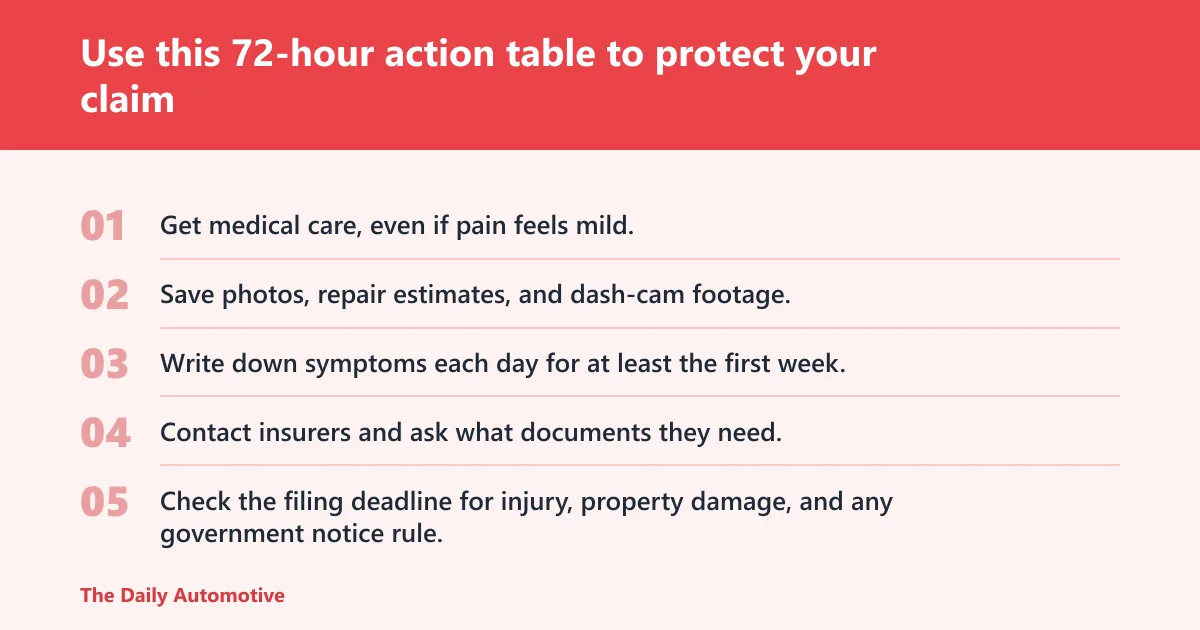
The first 72 hours after a crash are the most important for proof. That is when symptoms emerge, footage can disappear, and witnesses forget details. Use the checklist below to reduce deadline risk and preserve the records that support fault, repairs, and medical claims.
| Task | Purpose | Deadline risk if delayed |
|---|---|---|
| Seek care and create a medical record | Documents injuries, symptoms, and treatment timing | Delayed diagnosis can weaken causation and limit claim value |
| Photograph damage and the scene | Preserves repair evidence, vehicle positions, and visible impact points | Damage may be repaired, moved, or altered before review |
| Preserve dash-cam footage | Captures moments before and during the collision for fault determination | Footage can overwrite quickly if not saved |
| Notify insurers and track symptoms | Starts the claim process and ties symptoms to the crash timeline | Late notice can create coverage disputes or credibility questions |
| Verify the filing window for your state | Confirms the statute of limitations and any special notice rule | Missing the deadline can end the claim entirely |
- Get medical care, even if pain feels mild.
- Save photos, repair estimates, and dash-cam footage.
- Write down symptoms each day for at least the first week.
- Contact insurers and ask what documents they need.
- Check the filing deadline for injury, property damage, and any government notice rule.
For evidence, a dash cam can be especially useful because it documents moments before and during a collision. That footage can help with insurance claims and fault determination. A repair shop’s photos, medical records, and body-work invoices can reinforce the same timeline from different angles.
Related tools can also help after minor damage. A REDTIGER 4K Dual Dash Cam Front and Rear is listed at $119.99 for video evidence, a mechanics tool set is listed at $129.00 for minor DIY repairs after a fender-bender, and an OBD II scanner is listed at $23.99 for checking stored fault codes after a collision. Those items do not replace a claim file, but they can support one.
Can a crash affect your ability to work?
Yes. A crash can affect your ability to work through missed shifts, reduced hours, disability, income loss, and career disruption. Some people return quickly. Others cannot do lifting, driving, typing, standing, or concentration-heavy tasks without pain or restrictions, which changes how they earn.
Missed shifts, reduced hours, and job changes
Even a minor injury can force time off for appointments or rest. More serious injuries may require modified duty or a different schedule. If the job involves physical labor, driving, or long periods at a desk, the limits can show up fast.
Permanent disability and lost earning capacity
Permanent disability changes the claim from short-term wage loss to long-term earning capacity loss. That can mean less overtime, fewer promotions, a career shift, or no return to the same occupation. Medical opinions and work records matter here.
What proof supports income-loss claims
Keep pay stubs, tax records, employer notes, attendance records, and medical restrictions. If possible, document the exact days missed and the tasks you can no longer perform. That evidence helps show the financial effect of the injury, not just the diagnosis.
Say your job requires lifting 30-pound parts in a service bay. A wrist fracture may heal, but if grip strength stays low for months, the loss is not only medical. It can force a reduced schedule, lower earnings, or a move to lighter work.
What should I do after a car accident to protect my claim?
Start with care, records, and deadline checks. The goal is to preserve evidence before it disappears and to avoid missing any filing or notice window. Medical records, repair photos, dash-cam footage, and prompt insurer contact all help protect a claim.
Medical care and documentation first
Get examined quickly, then follow every treatment recommendation you receive. Keep discharge papers, prescriptions, imaging orders, and therapy instructions. These records help show what happened, when it happened, and how the injury changed over time.
Evidence preservation and insurer notice
Save the vehicle, if possible, until it is photographed and inspected. Preserve the dash-cam file in more than one place. Notify insurers promptly, but keep your description accurate and brief until you understand the injury and the claim timeline.
When to consult legal and medical professionals
Consulting legal and medical professionals after an accident is the safest general step when injuries, fault disputes, or deadlines are unclear. A doctor can document delayed symptoms. A lawyer can identify the correct filing window and any special rule for your state or agency involved.
Frequently asked questions
Can a car accident ruin your life?
Yes, but usually only when injuries, financial losses, and deadlines are ignored. A crash becomes life-altering when symptoms are missed, work is disrupted, and the filing window closes before the claim is filed. Fast medical care and documentation are the main defenses.
What are the physical effects of a car accident?
Car accidents can cause whiplash, bone fractures, spinal cord injury, and head trauma. Some effects are temporary and improve with treatment. Others can last longer or become permanent, especially when diagnosis is delayed or follow-up care is incomplete.
Can a car accident cause PTSD or anxiety?
Yes. Car accidents can lead to PTSD, anxiety and panic disorders, depression, and phobias such as fear of driving. These symptoms can affect sleep, routines, and work. Therapy and mental health records can help document the harm and support treatment planning.
What financial problems can a car accident cause?
Common financial problems include direct medical costs, missed pay, repair bills, attorney fees, and insurance premium increases. These costs can spread out over weeks or months. A seemingly small crash can become expensive if treatment, repairs, and missed work continue.
How long after a car accident can you claim compensation?
That depends on the state and the type of claim. Many injury claims fall within a statute of limitations that commonly ranges from 1 to 3 years, but property damage, government notice rules, and other exceptions can change the deadline.
What should I do after a car accident to protect my claim?
Seek medical care, save photos and dash-cam footage, notify insurers, and track symptoms from day one. Then verify the filing window for your state and any special notice rule. If injuries are serious or delayed, legal advice should come early.
Products related to this article
Sponsored / affiliate links. As an Amazon Associate I earn from qualifying purchases. I may earn additional commission from eligible campaigns.