Why Do Police Tap Your Car Trunk? Trunk Tap Meaning
Police may tap a trunk or rear panel during a stop to check for someone hiding, alert other officers that they made contact with the vehicle, or confirm the trunk is secure, but one tap alone does not mean a search is coming. Miss the surrounding facts, and you can read a routine safety move as probable cause or, worse, miss a real police action. This guide explains the common reasons for trunk taps, what officers may be signaling, and how to tell routine contact from a step toward a search.
What does a trunk tap mean during a stop?
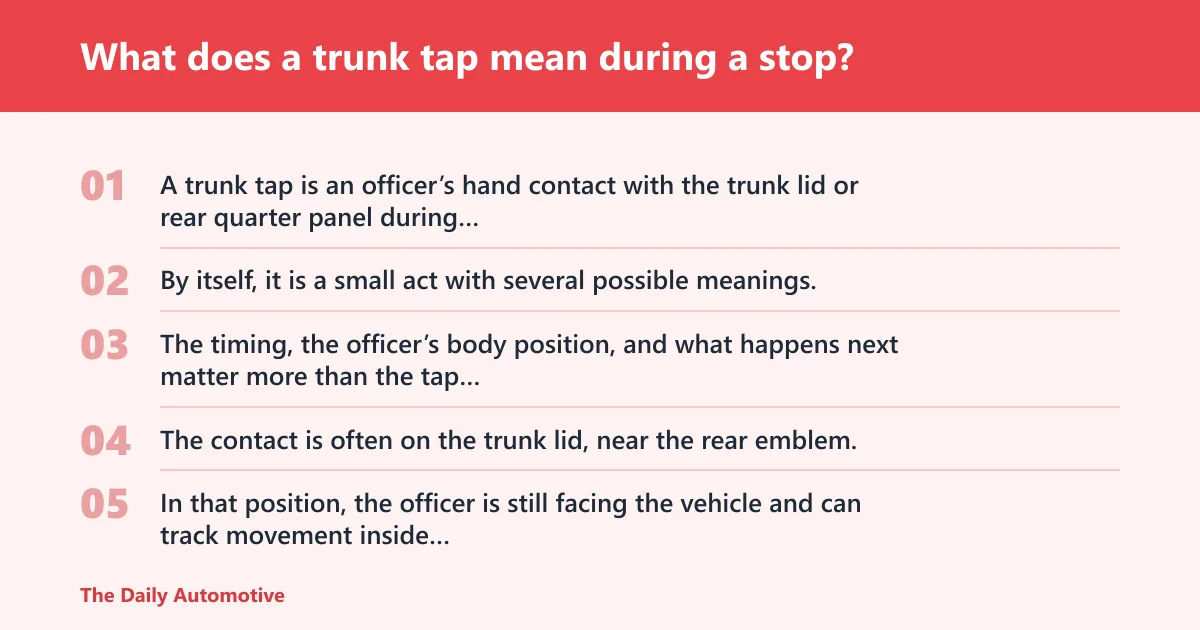
A trunk tap is an officer’s hand contact with the trunk lid or rear quarter panel during a traffic stop or roadside encounter. By itself, it is a small act with several possible meanings. The timing, the officer’s body position, and what happens next matter more than the tap alone.
Where the hand usually lands on the car
The contact is often on the trunk lid, near the rear emblem, or on a rear body panel just before the officer walks back to the patrol car. In that position, the officer is still facing the vehicle and can track movement inside the cabin while creating a clear path away from the stopped driver.
Why timing matters more than the tap alone
A tap that happens immediately before the officer turns away is different from a tap followed by a pause, a look into the rear of the car, or a call for backup. Time of day, road shoulder width, lighting, the number of officers present, and whether the driver is already out of the car all shape what the contact means.
How a tap differs from a search
A tap is physical contact, not a trunk inspection. Search and seizure rules turn on whether officers have consent, probable cause, a warrant, or some other lawful basis to inspect the car. The article suggests that a hand on the outside of the vehicle may not, by itself, open the trunk or authorize a search of the contents.
Why officers tap the trunk for safety
The most common reason is officer safety, not a hidden code. During a traffic stop, officers face a roadside encounter that can change fast. Touching the rear of the vehicle can create a contact point, help the officer stay aware of the scene, and confirm that the car’s rear area is not creating an immediate risk.
Maintaining a touch point while moving to the patrol car
Some officers are trained to keep one hand on the vehicle as they move away from the driver’s window. That contact helps orient the officer, reduces sudden blind-side movement, and creates a routine physical cue before walking back to write a citation or verify documents.
Checking the rear of the vehicle in a high-risk stop
A rear contact can also be part of a quick safety check. The officer may be watching for anyone standing in the trunk area, a partially open lid, or signs that the rear of the vehicle is not secure. In a dark shoulder stop or a stop with poor visibility, those checks can matter.
Why department policy and training vary
Police protocol is not universal. One department may teach a rear-panel touch as standard practice, while another may not mention it at all. That is why a single video clip or a viral post cannot define what the tap means everywhere. Training, assignment, and local procedure all shape the behavior.
Is a trunk tap a signal for backup?
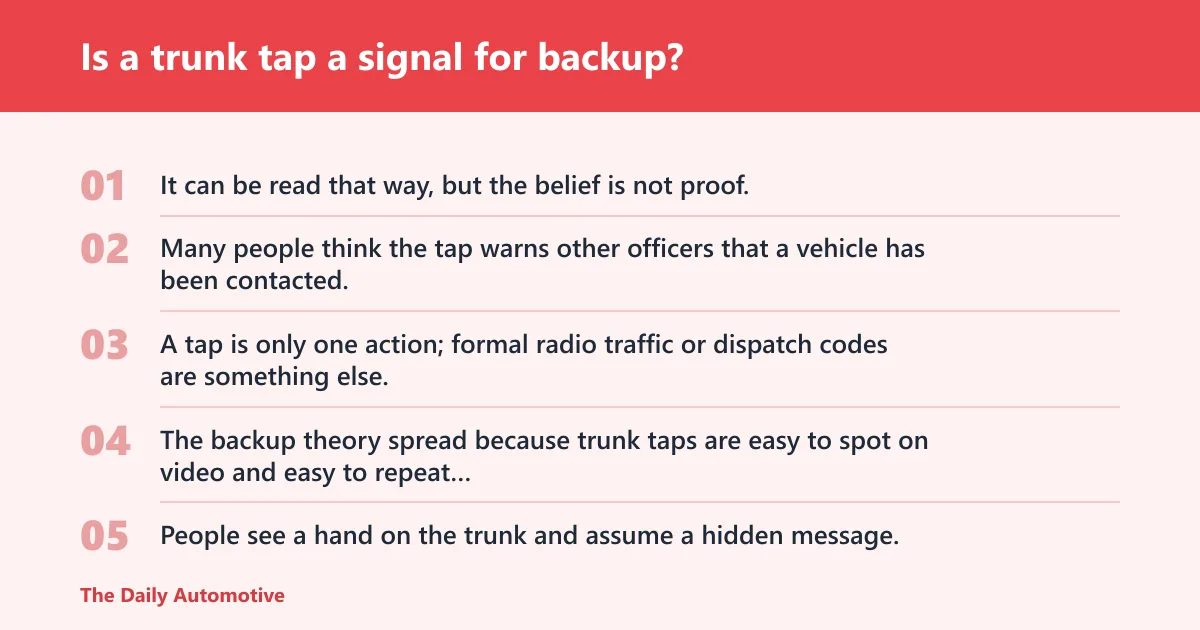
It can be read that way, but the belief is not proof. Many people think the tap warns other officers that a vehicle has been contacted, yet that explanation is not automatically supported by the facts of a given stop. A tap is only one action; formal radio traffic or dispatch codes are something else.
Why this belief spread
The backup theory spread because trunk taps are easy to spot on video and easy to repeat in social media clips. People see a hand on the trunk and assume a hidden message. That leap ignores the ordinary reasons officers touch the car during a stop, especially when they are walking away from the driver.
What counts as an actual police signal
An actual signal is more likely to be a radio transmission, dispatch request, or a department-specific hand signal used in training. Those actions are distinct from a brief hand tap on the vehicle. A casual contact with the trunk does not, by itself, establish a code, a request, or a warning.
Why a tap by itself is not proof of signaling
Without context, a tap is ambiguous. If the officer taps the trunk, walks straight to the patrol car, and never looks back, that may fit a routine stop. If the officer taps, scans the rear seats, steps back, and immediately radios for another unit, the meaning is different. The article suggests the tap alone may prove little.
When a trunk tap may point to a closer check
Sometimes trunk contact appears near a more detailed rear-of-vehicle check, but the tap still does not equal a search. Officers may be checking for a hidden compartment, an open trunk, or, in rare cases, evidence that someone could be inside the vehicle’s rear area. The surrounding conduct determines the significance.
Hidden compartments and person-check concerns
A hidden-compartment or person check is not something to assume from one tap. It becomes more plausible when the officer crouches, peers under the rear edge, asks about the trunk contents, or opens the trunk with a lawful basis. Those are separate actions, and they have different legal implications.
What officers may do before a trunk inspection
Before any trunk inspection, an officer may ask for consent, explain a concern, or rely on probable cause if facts support it. A tap can happen before those steps, after them, or not at all. The important point is that an outside touch is not the same as entering the trunk or opening containers inside it.
Say your car is stopped late at night on a two-lane road, and the officer taps the rear panel before walking back to the cruiser. That could be a routine positioning habit. If the same stop includes a flashlight aimed at the trunk seam, a second unit arriving, and a request to step out, the scene has changed.
How dashcam and bodycam footage help
Dashcam footage and bodycam footage can show what the tap looked like in context. Video captures timing, body position, and the officer’s next move, which are the details that matter most. A still frame of a hand on a trunk tells far less than ten seconds before and after the contact.
What to look for in the officer’s body position
Watch whether the officer is square to the rear of the vehicle, moving away from the stop, or leaning in to inspect something. A hand resting on the trunk while the officer turns toward the patrol car suggests routine contact. A crouch, a pause, or a look into the rear area suggests something more specific.
How timing can separate routine contact from an inspection
If the tap happens just before the officer returns to the cruiser, it often fits a traffic-stop rhythm. If the tap happens after questions about the trunk, after the driver is told to step out, or after backup arrives, the timing may point to a rear-of-vehicle check rather than a generic habit.
What should you do if an officer taps your car?
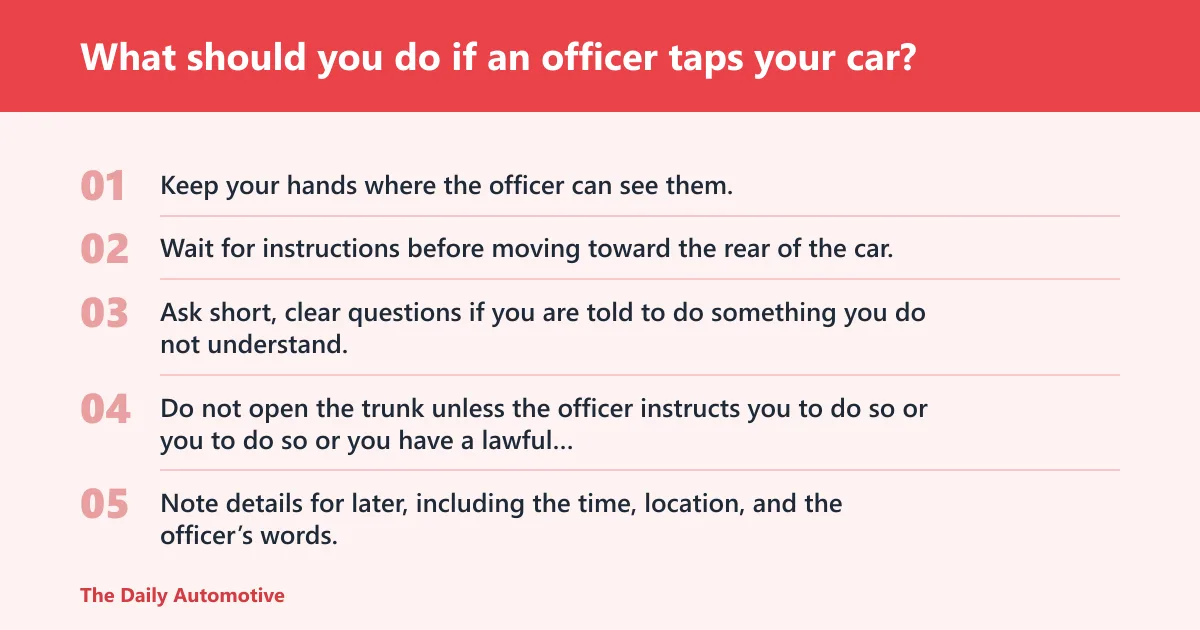
Stay still, keep your hands visible, and follow lawful instructions during a stop. Do not make sudden movements or reach toward the trunk unless asked. If the situation is unclear, answer later with a lawyer’s help rather than arguing at the roadside. The tap itself is not the moment to guess at intent.
How to stay calm and predictable
- Keep your hands where the officer can see them.
- Wait for instructions before moving toward the rear of the car.
- Ask short, clear questions if you are told to do something you do not understand.
- Do not open the trunk unless the officer instructs you to do so or you have a lawful reason to comply.
- Note details for later, including the time, location, and the officer’s words.
When to speak and when to wait
If the officer asks a direct question, answer calmly or invoke your right to remain silent without being argumentative. If the officer gives an order, comply first unless the order is unlawful on its face. Questions about why the trunk was tapped are usually better saved for later review, when the facts are clearer.
What lawful instructions take priority
Commands to stay in the car, step out, keep hands visible, or avoid the trunk take priority over speculation about the tap’s meaning. A roadway stop is a high-risk setting. The best response is predictable behavior, not trying to decode every movement in real time.
Context checklist: 6 trunk-tap scenarios and what they likely mean
Use context, not rumor, to read the tap. The same hand contact can mean routine safety positioning in one stop and something more serious in another. Time of day, the number of officers, where the hand lands, and what the officer does next are the key clues.
| Scenario | Likely meaning | Risk level | What you should do next | Signs it is not a search |
|---|---|---|---|---|
| Officer taps the trunk and walks back to the patrol car | Routine safety contact or body positioning | Low | Stay still and wait for instructions | No questions about the trunk, no attempt to open it, no inspection tools |
| Officer taps the rear panel, pauses, and looks into the back seat | Situational awareness; possible concern about occupants | Moderate | Keep hands visible and answer only what is asked | No trunk opening, no request for consent, no visible search of compartments |
| Officer taps the trunk after another unit arrives | Possible signaling behavior or coordination | Moderate | Observe calmly and follow lawful orders | No direct physical inspection of the trunk, no search language, no handling of items |
| Officer taps, crouches near the rear, and inspects seams or gaps | Possible hidden-compartment concern | Higher | Do not interfere; note details for later | No trunk lid opening yet; inspection remains external |
| Officer taps before asking for the trunk to be opened | Setup for a trunk inspection or consent request | Higher | Wait for the request, then decide based on the lawful basis given | No entry into the trunk until consent, probable cause, or another basis is stated |
| Officer taps once, then never returns to the rear of the vehicle | Routine contact with no follow-up | Low | Proceed with the stop as directed | No additional rear-area checks, no search gear, no trunk-related questions |
Frequently asked questions
Why do police tap your car trunk?
Police may tap a trunk to keep a touch point while moving away from the stop, confirm the rear of the car is secure, or stay aware in a high-risk roadside encounter. The tap can also appear in situations where officers are coordinating with others, but the contact alone does not prove that.
What does it mean when police tap the back of your car?
It usually means the officer is making brief contact with the vehicle as part of a stop, not automatically searching it. The back-of-car tap may be routine positioning, a safety habit, or a cue tied to local training. The rest of the officer’s conduct tells you more than the touch itself.
Is a trunk tap a police signal for backup?
Sometimes people read it that way, but a tap is not proof of a backup signal. Formal communication usually happens by radio, dispatch, or department-specific procedures. A single touch on the trunk is too ambiguous to treat as evidence of signaling without other facts from the stop.
Why do cops touch the trunk after pulling someone over?
The most common reason is officer safety. A touch can help the officer orient, keep a contact point while walking away, and stay alert to the rear of the vehicle. In some stops, the contact also fits a habit developed through training, rather than a warning or search step.
Does tapping the car mean they are checking for hidden people?
Not by itself. A hidden-person concern usually comes with other cues, such as a look into the rear area, questions about who is in the car, or a more detailed rear inspection. One tap is too little information to conclude that officers are checking for someone concealed in the trunk.
Is it legal for police to tap your car trunk?
Yes, the tap itself is generally lawful because it is not a search on its own. The article suggests Fourth Amendment questions can arise when officers go beyond contact and begin looking inside, opening the trunk, or searching containers. Those actions depend on consent, probable cause, a warrant, or another lawful basis.
Products related to this article
Sponsored / affiliate links. As an Amazon Associate I earn from qualifying purchases. I may earn additional commission from eligible campaigns.