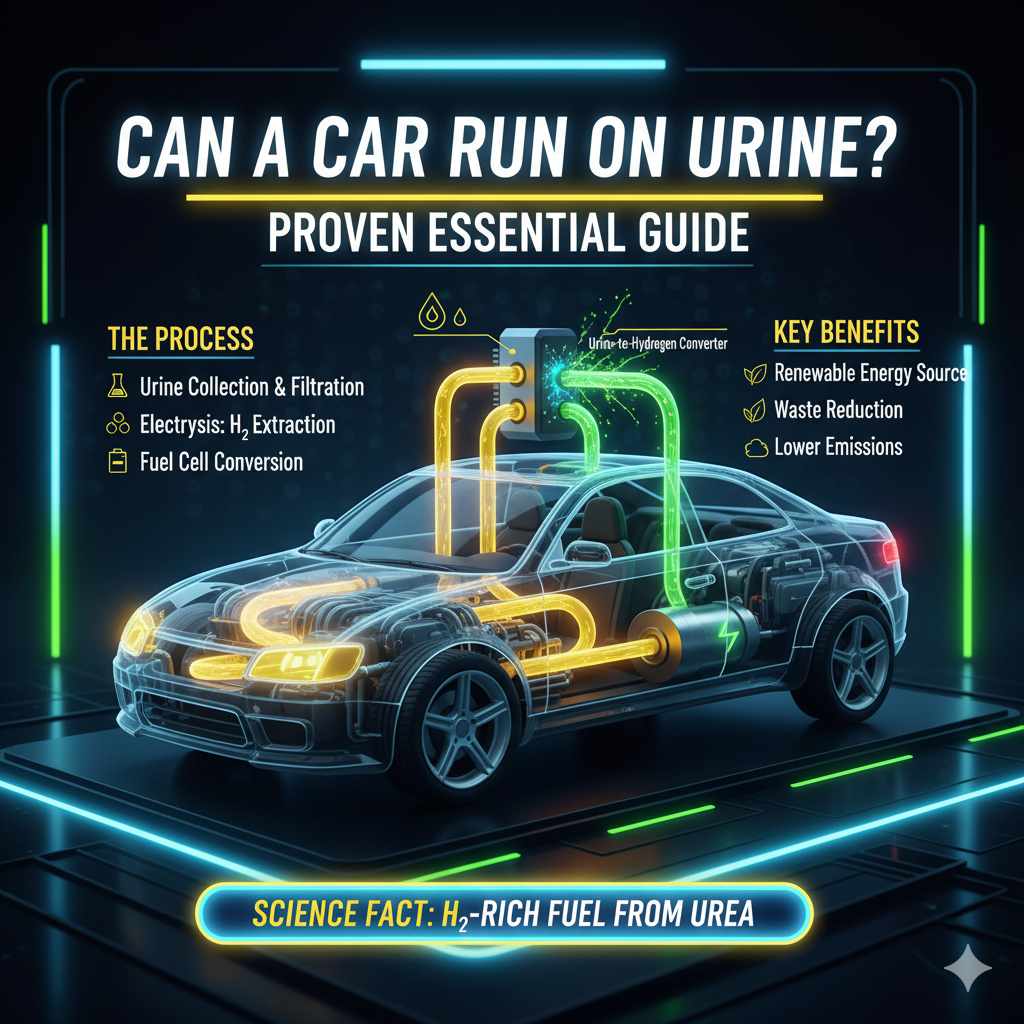
Can a Car Run on Urine? Myth vs. Reality Explained
No — a standard gasoline or diesel car cannot run on urine, which is about 95% water and contains no combustible hydrocarbons. Pouring it into a fuel tank won’t ignite the engine; it will corrode fuel lines and clog injectors instead. This guide explains why urine can’t power a car, the real urea-to-hydrogen research from Ohio University and the University of Adelaide, and where the “pee-powered car” myth actually came from.
Quick Answer
No — urine cannot power a car. It’s roughly 95% water with no combustible hydrocarbons, so it won’t ignite in an engine and will instead corrode fuel lines and clog injectors. Real research exists on pulling hydrogen from urea (found in urine) for fuel cells, but that’s lab technology — never something you pour into a gas tank.
Understanding How Cars Get Their Power
Before getting into unconventional fuels, it helps to know how a car actually works. Most cars use an internal combustion engine — a small, controlled explosion inside a cylinder pushes a piston, which turns a crankshaft and spins the wheels.
The ingredient that causes that explosion is fuel, usually gasoline or diesel. These are hydrocarbons — molecules made of hydrogen and carbon — that burn rapidly when mixed with air and ignited by a spark plug (gasoline engines) or compressed to high heat (diesel engines). For an engine to run, its fuel has to be highly combustible and energy-dense enough to create a powerful, repeatable explosion thousands of times a minute.
What Is Urine and What’s Inside It?
Urine is a liquid waste product made by your kidneys to filter waste and excess water out of your blood. So what’s actually in it?
- Water: Makes up roughly 95% of urine.
- Urea: The main waste product of protein metabolism — a compound containing nitrogen, carbon, hydrogen, and oxygen.
- Salts and minerals: Dissolved sodium, potassium, chloride, and phosphates.
- Other waste products: Small amounts of creatinine, uric acid, and hormone or medication byproducts.
Urine does contain urea, a nitrogen-rich compound researchers can process into hydrogen (more on that below). But in its raw, unprocessed form, it’s fundamentally a watery waste solution — not a source of usable combustion energy, and not something an engine can burn.
Can a Car Truly Run on Urine? The Simple Answer
The short, definitive answer: no, a car absolutely cannot run on urine directly.
Your engine is built to run on gasoline or diesel — fuels with the energy content and chemical makeup to burn efficiently and powerfully. Urine is mostly water and waste products; it isn’t combustible, meaning it won’t burn. Putting it in your fuel tank is closer to pouring in water than pouring in fuel — it would cause real damage, and the car simply wouldn’t start.
Urea, urine’s main organic component, isn’t a fuel in any sense an engine understands. It has no meaningful energy density and no combustion properties on its own. The water content alone prevents ignition, and the dissolved salts and waste can corrode and clog vital engine parts.
The Science Behind Fuel and Why Urine Doesn’t Cut It
A good engine fuel needs to release a lot of energy, fast, in a controlled way, over and over — thousands of times a minute. Here’s what that actually requires.
Key Properties of Engine Fuel
- High energy density: Gasoline packs a lot of chemical energy into a small volume, so a small amount produces a lot of power.
- Combustibility: The fuel has to ignite easily and burn rapidly, releasing heat and expanding gases.
- Stable chemical composition: Refined hydrocarbons burn predictably, batch after batch.
- Liquid at operating temperature: Fuel has to stay liquid enough to be pumped from tank to engine.
Why Urine Fails Every One of These Tests
- Low energy density: Raw urine has essentially no usable combustion energy. What little energy researchers extract only comes after heavy processing.
- Non-combustible: Because of its high water content, urine won’t burn — it will just sit there or boil off.
- Corrosive composition: Salts and urea can corrode metal fuel-system parts and clog filters, actively damaging an engine rather than powering it.
- Not a designed fuel: Urine exists for waste elimination, not for powering mechanical devices.
Where Did the “Pee-Powered Car” Myth Come From?
The idea isn’t pure internet fiction — it traces back to a real event that got exaggerated as it spread. In November 2012, four Nigerian secondary-school students — Duro-Aina Adebola, Akindele Abiola, Faleke Oluwatoyin, and Bello Eniola — demonstrated a urine-powered generator, not a car, at Maker Faire Africa. Their device used electrolysis to pull hydrogen gas out of urine and burn it to run a small generator.
The demonstration itself was real. What went viral, though, was an exaggerated claim that one liter of urine could power the generator for six hours. Fact-checkers at Snopes found that claim false — the actual device could run little more than a light bulb, and separating hydrogen from urine takes more energy than the process gives back.
Gerardine Botte, the Ohio University chemical engineer whose earlier urea-electrolysis research the students’ project was built on, was widely quoted saying it takes more energy to extract hydrogen from urine than you get back as usable electricity — and that the science-fair project shouldn’t be taken as proof of a practical urine-fuel breakthrough. That’s the real story behind the “car that runs on pee” headlines: a genuine but tiny-scale generator experiment, stretched online into a much bigger claim than the science supports.
Exploring the “Processing Urine for Fuel” Idea
You might be thinking, “But I’ve heard about scientists making fuel from urine!” This is where the confusion usually starts. Researchers have genuinely explored ways to extract useful compounds from urine and turn them into fuel — but that’s a complex, multi-step lab process, completely different from pouring urine into a gas tank.

What Researchers Are Actually Doing
The primary focus is extracting hydrogen from urea, urine’s main organic compound. Chemical engineer Gerardine Botte’s 2009 Ohio University research first demonstrated direct hydrogen production from urine using an inexpensive nickel electrode — the technology behind the viral 2012 story above. Here’s a simplified look at where that line of research has gone:
- Fuel cells: Instead of burning fuel, a fuel cell generates electricity through a chemical reaction. Catalysts or microbes can react with urea to produce electricity, which could then power an electric motor. This remains largely experimental — not something built into any production car today.
- Hydrogen production: Electrolysis can strip hydrogen gas directly out of urea. That hydrogen is a clean fuel usable in specialized engines or fuel cells, but getting it out still requires real equipment and energy input — not a DIY process.
- Biodiesel support: In some experimental setups, urine’s nitrogen content has been used to help algae or microorganisms grow faster for biodiesel production — urine as a growth input, not as the fuel itself.
📊 Splitting urea (from urine) into hydrogen uses 20–27% less electricity than splitting water — requiring only 0.37V versus 1.23V — and can produce hydrogen at around $1.81/kg, undercutting the U.S. Department of Energy’s 2030 target. — Source: Nature Communications, University of Adelaide, 2025
“It takes more energy to extract hydrogen from urine than you end up getting back as usable electricity — that’s why this stays a research topic, not a gas station replacement.”
These processes are real, but they’re energy-intensive lab research, not everyday applications. The key point: urine is being transformed into something else — hydrogen, electricity — through advanced methods. It is never used as fuel in its original form.
Why Direct Use Is Dangerous: A Warning
To be clear: putting urine in your fuel tank is a bad idea that will cause real damage. Like putting vegetable oil or any other non-fuel liquid in a gas tank, it doesn’t just fail to work — it actively harms the fuel system.
Urine’s dissolved solids, salts, and urea would cause specific, expensive problems if introduced into your fuel tank:
- Fuel pump failure: Dissolved solids and urea can clog the fuel filter and damage the fuel pump.
- Injector clogging: The fine spray injectors need to atomize fuel gets blocked by waste products.
- Corrosion: Salts and acidity corrode metal components in the fuel system and engine.
- Engine seizure: Any non-fuel liquid reaching the combustion chamber can cause the engine to seize, which means catastrophic, expensive damage.
Repairing that kind of damage costs far more than any imaginary savings from trying to use urine as fuel. (Curious what happens with other wrong substances? We’ve also covered what happens if you put vegetable oil in your car — the failure pattern is similar.)
Alternative Fuels and Your Car
Urine isn’t a viable fuel, but the world of legitimate alternative fuel types for cars is real and growing. If you want to run on something other than standard gasoline or diesel, several options already exist:
Common Alternative Fuels
- Ethanol: Often blended with gasoline (E10 or E85), made from plants like corn or sugarcane. Most modern cars handle some ethanol blend.
- Biodiesel: Made from vegetable oils or animal fats, used in diesel engines, sometimes blended with petroleum diesel (B5 or B20).
- Compressed natural gas (CNG): A clean-burning fuel stored under high pressure in specially designed tanks.
- Propane (LPG): Similar to CNG, usable in specially converted vehicles.
- Electric vehicles (EVs): Battery-stored electricity powering an electric motor — currently the most prominent alternative.
- Hydrogen fuel cell vehicles: Use hydrogen to generate electricity, emitting only water vapor.
If you’re interested in any of these, confirm your car is compatible or has been professionally converted first. Using the wrong fuel causes the same kind of damage as putting something completely unsuitable — like urine — in your tank.
Could Urine-Derived Ammonia Ever Power a Car?
Urine breaks down into ammonia, and ammonia is a genuine emerging vehicle fuel — just not one sourced from urine today. In 2021, Hong Kong Polytechnic University and the University of Oxford built the world’s first ammonia-powered fuel cell electric vehicle: a golf cart that converts liquid ammonia into hydrogen inside a fuel cell, releasing only nitrogen and water. The ammonia it uses is industrially produced, not extracted from urine, but the chemistry explains why “urine and cars” keeps resurfacing online — urea and ammonia genuinely sit near the edge of real automotive fuel research, even if a jar of urine in your tank does not.
It’s a similar dynamic to another popular myth — see our breakdown of whether a car can run on water: myth vs. reality — where a kernel of real chemistry gets stretched online into a much bigger claim than it can support.
When You Need to Fuel Up: The Right Way
For the vast majority of car owners, sticking to the fuel your manufacturer recommends is the safest, most reliable option. You’ll find this in your owner’s manual.
Where to Find Fuel Information
- Owner’s manual: Tells you exactly which fuel type (e.g., Unleaded 87, Premium Unleaded 91) and octane rating your engine requires.
- Fuel door sticker: Many cars have a sticker near the fuel cap listing the recommended fuel.
- Manufacturer’s website: Often has a digital copy of your owner’s manual.
Always double-check the fuel type before you pump. Using the wrong octane rating can hurt performance, and using the wrong fuel type entirely — like diesel in a gasoline car, or vice versa — can cause serious, immediate damage.
Frequently Asked Questions
Can I really pour urine into my gas tank?
No. A car’s engine needs gasoline or diesel — energy-dense hydrocarbons that ignite under compression or spark. Urine is roughly 95% water with dissolved salts and urea; it won’t combust, and it will corrode fuel lines, clog injectors, and can cause the engine to seize.
I’ve heard urine can be processed into fuel. Is that true?
Yes, but only through complex lab processes, never by pouring it into a tank. Ohio University’s Gerardine Botte pioneered a method using electrolysis to strip hydrogen from urea in urine, and 2025 research from the University of Adelaide made that process 20-27% more energy-efficient than splitting water. The output goes into fuel cells or hydrogen generators — never a direct liquid fuel.
What happens if I accidentally put urine in my gas tank?
Your car will likely not start. Water content prevents combustion, while salts and urea can clog the fuel filter, damage the fuel pump and injectors, and corrode fuel-system parts. Don’t try to start the engine — have the tank drained and the fuel system inspected by a mechanic.
What are alternative fuels I can actually use?
Legitimate alternatives include ethanol blends (E10, E85), biodiesel (B5, B20), compressed natural gas (CNG), propane (LPG), and electricity for EVs. Hydrogen fuel cell vehicles also exist commercially. Always confirm compatibility before using anything other than what your owner’s manual recommends.
Did the viral “urine-powered generator” story actually work?
Partly, but the claims were exaggerated. In 2012, four Nigerian schoolgirls built a working generator that used electrolysis to extract hydrogen from urine at Maker Faire Africa. It was real, but the widely shared claim that one liter of urine could power it for six hours was debunked — the device could run little more than a light bulb, and researchers noted it uses more energy than it produces.
Are there any DIY ways to turn urine into fuel for a car?
No. There’s no safe, practical, or legal way to convert urine into usable car fuel at home. The lab processes researchers use require electrolysis equipment, catalysts, and controlled conditions far beyond anything achievable in a garage.
If urine can’t fuel a car directly, can it power anything else?
In research settings, yes. Urine-derived hydrogen has powered small fuel cells and experimental generators, and ammonia — which urine breaks down into — powers a real fuel-cell golf cart built by Hong Kong Polytechnic University and Oxford in 2021. These remain lab and prototype systems, not something replicable with a jar and a garage.
Conclusion
The idea of a car running on urine is a persistent myth built on a real but greatly exaggerated 2012 science-fair story. Your car’s engine needs energy-rich hydrocarbons — gasoline or diesel — to run. Urine, mostly water and waste products, is not combustible and would cause serious, expensive damage if it ever reached your fuel tank.
Scientists are genuinely exploring ways to pull hydrogen from urea for fuel cells, and that research keeps getting more efficient — but it’s lab technology, not a fuel-tank shortcut. Stick to the fuel your manufacturer recommends, check your owner’s manual before fueling up, and leave the urea electrolysis to the researchers.
Products related to this article
Sponsored / affiliate links. As an Amazon Associate I earn from qualifying purchases. I may earn additional commission from eligible campaigns.