Can a Minor Own a Car in Florida? FLHSMV Co-Registrant Rules
Florida sets no minimum age to own a car — a minor can hold title — but FLHSMV requires a parent, guardian, or custodian listed as co-registrant whenever the minor is the sole applicant. Skip that step and the tag office rejects the paperwork, and no Florida insurer will name a minor as the sole policyholder. This guide covers Florida’s titling rules, insurance minimums, and the dangerous instrumentality liability law parents should know.
This article explains general Florida rules as of 2026 and is not legal advice — requirements can change, so confirm your specific situation with the Florida Department of Highway Safety and Motor Vehicles (FLHSMV) or a licensed attorney before you title, register, or insure a car for a minor.
Understanding Car Ownership for Minors in Florida
In Florida, the law defines a minor as anyone under the age of 18. While a minor can legally own a car through gifts, inheritance, or even purchase using their own funds, there are significant limitations due to their age. The primary hurdles involve the practicalities of registration, titling, and insurance, which are legally tied to individuals who can enter into contracts and are considered adults.
This means a licensed adult, usually a parent or legal guardian, will be the one to handle the paperwork and legal responsibilities. It’s not about limiting their ownership, but ensuring all the necessary legal frameworks are properly in place for driving legality and safety.
The Legal Picture for Minors and Vehicles
Here’s a quick look at the legal landscape:
- Ownership vs. Driving: A minor can possess a vehicle, but Florida’s FLHSMV will not process a registration listing the minor as the sole party on the application.
- Contractual Capacity: Individuals under 18 generally cannot enter into binding contracts, which includes car insurance policies and registration agreements.
- Co-Registrant Requirement: If the sole registrant listed on the application is a minor, FLHSMV procedure requires a parent, guardian, or custodian to be listed as co-registrant on that same application.
- Who Can Sign for the Minor: Only the minor’s natural guardian (a biological or adoptive parent) or an appointed guardian may sign the title application on the minor’s behalf — an appointed guardian must also submit their letters of guardianship with the application.

How a Minor Can Legally “Own” a Car in Florida
Let’s dive into the specifics of how a minor can have a car in their name, with the necessary adult involvement.
1. Purchase by a Minor (with Adult Assistance)
If a minor wants to buy a car, they can use their own money to do so. However, when it comes to the official paperwork, they’ll need an adult to help.
- The Purchase Agreement: The sales contract might list the minor as a buyer, but an adult will likely need to co-sign on any financing or be the primary buyer if paying cash, depending on the dealership’s policies.
- Titling and Registration: This is where adult involvement is essential. The car’s title and registration must be in the name of an adult, or an adult and the minor jointly (though the adult will bear the primary legal responsibility). This is because a minor cannot legally sign the necessary documents for FLHSMV.
- Insurance: A minor cannot independently purchase an auto insurance policy. An adult must add the minor as a driver to their policy or secure a policy in their own name that covers the vehicle the minor will be driving.
2. Receiving a Car as a Gift or Inheritance
This is a straightforward way for a minor to “own” a car.
- Gift: If a car is gifted to a minor, the process for titling and registration still requires adult involvement. The adult who gifts the car might handle some initial registration if they are gifting the car outright, but typically, a guardian will then need to ensure it’s properly titled and insured under their name or a joint name for the minor to drive it legally.
- Inheritance: If a minor inherits a vehicle, their legal guardian will manage the transfer of title and registration. The guardian will sign all necessary documents on behalf of the minor.
3. Joint Ownership with an Adult
This is a common and practical approach.
- Titling: The vehicle title can be issued in the names of both the adult (parent/guardian) and the minor. This signifies shared ownership.
- Registration and Insurance: The adult will be listed as the primary party responsible for registration and insurance. They will sign all official documents with FLHSMV and the insurance provider.
- Benefits: This setup clearly establishes who is legally responsible for the vehicle and its operation, while still acknowledging the minor’s ownership.
Note: this guide covers titling a car for your own minor child. If you’re on the other side of the transaction — a private seller or dealer wondering whether you can legally sell a car to someone else’s minor child — see our related guide, Can You Sell a Car to a Minor in Florida.
Essential Steps for Registering and Insuring a Car for a Minor in Florida
Now that we understand how a minor can own a car, let’s walk through the practical steps involved in getting that car on the road legally. Remember, an adult is the key player here!
Step 1: Obtain the Vehicle Title and Bill of Sale
- For Purchases: You’ll need a completed Application for Certificate of Title With/Without Registration (HSMV 82040) and a bill of sale. The seller (dealership or private party) will provide the title. If there’s a loan, the lienholder information will be on the title.
- For Gifts/Inheritance: You’ll still need the previous owner’s properly assigned title. If it’s an inheritance, you’ll need probate documents. A bill of sale isn’t strictly necessary for gifted vehicles but can be helpful.
- Adult Signature: The adult owner/co-owner will sign these documents — specifically the minor’s natural or appointed guardian, per FLHSMV procedure. If you need help with the assignment section on the back of an existing title, see our guide on how to fill out the back of a car title correctly.
This short walkthrough from a Florida county tax collector’s office shows exactly how the title application itself gets filled out:
Step 2: Secure Florida Auto Insurance
Florida law requires all drivers to have a minimum level of car insurance. Since a minor can’t legally buy their own policy, an adult must handle this. For a broader look at how insurers treat young drivers, see our guide on the minimum age for car insurance.
📊 Florida requires at least $10,000 of Personal Injury Protection (PIP) and $10,000 of Property Damage Liability (PDL) to register any vehicle — Source: Florida Department of Highway Safety and Motor Vehicles (FLHSMV), 2026.
- Minimum Requirements: Florida’s minimum coverage includes $10,000 of Personal Injury Protection (PIP) and $10,000 of Property Damage Liability (PDL). However, most experts strongly recommend higher coverage limits for greater protection. You can learn more about Florida’s insurance requirements from the Florida Department of Highway Safety and Motor Vehicles (FLHSMV).
- Adding a Minor Driver: The most common approach is to add the minor to an existing family auto insurance policy. The policyholder (parent/guardian) will file the necessary paperwork with the insurance company.
- Policy in Adult’s Name: If the minor’s car isn’t being added to a family policy, the adult will need to secure a new policy for the vehicle. The adult will be the named insured, and the minor will be listed as a driver.
- Proof of Insurance: You will need this proof to register the vehicle.
- Check With the Insurer First: Before titling the car in a minor’s name (even jointly), call the insurance company — some insurers price or underwrite policies differently depending on exactly who is listed on the title.
Step 3: Register the Vehicle with the FLHSMV
Once you have the title, completed application, and proof of insurance, you can proceed to register the vehicle.
- Visit a Tax Collector’s Office: Vehicle registration services in Florida are handled by county Tax Collector offices. You can typically make an appointment or walk in. Find your local office via the Florida TaxWatch directory.
- Required Documents: Completed Application for Certificate of Title With/Without Registration (HSMV 82040), proof of Florida insurance, proof of ownership (title), proof of identity for the adult registrant (e.g., driver’s license), and payment for fees and taxes.
- Special Considerations for Minors: When titling in a minor’s name as a co-owner, the adult will sign as the responsible party. The adult’s driver’s license information will also be required.
Step 4: Obtain Florida License Plates and Decals
After successful registration, you will be issued license plates and registration decals.
- Standard Plates: Most drivers opt for standard Florida plates. You can also choose specialty plates for an additional fee, which often support various Florida causes or interests.
- Temporary Tag: If you purchased from a dealership, they will usually provide a temporary tag to use while your permanent registration is processed.
- Placement: Ensure the license plate is securely attached to the rear of the vehicle, and apply the registration decal to the designated area on your license plate as instructed.
Key Differences: Minor Ownership vs. Adult Responsibility
It’s crucial to distinguish between owning a car and having the legal responsibility for it.
| Aspect | Minor’s Role | Adult’s Role (Parent/Guardian) |
|---|---|---|
| Title Ownership | Can be listed as a co-owner (often jointly with a parent/guardian). | Must be the primary owner or co-owner to legally handle registration, insurance, and financing. Can be the sole owner. |
| Registration | Cannot legally complete registration alone as the sole registrant. | Responsible for signing and submitting all registration paperwork to FLHSMV or the county tax office as co-registrant. |
| Insurance Policy | Cannot legally obtain or be the primary named insured. | Must procure and maintain the insurance policy, naming the minor as a covered driver. |
| Financial Liability | Indirect responsibility while driving. | Legally responsible for registration, insurance, maintenance, and may be liable for accidents involving the minor. |
| Contracts | Cannot enter into binding contracts (e.g., loans, financing). | Must co-sign or act as the primary party for loans, leases, or financing agreements. |
| DMV Transactions | Cannot conduct transactions independently. | Handles all DMV or FLHSMV transactions on behalf of the minor. |
| Accident Liability | May be personally liable for their own negligent driving. | Vicariously liable under Florida’s dangerous instrumentality doctrine as titled owner — and, if the adult signed the minor’s license application, potentially liable without a damages cap under F.S. §322.09. |
Important Considerations for Minor Drivers
Beyond the paperwork, there are several other critical aspects to consider when a minor is driving a car.
The Importance of a Driver’s License
A minor must possess a valid Florida driver’s license to operate a motor vehicle legally. Florida has specific requirements for teen drivers, including learner’s permits and graduated driver licensing (GDL) programs, which impose restrictions on driving times and passengers until the driver reaches a certain age or has held their license for a specified period. You can find detailed information on Florida’s Graduated Driver Licensing Program on the FLHSMV website.
Insurance Premiums and Young Drivers
Adding a young, inexperienced driver to an insurance policy will likely increase premiums. This is because statistics show that drivers under 25 are at a higher risk of being involved in accidents. Encouraging safe driving habits, maintaining good grades (many insurers offer discounts for good students), and completing defensive driving courses can help mitigate these costs.
Vehicle Maintenance and Safety
Even if a minor owns the car, the adult remains responsible for ensuring the vehicle is in safe working order. Regular maintenance checks (oil changes, tire pressure, brakes) are crucial for preventing breakdowns and accidents. Educating the minor on basic maintenance can also foster responsibility.
Financial Responsibility and Gifting
When purchasing a car for a minor, consider the ongoing costs: insurance, gas, maintenance, and potential repairs. Gifting a car can be a wonderful gesture, but ensure the financial implications are understood by all parties before the transfer.
Florida’s Dangerous Instrumentality Doctrine: What Parents Are Liable For
This is the single most important legal fact most guides on this topic leave out. Florida’s dangerous instrumentality doctrine holds the titled owner of a car strictly, vicariously liable for damage caused by anyone driving it with permission — the injured party does not have to prove the owner was negligent. If a parent or guardian is on the title (which FLHSMV requires whenever a minor is the applicant), that adult is automatically exposed to this liability whenever the minor drives, even if the adult did nothing wrong.
A second, separate rule makes this even more significant for parents of teen drivers specifically: under Florida Statutes §322.09, a parent or guardian who signs a minor’s driver’s license application becomes jointly and severally liable for that minor’s negligent driving — with no dollar cap — regardless of whose name is on the vehicle title. This liability exists independently of the dangerous instrumentality doctrine and applies even if the parent never titled or insured the car.
“If the sole registrant being listed is a minor, then the application for registration must have a parent, guardian, or custodian listed as a co-registrant.”
In practice, this means the adult listed on the title carries both the everyday paperwork burden and the bulk of the legal and financial risk if the minor causes a crash — a factor worth weighing seriously before deciding whether to title the car solely in the adult’s name or jointly with the minor.
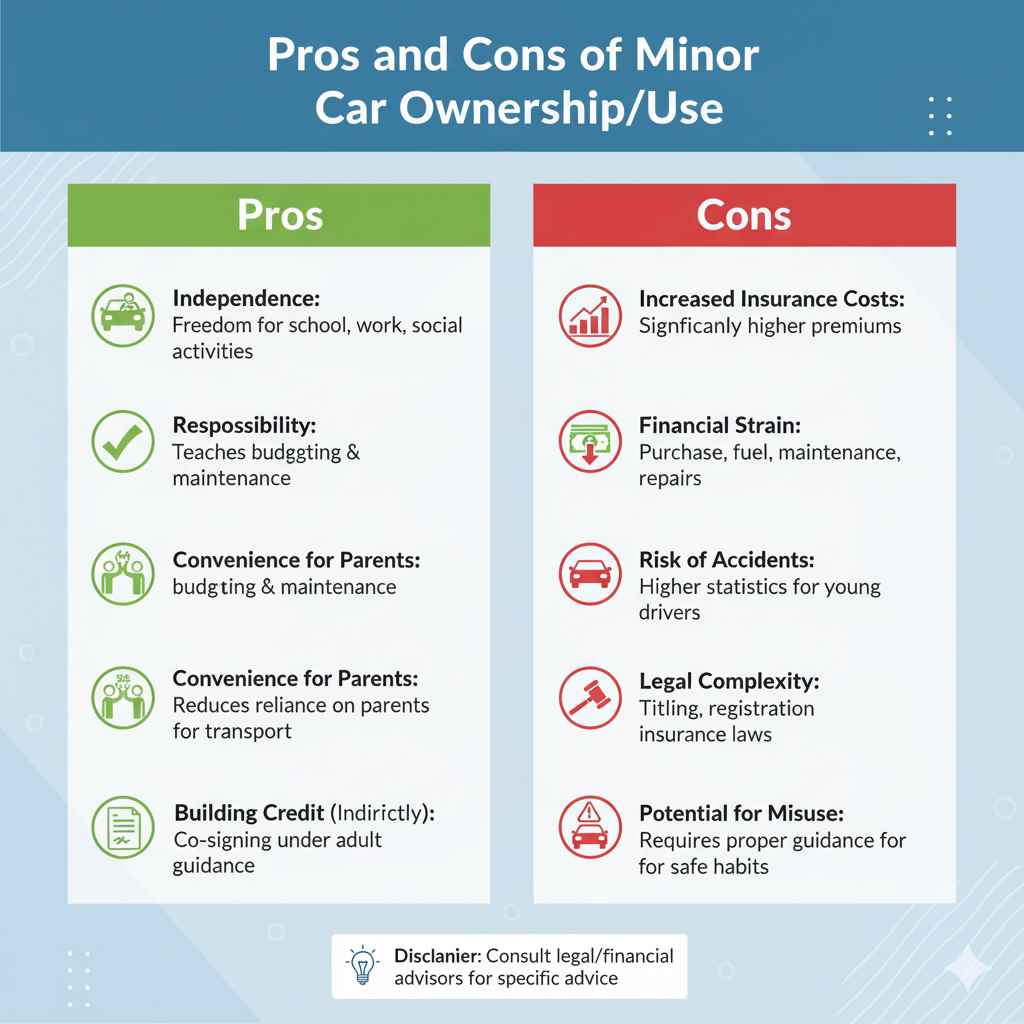
Pros and Cons of Minor Car Ownership/Use
Here’s a balanced look at the advantages and disadvantages:
Pros:
- Independence: Provides teenagers with greater freedom and mobility for school, work, and social activities.
- Responsibility: Owning or being primarily responsible for a car can teach young people valuable lessons about responsibility, budgeting, and maintenance.
- Convenience for Parents: Reduces reliance on parents for transportation.
- Building Credit (Indirectly): If the adult finances the car and the minor co-signs (requiring adult co-signer), it can indirectly help the minor build credit history under adult guidance.
Cons:
- Increased Insurance Costs: Premiums can be significantly higher for young drivers.
- Financial Strain: The costs associated with car ownership (purchase, insurance, fuel, maintenance, repairs) can be substantial.
- Risk of Accidents: Young drivers are statistically more likely to be involved in collisions.
- Legal Complexity: Navigating the titling, registration, and insurance laws requires careful attention from adults.
- Potential for Misuse: Without proper guidance, teens may not prioritize safe driving habits.
Frequently Asked Questions (FAQs)
Can a 16-year-old buy a car in Florida?
Yes, a 16-year-old can purchase a car in Florida using their own funds. However, because they are a minor, an adult (parent or legal guardian) must co-sign for any financing and will need to be listed on the title and registration as the primary responsible party. The adult must also secure auto insurance for the vehicle.
Do minors need a driver’s license to own a car in Florida?
While a minor can own a car, they cannot legally drive it on public roads without a valid driver’s license or learner’s permit from Florida. The license is separate from the ownership process.
Who puts the car in their name if a minor is given a car?
If a minor is gifted a car, the title and registration must be handled by an adult. The title can be issued in the adult’s name, or jointly in the adult’s and minor’s names. Only the minor’s natural guardian (a parent) or a court-appointed guardian (with letters of guardianship on file) is authorized to sign that documentation with FLHSMV.
Can a minor be the sole owner of a car on the title in Florida?
No. Florida places no age minimum on car ownership itself, but a minor (under 18) cannot be the sole registrant on a vehicle’s title and registration. FLHSMV requires an adult parent, guardian, or custodian to be listed as co-registrant to legally register and insure the vehicle.
What happens if a minor gets into an accident in a car registered in their parent’s name?
The parent’s or guardian’s insurance policy typically covers the damages up to the policy limits. But the parent’s exposure goes beyond the insurance payout: Florida’s dangerous instrumentality doctrine makes the titled owner strictly, vicariously liable for a permitted driver’s negligence, and under Florida Statutes §322.09, a parent who signed the minor’s license application faces uncapped joint-and-several liability for the minor’s negligent driving — regardless of whose name is on the title.
Are there any special fees or taxes for registering a car for a minor?
When registering a vehicle in Florida, there are title fees, registration fees, and potentially sales tax (or a credit if sales tax was paid at purchase). These fees are based on the vehicle’s age, weight, and value, not specifically on whether a minor is involved as an owner. The adult registrant is responsible for paying these.
Can a minor purchase a car with their own savings in Florida?
Absolutely. A minor can use their own money, such as savings from a job, to purchase a car. However, the purchase process, including signing paperwork and handling the title transfer, will require an adult’s involvement because minors lack the legal capacity to enter into binding contracts for vehicle ownership and registration.
Conclusion
Navigating the process of a minor owning a car in Florida is manageable once you know the rule that actually matters: FLHSMV allows minor ownership but requires a parent, guardian, or custodian as co-registrant whenever the minor is the sole applicant. That same adult typically carries the insurance policy and, under Florida’s dangerous instrumentality doctrine and F.S. §322.09, a meaningful share of the legal liability if the minor causes an accident. Confirm your specific situation with FLHSMV or a Florida attorney before finalizing the title, registration, or insurance for a minor’s car.
Products related to this article
Sponsored / affiliate links. As an Amazon Associate I earn from qualifying purchases. I may earn additional commission from eligible campaigns.