Trunk Organizer Cost: How Much Should You Pay for Your Car?
Many trunk organizers seem to fall somewhere in the roughly $15 to $60 range, with basic collapsible bins near $20, more structured models around $40 to $50, and heavy-duty or seatback systems above that. Spend too little and the organizer sags, tips, or tears; spend too much and you pay for capacity your cargo never uses. This guide matches price to use, so you know when $20 is enough, when $50 makes sense, and what higher prices buy.
This guide is part of our Car terms explained series.
What a trunk organizer costs by type


A trunk organizer is a storage insert for the car’s main cargo area, which is usually the rear trunk or hatch area. Some vehicles have that storage space in front, known as a frunk. Price depends less on the label and more on the structure, materials, and how well the organizer holds shape under load.
Soft-sided collapsible trunk organizer price range
Soft-sided collapsible trunk organizers usually sit in the budget-to-midrange zone because they use fabric panels, fold-flat storage, and lighter hardware. Expect one or more compartments, handles or straps, and often a non-slip base or hook-and-loop tabs. They fit groceries, daily carry items, and emergency gear without taking permanent space when empty.
Hard-sided trunk organizer price range
Hard-sided trunk organizers cost more because rigid walls, lids or covers, and spill resistance take more material and structure. These models resist tipping better, keep items separated under braking, and suit cargo that should not crush soft fabric sides. Higher price usually buys better cargo stability, not a nicer look.
Truck and SUV organizer price range
Truck and SUV trunk organizers tend to cost more than compact car versions because they cover a larger footprint and often need anchor straps or Velcro to stay in place. Vehicle-specific dimensions matter here. If the organizer is too short, it slides; too tall, and it blocks sightlines or cargo access.
Storage trunk and cargo box price benchmark
Storage trunks and cargo boxes are a useful price benchmark because they show what rigid capacity costs. Walmart lists a Sterilite 22 Gallon Heavy Duty Plastic Lockable Wheeled Footlocker Storage Trunk for $45.99, a Seward Trunk Rover 30-inch trunk with wheels and lock for $103.23, and a Casafield 36-inch storage trunk with a curved lid for $169.99. Those prices sit above most soft organizers because they are closer to furniture than to fabric bins.
📊 Walmart lists a Sterilite 22 Gallon Heavy Duty Plastic Lockable Wheeled Footlocker Storage Trunk for $45.99. Source: Storage Trunks for Organization and Travel.
What drives trunk organizer price up
Price rises when the organizer uses better materials, stronger structure, and more hardware. A simple fabric tote can be cheap. Add rigid walls, reinforced dividers, wipe-clean liners, lid panels, non-slip feet, and tie-down points, and the cost climbs quickly. Bigger units also cost more because they use more material and need more support.
Materials and build quality
Woven polyester, reinforced stitching, plastic side panels, metal handles, and thicker bases all add cost. Water-resistant or waterproof fabric also tends to cost more than basic cloth because it needs coating or tighter construction. Cheap units often save money by thinning the fabric or removing structure where the bag flexes most.
Lids, pockets, dividers, and non-slip bottoms
Lids keep loose cargo from spilling into the rest of the trunk. Pockets help separate cables, wipes, jumper cables, and first-aid items. Dividers improve sorting, but they only matter if they stay upright under load. Non-slip bottoms, hook-and-loop strips, and anti-slip feet are worth paying for if your trunk floor is slick or your driving includes hard stops.
Anchoring, rigidity, and spill resistance
Anchor straps and Velcro matter because sliding is one of the main failure cases. Rigid walls matter because a soft organizer can bow outward and dump weight to one side. Spill resistance matters for groceries, cleaning supplies, and damp sports gear. A wipe-clean interior or hard shell often pays for itself the first time something leaks.
Fold-flat storage versus fixed structure
Collapsible organizers cost less than rigid designs because they use less material and need fewer support parts. Their folded footprint is small, which helps if your cargo area changes weekly. Fixed structures cost more because they stay ready at all times, but you pay for that convenience with bulk and weight.
How much should you pay for your use case?
Pay for the cargo you actually carry, not the biggest organizer on the shelf. If you only need groceries and a spare umbrella, a low-cost collapsible unit usually does the job. If you split weekly hauling between bags, tools, and kid gear, move up to a stiffer midrange model. Heavy loads and large vehicles justify premium pricing.
Budget picks for groceries and daily carry
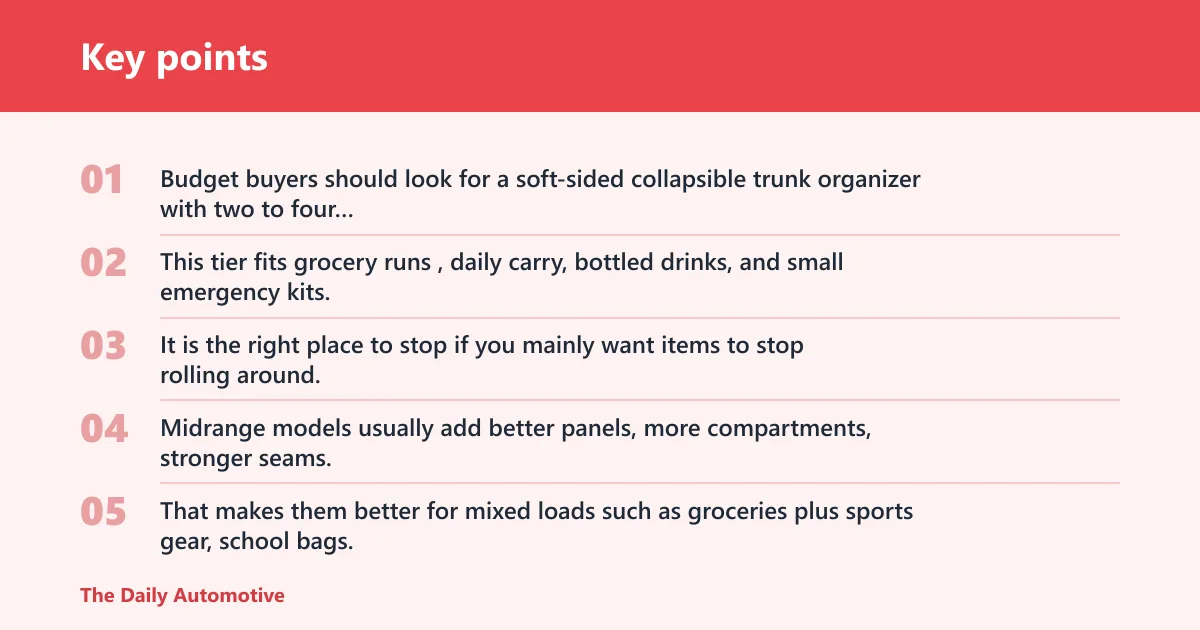
Budget buyers should look for a soft-sided collapsible trunk organizer with two to four compartments, handles or straps, and a fold-flat design. This tier fits grocery runs, daily carry, bottled drinks, and small emergency kits. It is the right place to stop if you mainly want items to stop rolling around.
Midrange picks for mixed loads and family use
Midrange models usually add better panels, more compartments, stronger seams, and a firmer non-slip base. That makes them better for mixed loads such as groceries plus sports gear, school bags, and roadside supplies. If your cargo changes often, this tier usually gives the best balance of cost and control.
Premium picks for heavy cargo and larger vehicles
Premium organizers make sense when cargo shifts hard, the cargo area is large, or you need rigid separation. Hard-sided trunk organizers, truck and SUV-specific units, and storage trunks with lids or lockable covers belong here. If you haul tools, muddy gear, or valuable equipment, the extra cost often buys real utility.
| Tier | Typical price | Typical materials | Stability features | Capacity clues | Best fit |
|---|---|---|---|---|---|
| Budget | $15 to $25 | Soft polyester, light fabric panels, simple stitching | Basic straps, non-slip bottom, fold-flat storage | 2 to 4 compartments, small daily items, groceries | Drivers who want order without spending much |
| Midrange | $25 to $60 | Reinforced fabric, stiffer walls, better bases | Velcro, anchor straps, dividers, pockets, better shape retention | Mixed loads, family gear, larger soft-sided bins | Most sedan, hatchback, and crossover owners |
| Premium | $60 and up | Rigid plastic, thick composite panels, coated fabric, lids | Rigid walls, spill resistance, lockable or covered tops, strong tie-downs | Large footprints, heavier cargo, truck and SUV use | Drivers hauling tools, wet gear, or bulky supplies |
Picture a compact sedan carrying two grocery bags, a case of water, and a jumper pack. A soft-sided organizer with three compartments and a non-slip base keeps the load from tipping without taking much trunk space. Now picture a three-row SUV with sports bags, cooler ice packs, and roadside gear. A rigid or anchored model makes more sense.
What size trunk organizer do you need?
Size should match both your cargo area and the way you load it. Measure the flat space you can spare, then check folded dimensions if the organizer collapses. The wrong size either wastes room or crowds the trunk so much that the organizer stops being useful.
Sedans and hatchbacks
Sedans and hatchbacks usually do best with narrower, lower-profile organizers that leave room for bags to sit beside them. A collapsible model works well if you want it to disappear when not in use. Look for compartments that fit grocery bags upright so bottles do not roll into the side panels.
SUVs and crossovers
SUVs and crossovers often have enough width for longer organizers, but that does not mean bigger is always better. Check rear floor width, wheel-well clearance, and whether the cargo floor slopes. Many buyers need straps or Velcro because a roomy cargo area can still let a lightweight organizer slide.
Trucks and cargo areas with larger footprints
Truck beds and larger cargo areas call for organizers built around a wider footprint, stronger anchoring, and more rigid construction. Truck and SUV trunk organizers can be larger than sedan models, but they should still match the usable space rather than the full vehicle width. Vehicle-specific dimensions matter more here than price.
Are trunk organizers worth it?
Yes, if your cargo moves around, tips over, or spills into open space. A trunk organizer is worth it when it replaces chaos with a fixed place for groceries, tools, or emergency gear. It is less useful when your cargo already rides in hard bins, or when you need maximum open space more than separation.
When an organizer solves sliding and tipping
An organizer earns its keep when a shopping bag tips over every time you brake, or when a loose box slides into the spare tire well. Soft-sided organizers help by grouping small items, while rigid models help by keeping a shape that resists collapse. Anti-slip bottoms and anchor points matter most in these cases.
When a bin or cargo box makes more sense
If your loads are wet, dirty, or heavy, a bin or cargo box may be the better buy. Storage trunks and cargo boxes cost more, but their size, lockable lid options, and rigid walls are better for gear that can leak or crush. Walmart’s 22 Gallon, 30-inch, and 36-inch examples show how fast price rises with sturdier construction.
When extra capacity matters more than price
Paying more is rational when capacity prevents repeat trips or damaged cargo. A larger organizer can keep tools, cords, and first-aid kits in one place, which is useful in a family vehicle or work truck. The point is not to buy the largest item available. It is to buy enough structure for the load you carry.
Where to buy a trunk organizer
You can buy trunk organizers from online retailers, mass merchants, and auto parts stores. The best place depends on whether you want quick comparison shopping, same-day pickup, or a chance to compare materials in person. Price is only part of the decision; dimensions and attachment hardware matter just as much.
Online retailers
Online stores usually offer the widest spread of prices, materials, and dimensions. That makes them the easiest place to compare soft-sided collapsible organizers with hard-sided models and truck-specific units. Read the listed measurements carefully, then compare them with your cargo area before buying.
Mass merchants and auto parts stores
Mass merchants and auto parts stores are useful if you want to see shape, stiffness, and compartment size before you pay. They also tend to stock practical organizers for groceries, daily carry, and emergency kits. Store listings can help you compare a low-cost fabric bin with a more rigid model in the same aisle.
What to check before you buy
- Measure the cargo area length, width, and height you can spare.
- Check folded dimensions if the organizer collapses.
- Look for straps, Velcro, or anti-slip bottoms if sliding is a concern.
- Match compartments and pockets to what you carry most often.
- Confirm whether the material is wipe-clean, water-resistant, or fully waterproof.
- For trucks and SUVs, verify the vehicle-specific fit before you order.
Frequently asked questions
How much does a trunk organizer cost
Most trunk organizers cost $15 to $60, with basic collapsible models near the low end and more structured organizers at the middle of the range. Heavy-duty hard-sided units, truck-specific organizers, and storage trunks can cost more. Price depends on material, build quality, and how much structure the organizer provides.
What is a trunk organizer
A trunk organizer is a cargo insert that keeps groceries, sports gear, tools, and emergency kits from rolling around in the vehicle’s main storage area. It may be soft-sided and collapsible, or hard-sided with rigid walls and a lid. Some vehicles use a rear hatch; others have a frunk in front.
What is a good price for a trunk organizer
A reasonable price for many drivers is often around the mid-$20s to about $50. That range usually gets you a sturdier soft-sided organizer, better compartments, and useful stability features such as straps or a non-slip base. If you need rigid walls, a lid, or heavy-cargo support, paying more can be justified.
How much is a trunk organizer for groceries
For groceries, a trunk organizer in roughly the $20 to $40 range is often enough if it has a firm base, a few compartments, and some way to prevent sliding. Soft-sided collapsible models are common here because they fold away after the shopping trip and still keep bags upright.
Why are some trunk organizers so expensive
Some trunk organizers cost more because they use rigid walls, stronger stitching, lids, spill-resistant materials, or anchor systems that hold shape under load. Larger truck and SUV models also need more material. You are often paying for stability, durability, and fit, not just for size.
Where to buy a trunk organizer
You can buy trunk organizers online, at mass merchants, and at auto parts stores. Online listings usually give the broadest range of sizes and prices, while stores make it easier to check fit and firmness in person. Before you buy, compare listed dimensions with your cargo space.
Products related to this article
Sponsored / affiliate links. As an Amazon Associate I earn from qualifying purchases. I may earn additional commission from eligible campaigns.