Can You Use High Mileage Oil In A New Car A Fatal Flaw
Using high mileage oil in a new car is not recommended and offers no benefits. It won’t cause immediate, catastrophic failure, but its additives are designed for older engines with more than 75,000 miles. These additives can slightly reduce fuel efficiency and performance in a new engine. Always use the specific oil type your car’s manufacturer recommends.
Walking down the oil aisle at the auto parts store can feel overwhelming. You see conventional, synthetic blend, full synthetic, and then there it is: “high mileage” oil. It sounds impressive, right? It must be tougher and better for your engine. You love your new car and want to give it the best, so you might wonder if using this special oil from the start can prevent future problems. It’s a common question, and you’re smart to ask it before you pour.
Feeling confused about motor oil is completely normal. The labels can be tricky, and you don’t want to make a costly mistake. But don’t worry, you’ve come to the right place. I’m Md Meraj, and my goal is to make car care simple and clear for everyone. In this guide, we’ll break down exactly what high mileage oil is, why it’s different, and whether it’s a good idea for your new vehicle. I promise by the end, you’ll feel confident choosing the right oil every single time.
What Exactly Is High Mileage Oil?
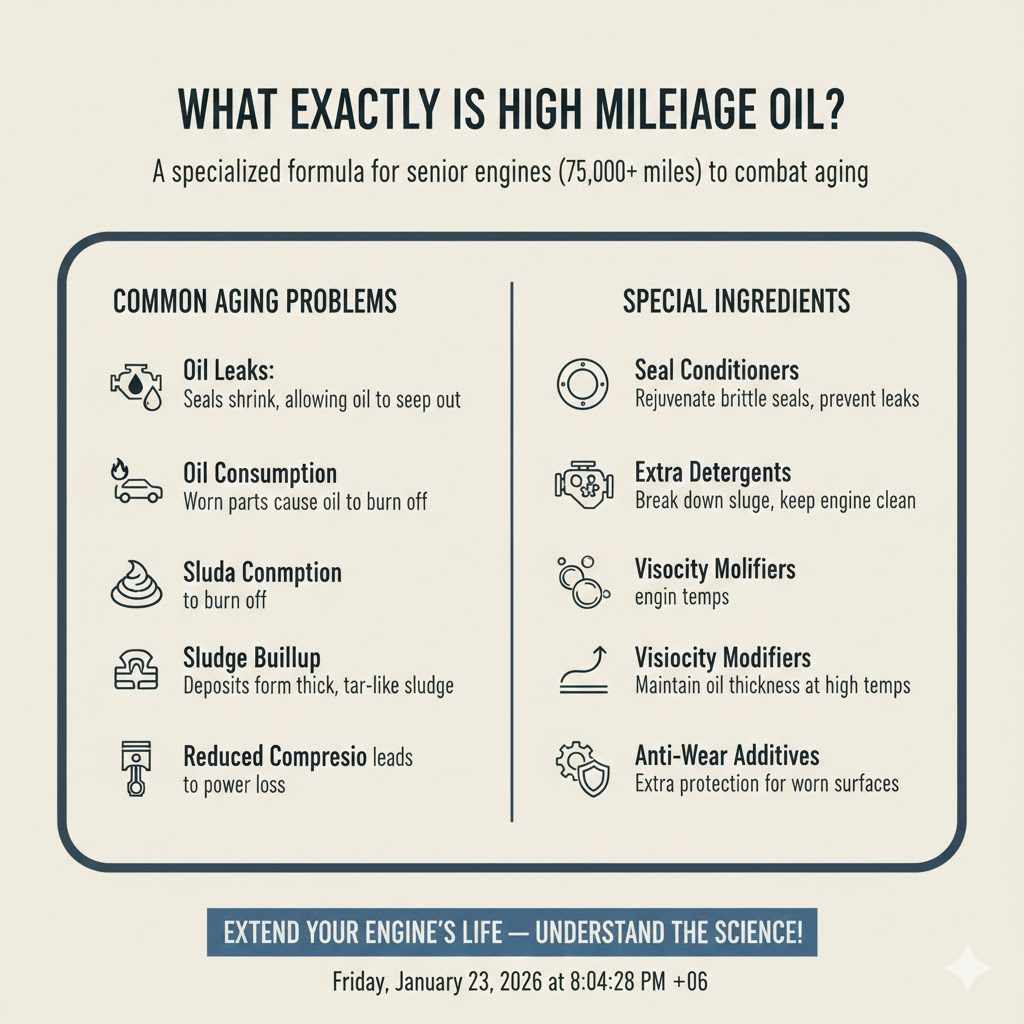
Before we can decide if it’s right for a new car, we need to understand what makes high mileage oil special. Think of it as a specialized formula for senior engines, typically those that have clocked over 75,000 miles. As an engine ages, its internal parts wear down, and its seals and gaskets can become dry, brittle, and shrink.
This aging process can lead to a few common problems:
- Oil Leaks: When seals shrink, they no longer create a tight barrier, allowing small amounts of oil to seep out.
- Oil Consumption: Worn parts can create tiny gaps, allowing oil to burn off more quickly.
- Sludge Buildup: Over many years, deposits and contaminants can build up inside the engine, creating a thick, tar-like substance called sludge.
- Reduced Compression: Wear and tear on pistons and cylinders can lead to a loss of power.
High mileage oil is engineered with a unique blend of additives specifically designed to combat these issues. It’s not just regular oil in a different bottle; it has a job to do.
The Special Ingredients in High Mileage Oil
The magic of high mileage oil comes from its additive package. These are the key components that set it apart from standard motor oils:
- Seal Conditioners: This is the most important ingredient. These are chemicals designed to be absorbed by the rubber seals and gaskets inside the engine. They cause the old, brittle seals to gently swell and become more pliable, helping them create a better seal and stop or prevent minor oil leaks.
- Extra Detergents and Dispersants: High mileage oils contain a higher concentration of cleaning agents. These detergents work to break down and dissolve existing sludge and prevent new deposits from forming, keeping the engine cleaner internally.
- Viscosity Modifiers: These additives help the oil maintain its proper thickness (viscosity) even at very high temperatures. This is important in older engines where wider gaps between moving parts require a more robust oil film to prevent metal-on-metal contact.
- Anti-Wear Additives: While all oils have anti-wear agents, high mileage formulas often include a boosted amount to provide extra protection for worn surfaces, reducing further friction and damage.
In short, high mileage oil is a prescriptive treatment for the common ailments of an older, well-loved engine. It’s designed to extend the life of a car that has already seen a lot of roads.
Understanding the Needs of a New Car Engine
Now, let’s shift our focus to the engine in your brand-new car. A new engine is a masterpiece of modern engineering. The internal components are manufactured with incredibly precise and tight tolerances. The seals and gaskets are fresh, flexible, and doing their job perfectly. There is no sludge, no wear, and no leaks.
A new engine’s priorities are completely different from an old one’s. The manufacturer designed it to achieve two main goals:
- Maximum Fuel Efficiency: To meet strict government regulations and provide you with better gas mileage, new engines are built to run with as little internal friction as possible.
- Peak Performance and Longevity: The engine is designed to deliver power smoothly and reliably for many years, provided it receives the proper maintenance.
To achieve this, automakers specify a very particular type of motor oil. In most cases, this is a low-viscosity, full synthetic oil. Low-viscosity oil (like 0W-20 or 5W-20) is thinner and flows more easily, especially when the engine is cold. This reduces drag on the internal parts, which directly translates to better fuel economy. Full synthetic oils are chemically engineered to provide superior protection against heat and breakdown, ensuring the engine stays clean and well-lubricated between oil changes.
The Fatal Flaw: Why High Mileage Oil Is the Wrong Choice for a New Car
So, can you use high mileage oil in a new car? The simple answer is no, you shouldn’t. While it won’t make your engine explode on the spot, it’s the wrong tool for the job. Using it is a “fatal flaw” in logic because it works against the very design of your new engine.
Let’s look at why those special additives are not only unnecessary but potentially counterproductive in a new car.
1. Seal Conditioners Have Nothing to Condition
The primary feature of high mileage oil—seal conditioners—has absolutely no work to do in a new engine. The seals and gaskets are already new, soft, and perfectly sized. Applying a chemical designed to make them swell is pointless. In a theoretical worst-case scenario, constantly exposing new seals to these agents could potentially cause them to soften or swell prematurely, which might shorten their lifespan. More practically, you’re paying a premium for an additive that provides zero benefits for your vehicle.
2. Thicker Oil Can Rob You of Fuel Economy
High mileage oils are often slightly thicker (or have modifiers to maintain thickness) than the ultra-thin synthetic oils specified for new cars. A new engine is built with very tight clearances, and it relies on a thin, free-flowing oil to get into every tiny space immediately upon startup. Using a thicker oil forces the engine to work harder to pump it, increasing internal friction. This can lead to a noticeable, albeit small, decrease in fuel economy and even slightly reduced engine responsiveness. You would be essentially sacrificing the efficiency that the engineers worked so hard to build into your car.
3. Aggressive Detergents are Overkill
A new engine is perfectly clean inside. The robust detergent package in high mileage oil is designed to tackle years of baked-on sludge and deposits. In a new engine, these powerful cleaning agents have nothing to clean. All quality motor oils contain sufficient detergents to keep a new engine clean, so the extra dose is redundant.
4. You Might Void Your Warranty
This is perhaps the most significant risk. Every new car comes with a manufacturer’s warranty that covers repairs to the engine for a certain period. This warranty is contingent on you following the recommended maintenance schedule and using the specified fluids. Your owner’s manual will list the exact type and viscosity of oil your engine requires (e.g., “Full Synthetic SAE 0W-20 meeting API SP specification”). If you use an oil that does not meet these exact specifications—like a high mileage oil when it’s not called for—and an engine problem arises, the manufacturer could deny your warranty claim. It’s a financial risk that is simply not worth taking.
The table below clearly summarizes the mismatch between what high mileage oil offers and what a new car needs.
| Feature of High Mileage Oil | Why It’s a Mismatch for a New Car |
|---|---|
| Seal Conditioners | New seals are already in perfect condition and do not need to be swelled. |
| Higher Viscosity / Modifiers | New engines require thin, low-viscosity oil for optimal fuel efficiency and flow. |
| Extra Detergents | A new engine has no sludge to clean, making these powerful detergents unnecessary. |
| Enhanced Anti-Wear Agents | Standard synthetic oil already provides excellent wear protection for new components. |
“Help! I Already Put High Mileage Oil in My New Car!”
If you’re reading this after you’ve already made the mistake, take a deep breath. It’s okay. Using high mileage oil for one oil change interval will not cause any lasting damage to your new engine. Modern engines are incredibly resilient.
You don’t need to drain the oil immediately. Simply drive the car as you normally would until your next scheduled oil change is due. When that time comes, make sure you or your mechanic uses the correct oil specified in your owner’s manual. The engine will be perfectly fine. Think of it as a learning experience, not a catastrophe.
How to Choose the Right Oil for Your New Car: A Simple Guide
Feeling confident about choosing the right oil comes down to knowing where to look and what to look for. It’s much easier than you think. Here is your step-by-step guide to getting it right every time.
Step 1: Open Your Owner’s Manual
This is your ultimate source of truth. The engineers who designed and built your engine have determined the exact type of oil it needs to run its best. Look in the index for “Engine Oil” or “Recommended Fluids.” The manual will tell you everything you need to know, including:
- Oil Viscosity Grade: This will look like “SAE 5W-30” or “SAE 0W-20.”
- Required Specification: It will list a specific industry standard, such as “API Service SP” or “ILSAC GF-6.”
- Oil Capacity: It will tell you how many quarts or liters of oil your engine needs.
Step 2: Understand the Viscosity Grade (The Numbers)
The numbers on the bottle, like 5W-30, describe the oil’s viscosity, or its resistance to flow. It’s simpler than it sounds:
- The first number with the “W” (for Winter): This indicates how the oil flows when it’s cold. A lower number means the oil is thinner and flows better on cold starts, which is when most engine wear occurs.
- The second number: This indicates the oil’s thickness once the engine is at its full operating temperature.
Your job isn’t to guess which is best. Your job is simply to use the exact grade the manufacturer recommends. They’ve already done all the testing for you.
Step 3: Look for the Certification Symbols
When you pick up a bottle of oil, look for two important symbols on the label. These are your proof that the oil is high quality and meets the latest standards.
- The API “Donut”: This circular symbol from the American Petroleum Institute displays the oil’s viscosity grade, whether it meets current performance standards (e.g., “API Service SP”), and whether it is resource-conserving.
- The ILSAC “Starburst”: This symbol indicates that the oil has passed tests for fuel economy and emissions system protection.
As long as the bottle has these symbols and matches the specifications in your owner’s manual, you can be confident you’re buying a quality product.
When Is It Time to Switch to High Mileage Oil?
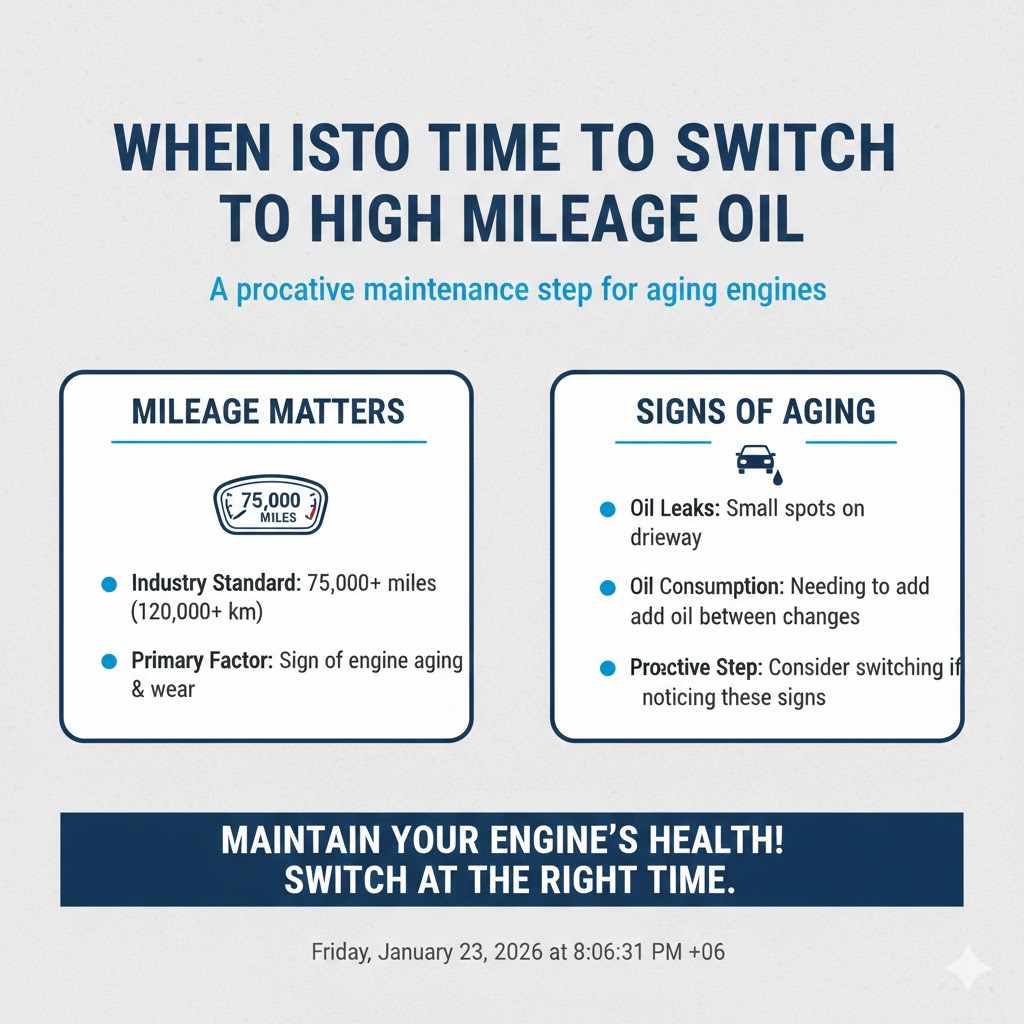
So, if you shouldn’t use it now, when should you? The industry-standard recommendation is to consider switching to a high mileage oil once your vehicle’s odometer reads 75,000 miles (about 120,000 kilometers).
However, mileage isn’t the only factor. You might also consider making the switch if you notice your older car is starting to show signs of age, such as:
- Small oil spots on your driveway: This can be a sign of drying seals, which the conditioners in high mileage oil can help.
- Needing to top off the oil between changes: If your car is consuming more oil than it used to, high mileage oil might help slow it down.
Switching to high mileage oil at the right time can be a smart, proactive maintenance step that helps you get many more reliable years out of your vehicle.
Frequently Asked Questions (FAQ)
1. What is the main difference between high mileage oil and regular synthetic oil?
The biggest difference is the additive package. High mileage oil contains special additives, most notably seal conditioners, to help swell old, brittle seals in engines over 75,000 miles. It also has more detergents to clean up existing sludge.
2. Will using high mileage oil in my new car void the warranty?
Yes, it absolutely can. Your new car warranty requires you to use fluids that meet the manufacturer’s exact specifications. If the high mileage oil doesn’t match the viscosity and certification requirements in your owner’s manual, an automaker could deny a warranty claim for an engine-related issue.
3. Can I mix high mileage oil with the regular oil in my car?
While mixing oils won’t cause immediate harm, it’s not a good practice. Doing so dilutes the additive packages of both oils, meaning you don’t get the full benefit of either one. It’s always best to use one type of oil consistently.
4. Is high mileage oil always thicker than regular oil?
Not necessarily. You can find high mileage oil in various viscosity grades (like 5W-20 or 5W-30). However, it is formulated to resist thinning out at high temperatures better than some conventional oils, which can make it behave like a more robust oil inside an older engine.
5. Will high mileage oil fix a major oil leak?
No. High mileage oil is designed to stop very minor leaks or seeps caused by dry, shrunken seals. It cannot fix a torn gasket, a cracked seal, or a leak from a loose bolt. Major leaks require a proper mechanical repair from a trusted mechanic.
6. Is it ever okay to switch back from high mileage oil to regular oil?
Yes. If you switch to high mileage oil and find it doesn’t help with oil consumption or you’d prefer to use a standard synthetic, you can switch back at your next oil change without any issues.
7. My new car requires synthetic oil. Do they make synthetic high mileage oil?
Yes, absolutely. Most major brands offer full synthetic and synthetic blend high mileage oils, so when your car eventually passes 75,000 miles, you can switch to a high mileage formula while still giving it the superior protection of a synthetic.
Conclusion: Trust Your Manual, Not the Marketing
When it comes to your new car, the path to proper engine care is simple and straightforward: follow the owner’s manual. The allure of “high performance” or “high mileage” labels can be tempting, but these are specialized products for specific situations. Your new engine is a finely tuned machine that thrives on the exact type of oil its creators specified—usually a clean, thin, full synthetic oil.
Using high mileage oil in a new car is a classic case of a solution in search of a problem. Its additives have no job to do on new seals and clean parts, and its formulation can work against your engine’s design for peak fuel efficiency. By sticking to the book, you ensure your engine is protected, your warranty remains intact, and your car runs exactly as it was meant to for years to come.
So next time you’re in the oil aisle, you can walk past the high mileage bottles with confidence, knowing they’ll be there for you when the time is right—many, many miles down the road.