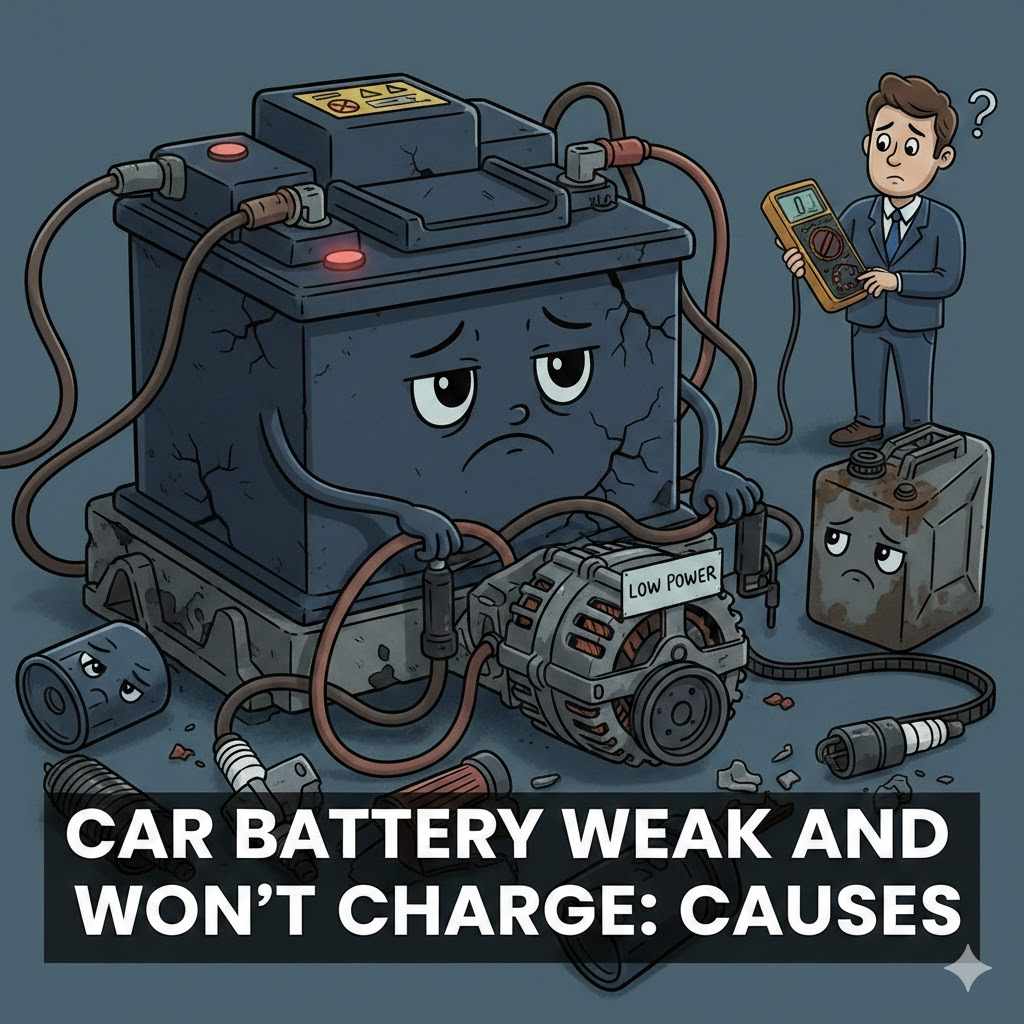
Car Battery Weak and Won’t Charge Causes
It can be really frustrating when your car battery acts up. You turn the key, and nothing happens, or maybe you just get a weak click. This problem, the Car Battery Weak and Won’t Charge?
Causes Explained, is super common. For many folks, figuring out why it’s happening can seem tricky. Don’t worry, though.
We’ll break it down simply, step by step. Let’s look at what could be going on and how to fix it.
Common Reasons For A Weak Car Battery
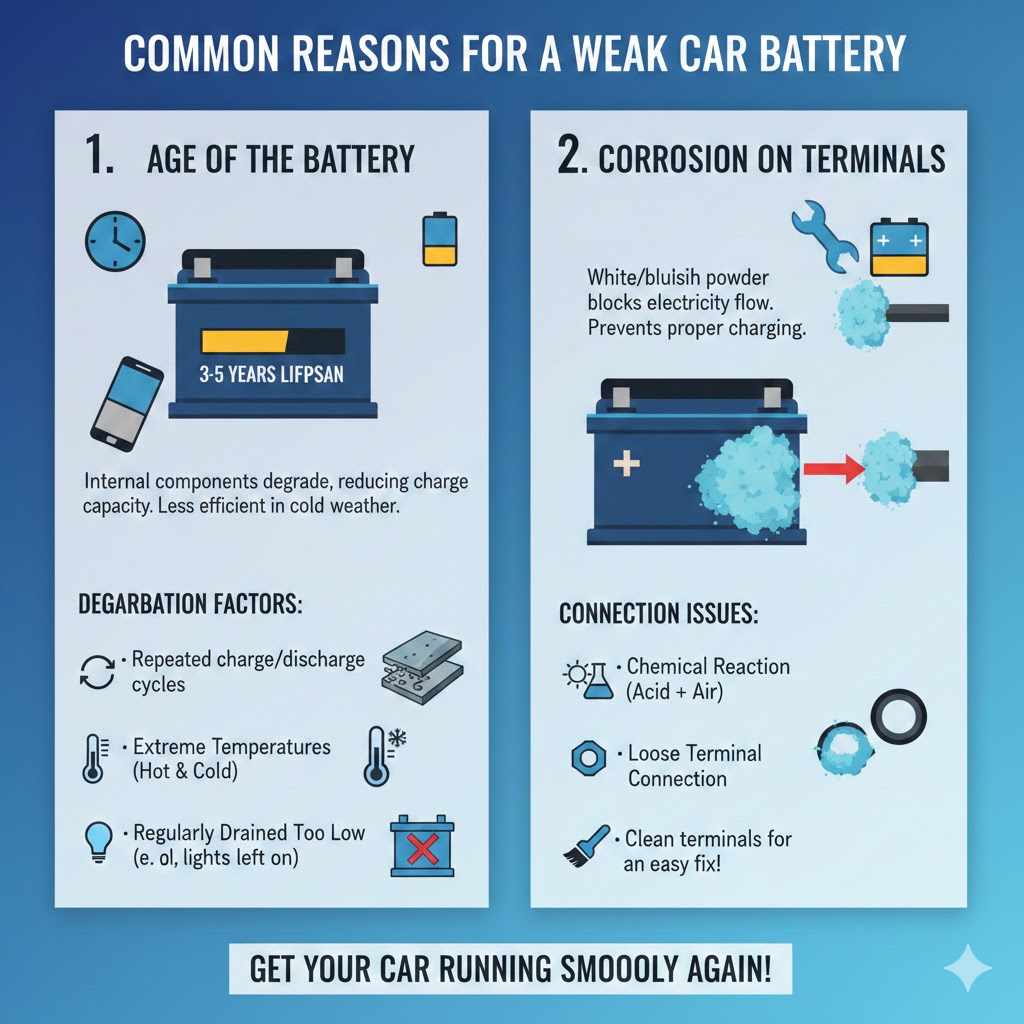
When your car battery is weak and won’t charge, it means something is preventing it from holding power or getting enough power. This can happen for several reasons, and many of them are quite simple to spot and fix. Understanding these common issues is the first step to getting your car running smoothly again.
We’ll explore the most frequent culprits, from simple wear and tear to electrical problems.
Age Of The Battery
Car batteries don’t last forever. Most car batteries have a lifespan of about 3 to 5 years. After this time, the internal components start to degrade.
The chemical reactions that store and release energy become less efficient. This means the battery simply cannot hold a full charge like it used to. It might still start your car sometimes, but it will struggle, especially in cold weather or when many accessories are in use.
Think of a battery like a smartphone battery. Over time, it just doesn’t hold a charge as long. For a car battery, this means it might show 12 volts when tested but can’t deliver the high amperage needed to turn the starter motor.
A weak battery might also take longer to charge from the alternator, and even then, it won’t reach its full capacity. This is a very common reason for a car battery weak and won’t charge issues.
-
Battery degradation occurs over time due to repeated charge and discharge cycles. This process wears down the lead plates inside the battery. Sulfation can build up on the plates, reducing their surface area and ability to react with the electrolyte.
-
Extreme temperatures, both hot and cold, can shorten a battery’s lifespan. Heat accelerates chemical reactions, leading to faster degradation, while extreme cold reduces the battery’s capacity and makes it harder for the engine to turn over.
-
If a battery is regularly drained too low, for example, by leaving lights on, it can cause permanent damage to the internal components. This reduces its ability to accept and hold a charge in the future, making it a prime suspect when a car battery is weak and won’t charge.
Corrosion On Terminals
The battery terminals are where the cables connect to the battery. These connections need to be clean and tight for electricity to flow properly. Over time, a white or bluish powdery substance can build up on these terminals.
This is called corrosion. Corrosion acts like an insulator, blocking the flow of electricity.
When corrosion is present, the alternator might be charging the battery, but the charge can’t effectively reach the car’s electrical system, or a good charge can’t be supplied to the battery itself. This makes it seem like the battery isn’t charging. It’s a very common, and usually an easy, fix.
You often just need to clean the terminals.
-
Battery terminal corrosion is typically a chemical reaction between the battery acid and the air. This reaction forms a brittle, insulating layer. It can appear as a fuzzy, white, blue, or greenish powder.
-
A loose terminal connection can also cause problems. If the cable is not firmly attached, it can create high resistance, similar to corrosion, and prevent proper charging or power delivery. This is another reason why a car battery might appear weak and won’t charge.
-
If you notice corrosion, it’s important to address it quickly. Leaving it can lead to further damage to the battery and the connection cables, making the problem more difficult and expensive to fix later on.
The Alternator’s Role In Battery Charging
The alternator is the unsung hero that keeps your battery topped up while your car is running. It’s a small generator that converts the engine’s mechanical energy into electrical energy. This electricity powers your car’s systems and recharges the battery.
If the alternator isn’t working right, your battery won’t get the charge it needs. This is a major reason why you might face a situation where your car battery is weak and won’t charge.
A failing alternator can produce less voltage than required, or it might stop producing electricity altogether. When this happens, the car’s electrical system relies solely on the battery’s stored power. Eventually, the battery will drain, leading to a dead car or one that struggles to start.
This is why checking the alternator is as important as checking the battery itself when you have charging issues.
Signs Of A Failing Alternator
You might notice several signs that point towards a faulty alternator. One common indicator is a dashboard warning light. Many cars have a battery-shaped light or a “check engine” light that illuminates when the alternator is not functioning correctly.
This light often means the battery is not being charged.
Other signs include dimming headlights or interior lights, especially when the engine is at idle or when you use accessories like the radio or air conditioning. You might also hear a whining noise coming from under the hood, which can be caused by worn bearings in the alternator. Sometimes, the car might even stall unexpectedly if the alternator can no longer provide enough power to keep the engine running.
-
The alternator has several key components, including the rotor, stator, rectifier, and voltage regulator. If any of these parts fail, the alternator will not be able to produce the correct amount of electricity. For example, a faulty voltage regulator can cause the alternator to overcharge or undercharge the battery.
-
Testing an alternator involves checking the voltage it produces while the engine is running. A healthy alternator typically outputs between 13.5 and 14.5 volts. If the voltage is significantly lower or higher, it indicates a problem.
-
A common misconception is that a dead battery is always the battery’s fault. However, if the alternator is bad, it will drain even a brand-new battery. This makes it crucial to diagnose the charging system as a whole when experiencing a car battery weak and won’t charge problem.
Alternator Output Voltage
The voltage output from your alternator is critical. It needs to be within a specific range to charge your battery properly and power your car’s electronics. This range is typically between 13.5 to 14.5 volts when the engine is running.
If the alternator’s output is too low, the battery will not receive enough charge, and you’ll eventually find yourself with a car battery weak and won’t charge. If the output is too high (overcharging), it can damage the battery and shorten its life by boiling the electrolyte. A mechanic can easily test this with a multimeter.
Example Scenario: Alternator Output Check
-
Start your car’s engine.
-
Set a multimeter to measure DC voltage.
-
Connect the red probe to the positive (+) battery terminal and the black probe to the negative (-) battery terminal.
-
Observe the voltage reading. It should be between 13.5 and 14.5 volts. If it’s below 13.5 volts, the alternator is likely not charging properly. If it’s above 14.5 volts, the voltage regulator might be bad, causing overcharging.
Electrical System Issues And Drains
Sometimes, the problem isn’t the battery or the alternator themselves but something else in the car’s electrical system that is causing a drain. This means that even when the car is off, something is using up the battery’s power. This constant drain can leave you with a car battery weak and won’t charge the next time you try to start it.
Identifying these parasitic drains can be a bit like detective work. It involves checking for electrical components that are drawing power when they shouldn’t be. Common culprits include faulty relays, short circuits, or even aftermarket accessories that were not installed correctly.
Parasitic Battery Drain
A parasitic drain is when a component in your car continues to draw electrical current even when the ignition is off. Small amounts of current draw are normal for things like the car’s clock or alarm system. However, if this draw is too high, it will drain the battery.
A typical parasitic draw should be very low, usually less than 50 milliamperes (mA). If a test reveals a draw significantly higher than this, it means something is not shutting off properly. This is a direct cause for a car battery weak and won’t charge situation because the battery is being depleted faster than it can be recharged.
-
To test for parasitic drain, a mechanic uses a multimeter connected in series with the battery. This allows them to measure the current flowing out of the battery when the car is supposed to be off.
-
If a high draw is detected, fuses are pulled one by one to isolate which circuit is causing the drain. Once the faulty circuit is found, further investigation can pinpoint the exact component that is drawing too much power.
-
Common sources of parasitic drain include interior lights that don’t turn off, faulty door latches, bad radio units, or even malfunctioning engine control modules. Even a small, constant drain can deplete a battery overnight.
Faulty Components
Various electrical components can go bad and cause issues. For instance, a faulty starter solenoid might stay engaged, drawing a lot of power. A malfunctioning relay could be stuck in the “on” position, powering something constantly.
Even a damaged wire with exposed insulation can cause a short circuit, leading to a power drain.
These issues are not always obvious. They might not make any noise or give immediate warning signs. However, they continuously sap power from the battery, leading to the frustrating experience of a car battery weak and won’t charge.
Diagnosing these faults often requires specialized tools and knowledge of automotive electrical systems.
Example Scenario: Finding A Parasitic Drain
-
Ensure the car has been off for at least 30 minutes, allowing all modules to go to sleep.
-
Disconnect the negative battery cable.
-
Connect a multimeter set to measure amperage between the disconnected negative battery cable and the battery’s negative terminal.
-
If the reading is above 50 mA, there’s a parasitic drain.
-
Begin pulling fuses one by one. When the amperage reading drops significantly, you’ve found the circuit causing the drain.
Short Circuits
A short circuit occurs when electricity takes an unintended path, usually through a damaged wire or a faulty component. This path often bypasses the normal resistance, causing a surge of current. This surge can drain the battery very quickly.
Short circuits can also cause fuses to blow, acting as a safety mechanism. However, a persistent short circuit that keeps blowing fuses or drawing significant power will lead to a battery that’s always discharged. This is why a car battery weak and won’t charge can be a sign of a more serious electrical fault.
-
Short circuits can happen due to frayed wires, loose connections, or water ingress into electrical components. The insulation on wires can degrade over time, especially in areas exposed to heat or moisture.
-
When a short circuit occurs, it can generate heat. In extreme cases, this can melt plastic components or even cause a fire, though modern cars have safety features to prevent this.
-
Repairing short circuits often involves tracing the affected wiring harness and identifying the exact point of the fault. This can be time-consuming and requires careful inspection of all electrical connections.
Environmental Factors And Usage Habits
How and where you use your car, as well as the climate you live in, can significantly impact your car battery’s health. Some habits, like frequent short trips, can put extra strain on the battery. Understanding these influences can help you prevent future problems.
The environment plays a big role too. Extreme hot or cold temperatures are tough on batteries. We’ll look at how these external factors contribute to a car battery weak and won’t charge.
Extreme Temperatures
Both very hot and very cold weather can harm your car battery. In hot weather, the battery’s internal chemicals can degrade faster. This reduces its overall capacity and lifespan.
Heat essentially cooks the battery from the inside out.
In cold weather, a battery’s ability to produce power is reduced. Even a fully charged battery will have less cranking power in freezing temperatures. If you combine cold weather with an older or weaker battery, starting your car becomes much more difficult, leading to that familiar “car battery weak and won’t charge” feeling.
-
Hot weather accelerates the rate of chemical reactions inside the battery. This can lead to increased self-discharge and damage to the internal plates, making it harder for the battery to hold a charge.
-
Cold weather thickens the battery’s electrolyte, slowing down the chemical reactions needed to produce electricity. This means the battery has less available power to start the engine, which requires a lot of energy.
-
The ideal temperature range for a car battery is generally between 40°F and 70°F (4°C and 21°C). Temperatures outside this range put stress on the battery and can shorten its life.
Frequent Short Trips
If you often take very short trips in your car, this can be bad for your battery. Each time you start your car, the battery uses a significant amount of power to crank the engine. The alternator then needs to run for a while to recharge that power.
On short trips, the alternator may not have enough time to fully replenish the battery’s charge. Over time, this consistent undercharging can lead to the battery becoming gradually weaker. This is a common reason why drivers experience a car battery weak and won’t charge, especially if they primarily use their car for quick errands.
-
A typical car engine requires a lot of amperage to start. The alternator’s primary role while driving is to power the car’s systems and then recharge the battery.
-
For example, a 15-minute drive might only be enough to recharge about 50% of the power used to start the car, especially if the engine is cold and accessories like headlights and the heater are on.
-
If your daily commute is short, consider taking your car for a longer drive (30 minutes or more) once a week to ensure the battery gets a full recharge.
Leaving Accessories On
Forgetting to turn off headlights, interior lights, the radio, or other accessories when the engine is off is a quick way to drain your battery. Most modern cars have features to prevent this, like automatic headlight shut-off or audible warnings if the lights are left on. However, these systems are not foolproof.
A drained battery from leaving something on overnight can often be recharged. But if this happens repeatedly, it can still contribute to weakening the battery over time and lead to the issue of a car battery weak and won’t charge.
-
Many car manufacturers have implemented “battery saver” features that automatically turn off interior lights and some accessories after a certain period of inactivity when the engine is off.
-
However, some accessories, like aftermarket stereos or charging ports, may not have these built-in protections and can drain the battery if left connected and powered.
-
Always do a quick visual check before leaving your car to ensure all lights are off and unnecessary accessories are disconnected. This simple habit can save you a lot of trouble.
Troubleshooting And Solutions
When you’re faced with a car battery weak and won’t charge, there are steps you can take to figure out the cause and what to do about it. It’s about systematically checking the most likely problems first. You don’t always need a mechanic right away.
We’ll cover how to test your battery, check the alternator, and what to do if you suspect a drain. These troubleshooting steps will help you get to the bottom of the issue and get your car back on the road.
Testing Your Car Battery
The first step is to test the battery itself. You can do this with a multimeter or a dedicated battery tester. A multimeter can measure the battery’s voltage.
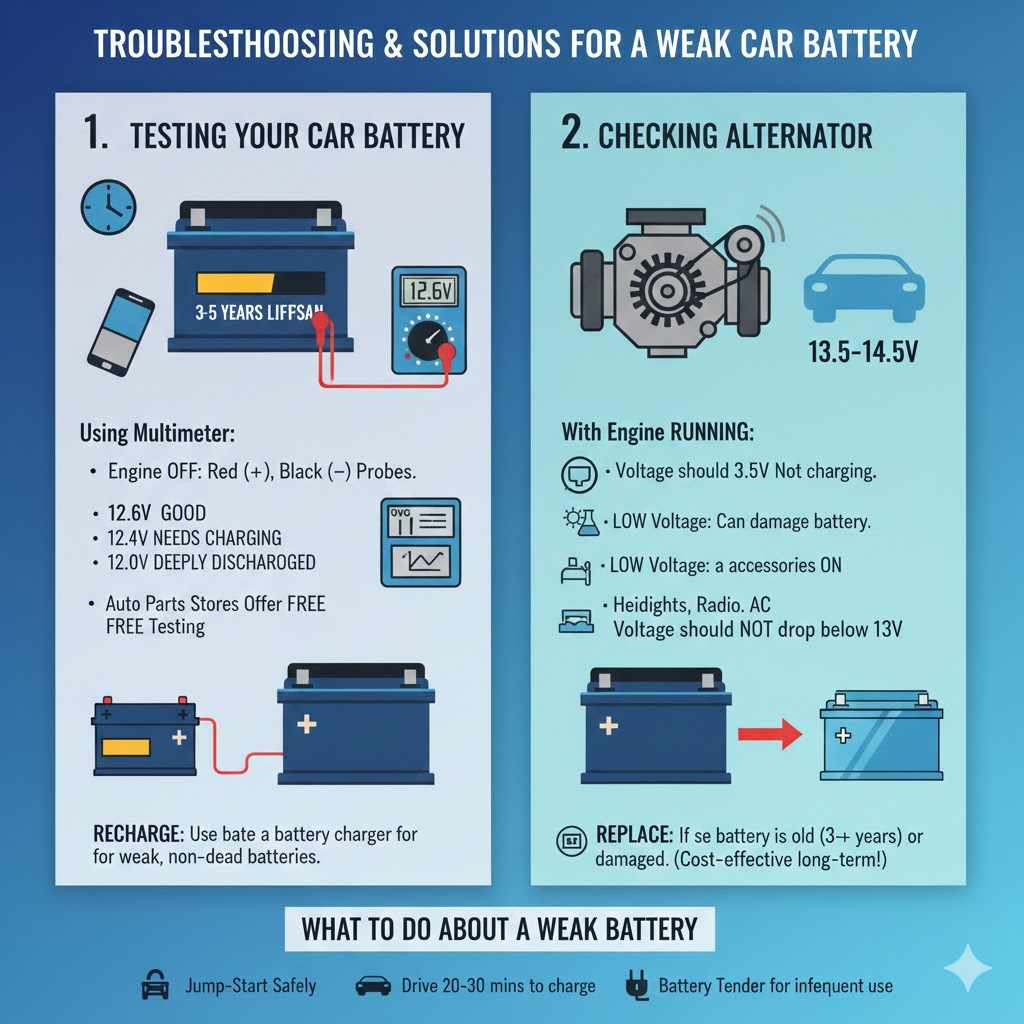
A fully charged battery should read around 12.6 volts when the engine is off. If it’s below 12.4 volts, it’s not fully charged.
A battery tester does more than just measure voltage; it can also check the battery’s “cold-cranking amps” (CCA), which is its ability to start an engine in cold weather. This is a more accurate test of the battery’s overall health and capacity. If the battery fails these tests, it likely needs to be replaced.
-
Using a multimeter: With the engine off, connect the red probe to the positive terminal and the black probe to the negative terminal. A reading of 12.6 volts or higher indicates a good charge. A reading below 12.4 volts suggests it needs charging. A reading below 12.0 volts means it’s deeply discharged and may be damaged.
-
Using a load tester: This device simulates the load of starting an engine. It will show if the battery can maintain sufficient voltage under stress. This is a more comprehensive test of the battery’s ability to perform its primary function.
-
Many auto parts stores offer free battery testing services. They have professional equipment that can quickly give you a clear picture of your battery’s condition.
Checking The Alternator
As discussed, the alternator is vital for charging the battery. You can test it by measuring the voltage output while the engine is running, as mentioned earlier. A reading between 13.5 and 14.5 volts indicates the alternator is likely working correctly.
If the voltage is too low, the battery isn’t getting charged. If it’s too high, it can damage the battery. In either case, a faulty alternator will lead to a car battery weak and won’t charge.
A mechanic can perform more in-depth checks of the alternator’s components.
-
Start the engine and let it run.
-
Set your multimeter to DC volts.
-
Measure the voltage across the battery terminals. It should be between 13.5V and 14.5V.
-
Turn on headlights, radio, and AC. The voltage should not drop significantly. If it drops below 13V, the alternator may be struggling to keep up with the electrical load.
What To Do About A Weak Battery
If your battery is weak but not completely dead, you might be able to recharge it. You can use a battery charger designed for automotive batteries. Connect it according to the manufacturer’s instructions.
If the battery is old (over 3-5 years) or has suffered significant damage, replacement is usually the best option. A weak battery can cause other electrical problems and leave you stranded. It’s often more cost-effective in the long run to replace a failing battery.
-
If you’re jump-starting your car, make sure to follow the correct procedure to avoid sparks and damage. Connect positive to positive and negative to a good ground on the dead car’s chassis, not directly to the dead battery’s negative terminal.
-
After jump-starting, drive the car for at least 20-30 minutes to allow the alternator to charge the battery. This might be enough to get it started next time, but it doesn’t fix an underlying issue.
-
Consider a battery tender if your car is driven infrequently. A battery tender maintains the battery’s charge without overcharging it, prolonging its life.
Frequently Asked Questions
Question: How long does it take for a car battery to charge?
Answer: It depends on the charger’s amperage and how depleted the battery is. A standard home charger might take 8-24 hours for a full charge. A quick jump start from another vehicle provides enough power to start the car but doesn’t fully charge the battery; driving for about 30 minutes is needed to get a partial recharge from the alternator.
Question: Can a car battery be overcharged?
Answer: Yes, a car battery can be overcharged if the alternator’s voltage regulator malfunctions and sends too much voltage to the battery. Overcharging can cause the electrolyte to boil, leading to battery damage, reduced lifespan, and potentially dangerous gas buildup.
Question: How do I know if my car battery is bad or just dead?
Answer: A dead battery can be recharged and might work fine afterward. A bad battery, often due to age or internal damage, won’t hold a charge well, even after being recharged. Symptoms of a bad battery include frequent draining, slow cranking, and needing jump-starts often.
Question: What is a parasitic drain on a car battery?
Answer: A parasitic drain is when a car’s electrical system continues to draw power from the battery even when the engine is off and all accessories are supposed to be turned off. This continuous draw can drain the battery overnight, leading to it being weak and not starting the car.
Question: Is it better to replace a battery or try to repair it?
Answer: For most car batteries experiencing issues like being weak or not charging, replacement is the most practical and reliable solution. Batteries are generally sealed units, and internal damage or significant wear means they have reached the end of their usable life.
Conclusion
When your Car Battery Weak and Won’t Charge? Causes Explained, it’s often due to age, corrosion, alternator issues, electrical drains, or environmental factors. By checking the battery’s age, terminal cleanliness, alternator output, and looking for electrical drains, you can pinpoint the problem.
Often, simple maintenance or replacement solves the issue, getting you back on the road with confidence.