Best Car Fuses for Electrical Systems (2026): We Compared
The best car fuse assortment kit matches the fuse family in your box first. Many daily drivers use a mix of standard ATO/ATC, mini, and sometimes low-profile mini or micro blade fuses in the exact amperage listed on the vehicle chart. Buy the wrong size or rating, and you risk dead circuits, repeat blowouts, or unsafe oversizing that can damage wiring. This guide ranks kits by fit, size coverage, amp spread, labeling, and how well they cut roadside guesswork.
Top pick: mixed-size fuse kit for mixed fuse boxes
A mixed-size kit is the safest default because modern vehicles often use more than one blade-fuse family. If your vehicle has a standard box up front and a mini or low-profile mini panel elsewhere, the right assortment keeps you from buying duplicate-heavy spares you may never use.
That matters more than raw piece count. A smaller kit with the right sizes and clear markings is often better than a huge box full of repeats, especially when you need one exact replacement at the side of the road.
Quick comparison
| Product | Badge | Best for | Price | ||
|---|---|---|---|---|---|
 |
100 Pcs Fuses Assortment Kit, Standard Car Fuses, Bladeoobathy | Our pick | 100 pcs · standard size · ATO/ATC kit | $4.99
Price as of 22 Oct 2026
|
View |
 |
JOREST 300Pcs Car Fuse Assortment Kit, 160 Mini Blade FusesJorest | Also great | 300 pcs · multi-size · micro, mini, standard | $13.99
Price as of 22 Oct 2026
|
View |
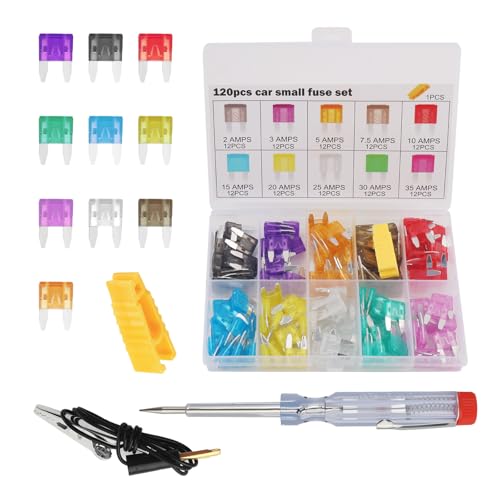 |
120PCS Car Fuses Assortment Kit with Tester &Bvcurdw | Also great | 120 pcs · with tester · multi-amp | $6.88
Price as of 22 Oct 2026
|
View |
Use the chart to compare size coverage, amperage spread, and whether a puller is bundled. The best choice is the one that matches your vehicle’s fuse family and leaves you with the fewest unused duplicates.
How we chose
We compared each kit by fuse-size coverage, amperage range, labeling clarity, puller inclusion, and storage quality. The goal was not the biggest box. It was the kit most likely to fit real fuse panels without creating extra clutter.
We also weighed how each kit handles common vehicle layouts. Standard ATO/ATC coverage helps older cars and some general-use vehicles. Mini, micro, and low-profile mini coverage matters more as fuse panels get tighter and more mixed.
Finally, we looked at how much guesswork each kit removes. Color-coded housings, printed amperage markings, and a compartmentalized case make the right fuse easier to grab fast.
Fuse kit decision matrix
This matrix turns fuse-box reality into a minimum viable kit spec. Pick the smallest kit that matches your vehicle’s fuse family and circuit chart, then add only the extra sizes you are likely to need.
| Vehicle type | Likely fuse-box style | Minimum kit spec | Amperage bands to carry | Puller needed | Storage format |
|---|---|---|---|---|---|
| Older cars, simple daily drivers | Standard ATO/ATC | Single-size standard blade kit | 5A to 30A, matched to the vehicle chart | Helpful, especially for tight panels | Small compartment case for glove-box use |
| Newer compact cars | Mini or low-profile mini, sometimes both | Mixed mini plus low-profile mini kit | 2A to 30A, with exact matches for the vehicle chart | Yes, because fuse boxes are often cramped | Flat organizer that stays sorted in a toolbox or glove box |
| Late-model vehicles with small panels | Micro, mini, and low-profile mini in the same vehicle | Triple-format kit with micro included | 2A to 40A only if the vehicle chart calls for those ratings | Strongly recommended | Compartmentalized case with clearly labeled slots |
| Trucks, RVs, boats, motorcycles, ATVs | Mixed layouts vary by platform and add-on equipment | Mixed-size kit with the families your equipment actually uses | Low-current and higher-current values based on installed circuits | Yes, due to tighter or awkward access | Portable case that can move between vehicle and storage bin |
Replacement rule: always install the exact amperage specified by the vehicle or equipment chart. A higher-rated fuse is not a fix. It can let a fault keep drawing current longer than the wiring should allow.
Say your compact hatchback uses mini fuses for interior circuits and low-profile mini fuses under the hood. A mixed kit with both sizes reduces the odds of buying the wrong shape, but only the exact amp rating belongs in the slot.
Suppose your RV has one standard ATO/ATC panel for accessories and a separate mini-fuse block for electronics. A single-size kit may leave gaps, while a mixed kit can cover both panels without forcing you to stock spares you will not use.
What is the best car fuse assortment kit for a standard and mini fuse box?
The best choice for a standard and mini fuse box is a mixed-size kit that includes both ATO/ATC and mini blade fuses, with the exact amperage ratings your vehicle chart lists. That combination cuts misfusing, covers mixed panels, and avoids the waste of separate boxes for each family.
If the vehicle only uses standard blade fuses, a standard-only kit can be the smarter buy. If it uses mini fuses in more than one panel, choose a kit that gives you enough of the common ratings without burying you in rare duplicates.
Oobathy 100-piece standard blade kit: best for standard-only layouts
This kit is a strong fit for older cars, general-use vehicles, and any layout that relies on standard ATO/ATC fuses. The 100-piece count and 10 ratings make sense when your fuse box is simple and you want a compact case with clear storage.
Its strengths are direct: standard blade coverage, printed amperage markings, and a sturdy transparent case. The drawback is just as clear. It does not cover mini, micro, or low-profile mini fuses, so it is the wrong buy for mixed modern panels.
The listed ratings run from about 2A to 35A, with the kit described as standard size and ATO/ATC. That range is broad enough for many common circuits, but you should still verify the exact slot rating on the vehicle’s fuse chart before replacing anything.
JOREST 300-piece mixed kit: best for mixed fuse boxes
This is the best fit when you need one kit that can handle micro, mini, and standard blade fuses in the same vehicle family. It is aimed at RVs, campers, boats, and trucks as well as cars, which makes sense when fuse layouts are not uniform.
Its main advantage is coverage. The kit includes micro, mini, and standard sizes, plus a puller, and the color-coded layout helps speed identification in a tight fuse box. The drawback is predictable: 300 pieces can mean duplicates you may never need, especially if your vehicle uses only one or two fuse families.
Published product details list 160 mini, 90 standard, and 50 micro fuses, with ratings from 2A through 40A. That spread is useful only if those sizes match the vehicle chart. If not, you are paying for unused spares and extra drawer space.
Bvcurdw 120-piece tester kit: best for quick diagnosis
This kit suits buyers who want a compact assortment plus a troubleshooting aid. The included tester can help confirm a blown fuse before replacement, which is useful when the fault is not obvious and you are working in a dark or cramped panel.
It covers 10 amperage ratings and comes with a storage box, so it is practical for glove-box or toolbox storage. The drawback is that it does not offer the same size-family coverage as the bigger mixed-format kits, so it is less flexible for vehicles with micro or low-profile mini slots.
The stated range runs from about 2A to 35A, and the kit is described as using color-coded organization. That is helpful for roadside work, but the kit still has to match the exact fuse family in your vehicle. A tester is useful. It is not a substitute for the right fuse shape.
Do you need standard, mini, micro, or low-profile mini fuses for your car?
You need the fuse family your vehicle’s panel was built for, and many vehicles use more than one. Older cars often lean on standard ATO/ATC fuses, newer compact vehicles more often use mini or low-profile mini, and many late-model panels also use micro sizes in tighter spaces.
The safe way to choose is simple: inspect the fuse box cover, owner’s manual, or circuit chart before buying. If the vehicle uses mixed panels, a mixed-size kit is usually the better call.
Standard ATO/ATC fits older and general-use layouts
Standard blade fuses are the common choice for older cars and many general-use vehicles. They are larger, easy to handle, and often easier to read at a glance because the housing is less cramped than the smaller families.
If every fuse in the box is standard size, buy a standard-only kit. That keeps storage cleaner and avoids paying for mini or micro spares that may never leave the case.
Mini and low-profile mini fit tighter modern panels
Mini fuses are common in newer vehicles, and low-profile mini fuses matter when the panel needs a shorter blade body. Those two families are easy to confuse if you shop by color alone, so shape matters as much as amperage.
If your vehicle uses both mini and low-profile mini, a mixed kit is safer than a single-size box. A small mismatch here can mean a fuse that will not seat fully or a replacement that looks right but does not fit the slot correctly.
Micro sizes matter in late-model compact fuse panels
Micro fuses are smaller than mini fuses and appear in modern compact fuse panels. Larger premium kits include them because they help cover vehicles that use very small blade footprints in electronics-heavy layouts.
Do not treat micro as a catchall. Some kits advertise “micro” without making the form factor clear, and that can lead to a poor fit if your panel expects a specific micro style.
What amperage range should your kit cover?
Your kit should cover the exact ratings listed on the vehicle’s fuse chart, not a wider range chosen at random. For many drivers, that means low-current slots for small electronics and higher-current slots for circuits that the factory specifies at those values.
The important point is not the widest spread. It is matching the ratings you actually need without loading the case with duplicates that never get used.
Use the vehicle chart, not guesswork
A fuse protects the circuit it was designed for. If the chart calls for 10A, replace it with 10A. A higher-rated fuse can hide the problem for a while and let damage continue longer than it should.
Competitors often list amperage ranges without mapping them to use cases. That leaves buyers guessing. A better kit is one that includes the common ratings in your vehicle and enough duplicates of the ones that fail most often.
Keep the spread practical
EPAuto’s kit includes 5A, 7.5A, 10A, 15A, 20A, 25A, and 30A. That kind of spread covers many common blade-fuse replacements without stretching into ratings you may never need.
Riseuvo’s assorted kit covers 2A through 35A across standard and mini sizes, while one JOREST kit is stated to cover 2A through 40A. Those wider spreads can help in mixed vehicles, but they make the most sense when your vehicle chart actually uses those values.
Avoid duplicate-heavy assortments when you do not need them
Oversized assortments look convenient, but they often hide a problem: too many repeats of the same sizes and too many ratings you will never touch. That wastes space and can make the case harder to sort in a hurry.
If your car uses only one fuse family and a narrow set of ratings, a smaller kit can be the smarter buy. Fewer pieces can mean faster selection and less stale inventory in the box.
Are fuse pullers and storage cases worth it?
Yes. A fuse puller helps in tight panels, and a compartmentalized case keeps the right amperage sorted so you do not burn time hunting through loose spares. Those extras matter most when the fuse box is cramped or the repair happens in poor light.
Cheap packaging is the weak point in many bargain kits. If the fuses rattle together, labels fade, or the slots mix sizes, the kit becomes slower to use exactly when speed matters.
Pullers reduce damage in tight boxes
Fuse pullers are useful because they let you remove a fuse without twisting the blades or chewing up the clip. That matters in small panels where fingers do not fit well and the fuse sits deep in the housing.
The best kits either include a puller or leave obvious room for one. If a kit does not include it, plan to keep a separate puller in the case.
Good storage keeps the kit usable
A compartmentalized box should keep each amperage visible and separated. Color-coded housings and printed amperage markings make that faster, especially when you are working on the shoulder of a road or in a dim garage bay.
Portable storage matters too. A glove-box-friendly case or a compact toolbox organizer makes the kit more likely to stay with the vehicle instead of disappearing into a junk drawer.
Cheap packaging can become the drawback
A low price is less useful if the case fails to hold the pieces in order. Loose spares and mixed compartments make misfusing more likely because the right amperage is harder to find at a glance.
A good kit should feel sorted before you ever open the fuse box. If the organizer is flimsy or unlabeled, the savings can disappear the first time you need the replacement fast.
Which one should you buy?
If your vehicle uses standard and mini fuse boxes, buy the JOREST 300-piece mixed kit. It gives you the broadest family coverage in this list and is the easiest pick when you do not want to guess which panel you will face next.
If your vehicle uses only standard blade fuses, the oobathy 100-piece standard kit is the cleaner buy. If you want a compact kit with a tester for quick diagnosis, the Bvcurdw 120-piece set is the better fit.
For trucks, RVs, boats, and motorcycles, the mixed-format JOREST kit is the safest option when the equipment uses more than one blade family. A smaller single-size kit makes more sense only when you already know the vehicle uses one family and a tight set of amperage values.
One common first-timer mistake is buying the biggest box on the shelf because it looks complete. That often leaves you with duplicate spares and the wrong fuse family for at least one panel.
Frequently asked questions
How do I know if a fuse kit is compatible with my vehicle?
Check the owner’s manual, the fuse-box cover, or the circuit chart before buying. Match the physical fuse family first, then match the exact amperage. If your vehicle uses more than one family, choose a mixed kit instead of assuming one size will cover everything.
What amperage range should a car fuse kit cover?
Buy for the vehicle chart, not for the widest number on the package. A useful kit usually covers the low-current and higher-current ratings your car actually uses, with duplicates of the most common values and no need to chase ratings your vehicle never calls for.
Are color-coded blade fuses easier to identify in an emergency?
Yes. Color-coded housings and printed amperage markings make it faster to spot the right fuse when you are working in poor light or under pressure. That does not replace checking the rating, but it lowers the chance of grabbing the wrong one during a roadside repair.
Should I buy a mixed-size fuse kit or a single-size kit?
Buy a mixed-size kit if your vehicle uses more than one fuse family or if you maintain several vehicle types. Buy a single-size kit if you know the panel uses one family and you want to avoid extra duplicates, clutter, and unused spares in storage.
What is the difference between ATO, ATC, and blade fuses?
ATO and ATC are common standard blade-fuse formats used in many automotive applications, and both fall under the broader blade-fuse category. For shopping, what matters most is the physical family your fuse box accepts, since a fuse that looks close still may not seat correctly.
Are fuse pullers included with the best automotive fuse kits?
Often, yes, but not always. A puller is worth having because it helps remove tight fuses without stressing the clip or housing. If a kit does not include one, the case should still leave room for a separate puller so the set stays useful.
Products related to this article
Sponsored / affiliate links. As an Amazon Associate I earn from qualifying purchases. I may earn additional commission from eligible campaigns.
 sdidzad 300 PCS Car Fuse Assortment Kit, Micro & Mini & Standard Blade Fuse Kit, Professional Automotive Replacement Fuses for Car, Truck, RV, Boat (2A 3A 5A 7.5A 10A 15A 20A 25A 30A 35A 40A)
 Innfeeltech 25 Pcs Standard Size Automotive Fuse, Flat Car Fuse 3A with 2 Plastic Clips for Car, Truck and Motorbike