Compression Ratio Calculator
A compression ratio calculator is only as accurate as bore, stroke, chamber volume, piston dish or dome, gasket thickness, deck clearance, and cam timing; for dynamic compression, intake valve closing can move the usable number by a full ratio point or more. Get one input wrong and you can pick the wrong fuel, invite detonation, or leave power on the table. This guide shows the inputs, unit checks, sign traps, and cam-timing choices that move compression most.
How is this calculated?
Press Calculate to see the math with your numbers.
What compression ratio means
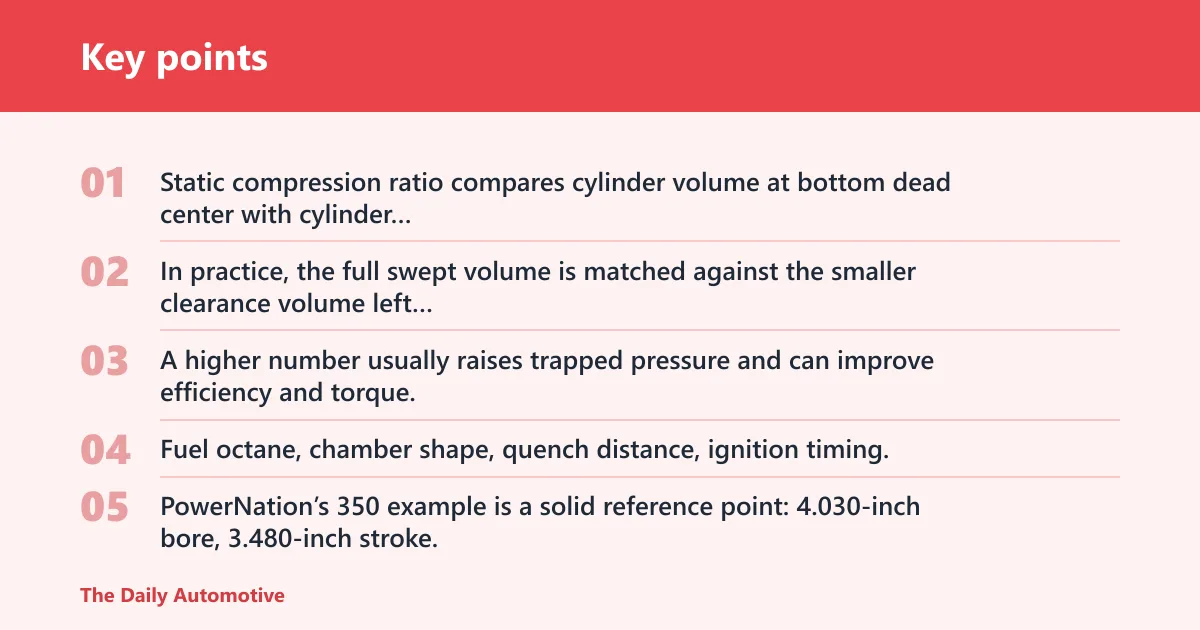


Static compression ratio compares cylinder volume at bottom dead center with cylinder volume at top dead center. In practice, the full swept volume is matched against the smaller clearance volume left when the piston reaches the top of the bore.
Why the ratio matters
A higher number usually raises trapped pressure and can improve efficiency and torque, but it also tightens knock margin. Fuel octane, chamber shape, quench distance, ignition timing, and cam timing all affect how much ratio an engine can tolerate.
PowerNation’s 350 example is a solid reference point: 4.030-inch bore, 3.480-inch stroke, 64cc chambers, and a 4.100-inch gasket bore with .041-inch thickness. That setup calculates to 9.75:1, while a .028-inch gasket raises it to 10.06:1 and 58cc chambers raise it to 10.44:1.
Which inputs the calculator needs?
You need bore and stroke, plus every part of the clearance volume: chamber cc, head gasket volume, deck clearance, and piston crown volume. The calculator can work in inches or millimeters, but every input has to stay in one unit system until the end.
Bore and stroke
Cylinder bore and stroke are the core displacement inputs. Swept volume is the displacement of one cylinder, and it is calculated from bore and stroke using 0.7854 × bore² × stroke.
Chamber, gasket, deck, and piston volume
Clearance volume is the chamber volume at top dead center, and it includes the combustion chamber, gasket, deck, and piston crown volume. Chamber volume is usually listed in cc, and it can also be measured by liquid fill if manufacturer data is missing.
Head gasket volume depends on gasket bore and compressed thickness. Deck clearance is positive if the piston sits below deck and negative if it sits above deck. Piston crown volume needs the right sign: domes are typically entered as negative numbers, while dishes and valve reliefs add volume.
Keep units consistent
This is where many calculator errors start. A bore in millimeters and a chamber in cubic inches will produce nonsense unless you convert everything first. If the calculator asks for cc, enter cc; if it asks for inches, keep every linear dimension in inches until the final calculation.
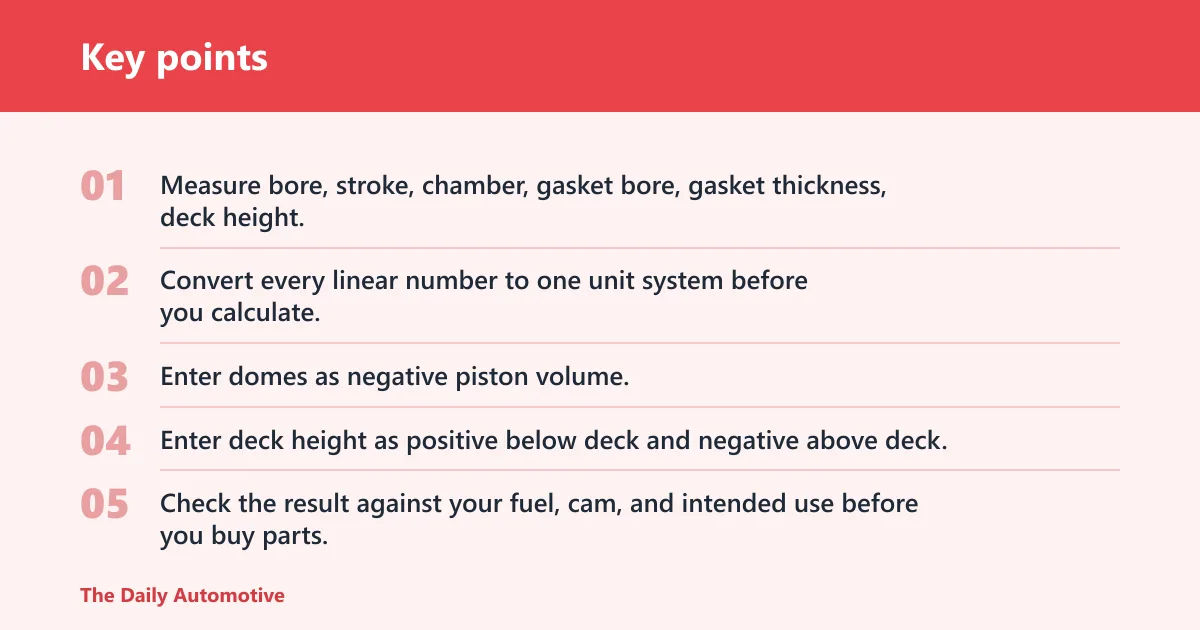
- Measure bore, stroke, chamber, gasket bore, gasket thickness, deck height, and piston crown volume.
- Convert every linear number to one unit system before you calculate.
- Enter domes as negative piston volume.
- Enter deck height as positive below deck and negative above deck.
- Check the result against your fuel, cam, and intended use before you buy parts.
How do you calculate compression ratio?
The standard formula is (swept volume + clearance volume) / clearance volume. Start with one cylinder, calculate the swept volume from bore and stroke, add all clearance items at top dead center, then divide the total volume at bottom dead center by the total at top dead center.
The formula in plain terms
Static compression ratio uses the full stroke and compares volume at bottom dead center with volume at top dead center. That is why it is a geometric number, not a pressure reading.
Worked example for one cylinder
Use the common 350-style example: 4.030-inch bore, 3.480-inch stroke, 64cc chambers, and a 4.100-inch gasket bore with .041-inch thickness. PowerNation’s example calculates to 9.75:1. If you change only the gasket to .028 inch, the ratio rises to 10.06:1.
Suppose you are checking a small-block Chevy for pump-gas street use and the calculator says 10.4:1. That number is not automatically wrong, but it does call for closer attention to chamber shape, quench, cam timing, and ignition timing before you call it safe.
How do you enter gasket, deck, and piston volume?
Enter gasket thickness and gasket bore as the calculator expects, then add deck clearance and piston crown volume with the correct signs. Head gasket thickness is not a minor detail; a few thousandths can move the ratio enough to matter.
Head gasket thickness and gasket bore
Gasket volume changes with both compressed thickness and bore. A larger gasket bore or a thinner gasket changes clearance volume, which changes the final ratio. On the PowerNation example, moving from a .041-inch gasket to a .028-inch gasket raises the ratio from 9.75:1 to 10.06:1.
Positive and negative deck clearance
Deck clearance is positive when the piston sits below deck. If the piston is above deck, enter that as a negative number. That sign convention matters because it changes clearance volume directly.
Domes, dishes, and valve reliefs
Domed pistons reduce clearance volume, so enter dome volume as a negative number. Dished pistons and valve reliefs increase clearance volume, so enter them as positive volume. Do not flip those signs; one mistake can swing the result by nearly a full ratio point on a street build.
Static vs dynamic compression
Static compression uses the full stroke. Dynamic compression depends on intake valve closing, so it is lower than static compression once the cam keeps the intake valve open after bottom dead center.
Why intake valve closing changes the effective ratio
When the intake valve closes later after bottom dead center, part of the upward piston travel happens while the intake is still open. That bleeds off some of the effective trapped charge, so the engine acts like it has less compression than the static number suggests.
Cam duration and ABDC context
Intake valve closing is measured after bottom dead center, or ABDC, and it is required for dynamic compression calculations. Longer cam duration usually pushes intake closing later, which lowers dynamic compression and can make a high-static-compression engine behave more politely on a given fuel.
A common first-timer mistake is judging a cammed engine by static compression alone. A 10.5:1 engine with a later-closing cam may tolerate the same fuel that could detonate in a milder cammed engine at the same static number, because the trapped compression is lower.
What the calculator can and cannot tell you
A calculator can give you static compression from the hard parts and dynamic compression from intake closing timing. It cannot tell you whether your chamber shape, quench distance, spark curve, or coolant temperature will keep the engine happy under load.
Compression ratio sensitivity table
This sample uses the 350-style example with 4.030-inch bore, 3.480-inch stroke, 64cc chambers, and a 4.100-inch gasket bore. The base result is 9.75:1. Change one variable at a time and the ratio moves more than many builders expect, especially when the change affects clearance volume.
| Change from base | New input | Approx. ratio | What changed |
|---|---|---|---|
| Base build | .041-inch gasket, 64cc chamber, zero deck, zero piston volume | 9.75:1 | Reference point |
| Thinner gasket | .028-inch gasket | 10.06:1 | Less clearance volume |
| Smaller chamber | 58cc chamber | 10.44:1 | Less clearance volume |
| Valve-relief piston | +6cc piston crown volume | 9.16:1 | More clearance volume |
| Dome piston | -6cc piston crown volume | 10.44:1 | Less clearance volume |
| More deck clearance | .010 inch below deck | About 9.54:1 | More clearance volume |
What moves the number most
Chamber cc and piston crown volume usually move the ratio more than small gasket changes. Gasket thickness still matters, but the table shows how fast the number shifts when you cut chamber volume or change the piston from a dish to a dome.
Compression ratio calculator checklist
| Check | Correct entry | Common mistake |
|---|---|---|
| Dome piston | Negative volume | Entered as positive |
| Dish or valve relief | Positive volume | Entered as negative |
| Piston below deck | Positive deck clearance | Entered as negative |
| Piston above deck | Negative deck clearance | Entered as positive |
| Chamber volume | cc | Mixed with cubic inches |
| Gasket thickness | Compressed thickness | Nominal thickness only |
What compression ratio can you run?
There is no single safe number for every pump-gas build. Fuel, chamber shape, quench, ignition timing, load, and cam timing all matter, and dynamic compression is the number that often explains why one engine pings while another does not.
Pump gas, strip use, and diesel context
PowerNation lists a Chevrolet Performance LS3 at 10.7:1 on 92 octane premium, while the 350/290 HP crate engine is 8:1 and uses 87 octane regular. Those examples show the range, not a universal limit. A later-closing cam can make a higher-static-compression engine workable on the same fuel, while a mild cam can make the same static number less forgiving.
When to revisit quench and ignition timing
If the engine pings under load, starts hard, or feels lazy despite a normal static number, revisit the whole package. Check quench distance, chamber volume, gasket thickness, deck height, and spark timing before assuming the calculator is wrong.
Picture a street small-block with 10.2:1 static compression, a tight quench, and a cam that closes the intake later than stock. The static number looks aggressive, yet the dynamic number may be reasonable for premium fuel if the tune is controlled and the chamber is not detonation-prone.
Can you use this on LS, small-block Chevy, and other builds?
Yes. The calculator works for LS engines, small-block Chevy combinations, motorcycle engines, single-cylinder builds, and diesels as long as you enter the right bore, stroke, chamber, gasket, deck, and piston data. The math does not change just because the engine family does.
Family-specific caution points
LS heads often use modern chamber shapes and tight quench targets, so chamber and gasket inputs deserve careful measurement. Small-block Chevy combinations often rely on a mix of aftermarket pistons, decks, and gasket choices, so valve-relief volume and deck height can move the result quickly. On motorcycle and single-cylinder engines, small volume changes can swing the ratio sharply because the clearance volume is small.
What is the difference between a compression test and compression ratio?
A compression test measures cranking pressure in psi. Compression ratio is a geometric comparison of cylinder volume at BDC and TDC. They are related, but they are not the same number, and a healthy compression test does not prove that the static ratio is low or high.
Why the numbers do not match
Cranking pressure depends on cam timing, engine speed, ring seal, throttle opening, starter speed, altitude, and temperature. A cylinder can show a normal compression test and still have a static ratio that is too high for the fuel, or a low test result because the cam bleeds pressure early.
Frequently asked questions
How do I account for head gasket thickness in a compression ratio calculator?
Enter the compressed thickness and the gasket bore, not just the nominal gasket number on the box. Thinner gaskets reduce clearance volume and raise compression; on the 350-style example, going from .041 inch to .028 inch raises the ratio from 9.75:1 to 10.06:1.
Do domed pistons raise or lower compression ratio?
Domes raise compression ratio because they reduce clearance volume. Enter dome volume as a negative number. Dishes and valve reliefs do the opposite, because they add clearance volume and lower the ratio.
What is the difference between static and dynamic compression?
Static compression uses the full stroke and compares BDC volume with TDC volume. Dynamic compression depends on intake valve closing after bottom dead center, so it is lower than static compression when the cam keeps the intake open later.
What compression ratio can run on pump gas?
There is no single answer. Fuel octane, chamber shape, quench, cam timing, ignition timing, and load all matter. PowerNation’s examples show 8:1 on 87 octane regular and 10.7:1 on 92 octane premium, but those are package-specific examples, not a universal rule.
Can I use a compression ratio calculator for an LS or small-block Chevy?
Yes. The same formula works for LS, small-block Chevy, motorcycle, single-cylinder, and diesel builds. The key is correct input data: bore, stroke, chamber cc, gasket bore and thickness, deck height, and piston crown volume with the right sign.
Products related to this article
Sponsored / affiliate links. As an Amazon Associate I earn from qualifying purchases. I may earn additional commission from eligible campaigns.