Dallas Cowboys Seat Covers for Cars: Licensed vs. Unlicensed
Buy officially licensed Dallas Cowboys seat covers if you want verified team approval, lower counterfeit risk, and a cleaner path to returns or support; choose Unlicensed only if lower price matters more than authenticity. Buy the wrong set and you can end up with poor fit, faded graphics, or no recourse when the seller disappears. This guide compares licensing, seller risk, materials, fit, and long-term value so you can pick the better buy for your car or truck.
| Factor | Licensed | Unlicensed | Winner |
|---|---|---|---|
| Authenticity and trademark use | Shows explicit NFL or team authorization language, plus cleaner trademark use on the listing and packaging. | May use Cowboys colors or logo-like art without clear proof that the team approved the product. | Licensed |
| Seller risk | Lower risk when the seller clearly names the license and supports returns and warranty terms. | Higher risk if the listing is vague, the storefront changes often, or support looks thin. | Licensed |
| Fit confidence | More likely to come from a detailed vehicle selector with year, make, and model matching. | Fit claims can be broad, with less detail about front seats, rear bench, or split-seat support. | Licensed |
| Long-term buying value | Better odds of support, clearer returns, and lower regret if you keep the vehicle for years. | Lower upfront price, but more uncertainty if the finish, fit, or seller support misses the mark. | Licensed |
Licensed vs. unlicensed: the real trade-off
Licensed covers win when you care about proof, support, and lower seller risk. Unlicensed covers can look similar at a glance, but the trade-off is plain: you give up confidence in authorization and often give up a cleaner support trail too. That matters more than logo size.
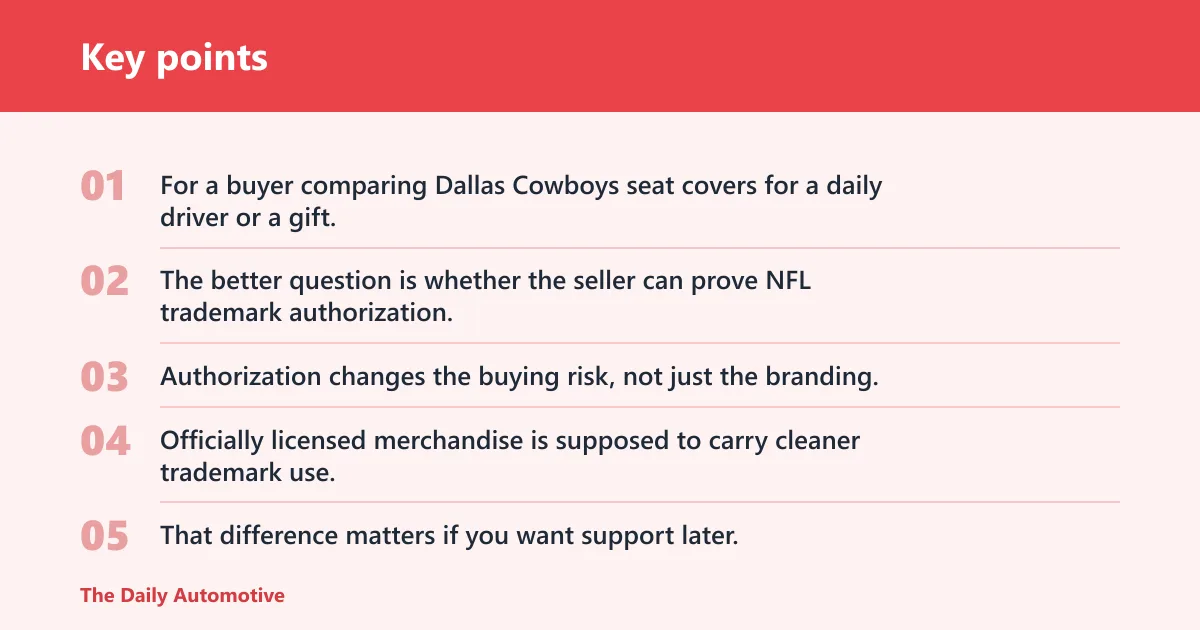
For a buyer comparing Dallas Cowboys seat covers for a daily driver or a gift, the logo is only the starting point. The better question is whether the seller can prove NFL trademark authorization, whether the fit is tied to your vehicle, and whether returns are straightforward if the set arrives wrong.
What changes when the team mark is authorized
Authorization changes the buying risk, not just the branding. Officially licensed merchandise is supposed to carry cleaner trademark use, more direct team approval, and less guesswork about whether the seller is moving gray-market stock or a copied design.
That difference matters if you want support later. A licensed listing usually gives you a more reliable paper trail for returns, warranty claims, and product questions than an unlicensed listing that leans on generic branding.
Why seller proof matters more than logo size
A large logo does not prove anything. A small logo with clear licensing language is better than a flashy product page with no authorization details, no vehicle selector, and no meaningful support terms.
Say the truck has a rear bench that folds down in sections. A licensed listing that asks for year, make, and model is far more useful than an unlicensed listing that only says “universal fit” and leaves you guessing about coverage.
How this comparison affects value over time
The cheapest set is not always the better buy after shipping, fit issues, and replacement hassles. Licensed seat covers usually carry higher confidence up front, and that can cut the odds of paying twice.
If you plan to keep the vehicle for years, value depends on the whole purchase: fit, support, and whether the seller still exists when you need a return. That is where licensed usually pulls ahead.
Look for direct authorization language before you look at the graphic. The listing should clearly say officially licensed NFL or officially licensed team merchandise, not just “Cowboys-inspired” or “team design.” If the seller cannot state that plainly, treat the claim as incomplete.
Then check the product photos and description for trademark use that matches the brand claim. The safest listings pair the license statement with a vehicle-specific selector, clear coverage details, and support terms that do not hide behind vague wording.
Buyer checklist for Dallas Cowboys seat covers
| Licensing proof | Seller signals | Material / fit clues | Return-policy red flags | Read |
|---|---|---|---|---|
| States officially licensed NFL or team authorization in the listing | Named seller, clear contact path, consistent branding | Year, make, and model selector; front and rear coverage; full surround fit | Vague return window, no warranty, no support details | Licensed |
| No clear authorization language, or only generic “team style” wording | Storefront looks temporary, copy is thin, or branding shifts across photos | Universal-fit language only; little detail about split seats or cupholders | Hard-to-find returns, restocking uncertainty, or no purchase protection | Unlicensed |
- Read the licensing line first. If it is missing, pause.
- Match the seat cover to your exact year, make, and model.
- Check for front seat and rear bench coverage, not only the front row.
- Look for side-airbag safe language and visible safety labeling.
- Confirm return terms and warranty length before checkout.
Will they fit your vehicle?
Fit depends more on vehicle-specific selection than on team branding. The better listings ask for year, make, and model, which is the clearest sign that the covers are intended for a defined cabin layout rather than a one-size-fits-most guess.
Front seat and rear bench coverage matter because Cowboys fans often want a matched set, not just branded front buckets. A listing that says full surround fit and supports front and rear coverage is a better fit signal than a page built around general style photos.
Front seat and rear bench coverage
Check whether the listing covers both rows or only the fronts. If you want the cabin to look consistent, full coverage matters more than a logo panel on one seat back.
For daily use, that also helps with wear patterns. A front-only set can leave the rear bench looking unfinished, which weakens the long-term value of the buy.
Split rear seats and cupholder access
Split rear seats need explicit compatibility, especially 60/40 layouts. The listing should mention whether the rear bench can fold up and whether cupholder access is supported through straps or a similar design detail.
Without that detail, you may lose fold-down function or end up reworking the cover every time you need the back seat. That is a fit problem, not a logo problem.
A common first-timer mistake is buying a “universal” rear cover for a truck with a 60/40 split bench. The cover may fit the bench surface, then block the fold-up access you use every week.
Airbags, heat, and seat materials
Safety and comfort claims should be visible in the listing, not assumed from the photo. For Dallas Cowboys seat covers, the strongest signals are side-airbag safe design, clear safety labeling, and material details that match heated or ventilated seat use.
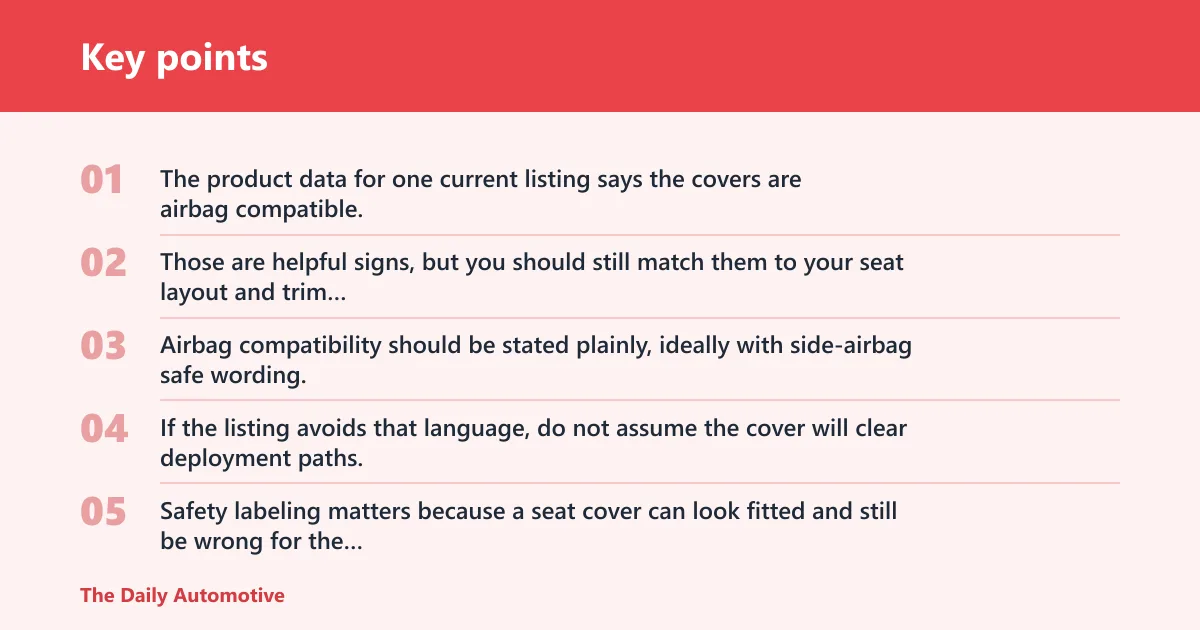
The product data for one current listing says the covers are airbag compatible, work with heated and ventilated seats, use perforated material, and have a full surround fit. Those are helpful signs, but you should still match them to your seat layout and trim package.
Side-airbag safe design and safety labels
Airbag compatibility should be stated plainly, ideally with side-airbag safe wording. If the listing avoids that language, do not assume the cover will clear deployment paths.
Safety labeling matters because a seat cover can look fitted and still be wrong for the seat. If the seller does not explain how the design preserves airbag clearance, move on.
Heated and ventilated seat compatibility
Heated and ventilated seats need material that does not choke airflow or trap heat. The listing should say it works with those seat functions, and perforated material is a better clue than a solid vinyl surface.
That does not mean every perforated cover will feel the same in every climate. It does mean the material choice is more compatible with seat airflow than a dense, sealed cover would be.
Perforated materials, breathability, and cleaning
Perforated construction helps with breathability and seasonal comfort. It also lines up better with a cover that is easier to clean, since many brands market smoother surfaces that wipe down without much fuss.
The listing data here also says the covers are easy to clean and designed in Minnesota, USA. Design location is not a fit guarantee, but material and cleaning claims can help you judge whether the cover matches your day-to-day use.
Are Dallas Cowboys seat covers licensed or unlicensed better?
Licensed is the better pick for most buyers because it lowers authenticity risk and gives you a cleaner path to support if something goes wrong. Unlicensed can make sense when price matters more than the paper trail, but you give up confidence on authorization, seller stability, and resale appeal.
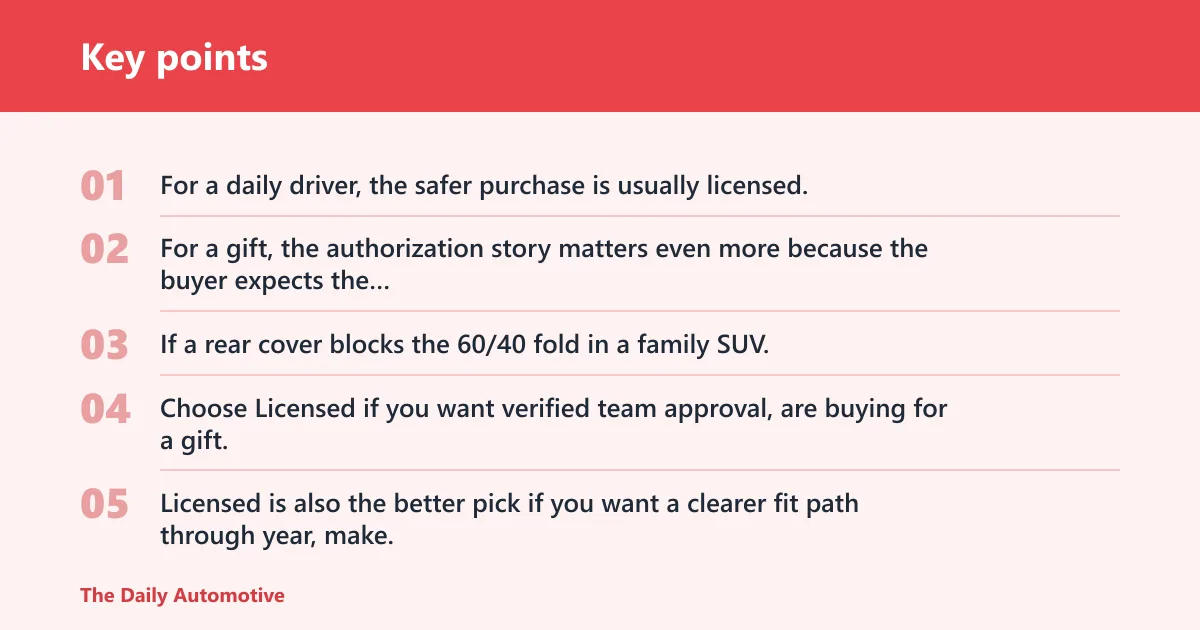
For a daily driver, the safer purchase is usually licensed. For a gift, the authorization story matters even more because the buyer expects the Cowboys branding to be legitimate, not merely team-colored.
If a rear cover blocks the 60/40 fold in a family SUV, a licensed seller with a stated return policy and warranty is generally easier to work with than an unlicensed storefront that did not spell out those terms up front.
Choose Licensed if…
Choose Licensed if you want verified team approval, are buying for a gift, or expect to keep the vehicle long enough that support matters. Licensed is also the better pick if you want a clearer fit path through year, make, and model selection.
Choose Licensed if you care about return protection, warranty support, and lower counterfeit risk more than the lowest sticker price.
Choose Unlicensed if…
Choose Unlicensed only if the lower upfront price is the main goal and you are willing to accept more risk on authorization, support, and fit confidence. It can also suit a short-term use case where you are less concerned about long-term value.
Choose Unlicensed if you can verify the seller separately, accept thinner recourse, and are comfortable treating the purchase as a budget buy rather than a brand-authentic one.

Frequently asked questions
How do I tell if Cowboys seat covers are officially licensed?
Look for explicit NFL or team authorization language in the listing, not just Dallas Cowboys colors or logo art. A strong listing also shows consistent branding, clear seller identity, and support terms that do not hide behind vague wording or a temporary storefront.
Do licensed Dallas Cowboys seat covers fit my vehicle?
They can, but only if the seller offers vehicle-specific fitment. Check for year, make, and model selection, plus front and rear coverage details. If the listing mentions a full surround fit, that is a stronger sign than a generic universal-fit claim.
Are Dallas Cowboys seat covers airbag compatible?
Some are, and the listing should say so plainly. Look for side-airbag safe design and visible safety labeling. Do not assume compatibility from the photo alone, because fit at the seam and deployment clearance are not the same thing.
What materials are Dallas Cowboys seat covers usually made from?
Listings commonly point to durable, easy-clean surfaces, and the product data here describes perforated material. Perforation helps with breathability and can be a better match for heated or ventilated seats than a solid, sealed surface.
Can seat covers work with heated and ventilated seats?
Yes, if the listing states compatibility and the material supports airflow. Perforated construction is the clearest clue in the supplied product data. If the seller gives no seat-function guidance, treat heated and ventilated compatibility as unconfirmed until you verify your trim.
How long does it take to install custom seat covers?
The listing says installation can be completed in under an hour. That is a seller claim, not a universal guarantee, so clarity matters: good instructions, labeled pieces, and seat-specific fit details are what make a quick DIY install more realistic.
Products related to this article
Sponsored / affiliate links. As an Amazon Associate I earn from qualifying purchases. I may earn additional commission from eligible campaigns.
 Coverado Car Seat Covers, Front Covers for Cars, Car Seat Cover Front Seats, Automotive Seat Cover, Waterproof, Leather Car Seat Cushion, Universal Interior Covers Seat Protectors for Most Cars
 FLORICH Leather Seat Cover, Car Seat Covers Front Set, Waterproof Car Seat Protectors, Front Seat Covers 2 Pack, Breathable Automotive Seat Covers Protector Fit for Most Cars Trucks SUV