How Does Climate Control Work in a Car? Review
Automatic climate control reads cabin temperature, sun load, and evaporator data, then changes blower speed, air mix, recirculation, and compressor duty to hold the set temperature. If it misreads those inputs or a part sticks, you get the wrong temperature, fogged glass, poor comfort, and larger repair bills. This guide explains how the system decides what to do, then ties each decision to the sensors, actuators, and HVAC parts that fail.
What is climate control in a vehicle?


Climate control is the system that keeps the cabin at a chosen temperature without constant driver input. In an automatic system, you set a target and the car handles heat, cooling, airflow, and defogging on its own. Manual A/C still needs more hands-on adjustment because you choose the fan, vent mix, and temperature more directly.
That difference matters when you diagnose a complaint. A bad compressor can cause weak cooling, but a stuck blend door can make the cabin blow hot air even when the refrigerant circuit is fine. The same symptom can come from different subsystems.
How does auto climate control work?
Automatic climate control uses sensors and software to compare the set temperature with cabin conditions, then changes the blower, vents, heater, and compressor until the difference shrinks. It does not simply switch the A/C on and off. It can make small decisions continuously, sometimes many times per minute.
What the system reads
Cabin temperature sensors measure interior air temperature and feed the climate control ECU or microprocessor. Outside temperature input helps the module judge how much heating or cooling is needed. Modern systems often use at least two temperature sensors, and some add humidity sensors, solar sensors, or GPS data to adjust for fogging, direct sun, or route conditions.
How it changes the cabin
The ECU responds by changing fan speed, vent direction, recirculation, heating, and cooling. It may close the fresh-air flap and recirculate cabin air to cool faster. It may open defrost vents and dry the air when fog risk rises. The goal is steady output, not a fixed blower speed or fixed vent position.
Suppose the car is set to about 72 degrees on a cold morning, but the windshield starts to haze after a couple of passengers climb in. The module may raise blower speed, move airflow toward the glass, and run the compressor briefly to dry the air, even though the heat setting has not changed.
Climate control parts that actually do the work
The control module only makes decisions. The parts that fail are usually the sensor, the blower circuit, the air doors, or the refrigerant path. Older vehicles often use cables, while modern ones use wires and electric motors to move the doors and control airflow.
Blower motor and fan control
The blower motor moves air through the HVAC box, and NAPA places it behind the glovebox in many vehicles. If the motor does not run, there is no airflow through the heater core or evaporator. The resistor or fan control module is a common failure point when the fan works on some speeds but not others.
Heater core, compressor, condenser, and evaporator
The heater core is a small radiator in the dash that uses hot engine coolant to warm air passing through it. The air conditioning compressor compresses refrigerant to start the cooling circuit. The condenser, mounted in front of the radiator, sheds heat and turns high-pressure refrigerant gas into liquid. The evaporator inside the HVAC case boils refrigerant and removes heat from the air, creating cold, dry air.
Blend doors, filter, and refrigerant
Blend doors, sometimes called air doors, route air over or around the heater core and evaporator. A failed motor or a broken door can leave you stuck hot or stuck cold. A cabin air filter catches dust, pollen, and debris, but a clogged filter can choke airflow and hurt odor control. Refrigerant systems use R-12, R-134a, or R-1234yf, and the system must stay airtight. Loss usually points to a leak.
What is dual-zone climate control?
Dual-zone climate control lets different parts of the cabin hold different temperature settings, often for the driver and front passenger. Larger vehicles may add rear-seat climate control or a third zone. The system can split temperature targets, but airflow between zones is still limited by the HVAC box, duct layout, and vent placement.
That is why a side-to-side difference can be real even when the setpoints match. If the driver side stays warm while the passenger side cools normally, the fault often sits in a blend door motor, a temperature sensor, or the control head rather than in the refrigerant charge.
Climate control symptom matrix
This matrix pairs a common complaint with the subsystem most likely involved, the first two checks to perform, and the direction the repair usually takes. It is meant to narrow the search, not replace diagnosis. Refrigerant problems are only one branch of the tree.
| Symptom | Most likely subsystem | First two checks | Most likely repair direction |
|---|---|---|---|
| No airflow | Blower motor or blower fuse/control module | Check fan command at the panel; inspect the blower fuse and connector behind the glovebox | Replace failed blower motor, resistor, or control module; repair wiring if power or ground is missing |
| Weak airflow | Cabin air filter or blower motor | Inspect the cabin air filter for blockage; verify blower speed changes at each setting | Replace clogged filter, then test blower output and motor current if flow stays low |
| Air stuck hot | Blend door or heater control side of HVAC box | Change the temperature setting from full cold to full hot; listen for actuator movement in the dash | Replace a failed blend door actuator, repair a broken door, or resolve a control module fault |
| Air stuck cold | Blend door or heater core flow problem | Set full hot and confirm engine reaches normal operating temperature; feel for heater hose temperature difference | Repair blend door control, verify coolant flow, or address a restricted heater core |
| Temperature mismatch side-to-side | Dual-zone blend door or sensor issue | Compare both zone settings; check for actuator noise or calibration faults after battery disconnect | Calibrate or replace the affected actuator, then verify the cabin temperature sensors |
| Windshield fogging | Humidity control, recirculation strategy, or evaporator issue | Check whether recirculation is stuck on; inspect the cabin air filter and defrost mode operation | Repair the mode door, humidity sensor, or evaporator control logic; replace a saturated filter if needed |
| System works only on some fan speeds | Blower resistor or fan control module | Cycle through every speed; inspect the resistor pack or control module connector for heat damage | Replace the resistor or electronic control module and inspect the blower motor for excess draw |
A common first-timer mistake is blaming low refrigerant for every hot-air complaint. If the fan is dead, refrigerant pressure will not restore airflow. If the air changes temperature side to side, the issue is more likely a door or actuator than a leak.
When climate control problems are DIY checks
Some faults are owner-checkable in minutes. A clogged cabin air filter, a blown fuse, a recirculation button that is stuck, or a failed setting after battery work can all mimic a bigger failure. If the complaint changes with fan speed, mode, or temperature setting, start with the HVAC controls and airflow path.
Start with the easy checks
- Check the cabin air filter and replace it if it is packed with dust, leaves, or debris.
- Inspect the climate control fuse and blower fuse, then verify the fan responds to every speed.
- Cycle temperature from full cold to full hot and listen for actuator movement behind the dash.
- Confirm that defrost, floor, and face modes all change vent direction as commanded.
If those checks fail, the likely problem is electrical or mechanical inside the HVAC case, not just a low refrigerant charge. That is when scan-tool diagnosis, actuator calibration, or gauge set work becomes useful.
How often should you service your car’s climate control system?
Climate control benefits from regular inspection, but the most useful routine service is often simpler than people expect. Replace the cabin air filter on the schedule in the owner’s manual, and inspect the system any time airflow drops, odors appear, or the vents stop matching the command. A proper HVAC inspection checks airflow, door movement, sensor readings, and refrigerant condition.
What a proper inspection includes
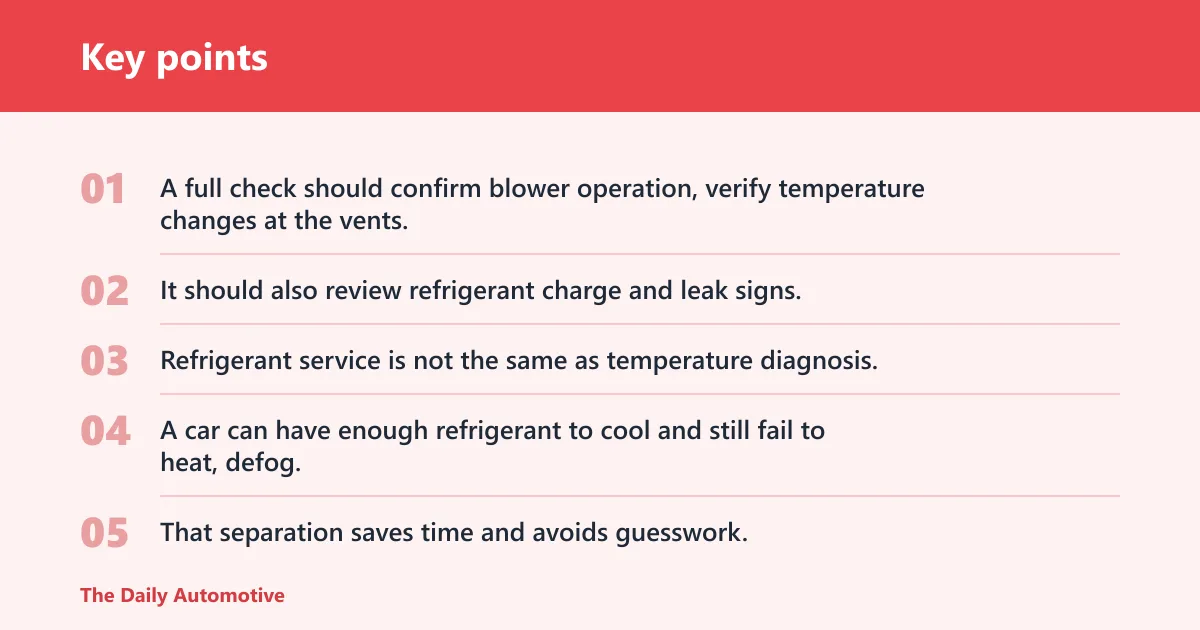
A full check should confirm blower operation, verify temperature changes at the vents, inspect the cabin air filter, and look for fault codes in the HVAC module if the vehicle supports scan-tool access. It should also review refrigerant charge and leak signs, because closed AC systems are hazardous to work on and a low charge usually means there is a leak somewhere in the sealed circuit.
Refrigerant service is not the same as temperature diagnosis. A car can have enough refrigerant to cool and still fail to heat, defog, or switch zones because a door, sensor, or control module is not doing its job. That separation saves time and avoids guesswork.
Can you retrofit climate control into an older car?
It is possible in some cases, but it is a major electrical and HVAC integration job, not a simple parts swap. The car needs sensor inputs, actuator wiring, control logic, and compatible ductwork or air-box hardware. If the donor system used wires and electric motors, the retrofit also needs power, grounds, and calibration support.
On a basic manual system, a retrofit can demand more than the dashboard controls. It may require an HVAC case change, a control module, multiple actuators, and wiring changes for the cabin temperature sensors and blower control. For most owners, that cost and complexity make a repair or original-equipment replacement a better path.
Frequently asked questions
What is auto climate control?
Auto climate control is the automatic version of cabin temperature management. Instead of asking the driver to manage fan speed and vent position, it uses sensors and control logic to decide how much heat or cooling to deliver. It can also react to sun load, humidity, and defrost needs.
How does climate control work in a car?
The control module reads cabin temperature, outside temperature, and other inputs, then compares them with the selected setpoint. It adjusts blower speed, recirculation, heater core flow, blend doors, and compressor operation until the cabin approaches the requested temperature. The process happens continuously, not in a single on-off step.
How is climate control different from air conditioning?
Air conditioning cools air. Climate control manages the whole cabin environment, including heat, cooling, fan speed, air direction, and defogging. Many automatic systems still use the A/C compressor during heating or defrost because dry air helps clear glass and keep comfort steady.
What sensors does automatic climate control use?
Most systems use cabin temperature sensors and outside temperature input. Many modern systems also use humidity sensors to help prevent fogging and solar sensors to account for direct sunlight. Some vehicles add GPS data so the controller can adjust for changing conditions ahead of time.
How often should I service my car’s climate control system?
Replace the cabin air filter on the schedule in the owner’s manual, and inspect the system whenever airflow drops, odors appear, or temperature control becomes uneven. Refrigerant loss should be treated as a leak concern, not a normal maintenance item. A shop inspection should check airflow, actuators, sensors, and refrigerant condition.
Products related to this article
Sponsored / affiliate links. As an Amazon Associate I earn from qualifying purchases. I may earn additional commission from eligible campaigns.