Cruise Control In Manual Car: The Essential Guide
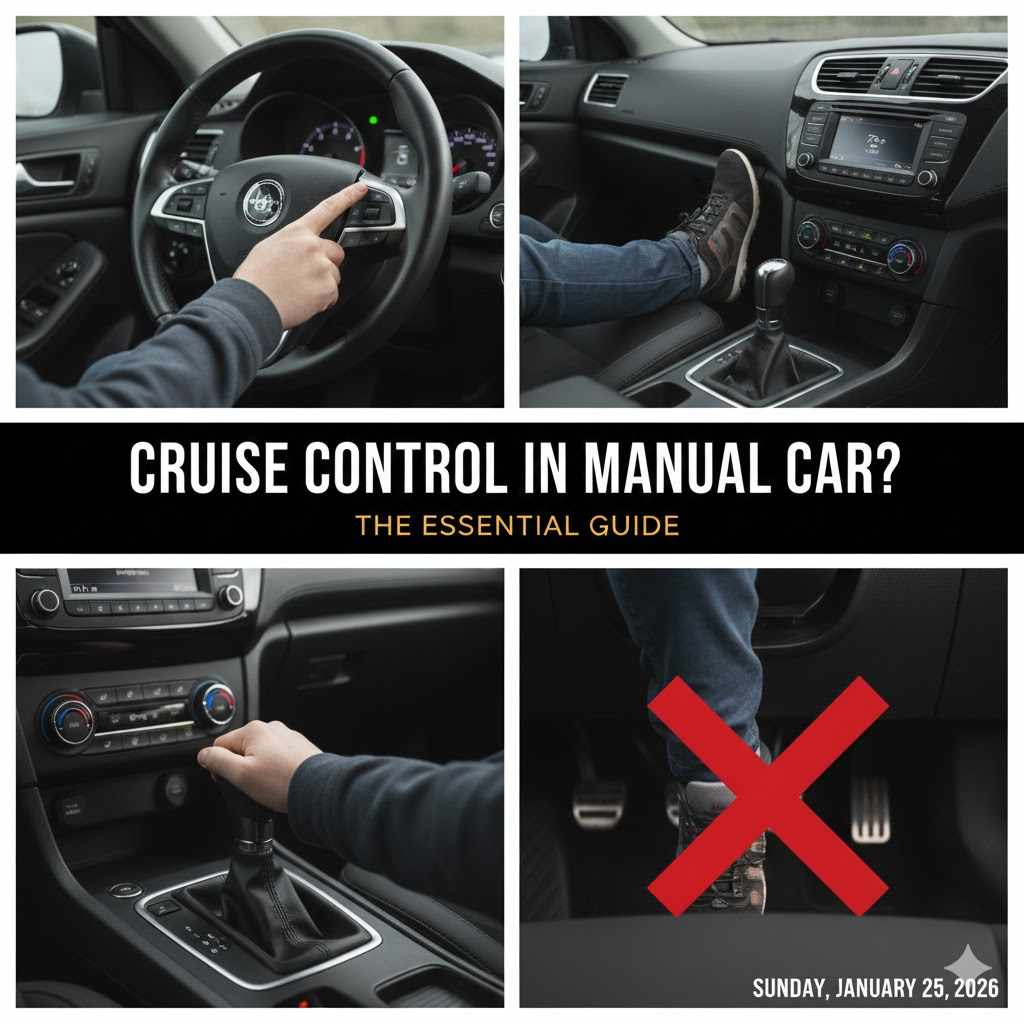
Yes, manual cars can have cruise control. It works just like in an automatic, maintaining your speed on the highway. However, you cannot shift gears while it’s active. Pressing the clutch or brake pedal will safely disengage the system, returning full control to you. It’s a simple, safe feature for long drives.
Have you ever wondered if a manual car can have cruise control? It’s a common question! Many drivers think this handy feature is only for automatics. The idea of the car controlling its speed while you manage the clutch and gears can sound confusing.
But I’m here to tell you it’s not confusing at all. In fact, cruise control in a manual car is simple, safe, and incredibly useful for long trips. You don’t need to be a car expert to master it.
In this guide, I’ll walk you through everything you need to know. We’ll cover how it works, how to use it step-by-step, and when it’s best to let your car take over. Let’s get you driving with more comfort and confidence!
How Does Cruise Control Even Work in a Manual Car?
You might be picturing some complex, magical system, but the truth is much simpler. At its core, cruise control in a manual car works almost identically to the way it does in an automatic. When you set your speed, your car’s main computer, often called the Engine Control Unit (ECU), takes over the throttle (the gas pedal). It makes tiny, constant adjustments to keep your car moving at the exact speed you selected.
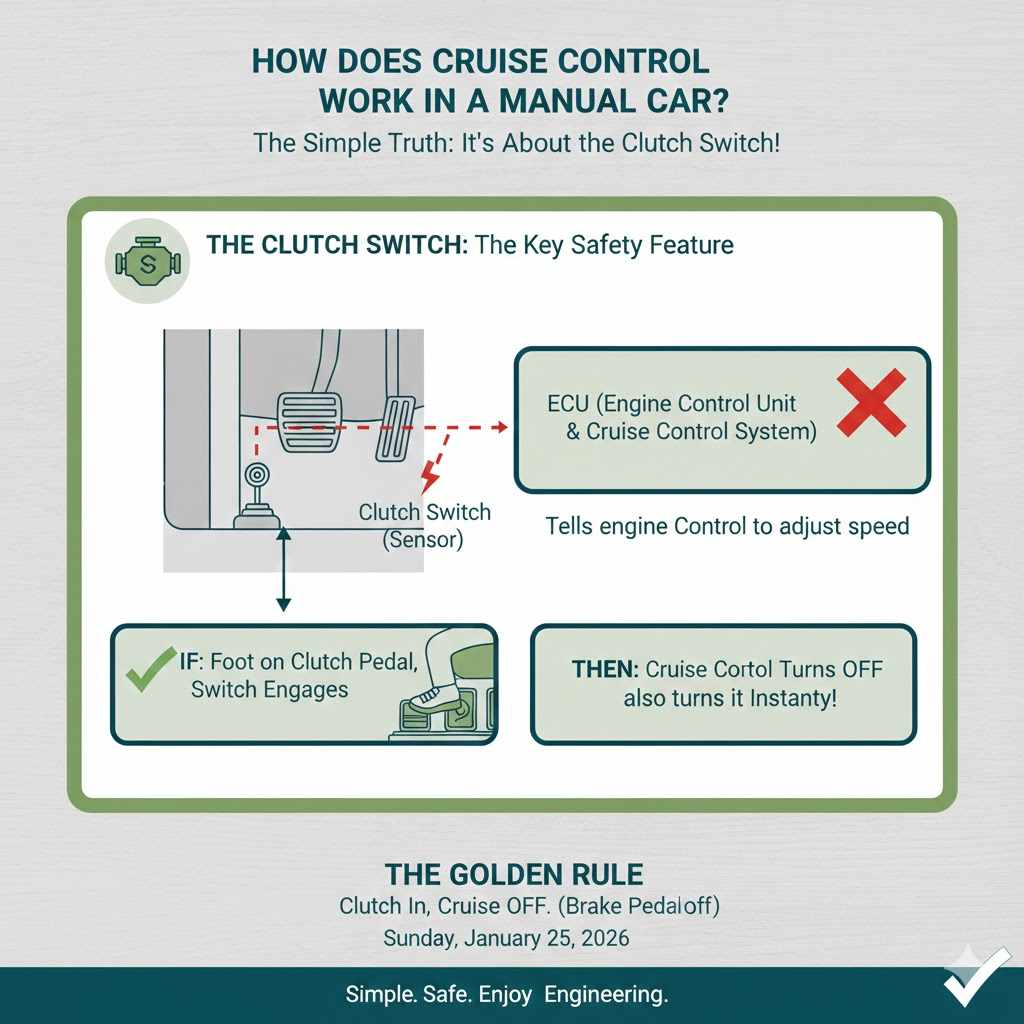
So, what’s the special part for a manual transmission? It all comes down to one tiny, brilliant component: the clutch switch.
This is a small sensor connected to your clutch pedal. Its only job is to tell the ECU when you press the clutch. The moment your foot even begins to push the clutch pedal down, the switch sends an immediate signal to the cruise control system, telling it to turn off instantly. This is the key safety feature that makes it all work seamlessly. It ensures the engine won’t rev wildly when you disconnect it from the wheels to shift gears.
The Golden Rule: Clutch In, Cruise Off
Think of the clutch pedal as a non-negotiable “off” switch for your cruise control, just like the brake pedal. The system is designed to be foolproof. It knows that if you’re pressing the clutch, you’re about to change gears, and it needs to give full control back to you. This simple but effective design is what makes cruise control both possible and perfectly safe in a car with a manual gearbox.
The Big Question: Can You Shift Gears with Cruise Control On?
This is the most frequent question I get, and the answer is a clear and simple: No, you cannot.
Let’s be very clear about this, because it’s the most important thing to understand. The moment you press the clutch pedal to prepare for a gear shift, the cruise control system immediately disengages. It turns off completely.
This isn’t a design flaw or a limitation; it is a critical safety feature. Imagine what would happen if it didn’t. You press the clutch, disconnecting the engine from the transmission. If the cruise control stayed on, it would think the car was slowing down and would command the engine to rev much higher to compensate. This would be jarring, inefficient, and potentially unsafe.
Your car’s engineers designed the system to hand control back to you whenever you interact with the core components of driving a manual: the clutch or the brakes. It ensures you are always the one in charge during a gear change.
A Step-by-Step Guide to Using Cruise Control in Your Manual Car
Ready to give it a try? Using cruise control is easy once you know the steps. The buttons are usually located on the steering wheel or on a stalk behind it.
- Get to Your Cruising Speed: First, drive as you normally would. Accelerate smoothly onto the highway and shift into your top gear (usually 5th or 6th). Settle at a steady, consistent speed you want to maintain, for example, 65 mph. Cruise control works best in the highest gear where the engine is relaxed.
- Turn the System On: Find the main power button for the cruise control. It’s often labeled “ON/OFF” or just has a symbol that looks like a speedometer. Press it to activate the system. A light will usually appear on your dashboard to let you know it’s ready.
- Set Your Speed: Once you’re at your desired speed, press the “SET” button. You will feel the car take over the throttle. You can now take your foot completely off the accelerator pedal. Congratulations, you’re cruising!
-
Adjusting Your Speed: You don’t need to disengage the system to make small speed changes.
- To go slightly faster, tap the “ACCEL” or “RES” (Resume/Accelerate) button. Each tap might increase your speed by 1 mph.
- To go slightly slower, tap the “COAST” or “SET” button. Each tap will decrease your speed by about 1 mph.
- Disengaging Cruise Control: You have three simple ways to turn it off and take back full control instantly.
- Tap the brake pedal: The most common way.
- Press the clutch pedal: As we discussed, this immediately cancels it.
- Press the “CANCEL” button: This also deactivates it without you needing to use the pedals.
- Resuming Your Set Speed: Let’s say you disengaged cruise control to slow down for another car. Once the way is clear, you don’t have to get back up to speed manually. Simply press the “RESUME” or “RES” button. The car will automatically accelerate back to your last set speed. This only works if you haven’t turned the main system off.
When to Use (and When NOT to Use) Cruise Control
Cruise control is a fantastic tool, but it’s not meant for every situation. Knowing when to use it is key to driving safely and efficiently.
The Best Times to Use Cruise Control
- Long, Straight Highways: This is the perfect environment. It allows you to relax and maintain a consistent speed over many miles.
- Flat or Gently Rolling Terrain: On roads without steep hills, cruise control can help you achieve better fuel mileage by keeping the throttle steady.
- Light, Predictable Traffic: When there are few cars around and traffic is flowing smoothly, cruise control reduces the need for constant speed adjustments.
- Clear, Dry Weather: Ideal conditions mean you have the best possible traction and visibility.
When You Should AVOID Using Cruise Control
- In Heavy or Stop-and-Go Traffic: You need to be in constant control of your speed and braking in dense traffic.
- On Steep Hills (Uphill or Downhill): While going uphill, the system might struggle to maintain speed, causing abrupt acceleration. Going downhill, it won’t apply the brakes, and you can easily gain unwanted speed. It’s better to control your speed yourself using the appropriate gear.
- On Winding or Curvy Roads: You need to adjust your speed for curves and turns. Relying on cruise control here is unsafe.
- In Bad Weather: This is extremely important. In rain, snow, or icy conditions, you need maximum control over your vehicle. A locked speed can increase the risk of hydroplaning or skidding. According to the National Highway Traffic Safety Administration (NHTSA), maintaining full control of your acceleration and deceleration is crucial in slippery conditions.
Pros and Cons of Cruise Control in a Manual Car
Like any feature, cruise control has its benefits and drawbacks. Here’s a quick breakdown to help you decide when it’s right for you.
| Feature | The Pro (The Good Part) | The Con (The Downside) |
|---|---|---|
| Fuel Economy | Maintains a steady speed, which prevents the inefficient gas-guzzling that comes from constant acceleration and braking. | On hilly roads, a skilled driver can often be more fuel-efficient by anticipating the terrain and using momentum. |
| Driver Comfort | Significantly reduces foot and leg fatigue on long road trips. You can rest your right foot instead of holding it on the pedal for hours. | It can lead to a feeling of complacency or reduced attention. You must always stay alert and ready to take control. |
| Speed Management | Helps you maintain a legal speed and avoid accidentally creeping over the speed limit, which can save you from costly tickets. | You must disengage it to shift gears or navigate changing traffic, making it less useful in conditions that aren’t perfectly stable. |
Common Myths Debunked
There are a few myths floating around about cruise control in manual cars. Let’s clear them up so you can drive with confidence.
Myth #1: “Using cruise control will stall my manual car.”
Fact: This is highly unlikely. Cruise control is typically used at highway speeds in top gear. If your speed were to drop so low that a stall was possible, you would instinctively press the clutch to downshift. The moment you touch the clutch, the cruise control turns off. The system itself won’t cause a stall; your driving actions (or lack thereof) would.
Myth #2: “It’s complicated and dangerous.”
Fact: It’s designed with safety as the number one priority. The multiple, intuitive ways to disengage it (clutch, brake, cancel button) make it very safe. Once you understand the “clutch off” rule, it’s no more complicated to use than in an automatic car. It’s all about using it in the right conditions.
Myth #3: “You can shift gears while it’s on.”
Fact: As we’ve covered thoroughly, this is the biggest and most important myth to bust. To repeat: pressing the clutch is an instant “off switch” for the cruise control. The system will never be active while you are performing a gear change.
What If My Manual Car Doesn’t Have Cruise Control?
Don’t worry if your car didn’t come with cruise control from the factory. Many older or more basic models don’t have it. If you do a lot of highway driving, you might want to consider adding it.
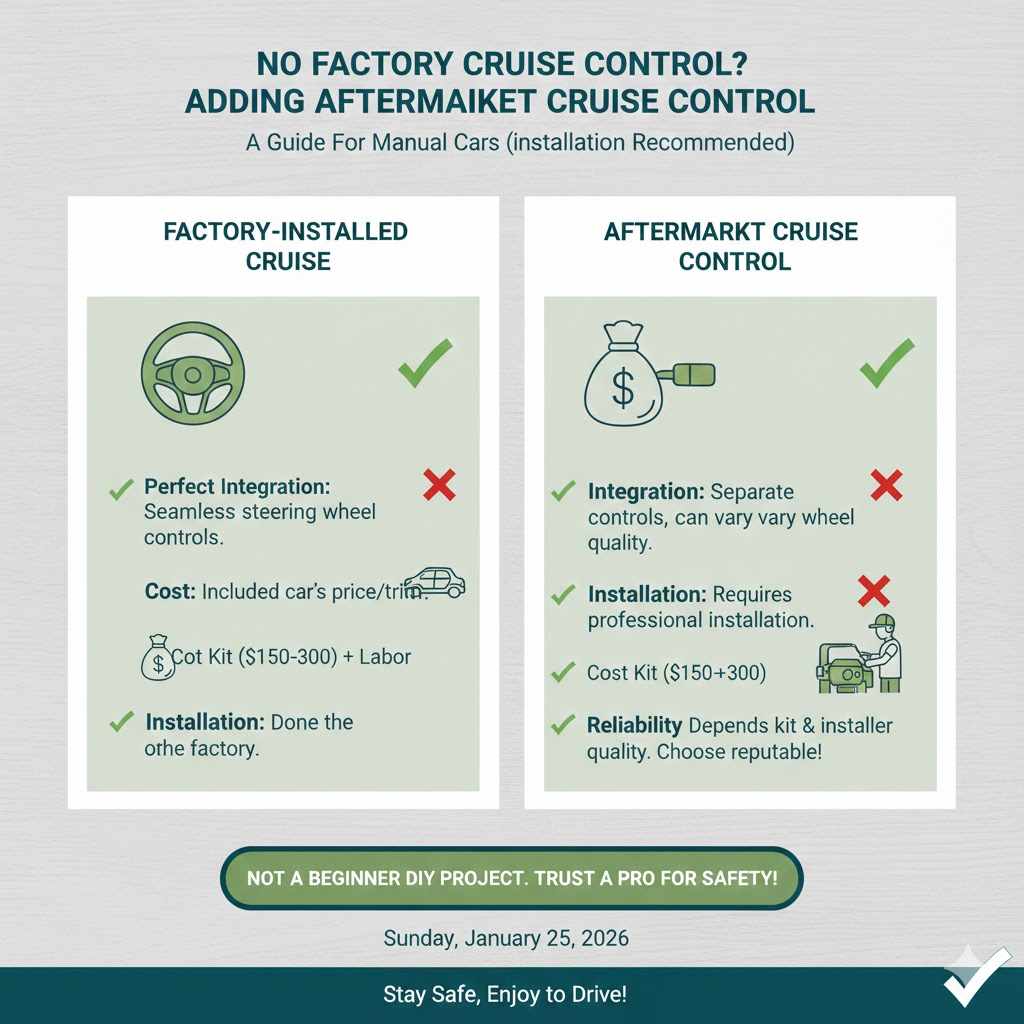
You can purchase aftermarket cruise control kits. These kits come with all the necessary components, including the control unit, wiring, and the buttons or stalk for your steering column. However, this is not a simple DIY project for a beginner.
I strongly recommend professional installation. This job involves working with your car’s critical electronic and throttle systems. A mistake could be costly or even dangerous. A professional mechanic will ensure it’s installed correctly and safely.
Factory vs. Aftermarket Cruise Control
| Feature | Factory-Installed Cruise Control | Aftermarket Cruise Control |
|---|---|---|
| Integration | Perfectly integrated into the car’s steering wheel and dashboard. Looks and feels seamless. | Controls might look slightly different or be placed in a less integrated spot. Quality can vary. |
| Cost | Included in the price of the car or as part of a trim package. No extra cost after purchase. | You’ll have to pay for the kit (usually $150-$300) plus several hours of labor for professional installation. |
| Installation | Done at the factory. No work needed on your part. | Requires professional installation for safety and proper function. Not a beginner DIY job. |
| Reliability | Generally very reliable and covered under the car’s warranty when new. | Reliability depends on the quality of the kit and the skill of the installer. Be sure to use a reputable brand and shop. |
Frequently Asked Questions (FAQ)
Can all manual cars have cruise control?
Theoretically, yes. Most modern manual cars have the electronic systems needed to support it. Whether a manufacturer offers it as a standard or optional feature depends on the model and trim level. If your car doesn’t have it, an aftermarket kit can often be installed.
What happens if I accidentally press the clutch?
Nothing bad happens! The cruise control will simply and safely disengage, just as if you had tapped the brake. You will have to manually control your speed until you decide to set or resume the cruise control again.
Does using cruise control save gas in a manual car?
Yes, in the right conditions. On flat, open highways, it can improve your fuel economy by maintaining a perfectly steady speed, which is more efficient than the small, frequent speed adjustments a human driver makes.
Is it hard to learn to use cruise control in a manual?
Not at all! Once you drive with it a few times, it will feel completely natural. The only new habit to learn is that you can’t shift gears with it active. Everything else is the same as in an automatic.
Why can’t I use cruise control on steep hills?
Going up a steep hill, the system may cause the engine to work too hard or “hunt” for the right amount of power. Going down a steep hill, cruise control doesn’t use the brakes, so your car will pick up speed from gravity, potentially going much faster than you set it.
Will cruise control keep my car from stalling?
No, the system is not designed to prevent a stall. Its job is only to manage the throttle. It’s still the driver’s responsibility to ensure the car is in the correct gear for the speed it is traveling.
Can I install an aftermarket cruise control kit myself?
While it is physically possible for someone with advanced mechanical and electrical skills, I strongly advise against it for beginners. The installation involves wiring into your car’s throttle and brake systems, and any mistake could compromise your safety.
Your Guide to a More Comfortable Drive
And there you have it! Cruise control in a manual car isn’t a mystery—it’s a smart, safe feature designed to make your long journeys more comfortable and efficient. By understanding the simple rule—that pressing the clutch or brake turns it off—you can use it with complete confidence.
Remember to use it only in the right conditions: on open highways with light traffic and clear weather. When used correctly, it reduces fatigue, helps you maintain a safe and legal speed, and can even save you a bit of money on gas.
So next time you head out on a long trip, don’t hesitate to turn it on. Enjoy the smooth ride, give your foot a rest, and drive on with the confidence of a pro. Happy cruising!