Do You Need A Moving Permit For AAA Towing
Usually no: AAA towing does not require a special moving permit, but your city or property owner may require parking approval where the tow truck stops, loads, or stages the vehicle. Skipping that step can lead to tickets, delays, or a second fee. This guide explains when permits matter and how to confirm the rules with AAA and local authorities.
What a moving permit covers
A moving permit is official parking authorization for commercial vehicles like moving trucks and vans. Cities may call it a street occupancy, right of way, or RoW permit. The permit usually controls curb space, not the tow itself.
In most cases, the permit reserves two adjacent on-street parking spaces. Many cities use daytime windows between 8:00 a.m. and 5:00 p.m., and some require temporary no-parking signs before the truck arrives. Costs can range from $10 to $80, depending on the city.
That matters because curb access is a parking rule issue, while AAA towing is a roadside assistance service. If the truck can reach the vehicle without blocking a restricted curb lane, a moving permit may be unnecessary. If the truck needs to stage in a tight street space, permit rules may apply.
Suppose a sedan needs to be moved from a narrow downtown block to a repair shop. AAA may be able to tow it, but the driver still cannot ignore a red curb, a loading restriction, or a posted permit zone.
Why curb space matters for towing
A tow truck needs room to stop, hook up, or load. On a quiet street that may be simple. On a crowded block, that stop can trigger parking enforcement if the vehicle or truck blocks traffic, a fire lane, or a signed no-parking area.
Moving permits help reserve space ahead of time so the tow or move can happen without a ticket or delay. They are most useful where parking is scarce, curb space is shared, or building rules are strict.
Does AAA towing need a permit?
Usually no special moving permit is needed for AAA towing. AAA towing itself does not need a special moving permit, because the permit is tied to curb access and parking control, not to AAA’s roadside assistance benefit. The real question is whether the pickup or drop-off location requires parking permission for the tow truck.
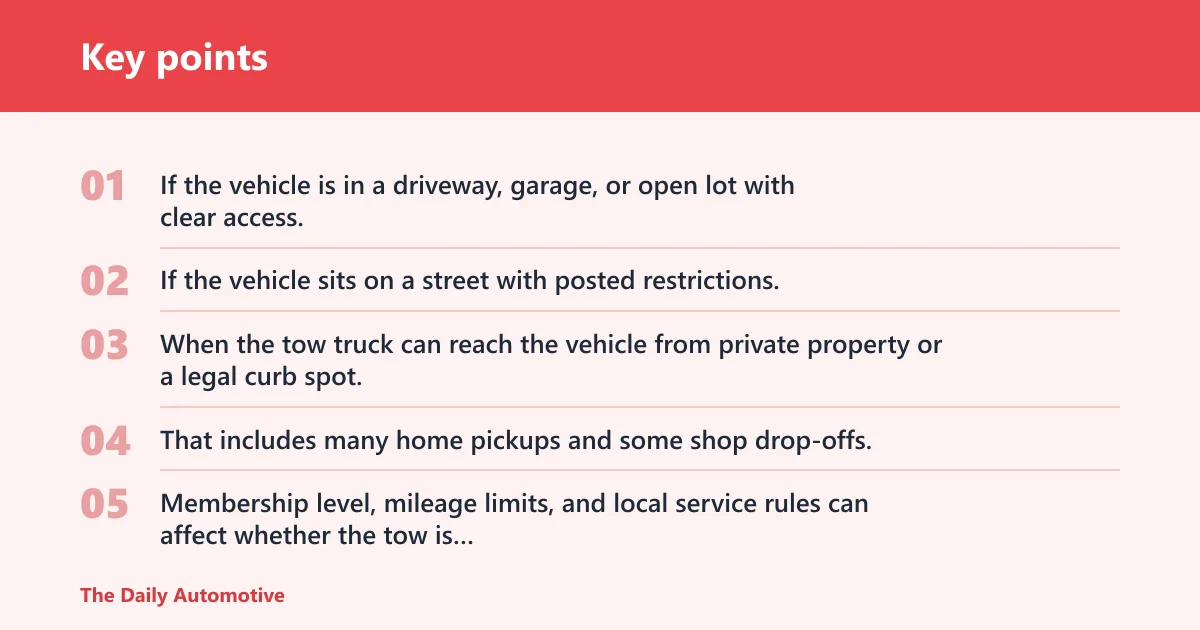
If the vehicle is in a driveway, garage, or open lot with clear access, a city permit is less likely to matter. If the vehicle sits on a street with posted restrictions, the answer may change based on local parking rules and property rules.
When the answer is usually no
When the tow truck can reach the vehicle from private property or a legal curb spot, the towing request often does not require a moving permit. That includes many home pickups and some shop drop-offs, as long as the location allows the truck to stop legally.
AAA coverage still has to fit the request. Membership level, mileage limits, and local service rules can affect whether the tow is approved and where it can go. Confirm those details before dispatch.
When curb access can trigger a permit need
If AAA has to load from a street where parking is controlled, the city or property manager may require a curb reservation, temporary no-parking signs, or another parking approval. That is common where the truck must occupy part of the lane or hold space for several minutes.
A common first-timer mistake is assuming the towing benefit covers the curb itself. It does not. The benefit may cover the tow; the city may still ticket the truck if the stop violates parking rules.
How local parking rules change the answer
Local enforcement can issue tickets for unpermitted parking and may threaten towing for blocking traffic. Fire lanes and bus zones are especially risky. Rules vary by city, so the same AAA tow can be simple in one neighborhood and restricted in another.
Apartment managers, downtown curb rules, and city permit systems can all change the answer. Check local rules before the tow is scheduled, not after the driver arrives.
AAA tow permit checklist
Use this checklist to separate the towing benefit from the curb-space rule. The table shows when a permit is likely, who usually issues it, and what to verify with AAA before dispatch.
| Scenario | Likely permit needed | Who issues it | What to confirm with AAA |
|---|---|---|---|
| Apartment curb pickup | Often yes if the truck must reserve curb space or use a signed loading area | City parking office or property management | Ask whether the tow truck can stage legally and whether curb access needs advance approval |
| Home driveway pickup | Usually no | Usually none; check HOA or city rules if the street is restricted | Confirm the driveway is accessible and whether the truck must stop on a public street |
| Street-side pickup | Possibly yes | City parking or transportation office | Confirm the exact curb location, stop time, and whether temporary signs are required |
| Gated community | Usually no city permit, but gate or access approval may be needed | HOA, security, or property manager | Ask whether the tow truck can enter, where it should meet the vehicle, and whether gate codes are allowed |
| Downtown loading zone | Often yes | City parking enforcement or permit office | Verify whether the zone is time-limited, whether the tow can use it, and whether any reservation is needed |
What AAA towing usually covers
AAA towing is a roadside assistance benefit, and the exact coverage depends on membership level and location. AAA may tow a vehicle to a home, shop, or other destination if the local rules and membership terms allow it. The mileage limit is not the same everywhere.
That is why the first step is not “Do I need a permit?” It is “What does my AAA plan allow, and where can the tow legally happen?” Those are separate questions.
Membership level and mileage limits
AAA towing mileage caps can vary by membership level and by local club rules. Some plans cover only short tows, while others cover longer distances. Do not assume the plan is unlimited unless AAA confirms it for the specific membership on the account.
Ask dispatch for the destination limit before the truck is sent. If the vehicle is headed to a distant repair shop, the mileage cap may affect the route, the price, or whether the tow is approved at all.
Where AAA may tow the vehicle
AAA may tow to a home, a repair shop, or another approved destination, but the destination has to fit the membership rules. A tow to a driveway is different from a tow to a curb. The truck still needs lawful access at both ends.
Say your non-running car is in a townhouse driveway and the destination is a nearby mechanic. That is a straightforward AAA tow in many areas, because the truck can load from private property and drop at a service bay without needing a curb reservation.
How to confirm service before you request it
Before you request the tow, confirm the vehicle location, the destination, the distance, and any access limits. Ask whether the truck can reach the car without blocking a lane or entering a restricted curb zone. That quick check can prevent a second call or a missed appointment.
Also confirm whether the vehicle needs special handling. Not every non-running car can be moved the same way, and the dispatch decision may depend on clearance, drivetrain, and parking position.
Can you schedule an AAA tow in advance?
Yes, in many cases you can schedule AAA towing in advance through AAA channels, but advance scheduling does not erase parking rules. It gives the dispatcher time to match the truck, the destination, and the access conditions to the request.
Advance notice matters most when the pickup is on a tight street, in an apartment complex, or near a loading zone. It also helps when the destination has gate access, business hours, or a narrow drop-off area.
What to confirm with dispatch
Give dispatch the exact pickup address, the vehicle type, whether it runs, and where it must go. Then ask whether any curb space issue could slow the tow or require a city permit. If the truck needs a legal stop in a limited area, ask what the local rule is.
- Confirm your membership coverage and mileage limit.
- Give the exact pickup point, including driveway, curb, or garage.
- Give the destination and any distance limit you need to meet.
- Ask whether the truck needs curb access, loading-zone approval, or another permit.
- Confirm the expected arrival window and any gate or building instructions.
When advance notice matters most
Advance notice matters most in dense areas where a moving permit or parking reservation may be needed. That is common near apartments, downtown blocks, and narrow residential streets with no spare curb space.
Some cities require 72 hours’ notice for moving truck permits. Others suggest applying no later than five days before the move, and two weeks is better when the curb space is tight or the block has heavy parking demand.
Tow dolly or car carrier?
A tow dolly and a car carrier are different ways to move a vehicle behind another vehicle or a rental truck. The right choice depends on the car, the route, and the provider’s rules. Not every vehicle can be towed with every setup.
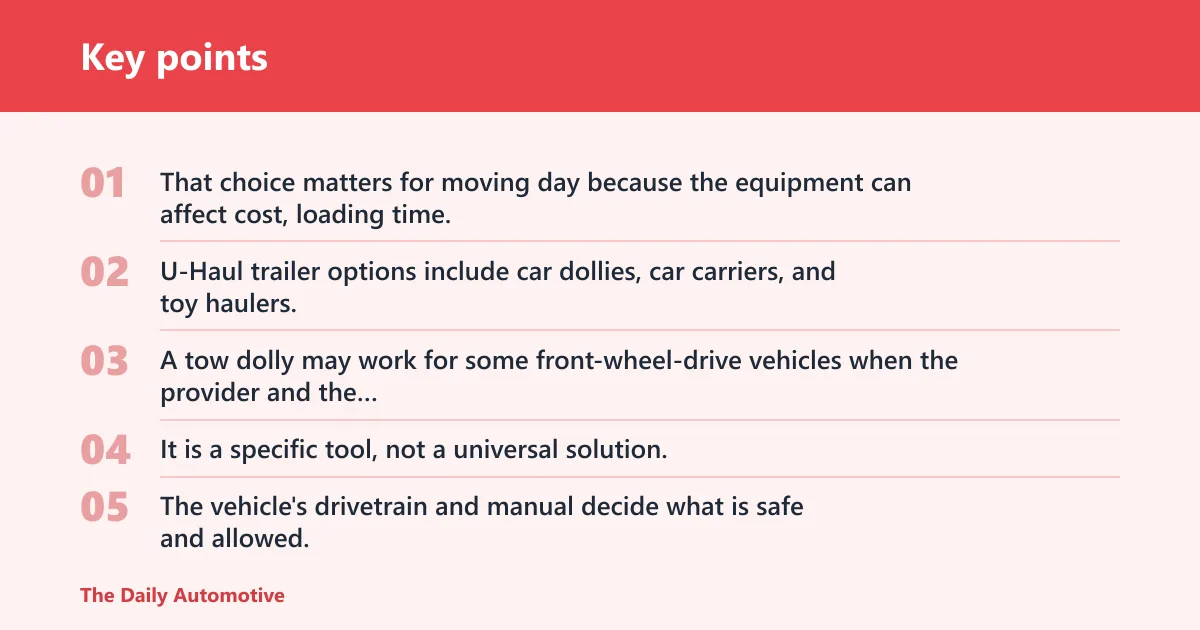
That choice matters for moving day because the equipment can affect cost, loading time, and curb space needs. U-Haul trailer options include car dollies, car carriers, and toy haulers, and provider pricing differs by setup.
When a tow dolly fits
A tow dolly may work for some front-wheel-drive vehicles when the provider and the vehicle manual allow it. It is a specific tool, not a universal solution. The vehicle’s drivetrain and manual decide what is safe and allowed.
Ask the rental company and check the owner’s manual before choosing a dolly. If the vehicle cannot be towed that way, do not assume the answer changes just because the move is short.
When a car carrier is the better fit
A car carrier is often used when the vehicle cannot be flat-towed or when the rental company says a dolly is not suitable. It carries the vehicle rather than leaving part of it on the road.
That can be a better choice for all-wheel-drive vehicles, low-clearance vehicles, or cars with drivetrain limits. It may cost differently from a tow dolly, so compare the provider’s options before you reserve.
Why vehicle type changes the choice
Vehicle weight, drivetrain, clearance, and manual limits all matter. The owner’s manual should guide the setup. Never exceed the vehicle’s tow or payload rating in the manual, and do not assume one tow method works for every car.
If the vehicle is damaged or immobilized, the tow provider may choose a different method than the one you planned. That is one more reason to confirm the vehicle details before the truck is dispatched.
What local parking enforcement can do
Local parking enforcement can ticket unpermitted parking, and in some places a blocked curb lane can lead to a tow warning. That risk applies to the tow truck, the moving truck, or any vehicle that sits where parking is restricted.
Permits and temporary signs reduce that risk. They tell other drivers and enforcement officers that the curb space is reserved for a specific purpose during a specific time window.
Tickets for blocked curb space
Unpermitted parking can lead to parking tickets of $65 to $150 per violation. In a fire lane or bus zone, tickets can be $250 to $500 per violation. Those penalties can apply even if the stop was brief.
That is why a curb reservation may be worth the fee when the location is tight. It is often cheaper than a ticket, a delay, or a second dispatch.
Why temporary signs and permits help
Temporary no-parking signs and a valid permit make it easier for a tow truck or moving truck to stop legally. They can also reduce the chance of a driver parking in the reserved space before your truck arrives.
Moving company permit responsibility may be handled by the mover, but it should be spelled out in the contract. Customer responsibility can vary by provider, so check the paperwork before the moving date.
Frequently asked questions
Do you need a moving permit for AAA towing?
Usually no. AAA towing does not normally require a moving permit, because the permit applies to curb space and parking control, not the towing benefit itself. A permit may still be needed if the pickup or drop-off spot is in a restricted curb zone or requires temporary parking approval.
Does AAA include towing?
Often yes, but the exact benefit depends on the membership level and local AAA rules. Some plans cover towing as part of roadside assistance, while mileage and destination limits can vary. Before you request service, verify what your specific membership includes and whether the tow fits the plan.
How do you get a tow from AAA?
Request it through AAA channels with the pickup address, the vehicle description, and the destination. Dispatch will check coverage, availability, and local rules. If the vehicle is on a tight street or in a parking-restricted area, mention that early so the truck can be scheduled with the right access plan.
Does AAA cover towing from home?
Often yes, if the vehicle is at a home and the truck can reach it legally. A driveway pickup is usually simpler than a street-side pickup. Even so, the membership rules and local access rules still apply, so confirm that the tow can be performed from your exact location.
How many miles does AAA towing cover?
The mileage limit varies by membership level and location. Do not assume a fixed number or an unlimited tow unless AAA confirms it for your account. Ask dispatch for the destination limit before the truck is sent, especially if the vehicle must go to a distant repair shop.
Products related to this article
Sponsored / affiliate links. As an Amazon Associate I earn from qualifying purchases. I may earn additional commission from eligible campaigns.