AWD Repair Cost: What You’ll Actually Pay
AWD repair cost is often about $150-$400 for a simple sensor or fluid service, about $800-$2,500 for common transfer case or differential work, and replacement may make more sense when repair costs exceed about half the vehicle’s value. Ignore grinding, binding, or leaks, and a small driveline fault can turn into axle, differential, or transmission damage. This guide breaks down the repair-cost ladder, the parts that fail first, and the point where you should stop driving.
AWD repair cost at a glance
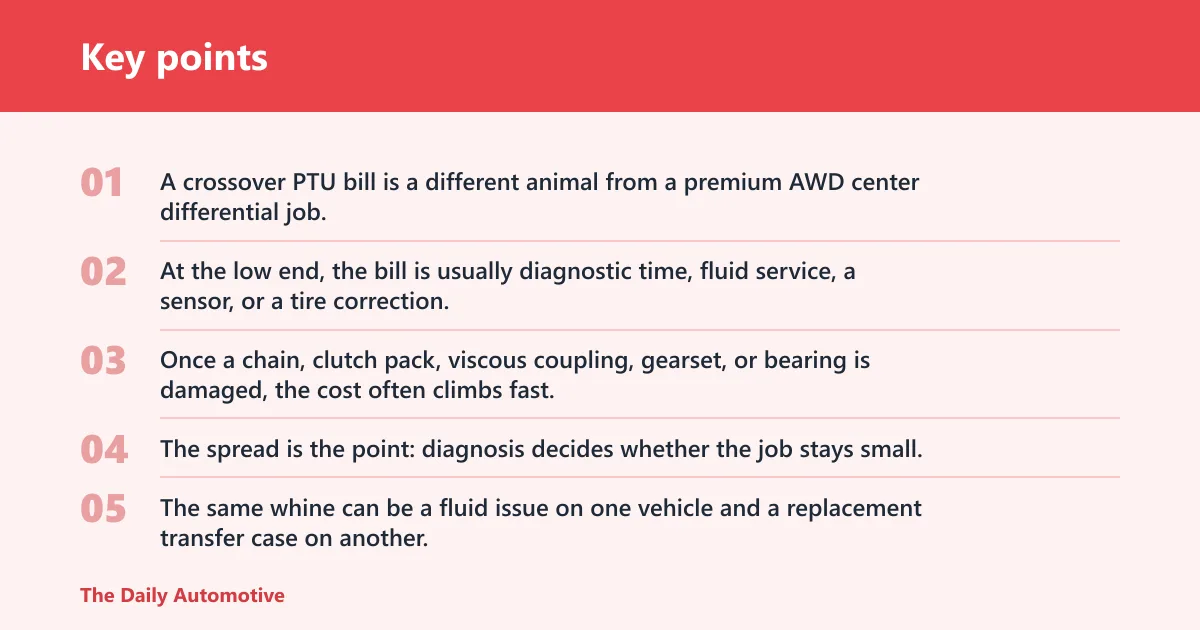
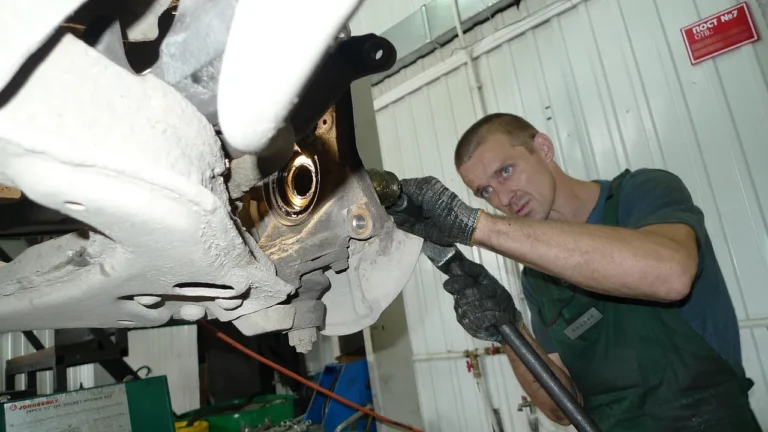
AWD sends power to both axles, but the bill depends on the platform, the failure point, and whether the problem stayed inside one component or spread to bearings, axles, or gears. A crossover PTU bill is a different animal from a premium AWD center differential job. So is a tire mismatch problem.
Typical low-cost fixes
At the low end, the bill is usually diagnostic time, fluid service, a sensor, or a tire correction. Tire rotation alone is estimated at $25 to $60 in 2026, which is far cheaper than letting the drivetrain bind long enough to damage a transfer case or differential.
When bills jump into four figures
Once a chain, clutch pack, viscous coupling, gearset, or bearing is damaged, the cost often climbs fast. Consumer-facing price guides put transfer case replacement roughly at $2,000 to $9,000, while a simple transfer case repair may only set you back a few hundred dollars. The spread is the point: diagnosis decides whether the job stays small.
What changes the price fastest
Three things move the total most: the component that failed, how long it was driven that way, and whether matching tires are still within tolerance. The same whine can be a fluid issue on one vehicle and a replacement transfer case on another. That is why a diagnostic scan should come before teardown.
AWD repair cost ladder
| Symptom | Likely component | Diagnostic step | Typical repair range | Replacement range | Do-not-drive threshold |
|---|---|---|---|---|---|
| Whine, binding, or shudder on turns | Transfer case | Scan codes, check fluid for glitter, inspect chain or clutch behavior | $300-$1,500 | $2,000-$9,000 | Stop if the noise grows under load or the AWD light flashes |
| Hop, chatter, or tight turns at parking speed | Center differential | Scan for drivetrain faults, inspect fluid condition, verify tire diameter match | $1,500-$3,000 | $2,500-$4,500 | Stop if the vehicle binds or the steering resists in slow turns |
| Grinding from the front or under the floor | Power transfer unit | Check codes, fluid level, and output play at the driveshaft | $1,200-$2,500 | $1,500-$2,800 | Stop if fluid leaks heavily or the case runs hot |
| Rumble, clunk, or leak from the rear | Rear differential | Inspect gears, bearings, seals, and axle lash after a scan | $1,200-$2,500 | $1,500-$2,800 | Stop if metal is in the fluid or the rear end locks up |
| Repeated traction control warnings after tire service | Tire-mismatch damage | Measure tread depth and rolling diameter across all four tires | $25-$60 for rotation, or tire correction cost | $1,500-$4,000 if drivetrain damage follows | Stop if the vehicle binds or the AWD warning stays on |
| Vibration, noise, or CV joint damage after neglect | Bearing and axle-related secondary damage | Inspect axle shafts, wheel bearings, and seals after the primary fault | $300-$1,200 | $1,000-$3,000+ | Stop if vibration becomes severe or a wheel-bearing roar gets louder with speed |
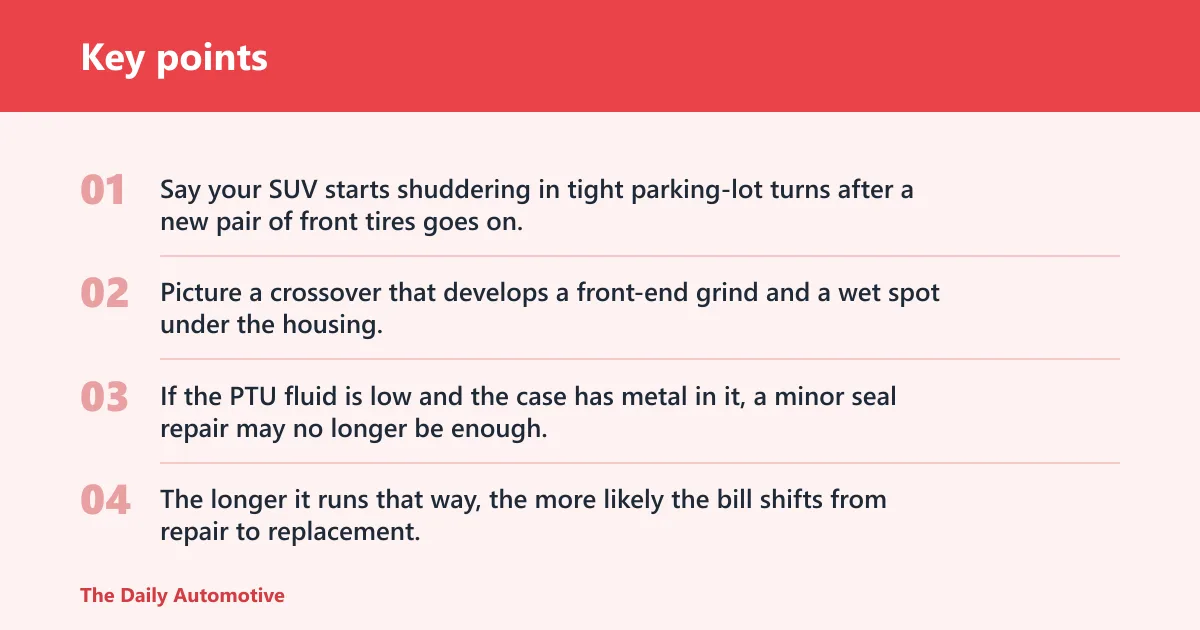
Say your SUV starts shuddering in tight parking-lot turns after a new pair of front tires goes on. If the front tires are a few 32nds taller than the rear pair, the AWD system can see a rolling-diameter mismatch and begin fighting itself. That is a tire problem first, not a transmission problem.
Picture a crossover that develops a front-end grind and a wet spot under the housing. If the PTU fluid is low and the case has metal in it, a minor seal repair may no longer be enough. The longer it runs that way, the more likely the bill shifts from repair to replacement.
What makes AWD repairs expensive?
AWD repairs get expensive because the system works across both axles, so one failed part can create stress everywhere else. A transfer case, PTU, center differential, rear differential, axle shaft, or bearing can all be part of the same bill. The damage is often connected, not isolated.
Power split across both axles
Because AWD constantly manages power front to rear, a mismatch in tire size or a worn internal clutch can create heat and drag. That stress does not stay contained. It can move into seals, bearings, and gears, which is how a modest fault turns into a four-figure repair.
Component-specific design differences
Some platforms use a transfer case with gears, chains, or clutches. Others use a center differential, and some crossovers use a PTU tied into the front-to-rear power path. That design difference changes labor time, parts cost, and whether replacement is cheaper than rebuilding the original unit.
Why secondary damage raises the bill
Once a failed component sends debris through the system, the repair bill can include the original part plus bearings, seals, axles, or even a differential. A diagnostic scan helps separate an electronic fault from a mechanical one before anyone orders hard parts.
Will mismatched tires damage AWD?
Yes. Mismatched tires can damage AWD components because the system expects the same rolling diameter at all four corners. AAA warns that tires varying in size can affect AWD and 4WD durability, and it says the mismatch can also affect ABS, traction control, and stability control. The risk goes beyond a warning light. (AAA)
Tread depth and rolling diameter
Tread depth matters because it changes tire circumference. A commonly cited threshold is about 2/32 inch tolerance, and once the gap between tires gets larger than that, some AWD systems may begin to work harder than they should. That strain can show up as binding, shudder, or drivetrain noise.
On many AWD setups, even a small mismatch is enough to start long-term wear. On more sensitive platforms, especially those with tighter clutch control or a center differential, the cost can show up later as a transfer case, PTU, or differential bill.
Rotation patterns to check in the owner’s manual
Do not assume every AWD vehicle uses the same tire rotation pattern. Some call for a modified X pattern. Others use a full X or a straight swap. The owner’s manual is the authority, because the wrong rotation pattern can create a mismatch you did not intend.
-
Measure all four tires.
Check tread depth at the inside, center, and outside of each tire. If one tire is significantly more worn than the others, the rolling diameter difference may be enough to bother the drivetrain.
-
Match the rotation pattern.
Use the pattern named in the owner’s manual, not a generic one from another vehicle. AWD layouts vary by brand and platform, so the same pattern is not always correct.
-
Replace in sets when needed.
If one tire is too far off the others, replacing the pair or the full set is often cheaper than risking a transfer case or center differential repair.
When tire replacement is cheaper than drivetrain repair
If the tread difference is enough to trigger binding or warning lights, the tire bill is often the better deal. That is especially true on systems that already show shudder in tight turns. A set of tires costs less than a damaged transfer case, and a matched set helps prevent repeat failure.
How do you diagnose AWD problems?
A diagnostic scan should come first because the same symptom can come from different parts. An AWD warning light, whine, or shudder does not automatically mean the transfer case failed. A scan can point to clutch slip, speed-sensor errors, or a control issue before anyone tears the drivetrain apart.
Why a diagnostic scan comes first
Modern AWD systems are monitored by control modules. A code can help separate a sensor fault from a mechanical fault. That matters because a sensor replacement may cost far less than opening a transfer case, PTU, or differential that was never the root problem.
How symptoms point to the likely component
A front-driven shudder often points toward the PTU area on crossovers that use one. A rear rumble can point to the rear differential. Binding on tight turns can point to a center differential or tire mismatch. A whine under acceleration often calls for a closer look at gears, chains, or bearings.
When a teardown is justified
Teardown makes sense after the scan, fluid check, and external inspection point to internal damage. Metal in the fluid, burnt smell, or repeated clutch faults are the kind of signs that justify opening the unit. If the unit is full of debris, repair may be less practical than replacement.
Repair or replace the AWD system?
Repair makes sense when the damage is isolated, the housing is sound, and the rest of the drivetrain has not been contaminated. Replacement becomes the better call when the cost to rebuild rises too close to the cost of a known-good unit, or when the vehicle has multiple damaged parts. Used assemblies can reduce the bill, but they also add risk.
When component repair makes sense
Repair is usually the better route for a clutch pack, seal, bearing, or sensor problem when the gears and housing are still usable. That is where the cost spread matters. Consumer-facing guides show some transfer case repairs in the few-hundred-dollar range, far below a full replacement quote.
When replacement is the better call
If the case is cracked, the gears are damaged, or the fluid has circulated metal through the system, replacement can be the cleaner answer. That is especially true when the repair estimate pushes past half the vehicle’s value. At that point, repair rarely makes financial sense.
How used assemblies affect the budget
A used transfer case, PTU, or differential can lower the parts bill, but it does not erase labor, fluids, coding, or adaptation work. It also does not guarantee the used unit was healthier than the one you removed. A used assembly is a budget tool, not a certainty.
AWD maintenance costs to expect
Regular maintenance is how you keep the annual AWD cost under control. Tire rotation, fluid changes, and matching tires prevent the kind of stress that turns a maintenance item into a drivetrain repair. On many vehicles, the annual cost is modest until a fluid interval is ignored.
Fluid service intervals
Most manufacturers call for periodic fluid service in the transfer case, PTU, center differential, or rear differential, but the interval varies by platform. Crossovers that tow, see short-trip use, or spend time in harsh weather often need attention sooner than the longest interval listed in the manual.
Tire rotation and matching
F1 shows AWD tire rotation costs at $25 to $60 in 2026. That is small compared with the risk of skipping rotation, since F2 puts possible transfer case repair bills at $1,500 to $4,000. Rotation keeps tread depth close and reduces the chance of diameter mismatch.
Annual cost drivers by platform
Common crossovers often land at the lower end of the repair spectrum, but premium AWD systems can expose you to higher parts and labor costs. Examples from current pricing show Subaru center differential or viscous coupling repairs at $1,500 to $3,000, Audi quattro center differential repairs at $2,500 to $4,500, BMW xDrive transfer case clutch pack repairs at $1,800 to $3,500, and Mercedes 4Matic transfer case clutch pack repairs at $2,000 to $4,000.
For some popular crossovers, the PTU or rear differential is the main cost driver. Toyota RAV4 AWD and Honda CR-V AWD PTU or rear differential repairs are listed at $1,200 to $2,500, while Ford Escape AWD and Edge AWD PTU or rear differential repairs are listed at $1,500 to $2,800. That is a useful reminder that platform matters as much as symptom.
Frequently asked questions
How much does it cost to fix all wheel drive?
Most AWD repairs fall somewhere between $150 and $2,500 when the issue is limited to a sensor, fluid service, seal, or a component that can be repaired. The bill climbs fast once the failure spreads to a transfer case, differential, or bearings. Repair is cheaper than replacement in many cases.
What is the average AWD repair cost?
A practical average depends on the failure type, but many owners land in the $800 to $2,500 range for common AWD work. That band covers more than a simple fluid service and less than a full replacement. Diagnosis matters because a code, leak, or tire mismatch can change the number quickly.
How much does AWD transfer case repair cost?
Transfer case repair can be a few hundred dollars for a limited fix, while replacement can run roughly $2,000 to $9,000. The exact number depends on whether the gears, chain, or clutch pack is damaged.
What does AWD maintenance cost per year?
Annual AWD maintenance often includes tire rotation, fluid checks, and occasional fluid changes. Tire rotation alone is estimated at $25 to $60 in 2026. The yearly total rises if your platform has short service intervals, if you tow, or if you need new tires to keep diameter mismatch out of the drivetrain.
Is it cheaper to repair or replace an AWD system?
Repair is cheaper when the damage stays inside one serviceable part, such as a seal, bearing, or clutch pack. Replacement is the better call when the unit has cracked, filled with metal, or spread damage across other components. A used assembly can lower cost, but it still carries risk.
Will mismatched tires damage my AWD system?
Yes. AAA warns that different tire sizes can affect AWD durability, and it says the mismatch can also affect ABS, traction control, and stability control. The danger increases when tread depth difference grows, especially if the owner’s manual calls for a specific rotation pattern and that pattern is ignored.
Products related to this article
Sponsored / affiliate links. As an Amazon Associate I earn from qualifying purchases. I may earn additional commission from eligible campaigns.