Does a BMW Have to Be Serviced by BMW? Legal Rights
No, a BMW does not have to be serviced by BMW to keep warranty coverage in the U.S.; under the Magnuson-Moss Warranty Act, BMW generally must prove an independent shop caused the failure before denying a claim. Skip records, use the wrong parts, or leave out fluid specs, and a warranty repair can turn into a fight over thousands of dollars. This guide explains what BMW can legally require, what proof beats a challenge, and which invoices, part numbers, and maintenance records you should keep.
Does a BMW have to be serviced by BMW?
No. In the U.S., BMW service at a non-dealer shop does not legally void the warranty. BMW may prefer its own network, but preference is not a legal requirement, and a BMW dealership cannot cancel coverage just because you chose an independent repair shop.
What a dealer can and cannot require
A dealer may ask for proof that service followed BMW-recommended intervals and used appropriate parts and fluids. It cannot require dealer-only labor as a blanket condition for warranty coverage. BMW warranty protection turns on the vehicle’s condition and maintenance history, not the logo on the invoice.
That distinction matters. BMW warranties cover certain repairs and replacements for a specific period or mileage, but coverage can still be challenged if neglect or misuse is involved. If a service issue and a failure line up, the records must show the car was maintained correctly.
What the Magnuson-Moss Warranty Act says about car servicing

The Magnuson-Moss Warranty Act is the U.S. warranty law that governs this issue. It limits a manufacturer’s ability to force dealer servicing as a condition of warranty validity. BMW must have a factual basis to deny a claim, not a blanket rule that punishes independent maintenance.
What BMW must show before denying a claim
If BMW refuses a claim, it will usually need some evidence that the independent work caused the failure or that the car was not maintained to the required standard. That proof can include wrong oil specification, missed filter changes, ignored brake wear, contaminated fluids, or a repair that introduced the fault.
The legal standard is practical, not sentimental. If the maintenance is correct and documented, the warranty argument is much stronger. If the paperwork is thin, the car may be fine mechanically but weak on proof.
How the law treats parts, labor, and maintenance standards
Magnuson-Moss does not say every part must be BMW-branded. It does mean the parts and labor must satisfy the service standard the manufacturer ties to the job. For BMW owners, that usually means the right oil spec, the correct filter, the right interval, and a record that shows who did the work.

Can BMW deny a claim if you used an independent garage?
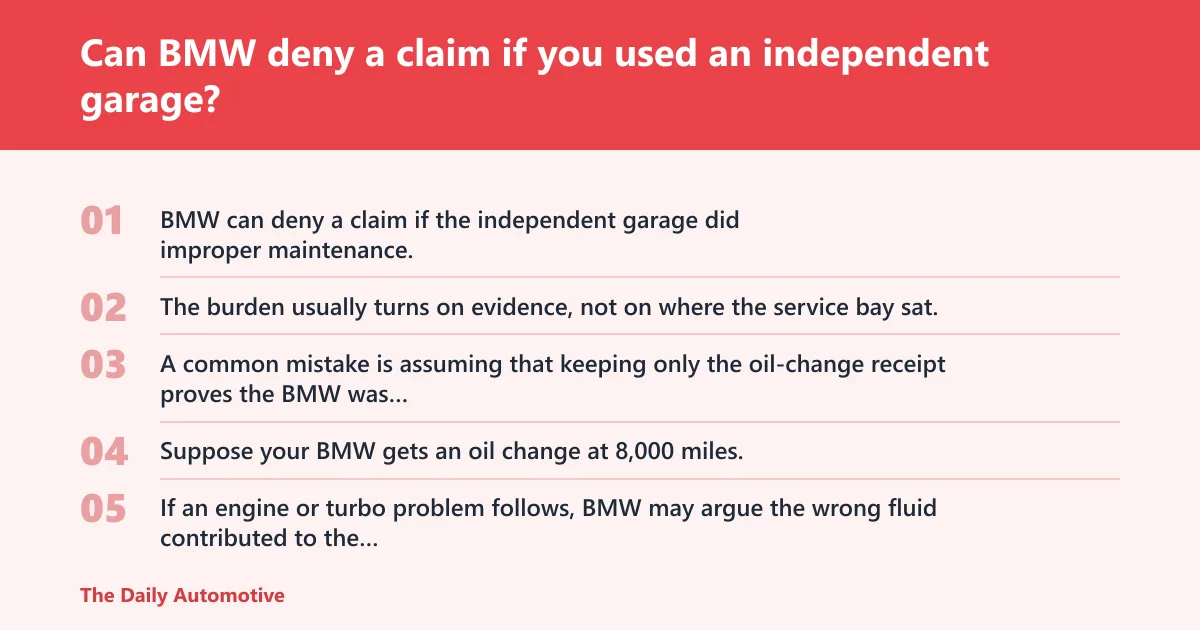
Yes, but only in the right circumstances. BMW can deny a claim if the independent garage did improper maintenance, used the wrong parts or fluids, missed a required service, or if neglect or misuse may have caused the damage. The burden usually turns on evidence, not on where the service bay sat.
When improper maintenance becomes a warranty problem
A common mistake is assuming that keeping only the oil-change receipt proves the BMW was serviced according to the warranty requirements. Suppose your BMW gets an oil change at 8,000 miles, but the shop uses oil that does not match BMW’s required specification. If an engine or turbo problem follows, BMW may argue the wrong fluid contributed to the failure.
Another common issue is missed routine work. BMW service includes routine oil changes, filter replacements, and brake checks. If a brake wear warning is ignored until metal-on-metal damage appears, that is maintenance failure, not a warranty defect.
Why the burden shifts to the evidence
BMW does not have to prove a dealership would have prevented the failure. It needs to show a connection between the problem and the maintenance lapse. That is why service records, part numbers, fluid specs, and date-and-mileage entries matter so much after non-dealer work.
What proof should an independent BMW service keep?
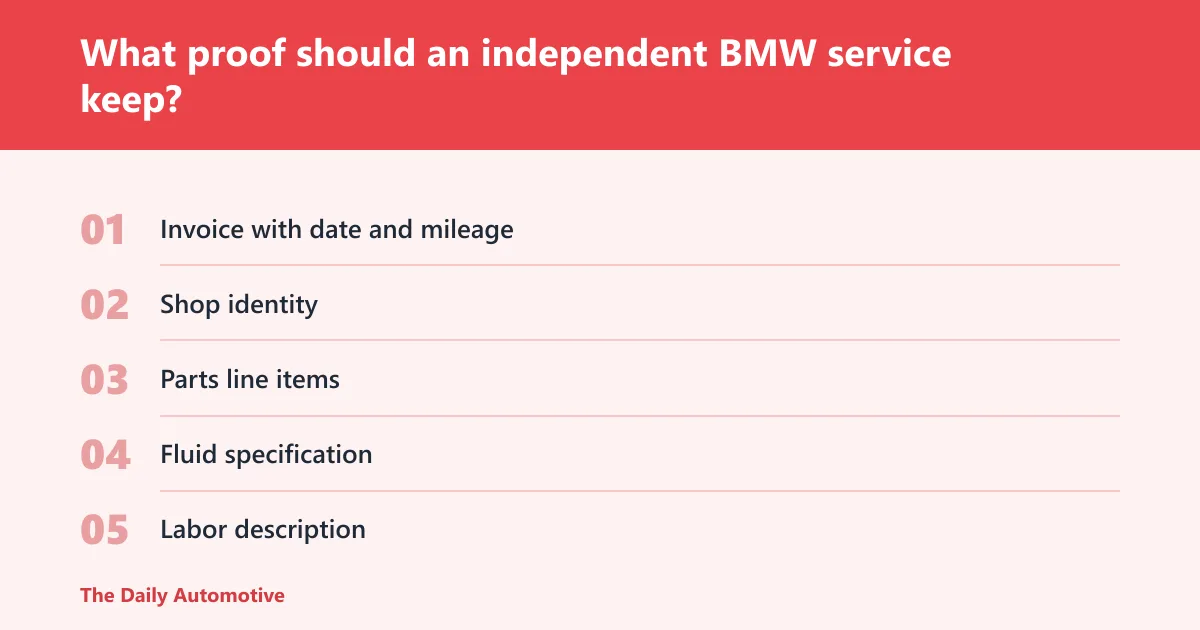
Keep a full service record for every visit. That means the invoice, the date, the mileage, the shop identity, the technician or facility name, the parts used, the fluid specification, and a plain description of the work completed. If the claim ever gets challenged, those details become the defense file.
Required documents after every service
- Invoice with date and mileage. The mileage at service time matters as much as the date.
- Shop identity. Keep the business name, address, and tax or business number if listed.
- Parts line items. Record brand names and part numbers for filters, plugs, belts, pads, and similar items.
- Fluid specification. Keep the exact oil or fluid spec named on the invoice or product label.
- Labor description. Save the work order showing what was inspected, replaced, or reset.
- Digital service record. Keep scanned copies in cloud storage and on a local device.
What to photograph and archive before leaving the shop
Photograph the old parts, the new part boxes, the oil container label, and the final invoice. If the shop returns the used oil filter or brake pads, keep them until the warranty window passes. That physical evidence can matter if BMW later questions whether the correct parts were installed.
Picture a 2021 BMW 3 Series with a brake warning at 31,200 miles. The independent garage replaces the pads and rotors, but the owner leaves with only a card receipt. Six months later, a caliper claim is disputed. The missing parts record makes the defense harder than it needed to be.
Warranty-protection checklist for non-dealer BMW servicing
| What to keep | What BMW may care about | Best evidence to store | When to save it |
|---|---|---|---|
| Invoice | Date, mileage, work completed | Itemized receipt with VIN if listed | Same day as service |
| Parts evidence | Correct fitment and brand | Box labels, part numbers, old parts photos | Before parts leave the shop |
| Fluid evidence | Correct BMW-approved specification | Container label, spec code, receipt line item | Before disposal of containers |
| Service description | Oil change, filter replacement, brake check | Work order with technician notes | At checkout |
| Shop identity | Who performed the work | Business card, invoice header, website screenshot | At service time |
| Digital archive | Long-term proof | Scans saved in two places | Within 24 hours |
Is BMW-authorized service still worth it?
Sometimes, yes. BMW-authorized service centers use trained technicians and BMW-specific tools, which can help with convenience, coding, and service-history continuity. They are not legally required for warranty validity, but they can reduce the chance of a paperwork dispute.
Service-history continuity and resale value
Documented BMW maintenance history can help boost resale value. Buyers and appraisers often respond well to a clean service trail, especially when routine oil changes, filter replacements, and brake checks are clearly logged. That does not mean dealer stamps are mandatory. It means clean records carry weight.
BMW-authorized service may also help if you want one service history in one database. Some owners value that simplicity. Others are comfortable managing receipts from an independent repair shop. The legal standard stays the same either way.
Can BMW deny a warranty claim because I skipped a service at the dealer?
Not just because you skipped the dealer. BMW can deny a claim if the missed service led to the failure or if the car was neglected, misused, or modified in a way that caused the problem. Missing a dealer stamp alone is not the legal test in the U.S.
How to respond if a dealer wrongly denies a claim
- Ask for the denial in writing.
- Request the specific reason, including the part or system BMW says failed.
- Provide your service records, invoices, and parts evidence.
- Ask whether BMW is alleging neglect, misuse, or an improper repair.
- Escalate to the warranty administrator or customer relations channel.
- If needed, contact the relevant state or federal consumer authority for guidance.
The key is to force the denial onto paper. Once BMW has to name the defect and the evidence, vague objections often narrow into something you can answer with records.
What did the FTC say about BMW MINI service restrictions?
BMW MINI was charged by the FTC in 2015 over dealer-only oil change messaging. That action is useful because it shows regulators have already challenged warranty language that implies dealer service is the only lawful path. The issue was not brand pride; it was illegal warranty pressure.
Why that precedent matters to BMW owners
The FTC action helps explain why a dealer cannot casually tell you that independent oil changes void coverage. A manufacturer can recommend its own network, but it cannot misstate the warranty law. If a service adviser repeats that claim, ask for the written policy and compare it with the actual warranty terms.
U.S. versus UK/EU: do the same rules apply?
No. This article is centered on U.S. warranty law and should not be read as a universal rule. UK and EU owners may be subject to different consumer protections, maintenance-plan rules, and service-book requirements. If your BMW is outside the U.S., check the market-specific warranty booklet and local consumer law.
Why market differences matter
Some markets treat service records and authorized networks differently, especially for maintenance packages and resale documentation. Even there, the practical lesson often stays the same: follow the schedule, use the correct fluids and parts, and keep proof.
Frequently asked questions
Does my BMW warranty stay valid if I service it at an independent garage?
Yes, in the U.S. a BMW warranty generally stays valid if you service the car at an independent garage and keep proper records. The shop should follow BMW’s maintenance schedule, use correct parts and fluids, and document everything. BMW can still deny a claim if bad maintenance caused the failure.
Can BMW require dealer servicing for warranty repairs?
BMW can ask for proof that the car was maintained properly, but it cannot require dealer servicing as a blanket condition for warranty validity in the U.S. Under Magnuson-Moss, the focus is on whether the maintenance was done correctly and whether any outside work caused the problem.
Will using non-BMW parts void my BMW warranty?
Not automatically. Non-BMW parts do not by themselves void coverage if they are proper replacements and the maintenance meets BMW’s standards. The risk rises when the part is wrong, poorly installed, or tied to a failure. Keep part numbers, brand names, and purchase records.
What proof do I need to keep if I service my BMW outside the dealer?
Keep the invoice, date, mileage, shop details, labor description, parts numbers or brand names, and fluid specification if available. Add photos of the parts and labels, plus a digital backup of everything. If BMW questions the work later, a thin paper trail is usually the weakest point.
Is it better to use a BMW-authorized service center for resale value?
It can help, mostly because buyers often like clean, easy-to-follow service history. BMW-authorized service centers also use trained technicians, which may add confidence for some buyers. Still, well-kept independent service records can also support resale value if they are complete and legible.
Products related to this article
Sponsored / affiliate links. As an Amazon Associate I earn from qualifying purchases. I may earn additional commission from eligible campaigns.