BMW i4 M50 Tax Credit: Eligibility, Lease, and Rebates
No—the BMW i4 M50 does not qualify for a 2026 federal clean-vehicle purchase tax credit, though a lease may be treated differently and state rebates can still apply. Miss this, and you could overpay by thousands or miss a better financing route. This guide explains the federal rules, state incentives, and the separate home EV charger credit.
Does the BMW i4 M50 qualify for a tax credit?


No for 2026 purchases. The BMW i4 M50 is an all-electric, luxury-performance EV with zero tailpipe emissions, but the federal vehicle credit ended for vehicles acquired after September 30, 2025. If you are shopping today, that means a new 2026 BMW i4 M50 is not a federal clean-vehicle purchase credit candidate.
The timing is the key detail. A buyer who acquired the car before the cutoff may still claim the credit on a 2025 return if the IRS requirements were met. After that date, the federal vehicle credit is gone for this model.
What changed after September 30, 2025
The federal EV tax credit is generally treated as a tax credit rather than a direct discount at the dealership. For this model, the program ended for vehicles acquired after September 30, 2025. That is why the BMW i4 M50 no longer qualifies for the federal credit in 2026.
Do not mix up the vehicle credit with the charger credit. Those use different rules, different deadlines, and different paperwork.
📊 The federal EV tax credit ended for vehicles acquired after September 30, 2025. Source: Does the BMW i4 M50 Qualify for a Tax Credit?.
Why the BMW i4 M50 may have qualified before the cutoff
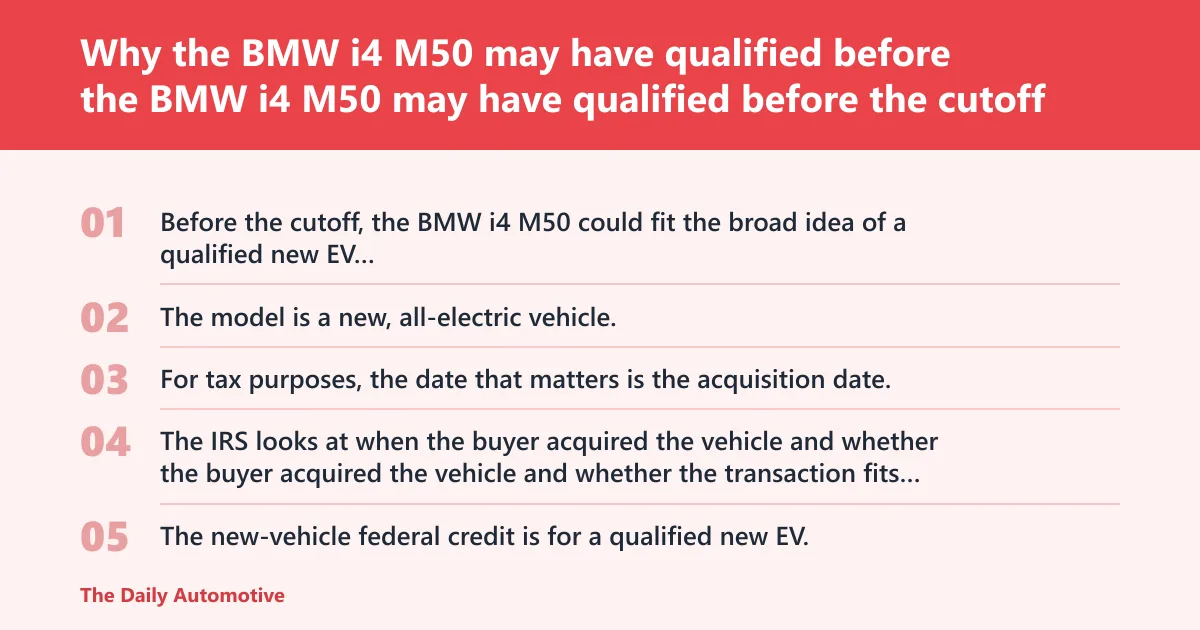
Before the cutoff, the BMW i4 M50 could fit the broad idea of a qualified new EV purchase if the buyer met IRS requirements. The model is a new, all-electric vehicle, and federal clean-vehicle rules have historically been built around new purchases, not used ones.
For tax purposes, the date that matters is the acquisition date, not a vague “I saw it on the lot” date. The IRS looks at when the buyer acquired the vehicle and whether the transaction fits the filing rules for that tax year.
New vehicle vs. used vehicle rules
The new-vehicle federal credit is for a qualified new EV. It is not the same as any separate used-EV program. If a buyer purchased a used BMW i4 M50, it would not generally qualify for the new-vehicle credit discussed here.
That distinction matters because shoppers often hear “EV tax credit” and assume every electric car qualifies. It does not. Vehicle status, purchase date, and IRS filing details all matter.
Acquisition date versus delivery date
Acquisition date and delivery date can differ, and that difference can affect the result. If a buyer signed papers before September 30, 2025 but delivery or final transfer happened later, the buyer should verify which date the IRS treats as the acquisition date for that transaction.
Paperwork timing matters because the return must match the actual eligible transaction. A dealer note, purchase agreement, or delivery record may be needed to show when the buyer acquired the vehicle.
What the IRS expects on the return
The IRS expects the buyer to claim the credit on the tax return for the correct year and to keep records that support eligibility. That usually means the purchase agreement, VIN, delivery records, and any dealer paperwork connected to the credit.
Use the current IRS rules before filing. If anything about the transaction is unclear, a tax professional or CPA can help confirm whether the claim belongs on a 2025 return or should not be claimed at all.
What the federal EV tax credit means now
The federal EV tax credit is a credit, not a point-of-sale discount, unless a separate program or filing path says otherwise. For the BMW i4 M50, the practical answer in 2026 is simple: new acquisitions do not qualify for the federal vehicle credit.
That does not mean every savings path is closed. It means buyers need to check the current federal vehicle rules, then look at state and charger incentives separately.
Why current model-year sales need a fresh eligibility check
Model-year marketing can be misleading. A car can still be on sale, still be new, and still fail to qualify for the federal vehicle credit because the acquisition date falls after the cutoff.
So, if a dealer mentions tax savings, ask which incentive they mean. The answer may be a state rebate, a utility program, or the home charger credit rather than a federal vehicle credit.
Eligibility checklist for buyers and owners
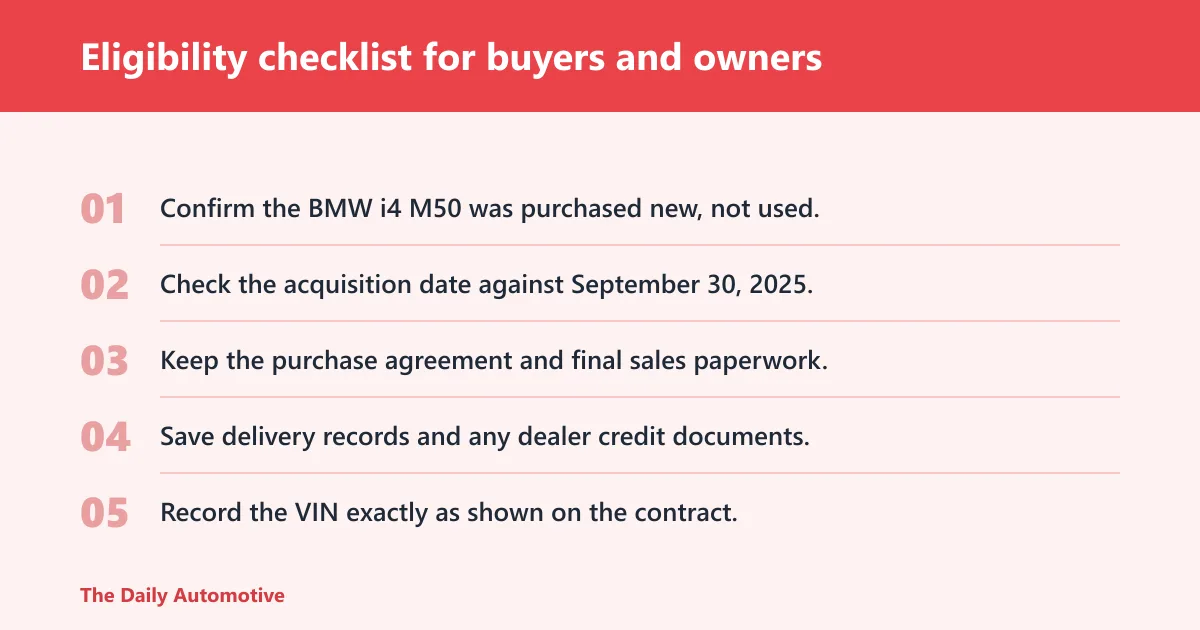
Start with records, not assumptions. The safest move is to verify the VIN, purchase date, and whether the vehicle was new when acquired, then compare those facts with the current IRS rules.
- Confirm the BMW i4 M50 was purchased new, not used.
- Check the acquisition date against September 30, 2025.
- Keep the purchase agreement and final sales paperwork.
- Save delivery records and any dealer credit documents.
- Record the VIN exactly as shown on the contract.
- Review the IRS filing rules before entering the credit on a return.
- Ask a CPA if the transaction date, lease structure, or dealer paperwork is unclear.
Documents to keep
The practical file should include the purchase agreement, VIN, delivery records, and dealer paperwork tied to the credit. If the buyer is trying to claim a 2025 credit, those records help show the vehicle was acquired before the cutoff and met the required conditions.
Questions to ask the dealer
Ask whether the sale is a purchase or a lease, what date the vehicle was acquired, and whether the dealership is treating the deal as eligible for any federal, state, or charger incentive. A dealer can help with paperwork, but the buyer remains responsible for the tax return.
When a CPA can help
A CPA can confirm whether the vehicle was acquired before the cutoff, whether the buyer is claiming the credit on the correct return, and whether the record set is strong enough to support the filing. That is especially useful if delivery was delayed or the paperwork is incomplete.
BMW i4 M50 credit scenarios
The table below separates the expired vehicle credit from still-possible savings. It also shows the evidence a buyer would need to support each scenario.
| Scenario | BMW i4 M50 federal vehicle credit result | Evidence needed | What savings may still remain |
|---|---|---|---|
| Purchased new before September 30, 2025 | May still qualify on a 2025 return if IRS rules were met | Purchase agreement, VIN, delivery records, dealer paperwork, tax return records | State incentive, charger credit, or none depending on location and home setup |
| Purchased new after September 30, 2025 | No federal vehicle credit | Sales contract showing acquisition date after the cutoff | State incentive, charger credit, utility rebate, or none |
| Purchased used | No new-vehicle federal credit | Title or sale documents showing used-vehicle status | Possible state program, local utility savings, or none |
| Vehicle credit is gone, but home charger is installed | No federal vehicle credit | Charger purchase and installation records, plus proof of location and date | Home EV charger tax credit through June 30, 2026 |
Picture a buyer who signs a BMW i4 M50 order in late September and takes delivery in October. That buyer should not assume the federal credit survived the calendar flip. The exact acquisition date and the IRS treatment of that transaction matter more than the delivery month alone.
A common first-timer mistake is mixing up a vehicle purchase with a charger purchase. A garage-installed Level 2 charger may still fit the separate home EV charger credit, while the car itself does not qualify for the vehicle credit in 2026.
What savings may still remain if the vehicle credit is gone?
Even when the federal vehicle credit is unavailable, savings may still exist through state-level incentives and the separate home EV charger tax credit. These are different programs with different rules, and they do not require the car itself to qualify for the expired federal vehicle credit.
State EV incentives
State-level incentives can still apply, and they vary by state. Depending on where you live, that may include rebates, tax credits, grants, or fee exemptions. Some states also add utility programs that reduce charging costs at home.
Do not assume every state offers the same deal. Some states have generous programs, while others offer little or nothing for this model.
Home EV charger tax credit
The home EV charger tax credit is separate from the vehicle credit and remains active through June 30, 2026. It applies to chargers, not to the BMW i4 M50 itself.
That means a buyer who missed the vehicle credit may still recover part of the cost of installing home charging equipment, if the installation and location meet the program rules.
Other local utility programs
Some utilities offer rebates, reduced rates, or installation support for home charging. These programs are local, not universal, and they often depend on where you live and how the charger is installed.
What cars are eligible for the federal tax credit?
Eligible cars must meet current IRS rules, and those rules can change. In general, shoppers should check the official vehicle list and verify the exact trim, assembly details, and model year before assuming a car qualifies.
Trim matters because one version of a vehicle can qualify while another does not. A VIN check and a current IRS review are safer than relying on a broad brand reputation or a model name alone.
How to check current IRS lists
Look up the current IRS guidance before you buy, then confirm that the exact vehicle on the contract matches the eligible configuration. If the BMW i4 M50 is being sold today, the seller should still be able to show you what incentive, if any, remains.
If the answer is unclear, stop there and verify with the IRS rules or a CPA. That is better than discovering after filing that the credit was never available.
Frequently asked questions
Can I still claim the BMW i4 M50 federal EV tax credit in 2026?
No. The BMW i4 M50 no longer qualifies for the federal vehicle credit in 2026 because the federal EV tax credit ended for vehicles acquired after September 30, 2025. If the car was acquired before that cutoff, the claim may still belong on a 2025 return if IRS rules were met.
If I bought a BMW i4 M50 before September 30, 2025, can I claim the credit?
Possibly, yes. A buyer who purchased before the cutoff can still claim it on a 2025 return if the vehicle was a qualified new EV and the filing records support the claim. Keep the purchase agreement, VIN, delivery records, and dealer paperwork.
Are there state incentives for the BMW i4 M50?
Yes, state-level incentives can still apply, but they vary by state. Depending on where you live, the BMW i4 M50 may still qualify for a rebate, tax credit, grant, or fee exemption. Some states also pair incentives with utility programs for charging equipment.
Does the BMW i4 M50 qualify for the home EV charger tax credit?
Potentially, yes, but only for the charger and installation, not for the car itself. The home EV charger tax credit is separate from the vehicle credit and remains active through June 30, 2026. Check the charger, location, and installation rules before filing.
What should I check before assuming my EV qualifies for a tax credit?
Check the acquisition date, whether the vehicle is new or used, the VIN, the dealer paperwork, and the current IRS rules. Then confirm whether you are dealing with the vehicle credit, a state incentive, or the home charger credit. A CPA can help sort the filing details.
Products related to this article
Sponsored / affiliate links. As an Amazon Associate I earn from qualifying purchases. I may earn additional commission from eligible campaigns.