Are BMW Electric Cars Reliable? i4 & iX Known Issues
BMW i4 and iX are generally reliable, but used buyers should rank charging faults, 12-volt failures, and brake warnings first, because those issues can stop a car from starting or charging before any battery wear matters. Ignoring recalls or software glitches can mean warning lights, dead-start events, or long dealer visits. This guide sorts i4 and iX known issues into no-drive risks, annoyances, recalls, and pre-purchase checks.
Are BMW electric cars reliable overall?
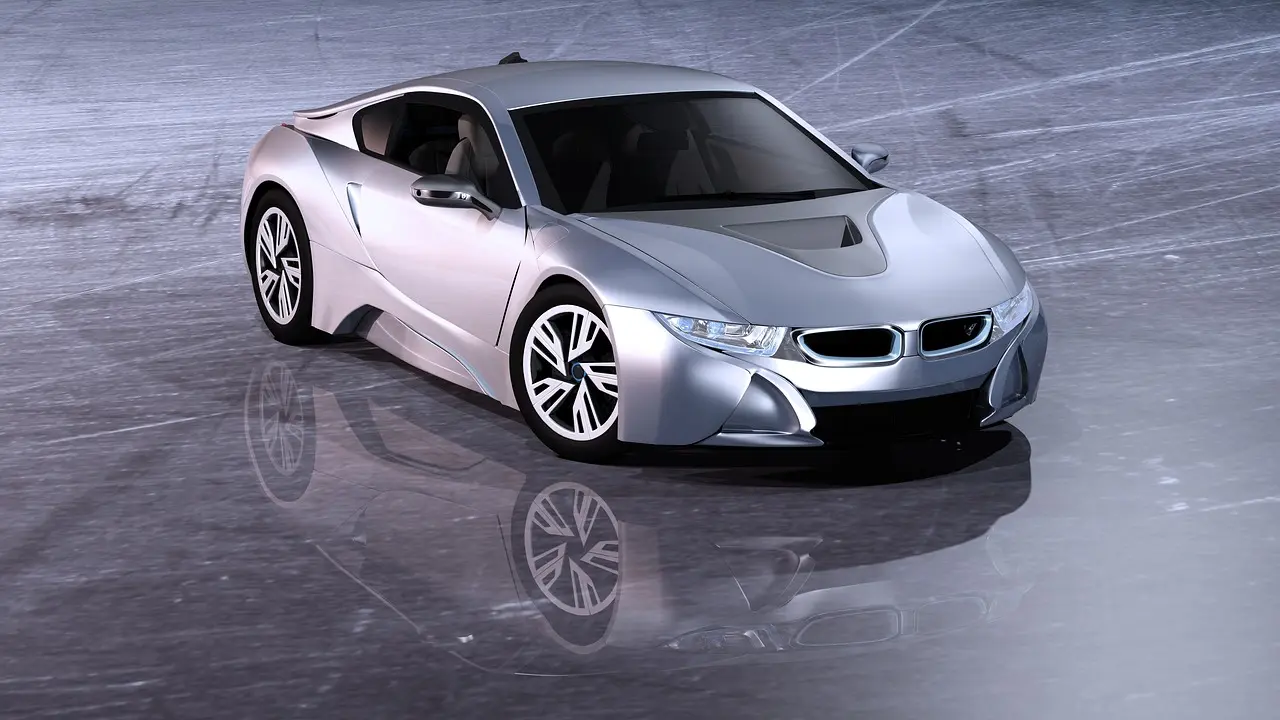


BMW EV reliability varies by model, not by brand name. The i4 sits closer to average reliability, while the iX has drawn more negative reliability sentiment from owners and survey data. Most reports involve software, electronics, charging interruptions, and 12-volt battery trouble rather than major battery-pack failure.
Why reliability differs between the i4 and iX
Consumer Reports predicts the 2026 i4 will have about average reliability, based on owner-survey data. It rated the 2025 iX as less reliable than other cars from the same model year. That gap matters because BMW EV shoppers often compare both vehicles as if they face the same risk profile.
The i4 launched for the 2022 model year, so it has had time to collect owner complaints, recalls, and service-bulletin history. The iX is newer in market presence, but it has picked up more negative sentiment because of electrical complaints, charging interruptions, and recall exposure.
What owner complaints usually point to in BMW EVs
BMW EV complaints filed with NHTSA are owner-reported, so they do not prove a failure rate. They do show where owners most often see problems: electrical system faults, transmission-related warnings, safety-system alerts, and charging issues. That pattern points more toward electronics and software than toward traction-battery collapse.
Picture a used i4 that throws an error message after an overnight charge. That may be an inconvenience, not a pack failure. But if the same car also shows repeated no-start behavior or a history of battery-related recalls, the buyer should slow down and verify every repair record by VIN.
BMW i4 reliability: what buyers should know
The i4 is the safer BMW EV bet for most used buyers. It still has software and electrical complaints, but its overall reliability picture is more average than alarming, and the biggest recent recall was handled with a software update rather than a hardware swap.
Common i4 complaint areas
Owner complaints on the i4 commonly involve infotainment glitches, warning lights, charging interruptions, and 12-volt battery failures. BMW EVs can also show brake-related complaints, often tied to electronic brake feel or fault messages rather than traditional hydraulic brake wear. That distinction matters when you sort nuisance faults from real drivability risk.
Model years and recall exposure
BMW’s 2025 recall for drive-power loss covered 2022-2025 i4 models. NHTSA recall 25V395 affected 70,852 BMW EVs across the i4 and iX lines and was remedied with a software update. That means a used i4 should not be judged by the recall alone, but it should not be bought without checking completion status.
BMW SIB 17 01 24 applies to 2022-2024 model years and concerns a coolant leak bulletin. Service-bulletin history matters because it can show whether a car had repeat cooling-system concerns, even if the issue never rose to a formal safety recall.
What matters most in a used i4 check
Start with the VIN and confirm every recall is closed. Then ask for proof of software updates, because BMW EV problems often sit in modules and control logic rather than in hard parts. If the car has a repeated 12-volt battery replacement history, that deserves more attention than a one-off screen freeze.
BMW iX reliability: what buyers should know
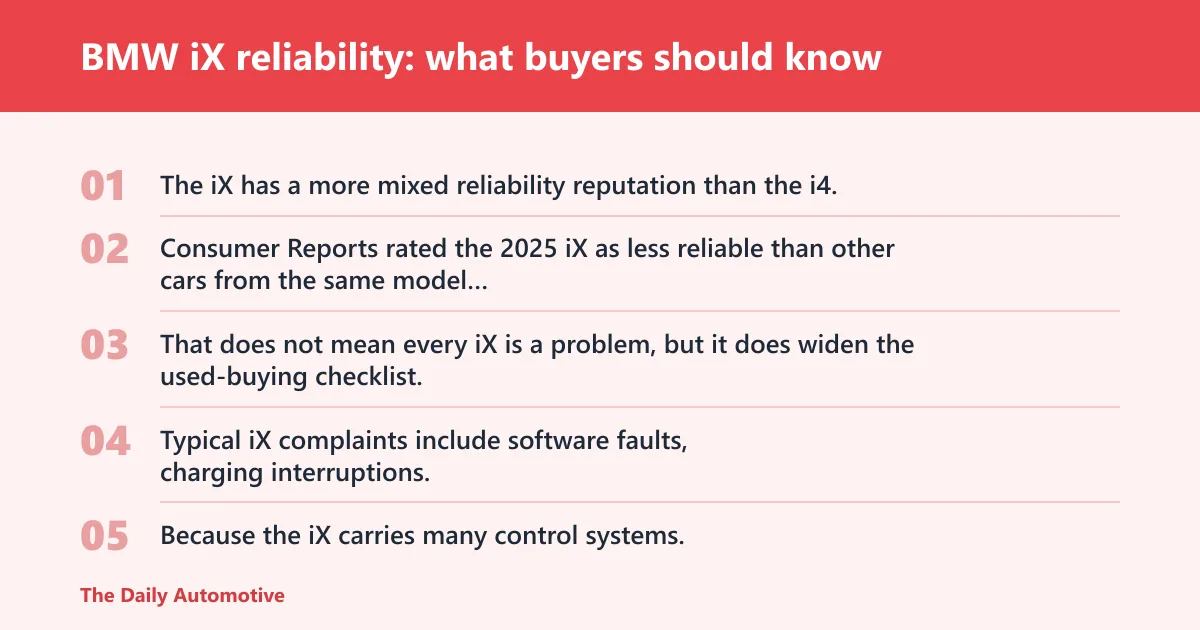
The iX has a more mixed reliability reputation than the i4. Consumer Reports rated the 2025 iX as less reliable than other cars from the same model year, and owner complaints lean harder toward electronics, charging interruptions, and battery-related warnings. That does not mean every iX is a problem, but it does widen the used-buying checklist.
Common iX complaint areas
Typical iX complaints include software faults, charging interruptions, 12-volt battery issues, and occasional high-voltage warning messages. Because the iX carries many control systems, a small glitch can trigger a chain of alerts that looks more serious than the root cause.
A common first-timer mistake is assuming a dash full of warnings means the battery pack is failing. More often, BMW EV trouble starts in low-voltage power supply, charging control, or software calibration. That still costs time and dealer visits, but it is not the same as a destroyed traction battery.
Why the iX draws more negative reliability sentiment
The iX has been touched by more visible recall and battery-adjacent issues than the i4. NHTSA recall 23V295 affected 31 units of the 2022 iX xDrive50 for high-voltage battery cell monitoring connections. A separate 2024 recall affected roughly 3 units of certain i4 and iX builds for high-voltage battery module assembly.
Those are narrow, VIN-specific actions, not evidence of a fleet-wide battery defect. Still, they create buyer anxiety because battery headlines age badly in the used market. Even a tiny recall can hurt resale confidence if sellers cannot document repair completion.
What matters most in a used iX check
Verify recall completion first. Then ask whether the car has had repeated charging interruptions, charging-port faults, or low-voltage battery replacements. If the service history is thin, budget extra time for dealer verification before signing. The iX is not a car to buy on a hunch.
Which BMW EV issues are real no-drive risks?
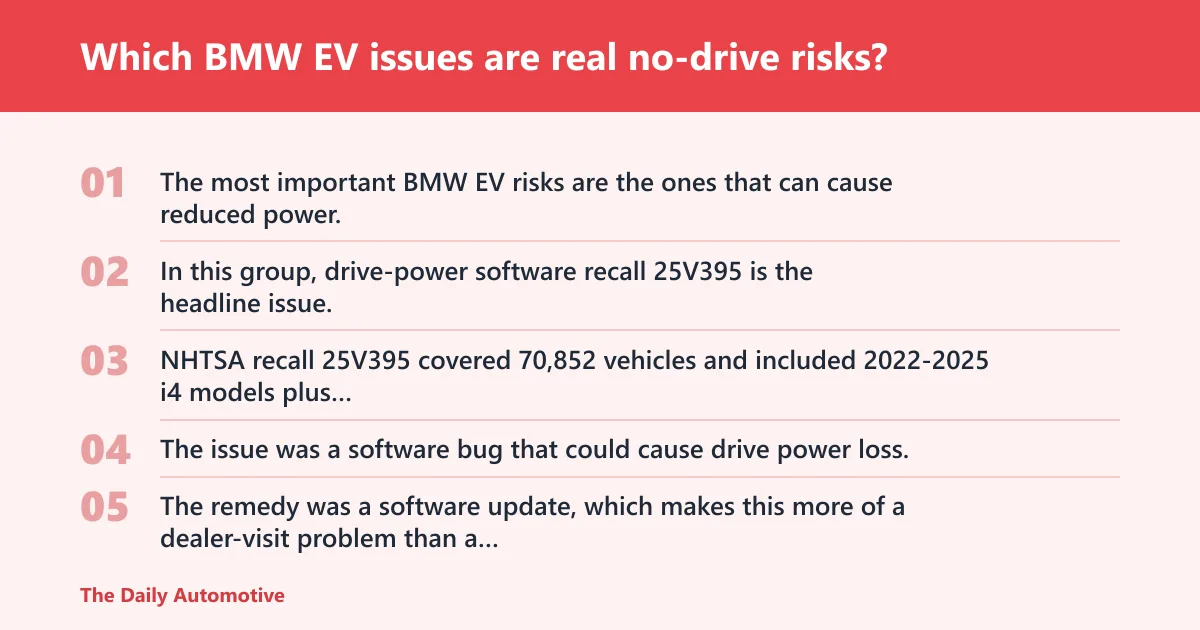
The most important BMW EV risks are the ones that can cause reduced power, charging refusal, or a no-start condition. In this group, drive-power software recall 25V395 is the headline issue, while the earlier battery-related recalls are narrower but still worth checking carefully by VIN.
Drive-power loss recall 25V395
NHTSA recall 25V395 covered 70,852 vehicles and included 2022-2025 i4 models plus 2022-2024 iX models. The issue was a software bug that could cause drive power loss. The remedy was a software update, which makes this more of a dealer-visit problem than a battery-replacement crisis.
For a used buyer, the practical risk is downtime. A car can look healthy on a short test drive and still have an incomplete campaign. If the update is not documented, assume the buyer may inherit scheduling delays and warning-light drama.
High-voltage battery recalls 23V295 and 24V-135
NHTSA recall 23V295 affected 31 units of the 2022 iX xDrive50 for high-voltage battery cell monitoring connections. NHTSA recall 24V-135 affected roughly 3 units of certain i4 and iX builds for high-voltage battery module assembly. Both are tiny populations, but they are still serious enough to verify.
These are not broad failure trends. They are VIN-specific build issues. That difference matters because a shopper should not avoid the whole model on the basis of a narrow recall, but should absolutely confirm a given car is cleared.
How to separate safety risk from nuisance faults
Safety and no-drive risks tend to involve loss of propulsion, battery warnings, or a recall with a defined remedy. Nuisance faults usually involve infotainment resets, temporary warning messages, or charging behavior that returns to normal after software correction. Both deserve attention, but they carry different urgency.
What problems show up most often in BMW EV complaints?
BMW EV complaints most often center on software and electronics, 12-volt battery failures, and charging interruptions. That pattern is less dramatic than battery-pack failure, but it still affects ownership because these issues can immobilize the car or force repeated dealer visits.
Software and infotainment faults
Infotainment freezes, module glitches, and false warning messages are common modern-EV complaints. On a BMW EV, a software issue can create driveability concerns, but it can also be as simple as a screen reboot or a control-unit update. That is why service records matter so much.
12-volt battery failures
Low-voltage battery failures are a recurring theme in EV ownership, and BMW EVs are no exception. When the 12-volt battery weakens, the car may refuse to start, show multiple unrelated warnings, or enter a reduced-function state. A fresh 12-volt battery history is worth checking on any used i4 or iX.
Charging interruptions and electrical-system complaints
Charging interruptions can come from software, charging hardware, or power-management faults. They are annoying because they create uncertainty: did the car stop charging because of the station, the cable, or the vehicle? With BMW EVs, that uncertainty is exactly why pre-purchase documentation matters.
How does BMW’s battery warranty affect repair risk?
BMW’s battery warranty covers 8 years or 100,000 miles, and it protects against capacity loss below 75%. That is useful protection, but it does not make every battery-related concern a warranty claim, and it does not remove the need to check recall status or low-voltage battery history.
What capacity loss below 75% means
This warranty language is about usable battery health, not every warning light. If the high-voltage battery falls below the stated capacity threshold within the warranty window, that is a warranty issue. If the car has a software fault, a charging interruption, or a 12-volt failure, the fix may sit elsewhere.
What the warranty does not cover
The warranty does not protect against every inconvenience that looks like a battery problem. It does not replace careful recall checks, and it does not automatically cover software-related downtime. Used buyers should still verify repair invoices, open campaigns, and any module replacements before purchase.
Model-by-model reliability triage table for i4 and iX
| Model | Issue | Severity | Affected model years | Likely symptoms | Fix type | Pre-purchase verification step |
|---|---|---|---|---|---|---|
| i4 | Drive-power software recall 25V395 | High | 2022-2025 | Reduced power, warning messages, possible no-drive event | Software update | Check VIN for open or completed recall status |
| i4 | 12-volt battery failure | Medium | All used years deserve review | No-start, multiple warnings, odd electrical behavior | Battery replacement and system check | Ask for battery replacement history and test results |
| i4 | Coolant leak bulletin SIB 17 01 24 | Medium | 2022-2024 | Coolant smell, level loss, service visits | Service bulletin repair | Request invoices showing the bulletin was addressed |
| iX | Drive-power software recall 25V395 | High | 2022-2024 | Reduced power, warning messages, possible no-drive event | Software update | Check VIN for recall completion before sale |
| iX | High-voltage battery cell monitoring recall 23V295 | High | 2022 iX xDrive50 | Battery-related warnings, drivability concern | Recall repair | Confirm the specific unit is not one of the 31 affected |
| iX | High-voltage battery module recall 24V-135 | High | Certain i4 and iX builds | Battery warnings, potential no-start concerns | Recall repair | Ask dealer to verify the exact build against the campaign |
| iX | Charging interruptions and electrical faults | Medium | All used years deserve review | Interrupted charging, warning lamps, dealer resets | Diagnostics and software updates | Review charging history and service invoices |
Should you buy a used BMW i4 or iX?
Used buyers should favor the i4 if they want the lower-friction choice, while the iX suits shoppers who are comfortable doing more verification before closing the deal. New-lease shoppers can worry less about long-term repair exposure, but used buyers should treat VIN confirmation as mandatory.
Best fit for new-lease shoppers
If you are leasing new, BMW EV software annoyances are easier to live with because warranty coverage and dealer support are still front-loaded. The biggest risk is inconvenience, not long-term ownership cost. Even then, ask the dealer to confirm all recalls and software campaigns are closed at delivery.
Best fit for used buyers
The i4 is usually the better used purchase if the service file is clean. The iX can still be a good buy, but it asks for more paperwork discipline. A complete recall history, documented software updates, and no recurring low-voltage battery issues should be your minimum standard.
What to verify by VIN before signing
- Check recall status for 25V395 on the exact VIN.
- Confirm any applicable battery recalls were repaired.
- Ask for proof of software updates and module coding work.
- Review service history for 12-volt battery replacements.
- Look for coolant-bulletin repairs on 2022-2024 vehicles.
That checklist is the fastest way to sort a clean BMW EV from one that may spend too much time at the dealer.
Frequently asked questions
Are BMW electric cars reliable?
BMW electric cars are generally reliable, but reliability varies by model and model year. The i4 trends closer to average, while the iX has more negative reliability sentiment. Most complaints involve software, electronics, 12-volt battery issues, and charging interruptions rather than major battery-pack failure.
Is the BMW i4 reliable?
The i4 is the stronger bet if you want a BMW EV with a more average reliability profile. Consumer Reports predicts the 2026 i4 will have about average reliability, and most complaint themes are manageable if recalls are closed and service records are complete.
Is the BMW iX reliable?
The iX is less reassuring than the i4. Consumer Reports rated the 2025 iX as less reliable than other cars from the same model year, and its complaint profile includes more charging and electrical concerns. It can still be a good buy with careful VIN and service verification.
Has BMW recalled the i4 or iX for drive power loss?
Yes. NHTSA recall 25V395 covered 70,852 BMW EVs, including 2022-2025 i4 models and 2022-2024 iX models, for a drive-power software bug. The fix was a software update, so used buyers should confirm completion rather than assume the issue has been handled.
Is BMW EV battery warranty 8 years or 100,000 miles?
Yes. BMW’s battery warranty covers 8 years or 100,000 miles and protects against capacity loss below 75%. That warranty is useful, but it does not replace recall checks or guarantee that software-related charging or starting problems will be covered the same way.
How bad are BMW EV software issues?
BMW EV software issues are common enough to matter, but they are usually more annoying than catastrophic. They can cause warning lights, charging interruptions, or temporary reduced power. The 2025 drive-power recall was fixed with a software update, which shows the practical difference between nuisance faults and true hardware failure.
Products related to this article
Sponsored / affiliate links. As an Amazon Associate I earn from qualifying purchases. I may earn additional commission from eligible campaigns.