E85 in Renault Twingo Will It Cause Damage
Many car owners wonder about using E85 fuel. This is especially true for specific car models like the Renault Twingo. It can seem tricky at first if you are new to alternative fuels.
This article makes it simple. We will walk you through what you need to know about E85 in Renault Twingo: Will It Cause Damage? so you can make a smart choice. Read on to discover how to keep your Twingo running smoothly.
Understanding E85 Fuel and Your Renault Twingo
This section looks at what E85 fuel is and why using it in a Renault Twingo might raise questions. We will explain the basics of this fuel type. We will also discuss why compatibility is important for your car’s engine and fuel system.
This helps set the stage for understanding potential issues.
What is E85 Fuel?
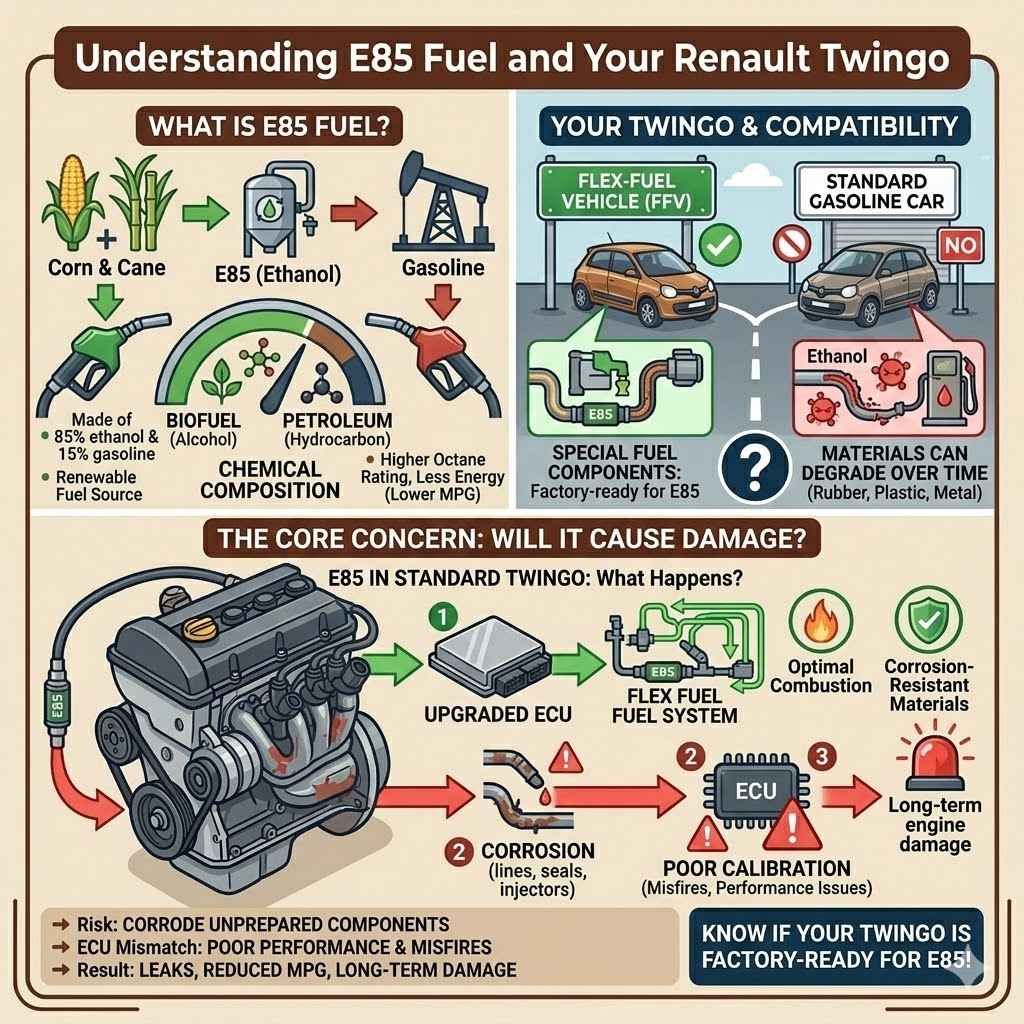
E85 is a biofuel. It is made of 85 percent ethanol and 15 percent gasoline. Ethanol is often made from corn or other plant materials.
This makes it a renewable fuel source. It can offer some benefits like lower emissions compared to pure gasoline.
Ethanol has a higher octane rating than regular gasoline. This means it can resist knocking or pinging better. This can be good for high-performance engines.
However, it also means ethanol contains less energy per gallon than gasoline. You will typically get fewer miles per gallon when using E85.
The key difference between E85 and regular gasoline is their chemical composition. Ethanol is an alcohol. Gasoline is a petroleum-based product.
This difference affects how they interact with engine parts. It also influences how much heat and energy they produce when burned.
Why Compatibility Matters for Your Twingo
Not all cars are built to run on E85 fuel. Cars designed for E85 are called flex-fuel vehicles or FFVs. These cars have special fuel system components.
They can handle the corrosive nature of ethanol.
Regular gasoline cars have fuel systems made from materials that can degrade. This is due to ethanol’s properties. Over time, ethanol can eat away at rubber and plastic parts.
It can also cause metal components to corrode. This damage can lead to leaks, fuel system failures, and engine problems.
If your Renault Twingo is not an FFV, using E85 is not recommended. It is like trying to use a different type of liquid for your car’s oil. The wrong type can harm the engine.
It’s essential to know if your Twingo is factory-ready for E85.
E85 in Renault Twingo Will It Cause Damage? The Core Concern
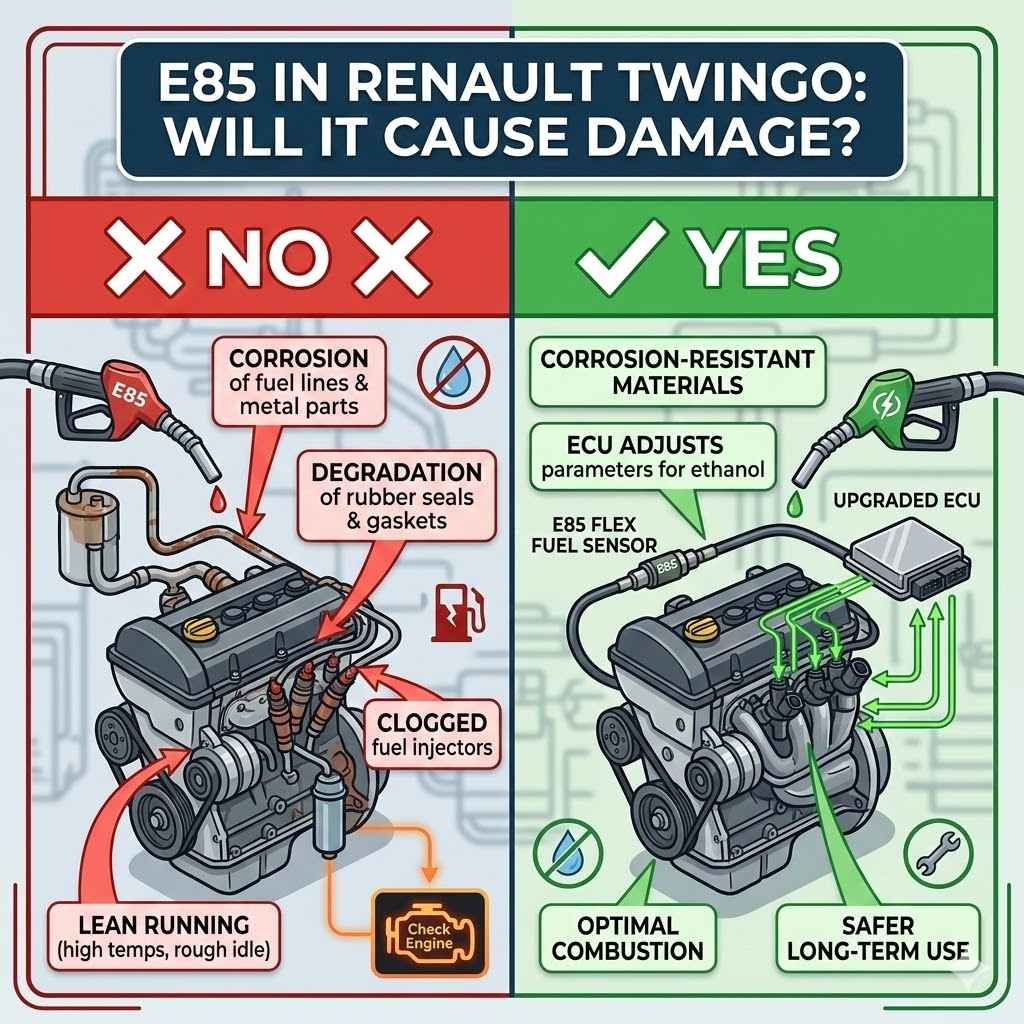
The main worry for Twingo owners is whether E85 in Renault Twingo Will It Cause Damage?. This concern comes from the fact that many standard Twingo models were not made as flex-fuel vehicles. Their fuel systems are designed for gasoline, not high concentrations of ethanol.
The risk is that the ethanol in E85 can corrode fuel lines, seals, and injectors. These parts might be made from materials that cannot withstand prolonged exposure to ethanol. This corrosion can lead to leaks, reduced fuel efficiency, and costly repairs.
Furthermore, the engine’s computer might not be calibrated to manage the different air-fuel mixture E85 requires. This can lead to poor performance, engine misfires, and potential long-term engine damage. So, the question is not just about fuel type but about the car’s specific engineering.
Assessing Your Renault Twingo’s Fuel System Compatibility
Before even thinking about E85, it’s vital to know if your specific Renault Twingo can handle it. This involves checking its original design and any modifications. We will guide you on how to find this information and what it means.
Identifying Flex-Fuel Capability
The easiest way to know if your Twingo can use E85 is to check if it’s a flex-fuel vehicle (FFV). Most manufacturers will clearly label FFVs. Look for a sticker on the fuel filler door or inside the gas cap.
It might say “Flex Fuel” or show the E85 symbol.
You can also check your car’s owner’s manual. It will specify the types of fuel approved for your vehicle. If the manual mentions E85 or flex-fuel compatibility, you are likely in the clear.
If it only lists regular gasoline, then E85 is not an option.
Another method is to check your Vehicle Identification Number (VIN). Some online VIN decoders can tell you if your car was manufactured as a flex-fuel model. This can be a reliable way to confirm.
However, always cross-reference with your owner’s manual if possible.
What If Your Twingo Is Not a Flex-Fuel Vehicle?
If your Renault Twingo is not a flex-fuel vehicle, then using E85 is not advised. The fuel system components are not made to resist ethanol corrosion. These components include the fuel pump, fuel lines, fuel injectors, and seals.
Ethanol can absorb water from the air. This water can cause corrosion in metal fuel tank parts. It can also cause rubber and plastic parts to swell, harden, or crack.
This degradation can lead to fuel leaks, which are a serious fire hazard.
Symptoms of using the wrong fuel might appear over time. These can include a check engine light, rough idling, poor acceleration, or even stalling. Addressing these issues can be very expensive.
It often requires replacing entire fuel system components.
Materials Science Behind Fuel System Components
The materials used in automotive fuel systems are carefully chosen based on the fuel they are designed to handle. Standard gasoline fuel systems often use materials like:
- Nitrile Butadiene Rubber (NBR): Common for seals and hoses. NBR can degrade when exposed to higher concentrations of ethanol over time. It can become brittle or swell, leading to leaks.
- Stainless Steel and Aluminum Alloys: Used for fuel tanks and lines. While generally resistant to gasoline, some alloys might be more susceptible to corrosion from ethanol-water mixtures.
- Certain Plastics and Polymers: Used for fuel pump components and filters. Some plastics can absorb ethanol and lose their structural integrity.
Flex-fuel vehicles use materials that are specifically designed to withstand ethanol. These include:
- Fluoroelastomers (like Viton): These are much more resistant to ethanol and offer better sealing properties in a flex-fuel environment.
- Corrosion-Resistant Stainless Steel Alloys: Used for fuel tanks and lines to prevent degradation from ethanol.
- Ethanol-Resistant Polymers: Used in fuel pumps and injectors to ensure durability and prevent leaks.
The difference in material science is the primary reason why using E85 in a non-flex-fuel car causes damage. It’s a mismatch between the fuel’s properties and the materials’ resistance.
Potential Damage from Using E85 in a Non-Flex-Fuel Twingo
If you decide to use E85 in a Twingo that isn’t designed for it, you risk significant damage. This section details the specific parts that can be affected and the consequences.
Fuel System Corrosion and Degradation
Ethanol is a solvent. It can break down certain types of rubber and plastic found in older fuel systems. This can cause components to become soft, swell, or become brittle and crack.
Fuel lines are particularly vulnerable.
Cracked fuel lines can lead to fuel leaks. This is a serious safety concern. It can also mean that not enough fuel reaches the engine, causing performance issues.
Fuel pump seals can also degrade. This can lead to pump failure and leaks.
The fuel injectors themselves can also be affected. If the seals or internal components are not ethanol-resistant, they can leak or become clogged. This disrupts the precise spray pattern needed for efficient combustion.
Damage to Fuel Pump and Injectors
The fuel pump is designed to work under pressure. If its seals or internal parts corrode, it can lose efficiency or fail entirely. A failing fuel pump won’t deliver enough fuel to the engine.
This can cause sputtering and a lack of power.
Fuel injectors are precision-engineered parts. They spray fuel into the engine cylinders. If the ethanol damages the seals or nozzles of the injectors, they can leak fuel into the cylinders when they shouldn’t.
They can also become partially blocked, leading to a poor fuel spray pattern.
A poor fuel spray pattern means the fuel and air don’t mix properly. This results in incomplete combustion. It can lead to reduced power, higher emissions, and increased wear on engine components.
Engine Performance Issues and Potential Mechanical Harm
Using E85 in a non-flex-fuel car can lead to noticeable performance problems. The engine’s computer is not programmed to account for the different energy content and combustion characteristics of E85.
You might experience rough idling. This is when the engine runs unevenly when stopped. Acceleration might be sluggish.
The engine could even misfire, causing a jerky ride or sounds of sputtering. These are signs the engine is struggling to run on the fuel.
In the long term, these issues can cause more serious mechanical harm. Unburned fuel can wash oil off cylinder walls, increasing wear. Overheating can occur because ethanol burns cooler but the engine’s cooling system might not be optimized for the fuel’s demands.
This can strain engine components like pistons and rings.
Real-World Scenarios and Consequences
Understanding potential damage is one thing, but seeing how it plays out in real situations is another. Here are some examples of what can happen when E85 is used incorrectly.
Case Study 1 A Twingo Owner’s Experience
A Renault Twingo owner, unaware their car was not a flex-fuel model, decided to try E85 fuel for a lower price. After a few weeks of using it, they noticed their car was not running as smoothly. The engine would hesitate when they pressed the accelerator.
Soon after, the check engine light came on. The car started to run rough at idle. It even stalled a couple of times.
The owner took it to a mechanic.
The mechanic found that the fuel lines had started to soften and swell. The fuel pump seals were also degraded. The fuel injectors were partially blocked and not spraying fuel correctly.
The repair bill was significant, involving replacement of most of the fuel system. This experience highlights the direct link between using the wrong fuel and costly damage.
Case Study 2 The Gradual Deterioration
Another Twingo owner used E85 very occasionally, perhaps once every few months, thinking it wouldn’t cause much harm. Over the course of a year, they didn’t notice major issues beyond slightly lower miles per gallon. However, the constant, even low-level, exposure to ethanol was slowly damaging the fuel system.
One day, the car suddenly lost power while driving. They had to pull over. Upon inspection, it was found that a fuel line had developed a large crack.
This caused a significant fuel leak. The gradual damage had finally led to a failure.
This scenario shows that even infrequent use can lead to problems over time. The cumulative effect of ethanol on incompatible materials is significant. It proves that E85 should only be used if the vehicle is explicitly designed for it.
Scenario Example for Non-Flex-Fuel Cars
- A driver fills their non-flex-fuel Renault Twingo with E85.
- The ethanol in the fuel begins to interact with the rubber seals in the fuel lines.
- Over the next few weeks, these seals soften and lose their integrity.
- This causes small fuel leaks to develop.
- The engine control unit detects the fuel system issues and illuminates the check engine light.
- The driver may experience poor engine performance, such as rough idling or hesitation.
- If the leaks worsen, the car’s safety is compromised due to the presence of flammable fuel.
- Eventually, a fuel line could rupture, leading to a dangerous fuel leak or complete engine failure.
Alternatives and Safe Fueling Practices
Given the risks, it’s important to know what you should do instead. This section offers practical advice on fueling your Twingo safely and what to do if you’re unsure.
Always Use Approved Fuels
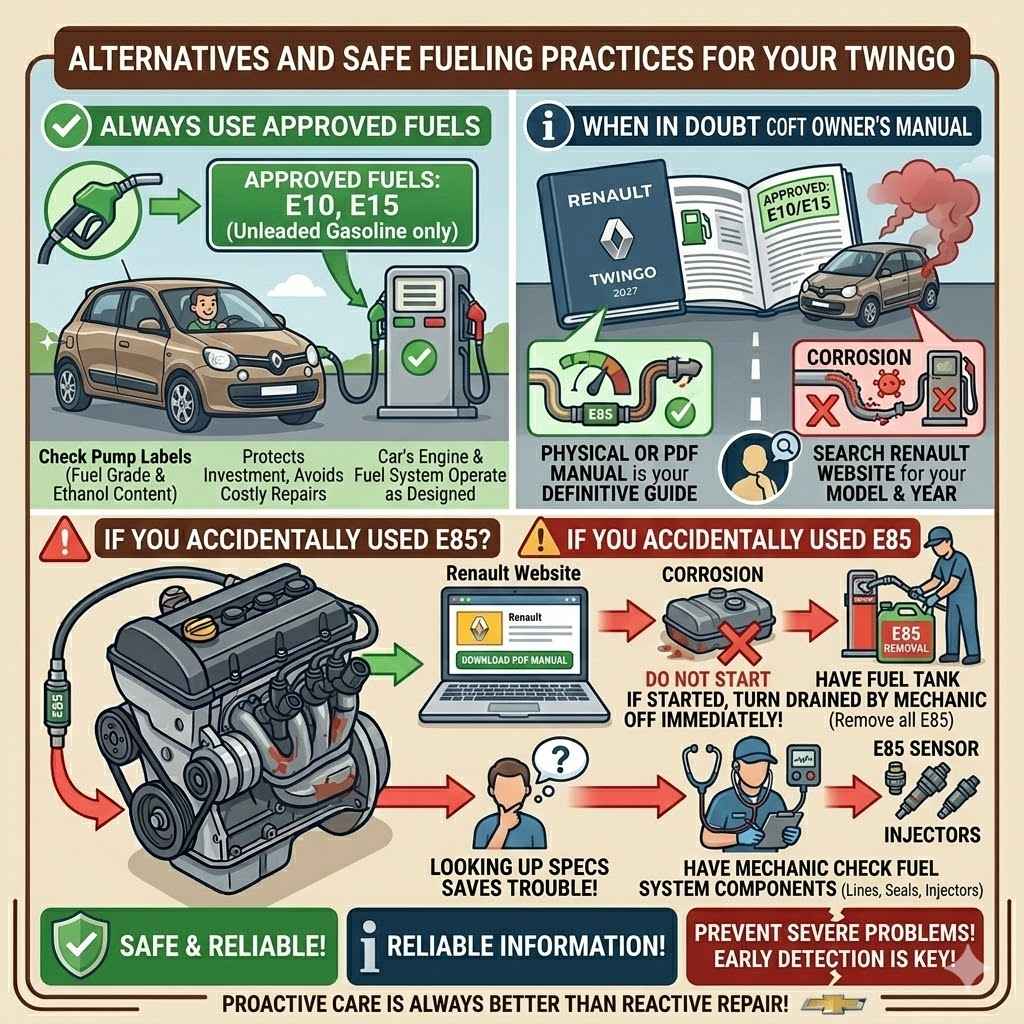
The most important rule is to only use the fuel types recommended in your Renault Twingo’s owner’s manual. If it specifies regular unleaded gasoline (e.g., E10 or E15 depending on region), stick to that.
Using the correct fuel ensures your car’s engine and fuel system operate as designed. It protects your investment and avoids costly repairs. Always check the label at the pump to confirm the fuel grade and ethanol content.
If you are unsure about a specific fuel, it’s always better to err on the side of caution. Choose a fuel that you know is safe for your vehicle. Your car’s longevity depends on it.
When in Doubt Consult Your Owner’s Manual
Your car’s owner’s manual is the definitive guide to its care and operation. It will clearly state what fuels are acceptable. It will also provide information on fuel system maintenance.
If you can’t find your physical manual, you can usually download a PDF version from the Renault website. Search for your specific Twingo model and year.
Looking up your car’s specifications can save you a lot of trouble. It is the most reliable source of information for your particular vehicle.
What to Do If You Accidentally Used E85
If you accidentally put E85 in your non-flex-fuel Twingo, do not start the engine. If you have already started it, turn it off immediately. The less the engine runs on the wrong fuel, the less potential damage will occur.
You will need to have the fuel tank drained by a mechanic. They will remove the E85 and
It’s wise to have your mechanic check your fuel system components. This is especially true if you drove the car for a significant distance on E85. Early detection of damage can prevent more severe problems down the line.
Frequently Asked Questions
Question: Can I put E85 in any Renault Twingo?
Answer: No, you can only put E85 in a Renault Twingo if it is specifically designed as a flex-fuel vehicle (FFV). Most standard Twingo models are not FFVs.
Question: What happens if I put E85 in a normal Twingo?
Answer: You risk damaging the fuel system. Ethanol in E85 can corrode rubber and plastic parts, leading to leaks, poor performance, and potential engine damage.
Question: How do I know if my Twingo is a flex-fuel vehicle?
Answer: Check for a “Flex Fuel” label on the fuel filler door or in the owner’s manual. You can also check your VIN with a decoder.
Question: Will E85 hurt my engine if I use it just once?
Answer: Even a single use can start to degrade fuel system components. Long-term or repeated use is much more likely to cause significant damage.
Question: What should I do if I accidentally put E85 in my Twingo?
Answer: Do not start the engine if possible. If you have started it, turn it off immediately. Have the fuel tank professionally drained and refilled with the correct gasoline, and have the fuel system inspected.
Final Thoughts
Using E85 in a Renault Twingo that isn’t a flex-fuel vehicle can cause serious damage to your fuel system and engine. Always confirm your Twingo’s compatibility before using E85. Stick to the approved fuels listed in your owner’s manual to keep your car running safely and reliably.
If you are unsure, it is always best to play it safe.