Car Garbage Bags: Hanging Pouches vs. Liner Rolls
Choose a reusable hanging pouch for wet, frequent messes and a liner roll for cheap, quick replacement or a low-profile backup; if you want one rule, use the pouch for daily family traffic and the roll for occasional overflow. Pick wrong, and trash leaks, smells, and spills spread across seats and footwells. This guide compares fit, cleanup time, price over time, odor control, and which style works best for parents and drivers.
| Decision factor | Hanging Pouches | Liner Rolls | Winner |
|---|---|---|---|
| Spill containment | Better for wet waste when the pouch has a leakproof or water-resistant lining and a lid | Better for dry trash; liquid can pool if the liner sags or slips in a can | Hanging Pouches |
| Odor control | Stronger when paired with a hinged top or odor control lid | Weaker unless the vehicle already has a lidded bin or frequent emptying | Hanging Pouches |
| Cleanup time | Wipe, dump, and rehang; reusable, but it adds a cleaning step | Pull the liner, tie it off, and drop it; fastest for quick turnover | Liner Rolls |
| Replacement cost | Lower per use over time if washed and reused | Higher over time because each bag is disposable | Hanging Pouches |
| Storage space | Takes more room than a flat stack because of the shell and hardware | Compact roll storage fits a console, glove box, or cargo bin | Liner Rolls |
| Installation ease | Needs a strap, hook, or seatback mount, then adjustment for height | Simple drop-in use if you already have a can or bin | Liner Rolls |
| Ride stability | More stable when the strap is snug and the pouch has side structure | Depends on the can or holder; loose liners can collapse | Hanging Pouches |
| Child-safety convenience | Better for back-seat reach, quick tosses, and front-access openings | Better as a spare, but less convenient for rear-seat snack traffic | Hanging Pouches |
| Best vehicle type | Sedans, SUVs, and minivans that see regular wet trash | Small cars, rideshare cars, and backup use where space is tight | Depends on use case |
| Best mess type | Food scraps, drinks, wipes, and sticky snack packaging | Wrappers, napkins, receipts, and light dry waste | Depends on mess type |
How hanging pouches and liner rolls differ in use
Hanging pouches stay in the cabin and catch daily messes where they happen. Liner rolls are made for fast replacement and small storage, so they fit as a spare bag with very little bulk.
What each format is built to do
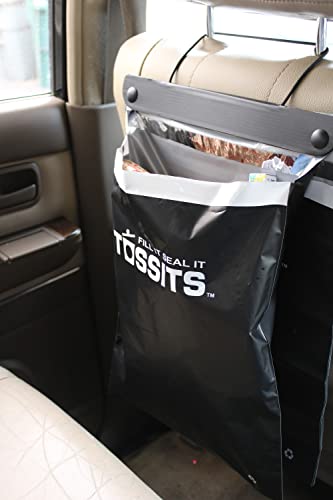
A hanging car trash bag usually mounts to a headrest or seatback with an adjustable strap, then opens from the front so passengers can toss trash in without pulling it down. Most hanging styles land around 1.75 to 2.5 gallons, with some going up to about 3 gallons, so the bag can handle repeated snack waste before it needs emptying.
Liner rolls work like can liners: you tear off a bag, fit it over a bin or holder, and replace it when full. That format suits drivers who want a low-profile backup and do not want to wash a reusable shell.
Car trash
A simple way to choose is to match the bag to the mess, not only the vehicle. Wet waste and food scraps push the decision toward Hanging Pouches. Dry wrappers, light clutter, and spare-bin use point to Liner Rolls.
How to read the table
- If the mess is wet or smells quickly, favor containment and odor control.
- If the main goal is fast replacement, favor a disposable roll.
- If the bag will live in the cabin full-time, check mounting and ride stability.
- If storage space is tight, look hard at the roll format.
Which format handles spills better?
Reusable car trash organizers often handle spills better because many use a waterproof or leak-proof lining such as PEVA, plus a shell made from Oxford fabric. A front-access opening and an optional odor control lid also help keep liquid waste and food scraps inside the bag instead of in the footwell.
Wet waste, wipes, and drink cups
That matters when the trash is not dry. A wet wipe, a half-empty juice box, or a tipped coffee cup can soak a loose liner or slide under the edge of a can, while a lined pouch keeps the mess in one place until you empty it.
When liner rolls still make sense for damp waste
Liner Rolls can still work for slightly damp trash if you empty them often and use a bin that keeps the bag from collapsing inward. For a dry commute, that is usually enough. For a family road trip with spill-prone snacks, it is usually not.
Which one cleans up faster?
Liner Rolls are faster at cleanup because the filled liner can be removed and replaced. Hanging Pouches take a little longer because you usually dump the contents, wipe the lining, and rehang the bag, but that extra step buys better reuse and better wet-mess control.
Emptying versus swapping
Reusable pouches are slower, but only by a small margin if the design uses a sticky strap bottom for dumping or a front opening that makes it easy to clear crumbs and wrappers. The trade-off is maintenance, not complexity.
Road-trip reality
Suppose a sedan carries two children, drinks, and snack wrappers for a 300-mile drive. The pouch gets fuller faster, but the same bag keeps the mess from spreading across the seatback area. A roll is easier to toss, yet it can become the weaker choice once liquids enter the mix.
Which one costs less over time?
Hanging Pouches usually cost less over time because one reusable shell can handle many fill-and-empty cycles. Liner Rolls look cheaper at the shelf, but replacement frequency adds up, especially if the car needs a fresh bag every few days.
Replacement frequency and cost per use
A reusable pouch can lower cost per use if it is washed regularly. That matters in minivans and family SUVs, where the bag may fill with wet wipes, snack packets, and drink lids every week.
Liner Rolls are the simpler budget pick for low-volume trash. They are also the easier choice when you want a cheap spare in the glove box or cargo area.
Washing time versus quick disposal
Reusable bags ask for wipe-down time, and that is the real ownership cost. Disposable liners ask for more frequent replacement, but less cleanup work. Choose which cost you dislike more: time at the sink or repeat spending on liners.
What size and fit should you buy?
For most hanging styles, about 1.75 gallons fits light commuter use, 2.5 gallons is a practical middle ground, and 3 gallons often works best for families, road trips, or rideshare duty. Bigger capacity usually means fewer emptying stops, but only if the bag still hangs securely and does not swing around.
Capacity and emptying frequency
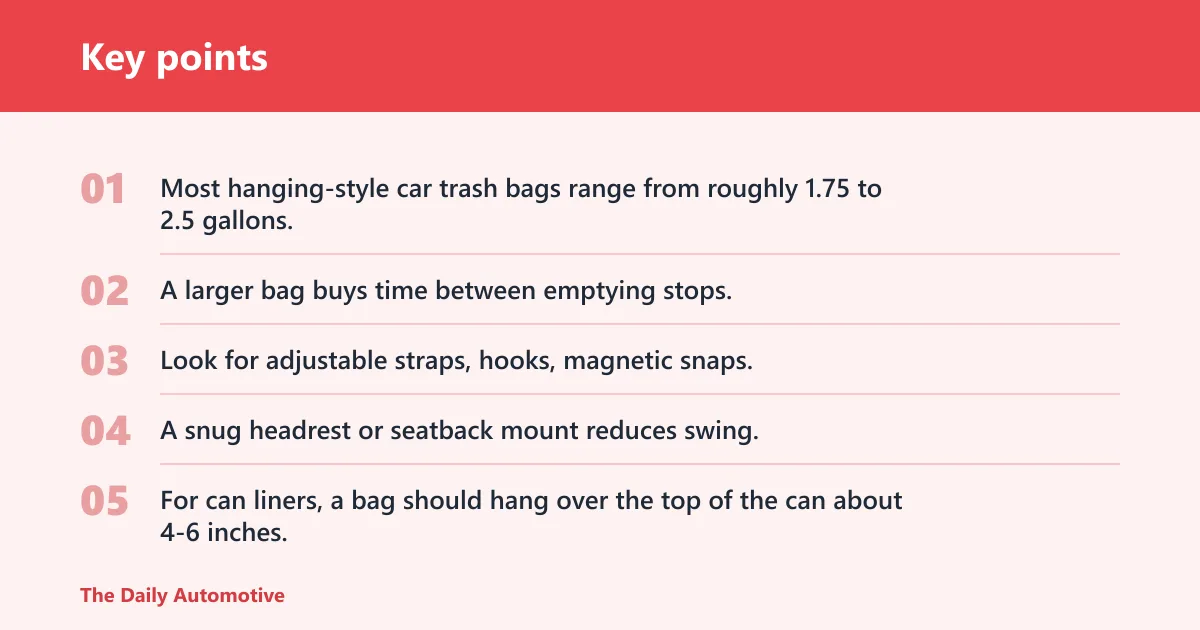
Most hanging-style car trash bags range from roughly 1.75 to 2.5 gallons, and a 3-gallon pouch gives more margin for food packaging and drinks. A larger bag buys time between emptying stops, but a small sedan may not have the clearance for an oversized pouch.
Mounting hardware and ride stability
Look for adjustable straps, hooks, magnetic snaps, or rigid side bars if you want the bag to stay open and keep its shape. A snug headrest or seatback mount reduces swing, which matters when passengers toss trash at speed or when the car corners sharply.
Overhang, liner fit, and backup use
Liner rolls need fit attention too. For can liners, a bag should hang over the top of the can about 4-6 inches; too little and it falls in, too much and it flops around. High-density liners are thinner and less puncture resistant, while low-density liners are stronger and more puncture resistant.
Best fit by vehicle type
Sedans usually do better with a compact hanging pouch near the rear of the center console or a seatback, especially if front-seat legroom is tight. SUVs and minivans have more room for a larger pouch and are the easiest place to use a 2.5-gallon or 3-gallon format without crowding the cabin.
Choose Hanging Pouches if… / Choose Liner Rolls if…
Choose Hanging Pouches if your car sees wet trash, sticky snack waste, wipes, and drinks. Choose them again if you want a mounted bag that stays in place, or if you drive a sedan, SUV, or minivan with regular kid traffic and need better spill control.
Choose Liner Rolls if you want the cheapest quick replacement, the smallest stored footprint, or a backup bag that lives out of the way until needed. They fit best for rideshare cars, dry trash, and drivers who already use a bin or holder that keeps the liner upright.


What material should a leakproof car trash liner use?
For reusable pouches, Oxford fabric with a PEVA lining is a strong combination because the outside shell handles wear while the inside wipes clean after spills. For disposable liners, LDPE is better when you need more puncture resistance, while HDPE is the thinner, more cost-effective choice for lighter waste.
Oxford fabric and PEVA lining
Oxford fabric shows up often in reusable hanging pouches because it is durable and washable. PEVA lining matters because it helps contain liquid and gives you a surface that wipes clean more easily after wet wipes, food residue, or a tipped drink.
LDPE and HDPE on liner rolls
LDPE liners are the better pick for sharper or heavier waste because they are stronger and more puncture resistant. HDPE liners are thinner, usually more affordable, and often come on rolls, which fits the quick-replacement role of a disposable backup bag.
How do you keep a car trash bag from sliding around while driving?
Start with the mount. An adjustable strap around the headrest or seatback is the most dependable setup, and rigid side bars can help the pouch keep its shape so it does not fold inward. If the bag still moves, shorten the strap and keep the load balanced.
Mounting choices that help
Hooks work when the vehicle has a stable anchor point. Magnetic snaps make bag changes faster on some designs. A seatback mount is usually better than a loose floor bin because the bag stays up, stays visible, and is easier for rear-seat passengers to reach.
Say your compact sedan has two back-seat riders and a pouch hanging from the front seatback. If the bag sits too low, it swings into the seat pocket and gets in the way. Raise the strap one notch and the opening stays reachable without bouncing against the seat.
What’s the difference between trash bags, garbage bags, and can liners?
For car shopping, the names often overlap. Plasticplace says trash bags, garbage bags, and can liners all refer to the same product, so the real decision is not the label; it is the fit, thickness, and whether you want a reusable pouch or a disposable liner.
Fit matters more than the name
Can liner fit depends on the bin and the overhang. If the bag does not sit about 4-6 inches over the top, it can sink into the container or flap around while the car moves. That is why a roll can fail in practice even when the size sounds close on paper.
Are hanging car trash bags better than liner rolls for a car?
Yes, for wet or messy cabin use, Hanging Pouches are usually the better car trash solution. Liner Rolls win when you want a cheap, compact spare that can be replaced in seconds. The right choice depends on whether your main problem is spill control or quick turnover.
Best use by vehicle and mess type
Families with kids usually get more value from a hanging pouch because snacks, wipes, and drink cups create mixed waste. Rideshare drivers often prefer liner rolls as a backup because they store easily and do not take up much room when the car is clean.
What size car trash bag should I buy for a sedan or SUV?
For a sedan, start at about 1.75 to 2.5 gallons so the bag fits without crowding the footwell or the seatback. For an SUV, 2.5 gallons to 3 gallons is usually the better range because the extra space handles family trash without forcing constant emptying.
Sedan versus SUV fit
Sedans need tighter placement and better mounting hardware. SUVs usually have the room for larger hanging pouches, but you still need to check the seatback shape, strap length, and whether the opening stays easy to reach from the rear seat.
Do car trash bags leak if I put drinks or wet wipes inside?
They can leak if the lining is weak, the opening is unsealed, or the bag is overloaded. A leakproof or water-resistant lining, plus a lid or tight front opening, lowers the risk. Wet wipes are usually manageable; open drinks are the problem.
What to look
Reusable pouches with PEVA lining are the safer bet for liquid messes. Disposable liners can work for dry trash, but once a drink cup tips over, the liner may bunch up or let liquid pool at the bottom of the car bin.
How often should I empty a car garbage bag on road trips?
Empty it whenever wet waste starts to sit for long stretches or the bag is about two-thirds full. On road trips, that often means at fuel stops or meal breaks, because odor control drops fast once food scraps and liquid trash build up.
Road-trip timing
A 2.5-gallon pouch can stretch farther than a small liner, but only if the trash is mostly dry. If the bag holds cups, wipes, or food containers, empty it earlier. That keeps odor down and prevents a spill from becoming a seat-cleaning job.
Which car trash bag type is best for families with kids?
Hanging Pouches are usually the better family choice because they are easier for rear-seat passengers to reach and better at containing wet, sticky, or mixed trash. A front-access opening, adjustable strap, and leakproof lining matter more in a child-heavy cabin than a low-profile disposable liner.
Family-use details
For snack-heavy driving, an odor control lid helps more than a plain open bag. In a minivan, a 3-gallon pouch gives the most breathing room, while a smaller sedan may do better with a 2.5-gallon format that stays out of the way.
Frequently asked questions
Do car trash bags come on rolls or in flat packs?
Both formats exist. Liner Rolls are the common disposable option and are easy to store in a glove box or cargo bin. Flat packs show up too, but rolls are simpler to dispense and are usually the better fit when you want quick replacement on the road.
Are reusable car trash pouches better than disposable liners?
Reusable pouches are better for wet, frequent messes and for drivers who want one mounted solution in the car. Disposable liners are better when you want a quick toss-and-replace option, lower storage bulk, or a low-commitment backup bag.
Products related to this article
Sponsored / affiliate links. As an Amazon Associate I earn from qualifying purchases. I may earn additional commission from eligible campaigns.