Gas Car Engines: An Essential, Ultimate Guide
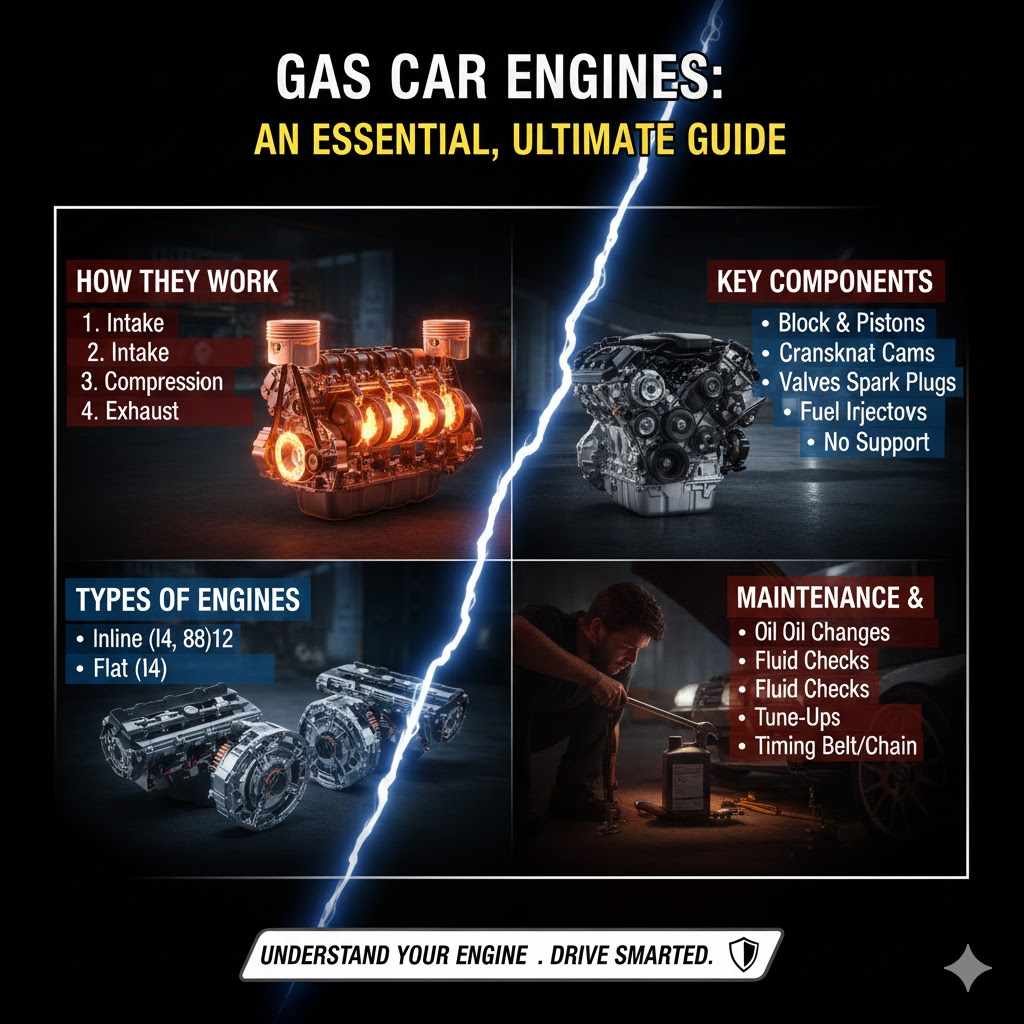
A gas car engine works by mixing fuel and air inside a cylinder, compressing it with a piston, and igniting it with a spark plug. This tiny explosion pushes the piston down, turning a crankshaft that powers your wheels. This process, called the four-stroke cycle, repeats thousands of times per minute to make your car move.
Have you ever popped the hood of your car and felt a little overwhelmed? All those wires, belts, and metal parts can look like a complex puzzle. It’s easy to feel like you need to be a rocket scientist to understand how it all works. But what if I told you that the heart of your car, the gas engine, operates on a very simple, repeating pattern?
You don’t need a mechanic’s license to grasp the basics. Understanding your engine helps you take better care of your car, spot problems early, and talk confidently with your mechanic. In this guide, I’ll walk you through everything you need to know, one simple step at a time. Let’s look under the hood together and uncover the magic that makes your car go.
What Exactly is a Gas Car Engine?
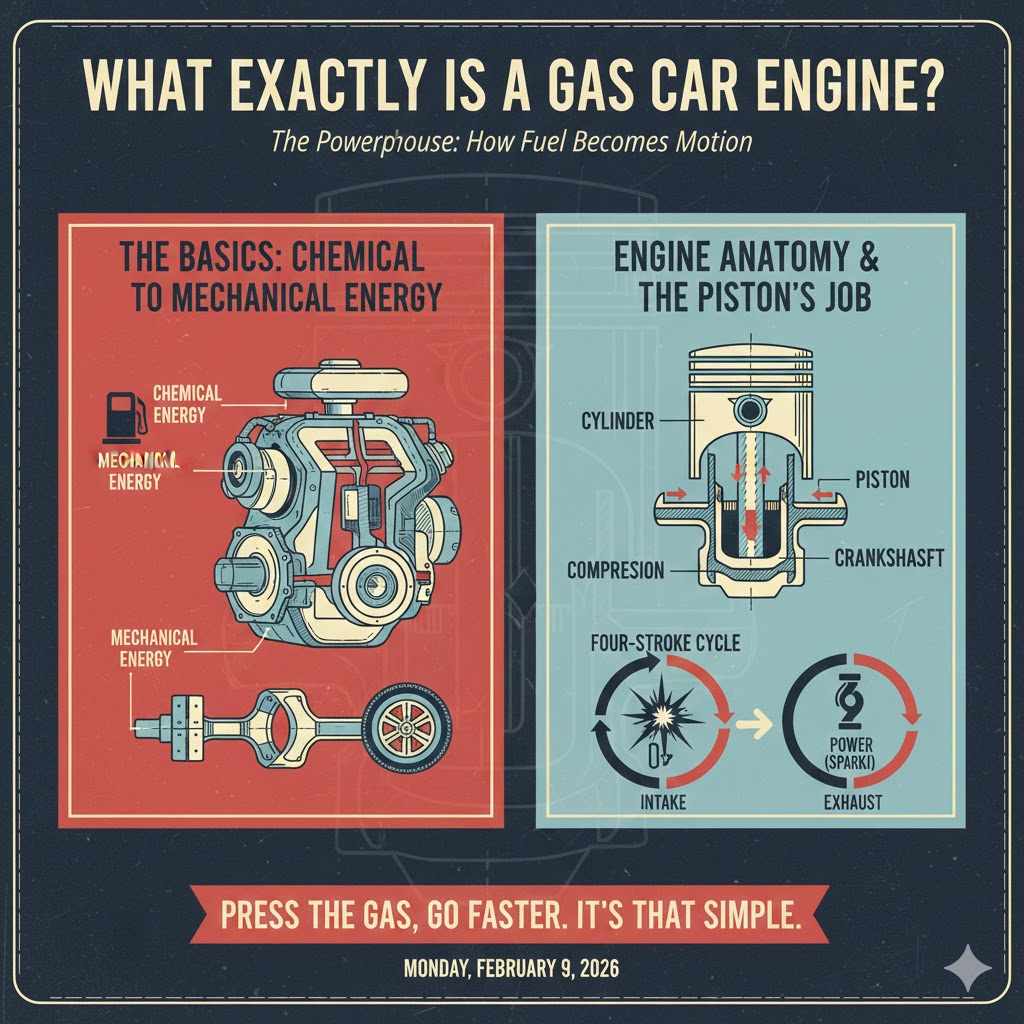
Think of your car’s gas engine as its powerhouse. Its main job is to turn the chemical energy stored in gasoline into the mechanical energy that moves your car forward. It does this through a process called internal combustion. That sounds fancy, but it just means the fuel burns inside the engine itself.
The engine is made up of several key parts that work together in perfect harmony. At its core are cylinders, which are hollow tubes where all the action happens. Inside each cylinder is a piston that moves up and down. This simple up-and-down motion is what starts the entire process of powering your vehicle. Every time you press the gas pedal, you’re telling the engine to do this job faster, creating more power and making your car accelerate.
The Heart of the Matter: The Four-Stroke Cycle Explained
Almost every gas car on the road today uses a four-stroke engine. This name comes from the four essential steps, or strokes, the piston makes to create power. Imagine pedaling a bicycle. Each push on the pedal creates movement. The four-stroke cycle is a similar idea, but it happens incredibly fast—hundreds or even thousands of times per minute!
Let’s break down these four simple steps.
1. The Intake Stroke
First, the piston moves down inside the cylinder. As it does, a tiny door called the intake valve opens. This creates a vacuum that sucks a mixture of air and a fine mist of gasoline into the cylinder. Think of it like drawing back the plunger on a syringe. The cylinder is now filled with the ingredients needed for combustion.
2. The Compression Stroke
Next, the intake valve closes, sealing the cylinder. The piston then moves back up, squeezing the air and fuel mixture into a much smaller space. Compressing this mixture makes it much more powerful when it ignites. It’s like squeezing a spring—you’re building up a lot of potential energy for the next step.
3. The Power (or Combustion) Stroke
This is where the magic happens! With the air-fuel mixture tightly compressed, the spark plug at the top of the cylinder fires, creating a small, controlled explosion. This explosion forces the piston down with incredible force. This powerful downward push is what generates the power to turn the car’s wheels. This is the “bang” that makes your car go!
4. The Exhaust Stroke
Finally, the piston moves back up one last time. As it does, another door called the exhaust valve opens. The piston pushes all the used-up gases (the exhaust) out of the cylinder and into the car’s exhaust system. Once the cylinder is clear, the exhaust valve closes, and the whole four-step process starts all over again.
This entire cycle happens in a fraction of a second, across multiple cylinders, creating the smooth, continuous power you feel when you drive.
Key Components of a Gas Engine (And What They Do)
While the four-stroke cycle is the main event, a team of important parts makes it all possible. You don’t need to memorize them all, but knowing the key players can help you understand what’s happening under the hood. Here’s a simple breakdown of the main components.
| Component | What It Does (In Simple Terms) |
|---|---|
| Cylinder Block | The main body of the engine that holds the cylinders and pistons. It’s the foundation for everything else. |
| Cylinders | The hollow tubes where the pistons move up and down. This is where the four-stroke cycle happens. |
| Pistons | The parts that move up and down inside the cylinders, pushed by the combustion of fuel. |
| Crankshaft | A rotating shaft that turns the pistons’ up-and-down motion into the spinning motion needed to turn the wheels. |
| Spark Plugs | Creates the spark that ignites the air-fuel mixture during the power stroke. Each cylinder usually has one. |
| Valves (Intake & Exhaust) | The “doors” that open and close to let the air-fuel mixture in and the exhaust gases out of the cylinders. |
| Camshaft | A rotating rod with lobes that pushes the valves open and closed at precisely the right time. |
| Fuel Injectors | Sprays a fine mist of fuel into the engine to be mixed with air. Modern cars use these for efficiency. |
Types of Gas Engines: What’s Under Your Hood?
You’ve probably heard terms like “V6” or “4-cylinder” before. These describe how the cylinders are arranged in the engine. Different arrangements affect an engine’s power, smoothness, and size. Here are the most common types you’ll find in cars today.
Inline Engines (e.g., I-4, I-6)
In an inline engine, all the cylinders are lined up in a single, straight row. This is a simple and common design, especially for four-cylinder (I-4) engines found in most compact and mid-size cars. They are known for being fuel-efficient and easy to work on.
V-Type Engines (e.g., V6, V8)
In a V-type engine, the cylinders are split into two rows, or “banks,” that are angled away from each other, forming a “V” shape. This design is more compact than an inline engine with the same number of cylinders. V6 and V8 engines are known for producing more power and running very smoothly. They are often found in larger sedans, trucks, and sports cars.
Boxer or Flat Engines
A less common but interesting design is the boxer engine, where the cylinders are laid flat and opposite each other. The pistons move in and out, like a boxer punching. This design gives the car a lower center of gravity, which can improve handling. You’ll find boxer engines in cars made by Subaru and Porsche.
| Engine Type | Commonly Found In | What It Means for You |
|---|---|---|
| Inline-4 (I-4) | Compact cars, sedans, small SUVs | Great fuel economy, affordable, easy to maintain. Perfect for daily driving. |
| V6 | Larger sedans, minivans, SUVs, some sports cars | A good balance of power and efficiency. Provides smooth acceleration. |
| V8 | Trucks, large SUVs, muscle cars, luxury vehicles | Lots of power for towing and high performance. Typically uses more fuel. |
| Boxer-4 | Subaru and Porsche models | Provides good balance and handling due to its low, flat shape. |
How Gas Engines Differ From Other Vehicle Types
Today, gas cars share the road with diesel, hybrid, and fully electric vehicles. Understanding how a gas engine is different from the power sources in these other cars can help you make better decisions when buying or maintaining a vehicle.
Gasoline vs. Diesel Engines
Gas and diesel engines are both internal combustion engines, but they ignite their fuel differently.
- Ignition: A gas engine uses a spark plug to ignite the fuel. A diesel engine compresses the air so much that it becomes incredibly hot, and the fuel ignites on its own as soon as it’s injected. No spark plug is needed!
- Fuel Efficiency: Diesel engines are generally more fuel-efficient and produce more torque (pulling power), which is why they are common in large trucks.
- Feel: Diesel engines often sound and feel a bit louder and rougher than gas engines.
Gasoline vs. Electric Motors (EVs)
This is a night-and-day difference. Electric vehicles (EVs) don’t have an engine at all; they have an electric motor.
- Power Source: A gas engine burns fuel. An electric motor uses electricity stored in a large battery pack.
- Moving Parts: A gas engine has hundreds of moving parts (pistons, valves, etc.). An electric motor has very few, with the main one being the rotor. This means EVs require much less maintenance (no oil changes!).
- Emissions: Gas engines produce exhaust emissions. EVs produce zero tailpipe emissions.
- Performance: Electric motors provide instant power and silent acceleration, which feels very different from the gradual power build-up of a gas engine.
Gasoline vs. Hybrid Vehicles
A hybrid vehicle is the best of both worlds. It has both a gasoline engine and an electric motor.
- How They Work: The car can run on the gas engine, the electric motor, or both at the same time. The car’s computer decides which to use to maximize fuel efficiency.
- Efficiency: At low speeds or when stopped, the gas engine often shuts off, and the electric motor takes over, saving fuel. The battery is recharged by the gas engine and through a process called regenerative braking.
- Benefit: Hybrids offer significantly better gas mileage than traditional gas cars, especially in city driving, without the “range anxiety” of a fully electric car.
Essential Maintenance for Your Gas Engine
A happy engine is a well-maintained engine. You don’t have to do complex repairs yourself, but staying on top of a few basic tasks will keep your engine running smoothly for years, save you money on costly repairs, and ensure your car is reliable.
- Regular Oil Changes: Oil is the lifeblood of your engine. It lubricates all the moving parts, reduces friction, and helps keep the engine cool. Follow your car’s recommended schedule for oil and filter changes (usually every 5,000 to 7,500 miles).
- Check Your Coolant: Coolant (or antifreeze) prevents your engine from overheating in the summer and freezing in the winter. Check the coolant level in the overflow reservoir regularly and make sure it’s at the proper level.
- Replace the Air Filter: Your engine needs to breathe clean air. A dirty air filter can reduce fuel economy and engine performance. This is one of the easiest and cheapest parts to replace yourself.
- Inspect Belts and Hoses: The rubber belts and hoses in your engine bay can crack and wear out over time. Give them a quick visual check for any signs of damage. A broken belt can leave you stranded.
- Listen for New Noises: You know what your car normally sounds like. If you hear any new or strange noises—like clicking, knocking, or squealing—it’s your engine’s way of telling you something might be wrong. Get it checked out sooner rather than later.
For more great maintenance tips, you can check out these official government resources on vehicle upkeep, which show how proper care can also improve your gas mileage.
Common Gas Engine Problems and What They Mean
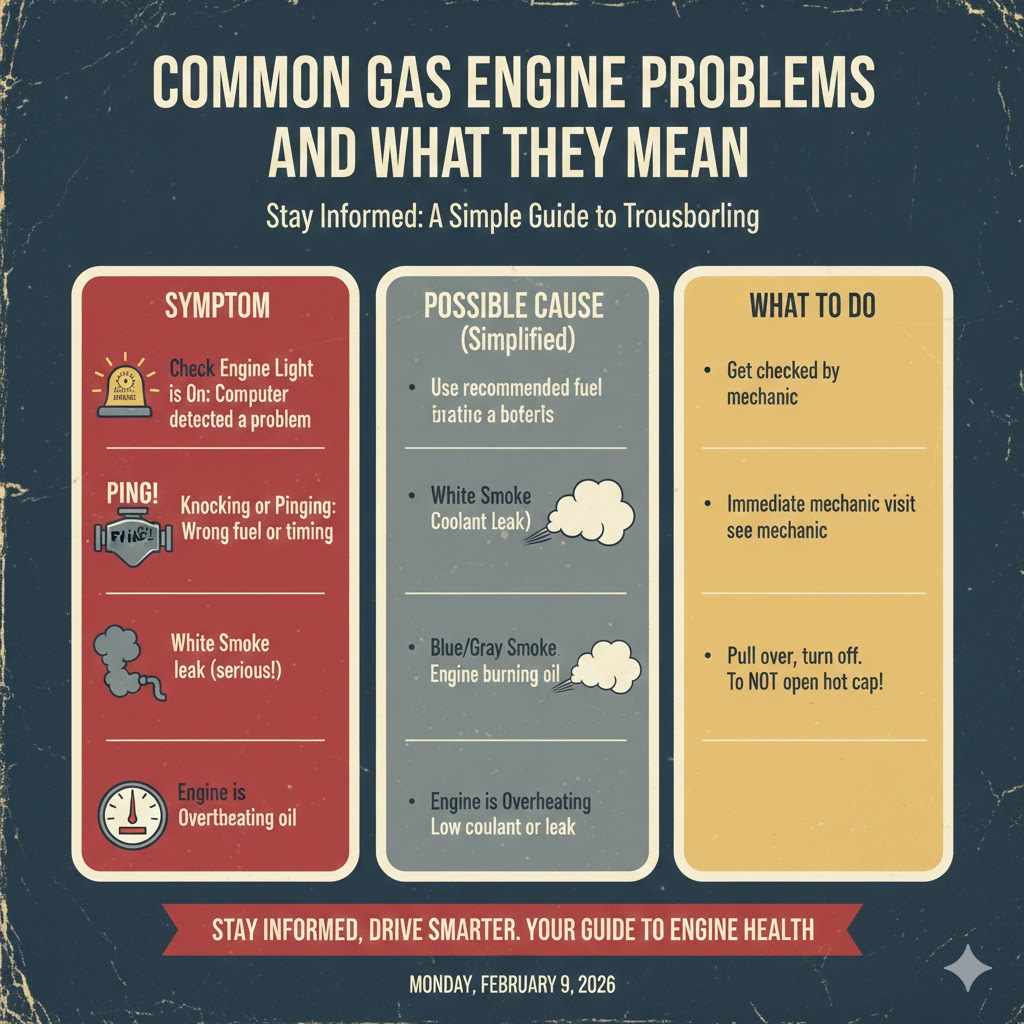
Even with good maintenance, things can sometimes go wrong. Here are a few common symptoms and what they might mean in simple terms. This isn’t for self-diagnosis, but it can help you have a more informed conversation with your mechanic.
| Symptom | Possible Cause (Simplified) | What to Do |
|---|---|---|
| Check Engine Light is On | Could be anything from a loose gas cap to a sensor issue. The car’s computer has detected a problem. | Don’t panic, but get it checked by a mechanic soon. They can read the error code to find the problem. |
| Knocking or Pinging Noise | This could be caused by using the wrong type of gasoline or a problem with combustion timing. | Make sure you’re using the fuel recommended in your owner’s manual. If it continues, see a professional. |
| White Smoke from Exhaust | A little bit of thin, white vapor is normal on a cold day. Thick, sweet-smelling white smoke could mean coolant is leaking into the engine. | If you see thick, persistent white smoke, have your car looked at immediately. This can be a serious issue. |
| Blue or Gray Smoke from Exhaust | This usually means the engine is burning oil, which could be caused by worn-out internal parts. | Monitor your oil level closely and schedule a visit to your mechanic for a diagnosis. |
| Engine is Overheating | The temperature gauge is in the red. This is often due to low coolant, a leak, or a faulty cooling system part like the thermostat or radiator fan. | Pull over safely as soon as possible and turn off the engine to let it cool. Do not open the radiator cap when it’s hot! Get professional help. |
FAQs About Your Gas Engine
What does “V6” or “4-cylinder” actually mean?
This refers to the number of cylinders in your engine and how they are arranged. A “4-cylinder” engine has four cylinders, usually in a straight line (inline-4). A “V6” has six cylinders arranged in a “V” shape. Generally, more cylinders mean more power, but often less fuel efficiency.
How often should I really change my oil?
The old rule of “every 3,000 miles” is outdated for most modern cars. Check your owner’s manual! Many new cars can go 5,000, 7,500, or even 10,000 miles between oil changes using modern synthetic oils. The manual is your best guide.
Why is my “Check Engine” light on?
The Check Engine light is a warning that the car’s onboard computer has found a problem in the emissions, ignition, or fuel system. It could be something as simple as a loose gas cap or a more complex issue like a faulty sensor. The best thing to do is have a mechanic scan the code to find out what’s wrong.
Is it bad to let my gas tank run close to empty?
It’s best not to make a habit of it. The fuel pump, which sends gas from the tank to the engine, is located inside the fuel tank and is kept cool by the surrounding gasoline. Running the tank very low can cause the pump to overheat. It can also pull sediment from the bottom of the tank into the fuel system.
What’s the difference between horsepower and torque?
In simple terms, horsepower helps determine your car’s top speed, while torque is the “pulling power” that gets you moving from a stop. Think of it this way: torque is what pushes you back in your seat when you accelerate, and horsepower is what keeps you moving fast.
Can I use a higher octane gasoline than my car needs?
You can, but it’s usually just a waste of money. Using “premium” (high-octane) fuel in a car designed for “regular” won’t provide any performance benefits. Always use the fuel octane level recommended in your owner’s manual. The only time this might differ is for high-performance or turbocharged engines that specifically require it.
What is a timing belt and why is it important?
The timing belt (or timing chain in some cars) is a rubber belt that synchronizes the rotation of the crankshaft and the camshaft. This ensures the engine’s valves open and close at the proper times. If it breaks, the engine will stop working and can suffer catastrophic damage. It’s crucial to replace it at the intervals recommended by your manufacturer.
You’re in the Driver’s Seat Now
See? The gas engine in your car isn’t such a scary mystery after all. By understanding the simple, four-stroke rhythm that powers your journeys, you’ve taken a huge step toward becoming a more confident and knowledgeable car owner. From identifying parts to knowing the difference between a V6 and an I-4, you now have the foundation to make smarter decisions about your vehicle.
Remember, you don’t need to be able to rebuild an engine to take great care of it. Knowing the basics of how it works, what it needs to stay healthy, and what the warning signs are is more than enough. The next time you pop the hood, I hope you’ll see it not as a complex puzzle, but as a powerful and elegant machine that you understand. Keep these tips in mind, stay on top of your maintenance, and you and your car will have many happy miles together.