12V Cigarette Lighter Car Heaters: Do They Work?
A 12V heater that plugs into your car’s cigarette lighter can take the bite off a cold cabin and help clear a fogged-up windshield, but it will not replace your car’s real heating system. Most of these devices are rated 150-200 watts, and that wattage claim is the part shoppers get wrong most often.
Here’s the honest version: a genuine 200-watt draw at 12V is about 16-17 amps. Most factory cigarette lighter outlets are fused for only 10 or 15 amps, so a “200W” heater can trip the fuse — or, worse, run at a reduced, watered-down output that never matches the box. Below we cover how these heaters actually work, what the amp math means for your specific car, and which plug-in heater is worth buying.
How Do 12V Cigarette Lighter Car Heaters Work?
2-IN-1 HEATER & DEFROSTER PICK
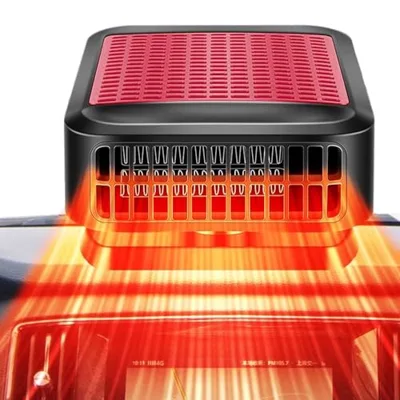 |
Portable Car Heater & Defroster, 12V 200W – $21.99 Plugs straight into the cigarette lighter and switches between heat and a plain cooling fan, with a 360-degree base you can aim at the windshield or your hands.
|
These devices are simple by design: a resistive heating coil (basically a small electric element, the same idea as a toaster or hair dryer) sits behind a fan. The fan pulls in cabin air, blows it across the hot coil, and pushes warm air out the front. Flip a switch and most models skip the coil entirely and just blow room-temperature or cool air, which is why they’re marketed as “2-in-1 heater and cooling fan” units. There’s no connection to your engine or coolant system at all — everything runs off the car’s 12V electrical system through the cigarette lighter or accessory outlet.
The Amp Math: Why “200W” Doesn’t Always Mean 200W
Wattage and amperage are directly linked at a fixed voltage: watts ÷ volts = amps. At 12V, a device drawing its full rated 200 watts pulls close to 16.7 amps continuously. That number matters because your cigarette lighter outlet isn’t just a socket — it’s protected by a fuse in your fuse box, and that fuse has a hard amp limit.
| Outlet fuse rating | Safe continuous wattage at 12V | What a “200W” heater does on it |
|---|---|---|
| 10A (common on older/compact cars) | ~120W | Will likely trip the fuse fast, or the heater’s internal circuit throttles down well below its advertised output |
| 15A (the most common rating) | ~180W | Sits right at the edge — fine for short bursts, but sustained full-power use risks nuisance fuse trips |
| 20A (some trucks and SUVs) | ~240W | Has real headroom to run at its full rated wattage |
Two things follow from this. First, check your owner’s manual or the fuse box lid for your specific outlet’s amp rating before you buy — it’s usually labeled “cigarette lighter,” “accessory,” or “power point.” Second, never “fix” a heater that keeps blowing the fuse by installing a higher-amp fuse than the manufacturer specified. The fuse is sized to the wiring gauge behind it, not to whatever device you plug in — oversizing it can let a fault overheat that wiring instead of tripping safely, which is a real fire risk, not a theoretical one. If a plug-in heater keeps popping your factory fuse, that’s the car telling you the circuit isn’t built for that load, not a defect to bypass.
Is a 150-200W Heater Actually Enough to Warm a Car?
Keep expectations realistic. Your car’s built-in heater moves air across a heater core that’s essentially fed by the engine’s own waste heat — effectively thousands of watts’ worth of thermal energy once the engine is warm. A 150-200W plug-in unit is a rounding error next to that. It will not raise the temperature of an entire cabin, especially with the windows cold-soaked overnight.
What it’s genuinely good for: aiming warm air at your hands while you wait for the real heater to kick in, taking the edge off a quick errand in a car that’s parked outside, or blowing warm air directly at a fogged section of glass to clear it faster than the factory defroster alone. If your goal is actually keeping a parked car from freezing overnight, a small plug-in fan-heater isn’t the right tool for that either — we cover the wattage math for that specific use case in our guide to whether 100 watts can keep a car from freezing.
What to Look for Before You Buy One
- Stated amp draw, not just wattage. A listing that gives you an actual amp figure (not just “200W”) is being more upfront about real-world draw.
- An auto shut-off or overheat cutoff. Since these sit directly against dashboard plastic, a thermal cutoff is a real safety feature, not a nice-to-have.
- A 360-degree or adjustable base. You’ll want to redirect airflow between the windshield and your hands without repositioning the whole unit.
- A short, heavy-gauge cord. Thin cords run hotter under sustained current draw — a stiffer, shorter cord is usually the better-built option.
A Different Approach: Heated Car Blankets

If your priority is keeping a passenger warm rather than defrosting glass, a 12V heated blanket is worth considering instead of (or alongside) a fan heater. The Sealy 12-Volt Electric Portable Heated Car Blanket ($39.99) plugs into the same outlet, offers three heat settings with a 4-hour auto-off, and is machine washable. Because it warms a person directly through contact rather than heating air, it uses its wattage more efficiently for comfort than a fan blowing into open cabin space — a real advantage for road trips or camping, though it obviously does nothing for a foggy windshield.
Frequently Asked Questions
Can Car Heaters Really Plug Into a Cigarette Lighter?
Yes. Portable 12V heaters are built specifically for the cigarette lighter or accessory outlet found in nearly every car, truck, SUV, and RV. They typically draw between 100 and 200 watts and need no other installation — you plug them in and switch them on.
Will a 200W Heater Blow My Car’s Fuse?
It can, depending on your outlet. A true 200W draw is roughly 16-17 amps at 12V, which exceeds a 10A fuse immediately and sits right at the limit of the more common 15A fuse. Check your fuse box lid or owner’s manual for your outlet’s rating before running one continuously, and never swap in a higher-rated fuse to stop it from tripping.
Are Portable 12V Car Heaters Safe to Leave Running?
They’re designed for short, supervised use rather than being left running unattended. Look for a model with an automatic overheat cutoff, keep it clear of loose fabric or paper, and avoid running it continuously with the engine off, since the draw can meaningfully drain your battery over time.
How Does a Heated Car Blanket Work?
A heated car blanket has thin electric heating wires woven through the fabric, powered through the same 12V outlet. Most offer 2-3 heat settings and an auto shut-off after a few hours, and warm the person wrapped in it directly rather than heating the surrounding air.
Do Portable Defrosters Actually Clear a Foggy Windshield?
Aimed directly at a fogged patch of glass, yes — the warm, moving air speeds up evaporation of the condensation on the inside of the window faster than waiting on cabin air alone. It works best as a supplement to your car’s own defrost setting, not a replacement for it, especially on a fully frosted exterior windshield.
What Features Should I Look for in a Car Heater?
Prioritize a stated amp draw over a bare wattage number, an automatic overheat shut-off, a 360-degree or adjustable head, and a short, heavy-gauge cord. Those four details tell you more about real-world safety and performance than the wattage figure printed on the box.
Conclusion
A cigarette lighter car heater is a genuinely useful backup for cold mornings — for clearing fog off the glass and warming your hands while the real heater catches up — but it’s not a substitute for your car’s heating system, and its wattage rating is only meaningful once you know what your outlet’s fuse can actually carry. Check that number first, keep expectations realistic, and a small plug-in heater or a heated blanket can genuinely make winter driving more comfortable.
Products related to this article
Sponsored / affiliate links. As an Amazon Associate I earn from qualifying purchases. I may earn additional commission from eligible campaigns.