
How to Avoid Paying Tax on a Company Car (Legal Ways)
You cannot legally avoid tax entirely on a company car once you drive it for anything personal — the IRS treats that personal use, including your daily commute, as taxable wages. What you can do is legally shrink the taxable amount, sometimes down to close to zero if the vehicle is used almost exclusively for business.
The gap between the two outcomes is real money. Depending on the vehicle’s value and how it is used, the taxable fringe benefit can run from a few hundred dollars a year to several thousand, and it shows up as extra income on your W-2 whether you notice it or not. Employees who never look at how their employer values that benefit routinely pay more tax than the law actually requires.
This guide covers what actually counts as taxable personal use under current IRS rules, the three methods employers use to put a dollar figure on it, and the specific, legal steps — mileage logs, the commuting valuation rule, and choosing a mileage reimbursement over a flat allowance — that reduce what lands on your paycheck. It also flags where “reducing” the tax crosses into reporting fraud, which is not a strategy, it is a federal offense.
Is Personal Use of a Company Car Really Taxable?
Yes. Under IRC Section 61 and IRS Publication 15-B, the fair market value of any personal use an employee gets from an employer-provided vehicle is a taxable fringe benefit, no different in principle from a cash bonus. The rule applies whether the employee is a rank-and-file worker, a manager, or a business owner who put the vehicle on the company’s books.
“Personal use” is broader than most people assume. It includes running errands, weekend trips, letting a family member drive the car, and — this is the one that catches people off guard — commuting between home and your regular place of work. The IRS does not treat the commute as a business expense just because you happen to be driving a company vehicle to get there.
“Business use” is narrower: driving to client meetings, between job sites, to pick up supplies, or any travel that is ordinary and necessary to doing your job, away from your regular commute. Only the business-use share of the vehicle’s total mileage is excluded from your taxable income. Everything else gets valued and added to your wages.
BUILT FOR IRS-COMPLIANT LOGGING
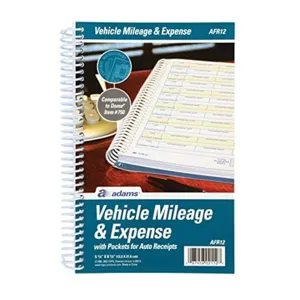 |
Adams Vehicle Mileage & Expense Journal – $14.99 As explained below, a contemporaneous mileage log is the main thing the IRS actually checks when it disputes a company car’s business-use percentage — this one is sized to live in the glove box so you actually fill it in.
|
How the IRS Puts a Dollar Value on Your Personal Use
Employers do not just guess at the taxable amount. The IRS lays out three approved valuation methods, and which one applies (or is even available) depends on the vehicle and how it is used. Knowing which method your employer is using, and whether a better one is legally available to you, is the first real lever you have.
| Method | How it works | Who can use it |
|---|---|---|
| General valuation rule (annual lease value) | Look up the vehicle’s fair market value on the IRS lease-value table, then multiply by the percentage of miles driven for personal use | Any employer-provided vehicle; the default method if no other rule applies |
| Cents-per-mile rule | Multiply personal miles by the IRS standard business mileage rate — 72.5 cents per mile from January 1 through June 30, 2026, and 76 cents per mile from July 1 through December 31, 2026 | Only if the vehicle’s fair market value was $61,700 or less when first made available in 2026, and it is driven at least 10,000 miles a year and used regularly in the business |
| Commuting valuation rule | Value each one-way commute at a flat $1.50, regardless of actual distance | Only when the employer has a written policy banning non-commuting personal use, the vehicle is needed for legitimate business reasons, and the employee is not a highly compensated “control employee” |
Notice that the cents-per-mile and commuting rules both produce a lower taxable number than the general lease-value method for most everyday vehicles — but neither one is automatic. Your employer has to affirmatively choose to use them and meet the eligibility conditions, generally by the first day the vehicle is made available for personal use. If your company defaults to the lease-value method on a modest sedan you mostly use for the commute, ask whether the commuting rule or cents-per-mile rule would legally apply instead.
One narrow exception eliminates the tax entirely: a qualified nonpersonal use vehicle. This is a legal category for vehicles that, by their design, an employee is unlikely to use for anything but work — think unmarked police cars, delivery vans with no passenger seating installed, or bucket trucks. A standard sedan, SUV, or pickup does not qualify just because company policy says “business use only.” If your vehicle is a normal passenger car, this exception will not apply to you.
6 Legal Ways to Reduce What You Owe
None of these make the tax disappear if you genuinely use the car for personal driving. What they do is make sure you are taxed on your actual personal-use percentage, not on an inflated default figure, and that your employer is using the cheapest valuation method the law allows.
1. Keep a Contemporaneous Mileage Log
This is the single most important habit on this list. Record the date, starting and ending odometer readings, destination, and business purpose of every trip, the same day it happens. If your employer’s default assumption is that all mileage is personal unless proven otherwise, an accurate log is the only thing that shifts the burden of proof in your favor at tax time or in an audit.

2. Genuinely Minimize Personal and Commuting Miles
The most direct way to shrink the taxable value is to actually drive the vehicle less for personal reasons. Running weekend errands in your own car instead of the company vehicle, or carpooling occasionally to trim commute days, lowers the personal-use percentage the valuation formula is applied to. It is not a trick, it is just less taxable benefit because there was less personal benefit.
3. Ask If the Commuting Valuation Rule Applies to You
If your job genuinely requires the vehicle (a service technician who needs tools and inventory on board, for example) and your employer bans personal use beyond the commute in writing, the $1.50-per-one-way-trip commuting rule can value a daily commute at a fraction of what the lease-value method would produce. This has to be set up by your employer’s payroll or HR team; it is not something you can elect on your own tax return.
4. Choose an Accountable-Plan Mileage Reimbursement Over a Flat Car Allowance
This is where a lot of employees leave money on the table. A flat monthly car allowance, say $500 a month regardless of how much you actually drive, is fully taxable W-2 wages, no different from a raise. A mileage reimbursement paid under an IRS accountable plan — where you submit substantiated business mileage and get paid at or below the standard rate — is not taxed at all. If you are offered a choice, or can request one, the accountable-plan reimbursement is almost always the better after-tax deal for genuine business drivers.
5. Understand What a Pool or Fleet Vehicle Actually Requires
A shared pool car can avoid personal-use tax, but only if it genuinely stays at the workplace when not needed and no single employee has regular personal access to it. If a “pool car” ends up parked in one employee’s driveway every night, the IRS will not treat it as tax-free just because of the label. The exemption depends on the actual use pattern, not the paperwork description.
6. Check What Your Employer Actually Reported on Your W-2
Employers sometimes use outdated mileage rates, the wrong valuation method, or an estimated personal-use percentage instead of your actual logged miles. Compare the fringe-benefit amount on your W-2 (usually broken out in Box 14) against your own mileage log before you file. If the numbers do not match your records, raise it with payroll before tax season, not after.
Where “Reducing” the Tax Turns Into Tax Fraud
Everything above works by changing your actual behavior or by making sure the correct, lower-tax method is being applied — not by hiding anything from the IRS. Falsifying a mileage log after the fact, claiming 100% business use when you regularly drive the car home and back, or asking an employer to simply not report your personal use are not gray-area strategies. They are misreporting income, and if the IRS catches a mismatch during an audit, you and potentially your employer can owe back taxes, interest, and civil penalties, with criminal exposure in egregious cases.
If your situation is complicated — you are a business owner setting vehicle policy for the first time, you have a mixed-use vehicle with a high fair market value, or you are unsure which valuation method your state also requires for payroll tax purposes — a CPA or enrolled agent who handles payroll fringe benefits can usually save you more in a single consultation than any DIY approach.
Frequently Asked Questions
Can I legally avoid all tax on a company car?
No. If you use an employer-provided vehicle for anything other than business, including your daily commute, the IRS treats that personal use as taxable wages under Publication 15-B. What you can legally do is minimize the taxable amount by limiting personal use, logging your mileage accurately, and using the valuation method that produces the lowest number for your situation.
Does commuting count as personal use of a company car?
Yes, in almost every case. The IRS specifically classifies commuting between home and your regular workplace as personal use, not business use, even if you are on call or make work calls during the drive. A narrow commuting valuation rule lets some employers value each one-way commute at a flat $1.50 instead of using the full lease-value method, but only when strict eligibility rules are met.
Is a car allowance taxed differently than a company car?
A flat monthly car allowance is normally fully taxable as W-2 wages, the same as regular salary, because it is paid regardless of actual business mileage. A mileage reimbursement paid under an IRS accountable plan, tied to substantiated business miles at or below the standard mileage rate, is not taxable income. That distinction, not the electric-vs-gas debate, is usually the bigger lever for reducing tax.
Do electric or hybrid company cars get a lower personal-use tax rate?
Not automatically. The IRS values personal use of any company vehicle, gas or electric, the same way, through the lease-value, cents-per-mile, or commuting-rule methods. A cheaper EV can end up with a lower taxable lease value simply because its fair market value is lower, but there is no separate EV exemption for the personal-use fringe benefit itself.
What records do I need to protect myself in an audit?
Keep a contemporaneous log with the date, starting and ending odometer readings, destination, and business purpose of every trip, plus your employer’s written vehicle-use policy if one exists. The IRS generally will not accept a mileage log reconstructed after the fact from memory, so recording each trip the same day matters more than the format you use.
Can my employer just not report my personal use to avoid the tax?
No. Employers are legally required to determine the value of an employee’s personal use of a company vehicle and include it in taxable wages on Form W-2, generally by the employer’s own year-end deadline. Deliberately failing to report it is not a loophole, it is noncompliance that exposes both the employer and employee to back taxes, interest, and penalties if the IRS catches it.
Conclusion
You cannot make the tax on a company car vanish if you genuinely use it for personal driving, and no accountant or forum trick changes that baseline IRS rule. What actually moves the number is behavior and paperwork: driving it less for personal errands, logging every trip the day it happens, confirming your employer is using the cheapest legal valuation method for your vehicle, and taking a mileage reimbursement over a flat allowance whenever you have the choice.
Start with the log. It costs a few dollars and a couple of minutes a day, and it is the one piece of evidence that protects you if your employer’s numbers, or the IRS’s, ever get questioned.
Products related to this article
Sponsored / affiliate links. As an Amazon Associate I earn from qualifying purchases. I may earn additional commission from eligible campaigns.