Turo Car Rental Review: Is It Worth It for Your Trip?
Turo can be worth it for flexible non-airport rentals and specialty cars. It often loses on airport trips under 3 days or long, high-mileage drives once fees, mileage limits, and insurance are added. Pick the wrong trip type, and you can pay more than Enterprise or Hertz while getting less counter support and a larger bill at return. This guide compares Turo with airport rental options and shows which trip profiles make Turo the better buy.
This guide is part of our Car rental guide: costs, rules, and tips series.
Turo car rental review: Is it worth it?
Turo launched in 2010 and now operates in 50+ countries with over 350,000 vehicles listed. It is a peer-to-peer car sharing marketplace, and it makes the most sense when your trip fits its strengths: flexible pickup, city delivery, or a specific car that traditional fleets do not stock. It is a weaker buy when convenience, mileage, and insurance certainty matter more than the base rate.
For a short airport trip, the listed daily price can look low and still finish higher after fees, delivery, protection, and overages. For a city weekend with low miles, Turo can beat a counter rental. For a road trip, the mileage cap is often the dealbreaker. For a specialty car, it can be the best option even at a higher total.
Quick summary of who should book Turo and who should skip it
Book Turo if you want a flexible pickup location, a specific model, or a local delivery arrangement that avoids the rental counter. Skip it if you need the fastest airport handoff, expect a long highway drive, or want the most predictable support path when plans change.
📊 Turo launched in 2010. Source: Wealthvieu.
Pros and cons of Turo
Turo’s appeal comes from choice and flexibility, not from a simple low daily rate. The platform can work well, but only if you read the host rules and total trip cost before checkout. That matters because the host sets the price, availability, and many trip rules.
Pros
- Flexible pickup and delivery options, including airport pickup or nearby handoff.
- Wide vehicle variety, from compact cars to specialty models.
- Potentially lower total cost for short, low-mileage city trips.
- Useful for renters who want a specific trim, color, or feature set.
Cons
- Mandatory trip fee at checkout, often about 15%–35% of the daily rate.
- Protection plans can materially raise the total cost.
- Many listings have mileage caps, often 150–250 miles per day.
- Host rules, late pickup issues, and cancellations add uncertainty.
Say your hotel is 2 miles from the host’s garage and you only need a car for a Saturday brunch run and one museum stop. Turo can fit that trip cleanly. Say your flight lands late, your connection slips, and you need a guaranteed counter handoff at midnight. Traditional rental companies usually handle that better.
How Turo pricing works
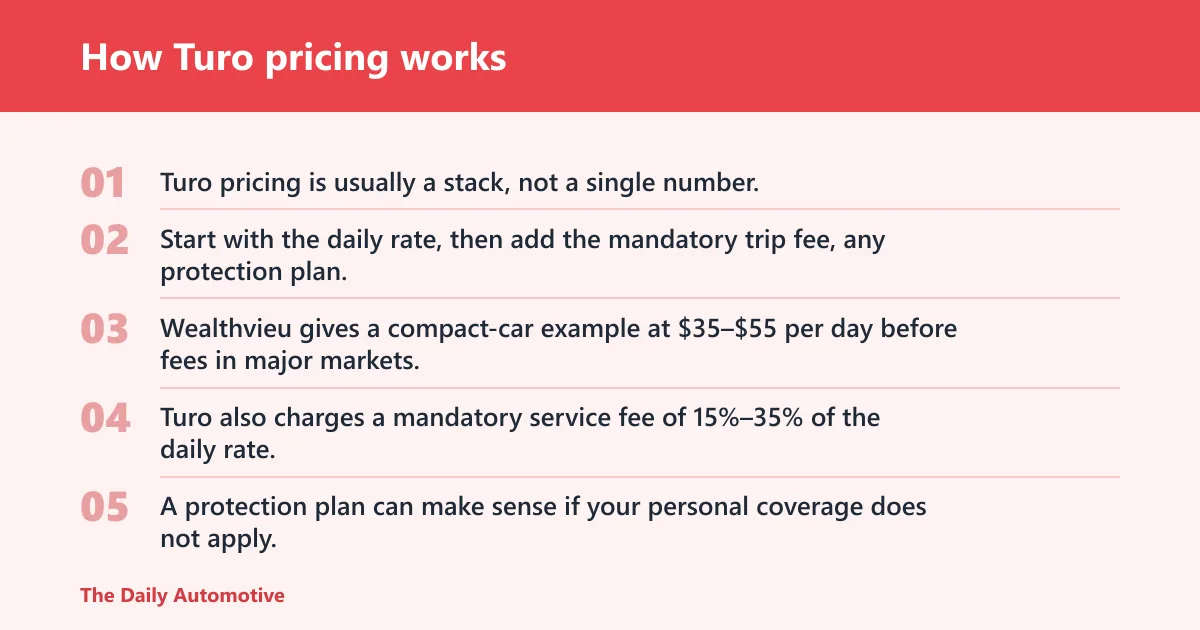
Turo pricing is usually a stack, not a single number. Start with the daily rate, then add the mandatory trip fee, any protection plan, delivery or airport handoff charges, taxes, and mileage overages if you exceed the listing’s cap. The listed rate is only the opening number.
Base rate versus trip fee versus protection plan
Wealthvieu gives a compact-car example at $35–$55 per day before fees in major markets. Turo also charges a mandatory service fee of 15%–35% of the daily rate, and that fee can shift with protection choices. A protection plan can make sense if your personal coverage does not apply.
Delivery charges, taxes, and mileage overage fees
Many airport pickup options involve a delivery fee. Common mileage limits on listings are 150–250 miles per day, and overage fees can be $0.10–$0.50 per mile. Those charges hit fast on a road trip, where a cheap daily rate can disappear under distance charges.
Why the listed rate can be far below the real total
The booking page may show a number that looks lower than Hertz or Enterprise, but the checkout screen can tell a different story. Trip fee, delivery, taxes, protection, and mileage all move the total. For airport economy rentals, Wealthvieu compares Turo at $140–$220 for three days against traditional airport economy rentals at $200–$350 for three days.
| Cost item | What to compare | Why it changes the total |
|---|---|---|
| Daily rate | Base price before checkout | Often looks cheaper than a counter rental |
| Trip fee | 15%–35% of the daily rate | Mandatory and adds at checkout |
| Protection plan | Coverage level and price | Can materially raise the booking total |
| Delivery or airport fee | Host handoff or garage fee | Common with airport pickups |
| Mileage overage | Daily cap and per-mile penalty | Important on road trips and day trips |
Does insurance cover Turo rentals?
Coverage depends on your own policy, your credit card benefits, and the Turo protection plan you choose. Do not assume a personal auto policy or card benefit applies to peer-to-peer rentals. If either one is unclear, the protection plan may be the safer route.
When a personal auto policy may apply
Some personal policies cover rental cars, but peer-to-peer car sharing is not the same as a standard agency rental. Before booking, confirm with the insurer that Turo is included and ask whether any exclusions apply for car sharing, luxury vehicles, or liability limits.
What to confirm with a credit card issuer
Credit card coverage can be limited, and many issuers draw a line between traditional rental agencies and peer-to-peer platforms. Verify whether the card covers Turo at all, whether liability is excluded, and whether the benefit requires you to decline the host’s or platform’s protection options.
When a Turo protection plan may be the safer choice
If your policy does not clearly cover the booking, a protection plan may be the cleaner decision. It can add cost, but it also reduces ambiguity at checkout. That matters for travelers who do not want to sort out a coverage dispute after a claim or incident.
Decision matrix: when Turo wins and loses
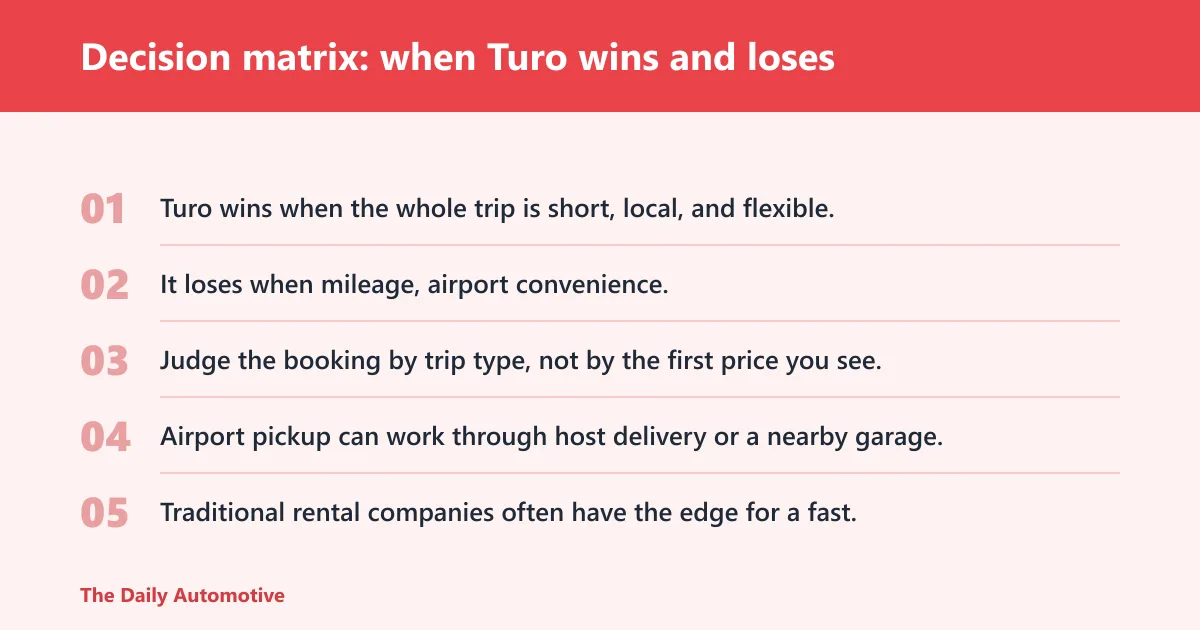
Turo wins when the whole trip is short, local, and flexible, or when the car itself is part of the value. It loses when mileage, airport convenience, or support reliability matter more than the headline rate. Judge the booking by trip type, not by the first price you see.
Airport pickup: compare convenience, fees, and cancellation risk
Airport pickup can work through host delivery or a nearby garage, but it often comes with extra fees and more moving parts than a terminal counter. Traditional rental companies often have the edge for a fast, predictable airport handoff and for replacement options if something goes wrong.
City weekend: where Turo can be cheaper or easier
For a city weekend with modest driving, Turo can sometimes be the better buy because you may avoid some airport-related fees and get a car closer to your hotel or home. The savings are real only if the trip fee, protection, and delivery charges stay low and the host’s rules match your plans.
Road trip: how mileage caps change the math
Road trips are where Turo often loses. A 150–250 mile daily cap can vanish fast on interstate runs, and $0.10–$0.50 per extra mile adds up quickly. A three-day trip with long highway legs should be priced with overages included before you compare it with a rental counter.
Specialty vehicle: why Turo can make sense even at a higher price
When you need a convertible, a truck, a premium SUV, or a model that is not commonly available from fleet agencies, Turo can be a practical option. In that case, paying more may still be the best outcome because the vehicle itself solves the trip problem.
| Trip scenario | Compare these cost components | Main risk to watch | When Turo likely wins or loses |
|---|---|---|---|
| Airport pickup | Daily rate, trip fee, delivery fee, protection, taxes | Late arrival, host cancellation, terminal friction | Wins for cheaper non-terminal access; loses for tight business schedules |
| City weekend | Base rate, trip fee, local delivery, parking logistics | Pickup coordination, host rules | Wins if the pickup is close and miles stay low |
| Road trip | Daily rate, trip fee, mileage cap, overage fees, protection | Per-mile penalties and breakdown of trip value | Loses when extra miles push the total above a rental company |
| Specialty vehicle | Availability, daily rate, protection, delivery | Replacement difficulty, host rules | Wins when standard fleets do not have the vehicle |
Should you use Turo for airport pickup?

Turo can work for airport pickup, but it is usually less convenient than a rental counter. Host delivery or a nearby garage can be useful, yet extra fees, timing friction, and cancellation risk make it a weaker choice for travelers who need a fast, guaranteed handoff. For many flyers, Enterprise or Hertz is simpler.
Host delivery versus nearby garage pickup
Host delivery can reduce shuttle rides, but it can also add a fee and require tighter timing. Nearby garage pickup keeps the car close, though it still puts the handoff outside the terminal flow. Either option should be checked against the airport counter total before booking.
How airport fees compare with Enterprise and Hertz
Airport rental companies often build convenience into the price, and they usually handle check-in, replacement cars, and extensions more predictably. Turo may still be cheaper on some airport bookings, but Wealthvieu’s three-day figures show how quickly the comparison narrows once fees are added.
When a terminal counter is still the better option
If your flight lands late, your itinerary is fixed, or you need one-stop support from pickup to return, the counter is usually the safer choice. That is especially true for business travel, where delays and rebooking risk can outweigh a small savings at checkout.
Who is Turo best for?
Turo is best for travelers who can plan around pickup details, compare the full checkout total, and stay within the mileage rules. It is also a strong fit for renters who want a specific vehicle that traditional agencies may not have on the lot. It is less useful for rushed airport trips and long drives.
Who should skip Turo and book a traditional agency instead
Skip Turo if you want a terminal counter, have a tight flight connection, expect heavy mileage, or need the easiest path to a replacement car. Travelers who depend on employer billing, standardized corporate pricing, or round-the-clock airport support usually do better with Enterprise, Hertz, or a similar agency.
What should you check before booking a Turo car?
Check the total price, the mileage cap, the pickup method, the protection plan, and the host’s cancellation terms before you pay. A low base rate means little if overages, delivery, or insurance fill the gap. Read the listing like a contract, not like an ad.
- Confirm the daily rate and add the trip fee.
- Check whether a delivery or airport fee applies.
- Read the mileage limit and the overage charge per mile.
- Verify whether your personal policy or credit card covers the trip.
- Review the protection plan options before checkout.
- Check the host’s cancellation and pickup rules.
- Compare the final total against Hertz or Enterprise for the same dates.
A common first-timer mistake is booking a compact car for a cheap weekend, then discovering the airport delivery fee, protection plan, and mileage overage push the total above the agency counter. Another is assuming the host will wait through a delayed connection. That is where the savings vanish.
Frequently asked questions
Is Turo worth it compared with Hertz or Enterprise?
Turo can be worth it if you want flexible pickup, a specific vehicle, or a short city trip with low mileage. Hertz or Enterprise is usually better for airport convenience, faster counter service, and fewer surprises when a flight is delayed or plans change.
How much are Turo fees and protection plans?
Turo charges a mandatory service fee of 15%–35% of the daily rate, and protection plans can add more cost at checkout. Delivery fees, taxes, and mileage overages can also raise the total, so the final price can sit well above the listed daily rate.
Does insurance cover Turo rentals?
Sometimes, but not always. A personal auto policy may exclude peer-to-peer rentals, and credit card coverage often has separate rules. Confirm both before booking. If the answer is unclear, a Turo protection plan may be the safer way to avoid coverage gaps.
What happens if my Turo host cancels?
A host cancellation can leave you hunting for a replacement car, often under time pressure and sometimes at a higher price. That risk matters most for airport trips and tight schedules. Check the cancellation policy, and avoid depending on Turo when a backup plan would be hard to arrange.
Can I use Turo for a road trip with lots of miles?
You can, but it is often the wrong value choice. Many listings cap mileage at 150–250 miles per day, and overage fees can be $0.10–$0.50 per mile. Once a long route is priced honestly, a traditional rental may be cheaper.
When does Turo become cheaper than a rental company?
Turo is more likely to be cheaper on short, low-mileage trips with flexible pickup, especially when a nearby delivery avoids airport fees. It becomes less competitive when trip fees, protection, delivery charges, and overages are added, or when the rental needs a terminal counter and heavy support.
Products related to this article
Sponsored / affiliate links. As an Amazon Associate I earn from qualifying purchases. I may earn additional commission from eligible campaigns.