How Much Does an Oil Change Cost? Price Breakdown
An oil change may usually cost around $35 to $100, but full-synthetic service, larger engines, and dealership labor can raise it into the roughly $120 to $180 range. Paying too much, or skipping it too long, can mean oil starvation, faster engine wear, and a much larger repair bill. This guide shows how oil type, engine size, provider type, and add-ons shape the quote you should expect.
This guide is part of our Car ownership essentials series.
How much does an oil change cost overall?
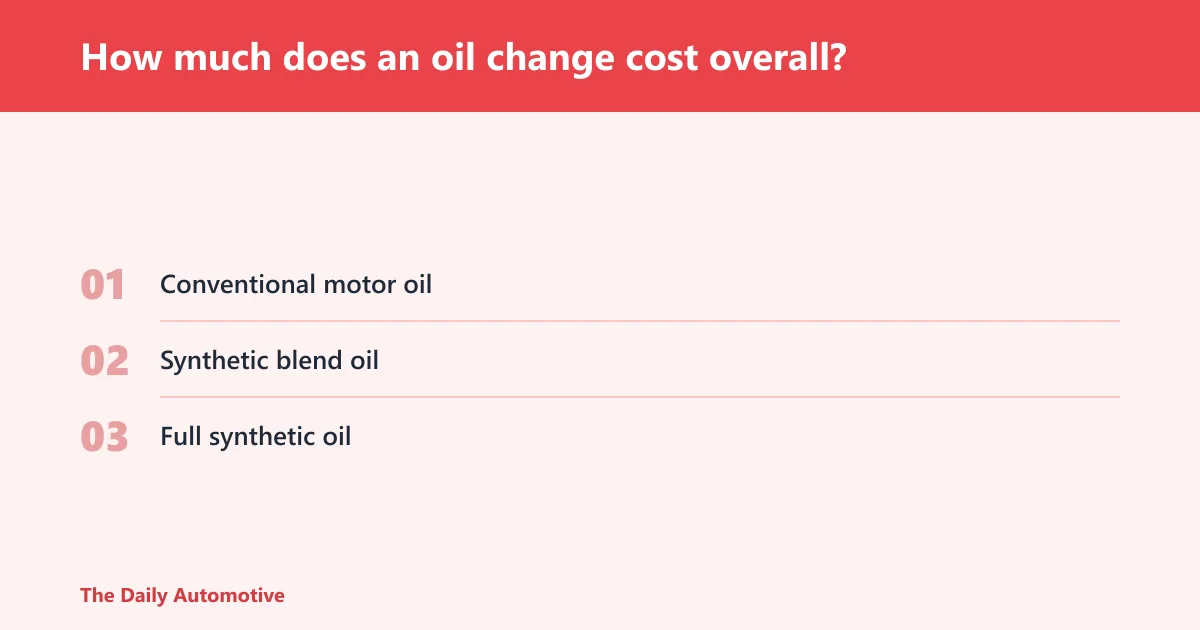


Most drivers will see a quote in the $35 to $100 range, with conventional oil at the low end and full synthetic at the high end. The total climbs when the engine takes more oil, needs a specialty filter, or is harder to service. Oil-change cost can vary with how much oil is needed, the type of oil, and how easy the service is.
Broadly, the bill is built from oil, a filter, labor, and sometimes taxes or disposal charges. carVertical says oil change cost can vary between $20 and $150, while mechanics may charge $20-$60 for the work alone. That spread makes the service provider as important as the oil type.
How oil type changes the price
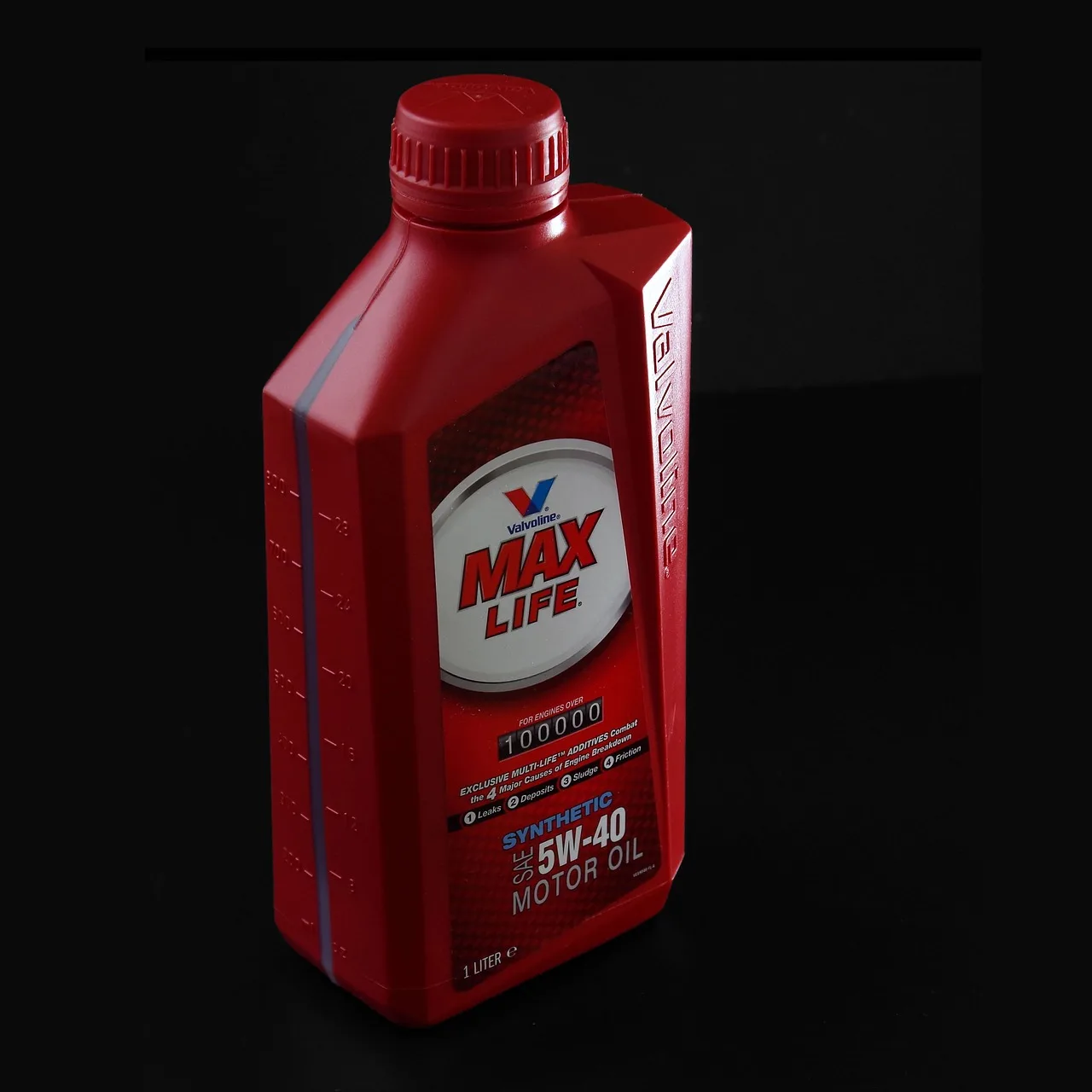
Oil type is the main driver in a basic quote. Conventional motor oil is the lowest-cost oil type, synthetic blend sits in the middle, and full synthetic is the highest common mainstream tier. The jump is not just about brand names; it reflects base stock quality, interval length, and temperature protection.
Conventional oil is often used for older vehicles and simpler service schedules. It usually carries the shortest change interval of the three. Synthetic blend oil mixes conventional and synthetic base stocks, so it offers a middle-ground cost and protection level. Full synthetic is recommended for many 2012+ vehicles and performs better in high heat and cold starts.
- Conventional motor oil: lowest-cost option, often a fit for older vehicles, shorter intervals than synthetic.
- Synthetic blend oil: mixed conventional and synthetic base stocks, balanced cost and protection.
- Full synthetic oil: highest common mainstream price tier, commonly used for many 2012+ vehicles, typical interval 7,500-10,000+ miles.
TheHowMuch says conventional oil changes cost $35-$75, synthetic blend oil changes cost $45-$90, and full synthetic oil changes cost $65-$125. Those bands help explain why a quote can look reasonable for one vehicle and high for another.
📊 carVertical says oil change cost can vary between $20 and $150. Source: How Much Does An Oil Change Cost?.
What affects the final bill?
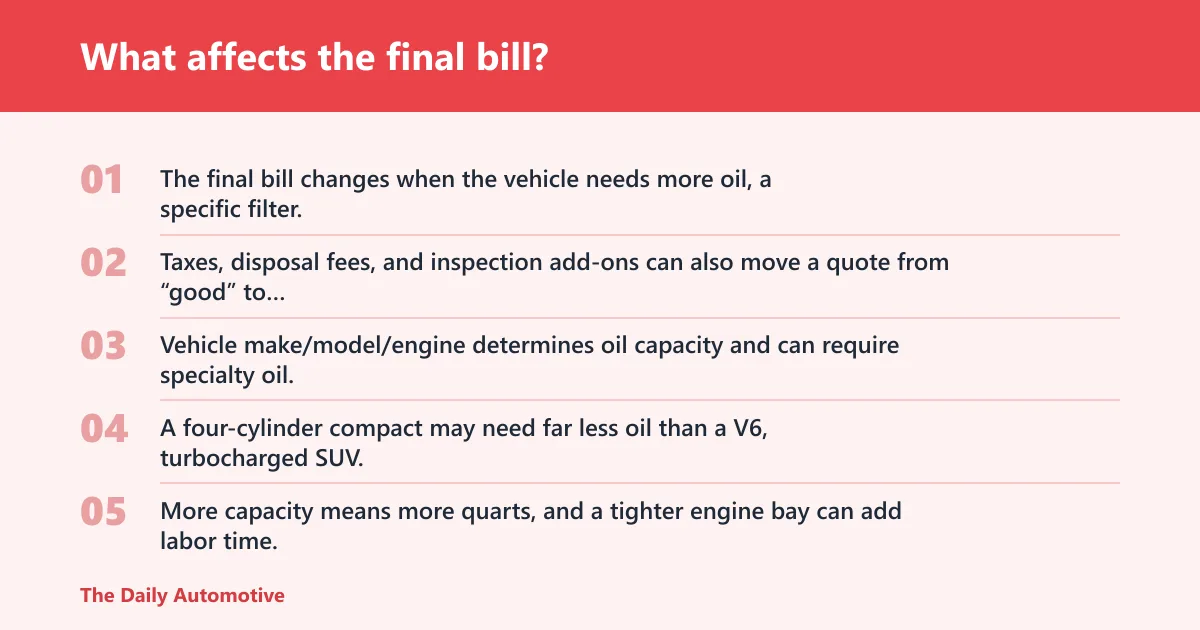
The final bill changes when the vehicle needs more oil, a specific filter, or extra labor to reach the drain plug and filter. Taxes, disposal fees, and inspection add-ons can also move a quote from “good” to “surprisingly high.” A quote is only useful when those items are clearly separated.
Vehicle make, model, and engine size
Vehicle make/model/engine determines oil capacity and can require specialty oil. A four-cylinder compact may need far less oil than a V6, turbocharged SUV, or European performance model. More capacity means more quarts, and a tighter engine bay can add labor time.
Suppose a smaller sedan needs several quarts of full synthetic oil and a standard filter. That quote should land very differently from a 5.7-liter pickup that takes 7 or more quarts and a higher-spec filter. The second vehicle usually carries more oil cost and more labor exposure.
Oil filter type and shop supplies
An oil filter is typically included in the service price, but standard and premium variants can change the total. Some shops bundle the basic filter into the advertised price and charge extra for an upgraded filter, larger cartridge design, or specialty housing. Shop supplies can also appear as a separate line item.
If a quote says “oil change” but does not specify the filter, ask whether it includes a standard replacement filter, a premium filter, and any crush washer or seal required by the engine. Missing that detail is one of the fastest ways to turn a low quote into a higher invoice.
Labor cost and access to the drain plug and filter
Labor cost is the provider-dependent part of the bill. It tends to be less variable than oil type, but access matters. If the drain plug and filter are easy to reach, labor stays lower. If the vehicle sits low, uses underbody panels, or places the filter in a tight location, labor can rise.
Dealership service usually costs more than a quick lube visit because the labor rate is higher and the work often follows OEM-specific procedures. That can be worth it for some warranties or specialty vehicles, but it should be priced as a premium service, not a mystery fee.
Taxes, disposal fees, and inspection add-ons
Quoted prices may or may not include tax, disposal, filter, and shop supplies. That difference matters. A quote that excludes disposal or sales tax is not the same as an all-in price. Courtesy checks for tire pressure and fluid levels are common, but maintenance-package upsells should be separated from the base oil change.
Its service may include checking tire pressure and several fluid levels. That is useful as a standard service note, but it should not be confused with a paid rotation, alignment, or fluid exchange.

What should a quote include before you approve it?
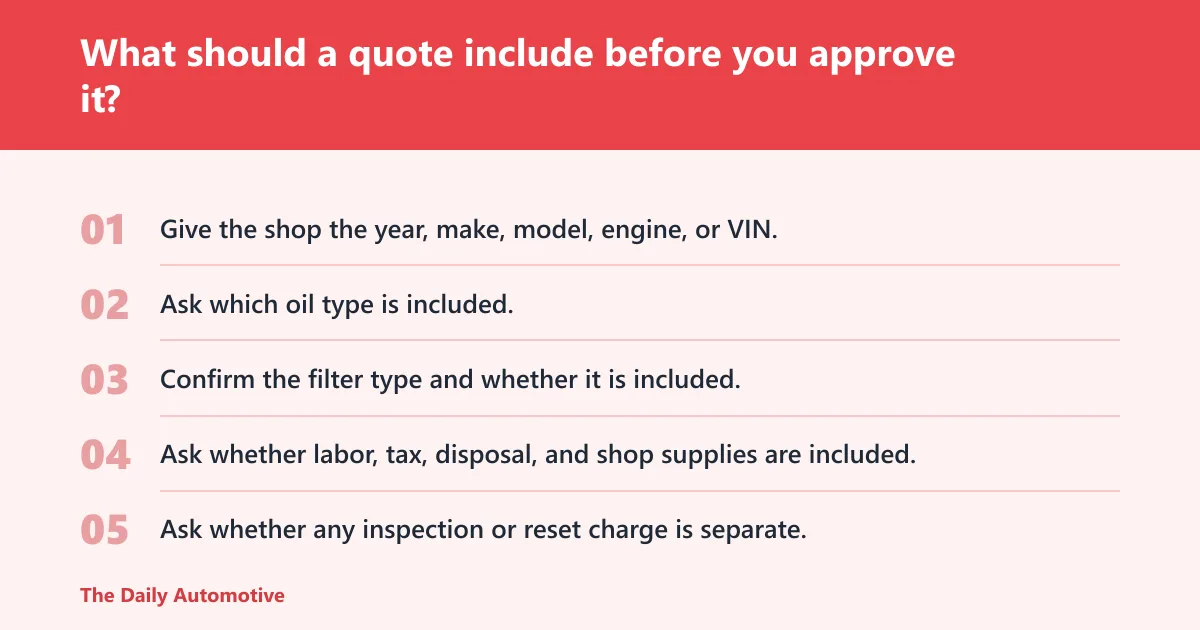
A fair quote should name the oil type, filter type, labor, and any extra fees before the shop calls it final. It should also identify the vehicle details used to price the job. If the quote is vague on capacity, filter, or disposal, treat it as an estimate and ask for a revised total.
Jiffy Lube’s estimate flow asks for year, make, model, and engine or VIN. That is the right starting point because oil capacity and service access change by vehicle. Jiffy Lube also says its oil change is available nationwide, and it advertises a “15 Minute Oil Change Service.” Those details tell you about the offer, not whether the price is complete.
Quote-checklist table
| Oil type | Vehicle class | Provider type | Expected price band | Should the final quote include these line items? |
|---|---|---|---|---|
| Conventional | Older compact car, 4-cylinder | Quick lube | $35-$60 | Oil, standard filter, labor, tax, disposal, shop supplies |
| Synthetic blend | Mid-size sedan or crossover | Quick lube or independent shop | $45-$90 | Oil, filter, labor, tax, disposal, any premium filter charge |
| Full synthetic | Many 2012+ vehicles, turbo engines | Quick lube or dealership | $65-$125 | Correct oil spec, filter, labor, tax, disposal, underbody access fees if any |
| Full synthetic | BMW, Mercedes, other European luxury vehicle | Dealership | $120-$180 | OEM-spec oil, correct filter, labor, tax, disposal, service reset if included |
| High-mileage or specialty oil | High-capacity engine, truck, SUV | Independent shop | $70-$130 | Extra quarts, specialty filter, labor, tax, disposal, shop supplies |
Use that table as a sanity check, not a promise. A quote can sit outside the band if the engine needs extra oil, a premium filter, or specialty service. But if the shop cannot explain why the number moved, the quote is not final enough to approve.
- Give the shop the year, make, model, engine, or VIN.
- Ask which oil type is included.
- Confirm the filter type and whether it is included.
- Ask whether labor, tax, disposal, and shop supplies are included.
- Ask whether any inspection or reset charge is separate.
Where can you get an oil change?
Quick lube shops, dealerships, independent repair shops, and DIY service are the main paths. Quick lube providers usually compete on speed and coupons. Dealerships usually charge more but know the brand-specific procedure. DIY can be cheapest on paper, but only if you account for tools, time, and oil disposal.
Quick lube provider pricing and coupon-heavy offers
Quick lube chains are common for drivers who want speed and a simple booking process. Jiffy Lube says it offers a “15 Minute Oil Change Service,” and it advertises a “$10.00 Off” oil change coupon. Those chains often lean on coupon pricing, but upsells can raise the final bill quickly.
Common quick lube names include Valvoline, Jiffy Lube, Take 5, Walmart, Firestone, Canadian Tire, and Les Schwab, though the actual quote still depends on the vehicle and oil spec. Ask for the out-the-door amount before you agree to extras.
Dealership service pricing and OEM-specific work
Dealership service usually costs more, but it can be the right choice for newer European models, warranty-sensitive maintenance, or vehicles that need brand-specific oil standards. That is especially true when the factory specifies a particular oil certification or a hard-to-reach filter layout.
For BMW and Mercedes owners, the quote often rises because the correct oil spec and service procedure matter more than the sticker price. A low price is not helpful if it uses the wrong spec or omits required parts.
DIY oil change parts and tool costs
DIY oil change costs include oil, filter, a drain pan, a wrench or socket set, gloves, and disposal. That can beat a shop quote over time, especially for vehicles with simple access and inexpensive oil capacity. But the savings shrink if you need ramps, a jack, specialty tools, or paid disposal.
A common first-timer mistake is counting only the oil and filter, then ignoring the tools and disposal. The real comparison is parts plus tools plus time versus the shop’s all-in charge.
Should you add a tire rotation or buy it separately?
A bundled oil change and tire rotation can save money when the package price is lower than the two services bought separately. It is less attractive when the bundle quietly inflates the oil change or adds fees that would not appear on a stand-alone visit. Compare the combined price line by line.
Ask for the oil change price alone and the rotation price alone, then compare that sum with the package. If the bundle is only a few dollars lower, separate service may be the better value, especially if your tires do not need rotation yet.
How to compare package pricing against stand-alone labor
First, confirm whether the rotation is included in a basic maintenance package or sold as an add-on. Then ask whether the quoted bundle includes taxes, shop supplies, and disposal. A package that sounds cheaper can become more expensive once those lines are added.
Next, check whether the rotation is truly needed. If the tires were rotated recently, paying for another rotation may not make sense. If the shop is already under the car for the oil service, a discounted rotation can be a fair add-on.
How often should you change the oil?
Oil-change intervals usually run from 3,000 to 10,000 miles, depending on oil type and driving conditions. Conventional oil tends to need shorter intervals. Full synthetic often lasts longer, and some vehicles allow 7,500 to 10,000+ miles. Check the owner’s manual before setting a schedule.
carVertical says oil change intervals vary between 3,000 and 10,000 miles. TheHowMuch says full synthetic is best for many 2012+ vehicles, and that fits the longer-interval trend seen in many newer engines.
How driving conditions change the schedule
Short trips, heavy towing, hot weather, cold starts, and stop-and-go traffic can shorten the interval. A vehicle that idles often or runs under load may need service earlier than the maximum interval printed in the manual. Severe service always costs more over a year.
That matters for annual budgeting. A car that needs service every 3,000 miles may need three or four oil changes a year. A car that safely runs 7,500 miles may need only one or two. The per-visit price is only part of the cost picture.
Frequently asked questions
how much does an oil change cost at valvoline
Valvoline pricing usually follows the same drivers as other quick lube chains: oil type, engine capacity, filter type, and coupons. A conventional quote often lands at the lower end of the national range, while full synthetic and larger engines move the total higher. Ask whether tax and disposal are included.
how much does an oil change cost at jiffy lube
Jiffy Lube says its oil change is available nationwide and offers a “15 Minute Oil Change Service.” It also advertises a “$10.00 Off” oil change coupon. The final price still depends on oil amount, oil type, and ease of service, so confirm the all-in total first.
how much does an oil change cost at take 5
Take 5 is usually priced like a quick lube provider, which means the quote depends on oil type, vehicle access, and local labor rates. Expect conventional service near the lower end, synthetic blend in the middle, and full synthetic at the high end, especially for larger engines or specialty filters.
how much does an oil change cost at walmart
Walmart oil-change pricing can look low at first, but the useful question is whether the posted price includes a filter, labor, tax, and disposal. If the vehicle needs full synthetic or a larger oil capacity, the final amount can move up quickly. Ask for the out-the-door number.
how much does an oil change cost for a bmw
A BMW oil change often costs more than a standard domestic compact because many models need full synthetic oil, brand-specific specs, and a premium filter. Access can also be tighter, which adds labor. A dealership quote is often higher, but it may be the clearest route for correct service.
how much does an oil change cost for a mercedes
A Mercedes oil change usually sits in the higher part of the market because the vehicle often needs full synthetic oil and a specific filter spec. The quote can rise further if the shop charges more labor for underbody access or includes service-reset work. Confirm the exact oil standard before approving.
Products related to this article
Sponsored / affiliate links. As an Amazon Associate I earn from qualifying purchases. I may earn additional commission from eligible campaigns.