Take Over Car Payments: The Legal and Financial Risk Audit
You can usually take over car payments only if the lender or lessor approves the transfer in writing and the contract is assigned or refinanced in your name; otherwise the original borrower may still owe the debt. Skip that step and you can lose the car, miss insurance rules, or pay for a debt you cannot enforce. This guide checks legality, lender approval, liability, and hidden costs before you hand over any money.
What does taking over car payments mean?
In practice, “take over car payments” can mean three different things: you pay an informal handoff, you sign a formal loan assumption, or you complete a lease transfer. Those are not interchangeable. The label matters because title, credit reporting, and who can be pursued for default change only when the contract and DMV records change.
Informal handoff versus formal transfer
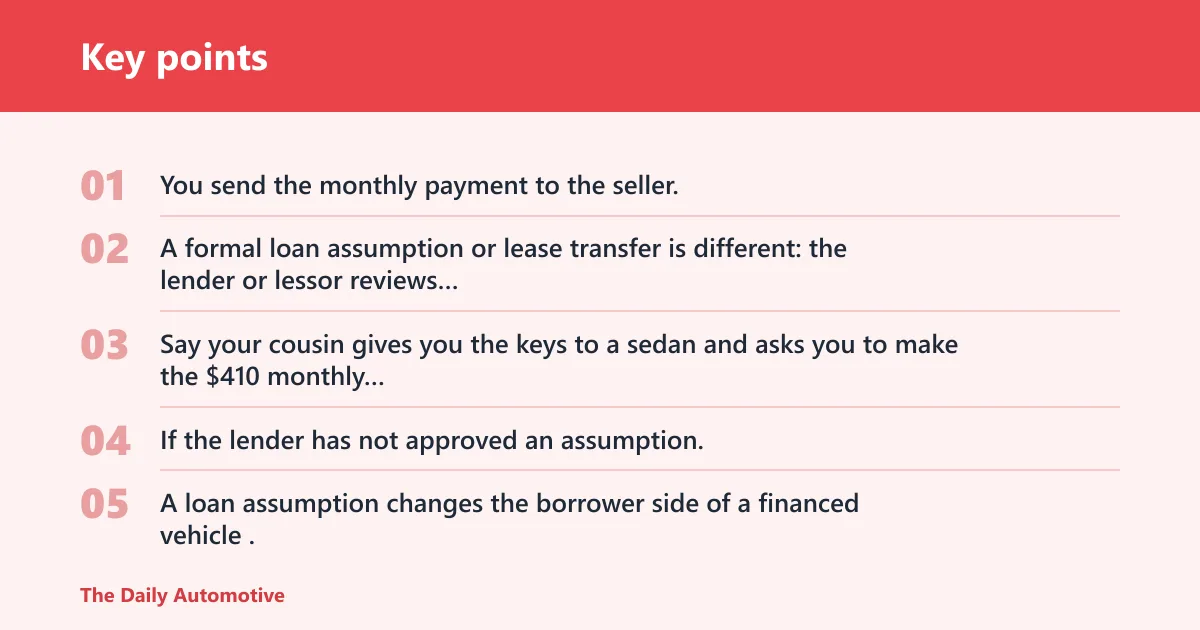
An informal handoff is the weakest version. You send the monthly payment to the seller, but the loan or lease stays in the seller’s name. A formal loan assumption or lease transfer is different: the lender or lessor reviews you, approves the change, and issues paperwork that shifts at least part of the legal burden.
Say your cousin gives you the keys to a sedan and asks you to make the $410 monthly payment by bank transfer. If the lender has not approved an assumption, the original borrower may still owe missed payments, and the account can still be reported under the original borrower’s credit file.
Why the label on the deal matters
A loan assumption changes the borrower side of a financed vehicle. A lease transfer changes the lessee side of a rented vehicle with mileage and term limits that already exist. If you treat a lease like a loan, or a payment handoff like a transfer, you can end up paying on a contract that never moved to your name.
Can you legally take over the payments?
Yes, but only when the lender or lessor allows it and the paperwork is completed. Most real transfers need written approval, and many contracts limit assumptions or transfers outright. Until that approval is signed, the original borrower may remain liable, even if you are the one sending the money each month.
When approval is required
Loan assumption usually requires lender approval because the creditor is choosing a new obligor. That often means a credit review, income verification, and signed assumption papers. Lease transfers usually need lessor approval for similar reasons, and the lessor may charge a transfer fee or reject the request if credit standards are not met.
Why the original borrower may still be liable
Payment changes do not erase the old contract. If the lender has not issued a formal release, the original borrower can still be pursued for missed payments, repossession costs, and collection activity. The credit bureaus may also continue to show the account under that borrower until the lender updates the reporting file.
What signed assumption papers should say
Any assumption agreement should identify the parties, list the balance and monthly payment, state who pays fees, taxes, and repairs, and define default and indemnity terms. It should also say whether the original borrower is released or remains secondarily liable. If that release is missing, the risk remains.
Loan assumption and lease transfer differences
Loan assumption and lease transfer both move payment responsibility, but they do not move the same legal rights. A loan assumption can change the debt holder relationship if the lender agrees. A lease transfer usually just substitutes one approved lessee for another while the lease terms keep running exactly as written.
Loan assumption: credit review and contract limits
Many auto loans allow no assumption without lender consent. Others permit it only after underwriting, a fee, and signed transfer documents. Some contracts forbid it completely. A lender may deny the request if your credit, income, or documentation does not fit its standards, even when the car itself is in good condition.
Lease transfer: remaining term, mileage limits, and fees
A lease transfer usually keeps the existing lease term, mileage cap, wear standards, and end-of-lease charges. The lessor may approve you only after a credit check, and a transfer fee may apply. You do not start a new lease; you step into the remaining one, with all its limits intact.
What changes and what does not
What changes: the approved party, the payment source, and sometimes the party responsible for future charges. What does not change: the original contract terms unless the lender or lessor rewrites them. Title, lien status, and DMV registration may also lag behind the payment switch, which is why the paperwork order matters.
Car payment takeover risk audit worksheet
Use this worksheet before any money changes hands. A “yes” only counts if you have the document or confirmation in hand, not a promise over text. If too many answers are “no,” stop and verify before paying a deposit or first month’s installment.
| Take Over Car Payments Risk Audit | Yes/No check | What proves it |
|---|---|---|
| 1 | Is the lender or lessor transfer approved in writing? | Signed approval or assumption letter |
| 2 | Does the contract allow assumption or transfer? | Loan or lease contract clause |
| 3 | Has the original borrower been formally released? | Release language in lender papers |
| 4 | Is the current balance known? | Payment history report |
| 5 | Is the remaining term known? | Account statement or lease summary |
| 6 | Is the account current with no active delinquency? | Recent lender status report |
| 7 | Are late fees and default history disclosed? | Full payment history report |
| 8 | Has the vehicle been inspected independently? | Third-party inspection or mechanic review |
| 9 | Is mileage consistent with the paperwork? | Odometer reading matched to records |
| 10 | Do you know whether gap insurance is required? | Policy terms and lender rule |
| 11 | Have title and lien steps been confirmed for your state? | DMV and lienholder instructions |
| 12 | Is a written deal signed by all parties? | Assumption or transfer agreement |
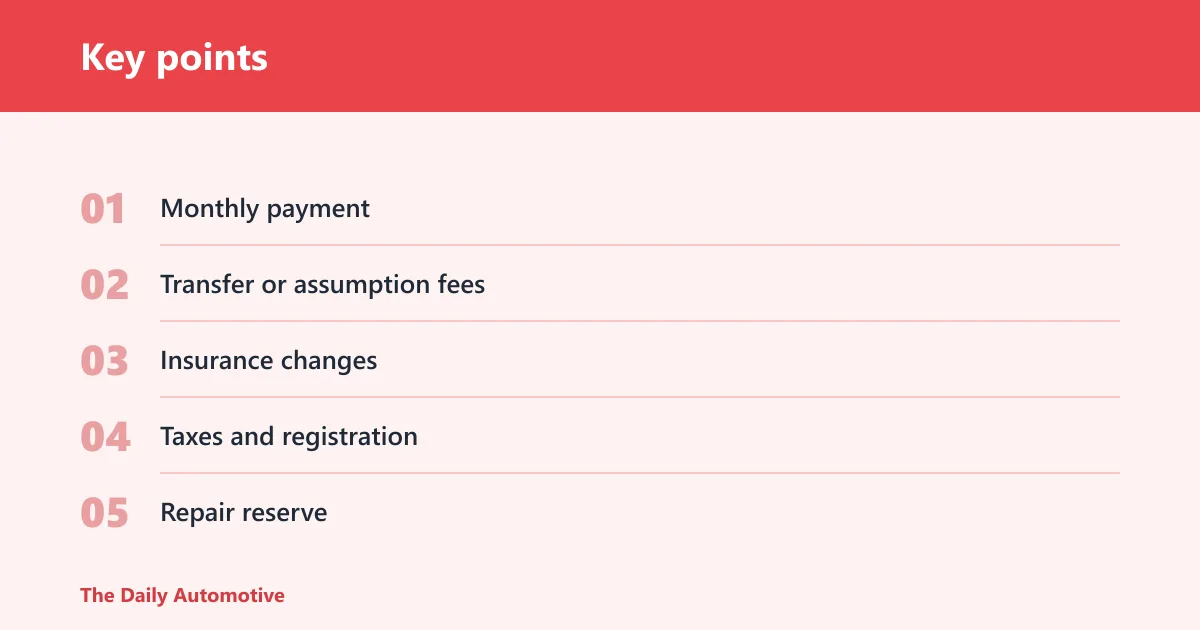
Five-line cost stack
- Monthly payment: the contract payment, not the seller’s verbal quote.
- Transfer or assumption fees: lender, lessor, and paperwork charges.
- Insurance changes: new driver rating, lienholder coverage rules, and possible gap insurance.
- Taxes and registration: title, registration, and any applicable state taxes.
- Repair reserve: money set aside for tires, brakes, fluids, and hidden defects.
Go/no-go rule
Go only if three items are true: the lender or lessor has approved the transfer, negative equity is manageable after you compare balance to market value, and title or lien status has a path to formal change. No approval, deep negative equity, or blocked title means no deal.
What should you verify before you agree?
You need a payment history report, an independent condition check, and a look at insurance and gap coverage. Do not rely on the seller’s summary. If you are not the borrower, ask for the account balance, the remaining term, delinquency status, late fees, and default history only if the lender can provide them to you or the borrower authorizes release of the information before you decide whether the deal is worth the risk.
Payment history report
The report should show the current balance, remaining term, delinquency status, late fees, default history, and whether the account is current. If you are not the account holder, the lender may require authorization before sharing the full report. If the account has recent late marks or a prior default, the risk is higher because the lender has already seen payment stress. That can affect approval too.
Picture a compact SUV with a monthly payment of $365 and a balance that still sits well above its market value. If the report also shows two 30-day late marks in the past year, the lender may view the account as strained, and the gap between balance and value becomes your problem if the car is totaled.
Vehicle condition and mileage check
Vehicle condition and mileage must be verified independently because wear affects resale value and hidden repair risk. Check tires, brakes, suspension, fluids, warning lights, body damage, and service records. Match the odometer to the paperwork. Higher mileage with weak maintenance usually means the real cost is larger than the payment alone.
Gap insurance and coverage transfer check
Gap insurance matters when the loan balance is higher than the car’s market value, especially on newer vehicles or stretched terms. Some lenders require it. Do not assume the policy transfers automatically; confirm whether the coverage follows you, whether you can buy a new policy, and what the deductible is.
How do title and lien release work?
Title does not move cleanly just because payments change hands. A lender lien release or equivalent lender release is part of the title path, and state DMV rules vary. If the lienholder is still on record, the car cannot be transferred like an unencumbered vehicle, even if everyone agrees in writing.
UCC lien release and title timing
The lienholder usually needs to be removed or formally acknowledged before title can move cleanly. That usually happens after payoff, refinancing, or a lender-approved assumption process. If the debt remains open, the title may still show the lender’s interest, and the DMV may refuse a simple ownership change.
State DMV and registration differences
Some states handle title reassignment, registration updates, and lien release timing in different steps. Others require the lender to send release documents directly. The rule to follow is simple: check the DMV process for your state before you hand over money, because a signed side agreement does not rewrite local title procedure.
Why a written deal is not enough
A private agreement can assign responsibility between the people involved, but it cannot force the lender to release liability or the DMV to issue title in your name. Without lender action, the old borrower can still be on the hook, and the vehicle can still sit in lien status.
Who pays if the deal goes bad?
If the buyer stops paying after a takeover, the lender pursues the party listed on the contract and may also pursue the original borrower if no formal release exists. Default can trigger repossession, fees, and credit reporting. If the seller disappears, your only protection is the paper trail you already secured.
Default, repossession, and credit reporting
When payments stop, the account can go delinquent, late fees can grow, and repossession can follow if the contract permits it. Credit reporting usually follows the legal account holder, not the person who casually agreed to send money. That is why an informal handoff is a weak shield.
Seller disappearance and missing documents
A common first-timer mistake is sending money before getting lender approval and then learning the seller has no title copy, no payoff statement, and no signed transfer form. If the seller disappears, you may have a car you cannot legally register and payments you cannot prove were part of a valid transfer.
Indemnity language and practical limits
An indemnity clause can say who reimburses whom if fees, taxes, or defaults arise, but it is not a substitute for lender consent or title transfer. If the other party has no money, the clause may be hard to collect on. Use it as backup, not as the main protection.
How do you protect yourself with a written agreement?
You protect yourself by putting the entire deal in writing before any payment changes hands. The agreement should identify the parties, list the balance and monthly payment, state who pays fees, taxes, and repairs, and define default, insurance, and indemnity terms. It should also say whether lender approval is still pending.
- Attach the lender or lessor approval letter.
- List the exact balance, payment date, and due amount.
- State who pays transfer fees, taxes, registration, and insurance changes.
- State who handles repairs, tires, towing, and breakdowns before title moves.
- Say what happens if approval is denied or documents never arrive.
Do not sign a “deal” that leaves the title, lien, or release status vague. If approval is still pending, make that clear in the document and avoid sending a full payment until the transfer can be completed. That keeps the agreement tied to the actual legal event, not a promise.
Frequently asked questions
Can you legally take over someone else’s car payments?
Only if the lender or lessor approves the transfer in writing and the contract allows it. A private promise to keep paying is not the same as a legal assumption or lease transfer. Without approval, the original borrower can still be liable, and the vehicle may still sit under the old account.
How does a car payment takeover work without getting scammed?
Start with the account documents, not the keys. Verify the balance, the remaining term, the delinquency status, and whether lender consent exists. Match the title and lien status to the paperwork, and do not pay a deposit until you see signed approval or transfer papers that name you.
What should I check before assuming a car loan?
Check whether the loan permits assumption, whether the lender will underwrite you, whether the account is current, and whether late fees or defaults exist. Then inspect the car, compare the balance to market value, and confirm how the lien will be released or carried into your name.
Is a payment takeover the same as a lease transfer?
No. A lease transfer usually keeps the same lease terms, mileage cap, and end-of-lease obligations, while a loan assumption changes the borrower side of financed debt if the lender approves it. The approval process, fee structure, and liability outcome are different for each.
Who is liable if the buyer stops paying after a takeover?
The party legally named on the contract remains the first target for collection, repossession, and credit reporting, but liability after a formal assumption or lease transfer depends on whether the original borrower was released under the specific contract. If the original borrower never received a formal release, that borrower may still be pursued too. An informal payment handoff does not erase the lender’s rights against the old account holder.
What fees and taxes come with taking over car payments?
Expect possible transfer or assumption fees, title and registration charges, applicable state taxes, insurance changes, and a repair reserve. If the vehicle is leased, the lessor may also charge a transfer fee. The monthly payment alone is not the real monthly burden.
Products related to this article
Sponsored / affiliate links. As an Amazon Associate I earn from qualifying purchases. I may earn additional commission from eligible campaigns.