How Long Does Synthetic Oil Last in a Car? Mileage Guide
Synthetic oil in many cars is often scheduled for roughly 6,000 to 10,000 miles or about 6 to 12 months, but short trips, long idling, and storage can move that deadline earlier. Old oil loses protection and can carry moisture and fuel, which raises wear and repair risk. This guide breaks the interval into mileage, calendar age, and storage conditions so you can judge whether the oil is still serviceable.
How long does synthetic oil last in a car?

Synthetic oil in a car lasts by miles in service and months in service, not by one fixed number alone. Most manufacturers tie oil changes to the owner’s manual, the oil life monitor, and whether driving is normal or severe. If the car sees short trips, cold starts, idling, or towing, the safe interval usually gets shorter.
The short answer: mileage and time both count
Full synthetic oil generally handles heat and oxidation better than conventional oil, so it can stay serviceable longer. Even so, oil still ages on the calendar. Additives get used up, moisture can collect, and fuel can thin the oil before the odometer reaches the mileage limit.
Why the owner’s manual is the first limit to check
The owner’s manual sets the base service schedule for that engine, that oil viscosity grade, and that duty cycle. Some manuals list a normal-service interval and a severe-service interval. Others rely on an oil life monitor. Start there, because the right answer for one engine can be wrong for another.
Why synthetic oil still ages before the mileage limit
Oil chemistry does not pause just because the car is parked. Oxidation continues slowly, and contamination can build as the engine warms and cools. That is why a low-mileage car may still need a change at 6 or 12 months even if the odometer barely moved.
What actually wears synthetic oil out?
Synthetic oil wears out from chemistry and contamination. Oxidation depletes additives, fuel dilution thins the oil, soot and acids build up, and water from condensation can enter the crankcase. When that happens, the oil loses its ability to lubricate, clean, and protect as well as fresh oil.
Oxidation and additive depletion
Heat and air slowly change the oil’s base stock and consume the additive package. Detergents, dispersants, anti-wear agents, and corrosion inhibitors do not last forever. Full synthetic oil usually resists oxidation better than synthetic blend, but both still age in service.
Fuel dilution, soot, and acid buildup
Short trips and repeated cold starts can leave unburned fuel in the oil. That lowers viscosity and can reduce film strength. Soot and combustion byproducts also load the oil, while acids form as the oil handles blow-by gases. Over time, that combination can push sludge formation.
Water from short trips and repeated cold starts
If the engine does not get fully hot often enough, water may not boil off. That matters in winter and in stop-and-go use. Moisture contamination is one reason time matters even when mileage stays low.

How long does full synthetic oil last versus synthetic blend?
Full synthetic usually lasts longer than synthetic blend because it has better oxidation resistance and better control of viscosity under heat. But the label on the bottle does not replace the service schedule. The engine still needs the viscosity grade and oil specification the manufacturer calls for.
Full synthetic vs. synthetic blend
Full synthetic oil is built to tolerate heat, shear, and oxidation better than a blend. A synthetic blend can still be acceptable if the manual allows it, but it may have less reserve life in severe use. The right choice is the oil that meets the engine’s required specification.
Why the oil label does not replace the service schedule
A 0W-20 full synthetic does not mean “10,000 miles no matter what.” The schedule still depends on how the car is used. A short-trip commuter, a tow vehicle, and a weekend cruiser can all need different timing.
Viscosity grade and why it still has to match the engine
Viscosity grade matters because it controls how the oil flows at startup and how it protects at operating temperature. Use the grade listed in the manual unless the manufacturer gives an approved alternative. Better oil chemistry does not cancel a wrong viscosity.
When mileage matters more than the calendar
Mileage matters most when the engine reaches full operating temperature often and stays there long enough to evaporate moisture and fuel. A daily driver on normal commutes may follow a mileage-based interval. Once service gets severe, the calendar and the operating pattern matter more than the odometer alone.
Daily drivers and normal-service intervals
For a car used mostly for longer drives, the mileage limit in the manual may arrive before the month limit. That is the easy case. The oil life monitor, if equipped, can help estimate remaining life, but it is still a manufacturer-specific estimate, not a universal rule.
Short trips, idling, towing, and stop-and-go traffic
These conditions shorten oil life quickly. Short trips and cold starts leave more moisture and fuel in the crankcase. Idling adds hours without adding much temperature stability. Towing and stop-and-go traffic increase heat load and can speed oxidation and additive depletion.
Why severe service shortens the interval
Most manuals define severe service because it is easier on the engine to shorten the interval than to guess wrong. If the car regularly sees repeated short trips, mountain driving, dusty roads, trailer towing, or long idle periods, use the severe-service schedule.
How long does synthetic oil last in a car not driven?
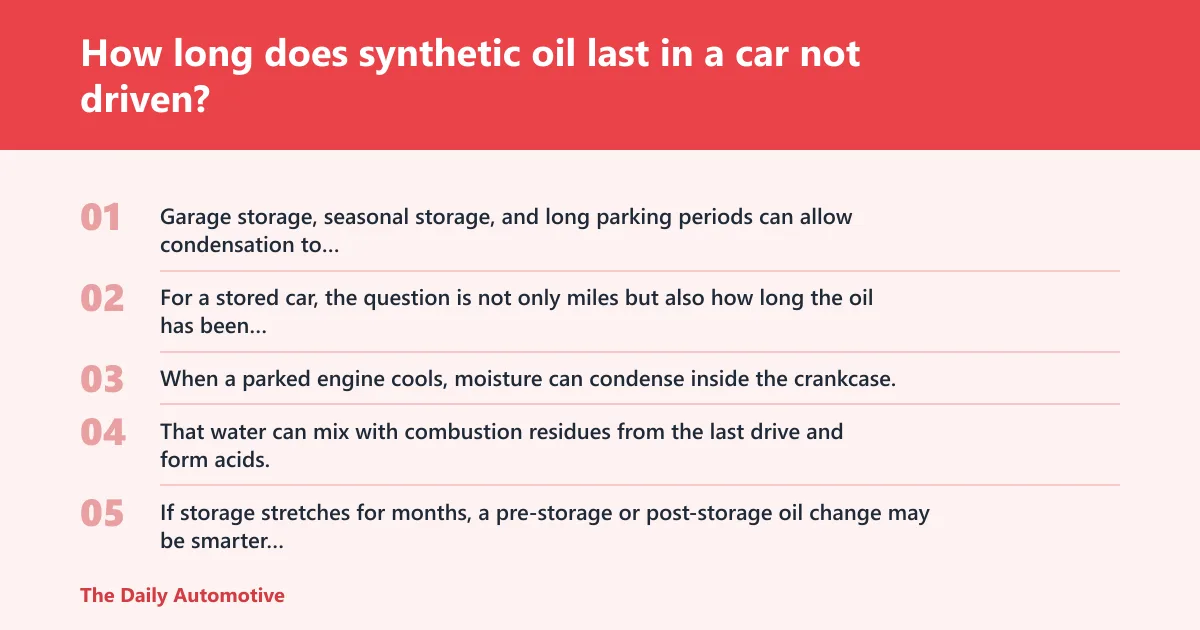
A car that is not driven still ages its oil. Garage storage, seasonal storage, and long parking periods can allow condensation to form, and contaminants do not disappear just because the engine is off. For a stored car, the question is not only miles but also how long the oil has been sitting.
Stored car timing and condensation risk
When a parked engine cools, moisture can condense inside the crankcase. That water can mix with combustion residues from the last drive and form acids. If storage stretches for months, a pre-storage or post-storage oil change may be smarter than waiting for mileage alone.
Garage storage and seasonal storage
A garage slows temperature swings, but it does not stop aging. Seasonal storage is common for convertibles, classic cars, motorcycles, and weekend cars. If the car sits for an entire season, check the time limit in months, not just the miles.
Change before storage or after storage?
If the oil is already near its time limit, change it before storage so the engine sits with fresh oil and a fresh filter. If the car went into storage after a recent oil change and the interval remains well inside the time limit, service can wait until the car returns to use. The key is not to store dirty, depleted oil for long periods.
Decision table for three common cases
| Use case | Miles in service | Months in service | Severity trigger | Action |
|---|---|---|---|---|
| Daily driver | Follow the manual’s normal-service mileage limit, often about 7,500 to 10,000 miles | Usually 6 to 12 months | Short trips, idling, towing, stop-and-go traffic | Change at the first limit reached |
| Low-mileage driver | May not hit the mileage limit for a long time | Usually the calendar limit comes first, often 6 to 12 months | Frequent cold starts or short errands | Change by time, even if miles are low |
| Stored car | May add almost no miles | Check before storage if the oil will age past its limit | Seasonal storage, condensation risk, long idle periods | Service before storage or immediately after return to use |
Say your sedan gets 4,200 miles a year, mostly five-mile errands in winter. The oil may still need to be changed at around 6 or 12 months because short trips may not let the crankcase dry out fully. The odometer is not the only clock that matters.
Can you go a year between synthetic oil changes?
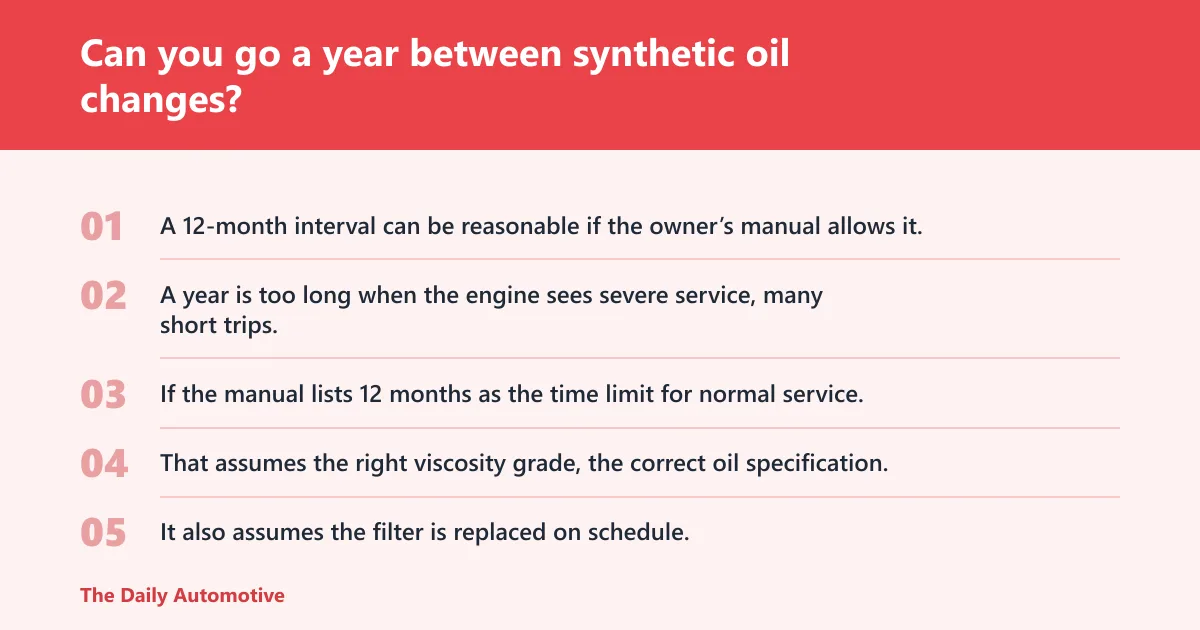
A 12-month interval can be reasonable if the owner’s manual allows it, the oil life monitor has not called for service, and the car is driven under normal conditions. A year is too long when the engine sees severe service, many short trips, or long storage with condensation risk.
When a 12-month interval is reasonable
If the manual lists 12 months as the time limit for normal service, a year between changes can be fine. That assumes the right viscosity grade, the correct oil specification, and a healthy driving pattern. It also assumes the filter is replaced on schedule.
When a year is too long
If the car is used mostly for short hops, idling, or towing, a year can exceed the oil’s useful life even with low mileage. The same is true if the car sits for long stretches in humid conditions. Time can be the first limit to fail.
How the oil life monitor fits into the decision
An oil life monitor estimates remaining service life using an algorithm that may take engine temperature, run time, trip pattern, and other inputs into account. It is not the same as a fixed 5,000-mile rule. Reset it after service, following the manufacturer’s procedure, so the next estimate is meaningful.
What shortens synthetic oil life the fastest?
The fastest oil-life killers are repeated short trips, cold starts, long idling, stop-and-go traffic, and towing. Those conditions create heat swings, fuel dilution, and moisture buildup. Dusty driving, high engine load, and infrequent use can add to the damage.
Signs the oil is nearing the end of service
Check the owner’s manual first, then the oil life monitor if equipped. If the oil is very dark, smells strongly of fuel, or the warning light appears, service should not wait. Dirty appearance alone is not a perfect test, but it is a reason to inspect the schedule carefully.
Don’t forget the oil filter
The filter captures contaminants, but it can saturate over time. Once loaded, it may stop trapping debris as effectively, and that dirt stays in circulation. Replace the oil filter with the oil change unless the manufacturer specifies a different service pattern.
A common first-timer mistake is ignoring low mileage
Picture a crossover driven 2,000 miles a year on school runs and grocery trips. The owner sees low mileage and skips service for two years. That oil can age, pick up moisture, and lose additive reserve long before the odometer looks high.
How long does engine oil last in a car?
Engine oil in a car generally lasts according to the manufacturer’s mileage and time schedule, not a single universal number. For many cars, that may mean roughly 6,000 to 10,000 miles or about 6 to 12 months, though severe service can shorten those intervals. The manual sets the real boundary.
Normal-service schedule versus severe-service schedule
Normal service assumes the engine gets warm regularly and operates in moderate conditions. Severe service assumes short trips, cold starts, heavy loads, stop-and-go driving, dusty roads, or towing. If either schedule applies, use the one that matches the car’s actual life.
Why the filter and oil should be changed together
Fresh oil with an old, saturated filter is a compromise. The filter may hold old debris, and bypass flow can increase if the media loads up. Matching the filter to the oil change gives the engine a clean start and resets both service clocks.
Frequently asked questions
How long does synthetic oil last in a car?
Most cars on synthetic oil fall somewhere around 6,000 to 10,000 miles or 6 to 12 months, but the manual is the better guide. Short trips, idling, towing, and cold starts can shorten that window. Change at the first limit reached.
How long does full synthetic oil last in a car?
Full synthetic oil usually lasts longer than synthetic blend because it resists oxidation and heat better. Even so, it still ages on the calendar and can collect fuel, water, and acids. Follow the manual’s normal- or severe-service schedule, not the bottle alone.
How long does synthetic oil last in a car not driven?
In a parked car, synthetic oil can age by time even with very few miles. Condensation, temperature swings, and residual contamination can still shorten life. If the car sits for months, use the calendar limit and consider changing the oil before storage.
How long can synthetic oil sit in a car?
Synthetic oil can sit in a car for months, but that does not mean it stays fresh indefinitely. If the engine is stored after a long run or in humid conditions, moisture and acids can build. Use the manufacturer’s time limit, usually 6 to 12 months.
Is mileage or time more important for synthetic oil changes?
Neither one always wins. Mileage matters when the engine reaches operating temperature often and the oil stays clean. Time matters when the car sees short trips, storage, or low annual miles. Use whichever limit comes first in the manual or oil life monitor.
Can I go a year between synthetic oil changes?
A year can be fine if the owner’s manual allows 12 months, the oil life monitor has not called for service, and driving is normal. It is usually too long for severe service, heavy short-trip use, or a car that sits for long stretches in humid weather.
Products related to this article
Sponsored / affiliate links. As an Amazon Associate I earn from qualifying purchases. I may earn additional commission from eligible campaigns.
 ECOGARD X10023 Cartridge Engine Oil Filter for Conventional Oil - Premium Replacement | Fits 2018-2023 Volkswagen Atlas 3.6L; 2020-2023 Atlas Cross Sport 3.6L
 ECOGARD X10040 Cartridge Engine Oil Filter for Conventional Oil - Premium Replacement | Fits 2011-2026 Jeep Grand Cherokee, Dodge Durango 3.6L; 2012-2026 Wrangler 3.6L; 2014-2022 Cherokee 3.2L