How Many Car Lengths Is 200 Feet? Easy Distance Guide
200 feet is roughly 12 to 13 average car lengths, with smaller cars making it a bit more and larger vehicles making it a bit less. Miss that gap and you can tailgate or miss theory-test answers. This guide shows the feet-to-car-length conversion, how vehicle size changes the number, and why it matters for safe following gaps.
How many car lengths is 200 feet?
Using a rough 13-foot average car length, 200 feet is about 15 car lengths. Rounded for everyday use, that is about 15 car lengths. The answer shifts if the vehicle is shorter or longer, so the same 200 feet can look very different behind a compact car, an SUV, or a pickup.
Quick answer using a 13-foot average car
Average car length is often treated as 13 feet, or roughly 4 metres. That works out to roughly 15 car lengths if you use 13 feet per car length. Rounded, the clean answer is about 15 car lengths. It is an estimate, not an exact count, because real cars are not all the same size.
Why the result shifts by vehicle type
A short hatchback leaves more car-lengths in the same 200 feet. A long SUV or pickup leaves fewer. That matters because people often estimate by eye, and the eye usually measures bumper-to-bumper length, not a vague body length. A longer vehicle changes the count even though the road distance stays the same.
How do you convert feet to car lengths?
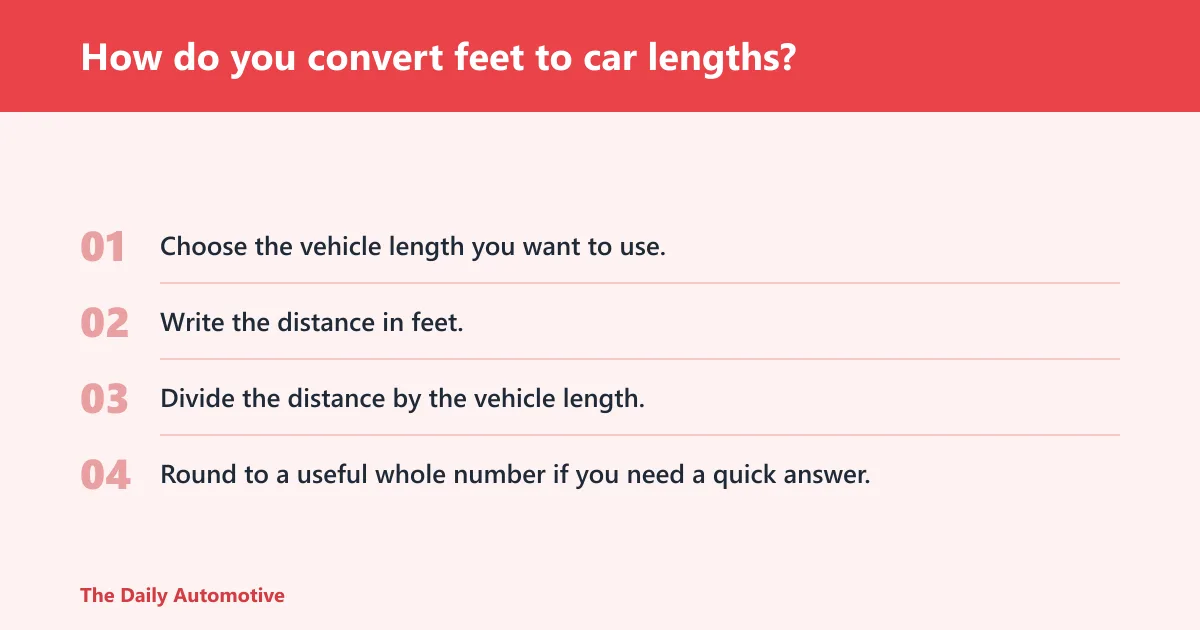
Convert feet to car lengths by dividing the distance in feet by the vehicle length in feet. If you use the common 13-foot average car, the formula is simple: feet ÷ 13 = car lengths. The same method works for any vehicle size, as long as you use one clear length from front to rear.
The simple division method
- Choose the vehicle length you want to use.
- Write the distance in feet.
- Divide the distance by the vehicle length.
- Round to a useful whole number if you need a quick answer.
For example, 175 feet comes out to a little over 13 car lengths if you use 13 feet per car, so it rounds to about 13. The math is plain. The only real decision is which vehicle length you are using.
Common mistakes when estimating by eye
A common first-timer mistake is using bumper-to-bumper length without saying so. Another is mixing car lengths with lane markings, light poles, or dashed road paint, which are not fixed units. A third is treating a large pickup and a small hatchback as if they measure the same. They do not.
| Vehicle type | Length used | Math for 200 feet | Result |
|---|---|---|---|
| Average car | 13 feet | 200 ÷ 13 = 15.38 | About 15 car lengths |
| SUV | 15 feet | 200 ÷ 15 = 13.33 | About 13 car lengths |
| Pickup | 20 feet | 200 ÷ 20 = 10 | 10 car lengths |
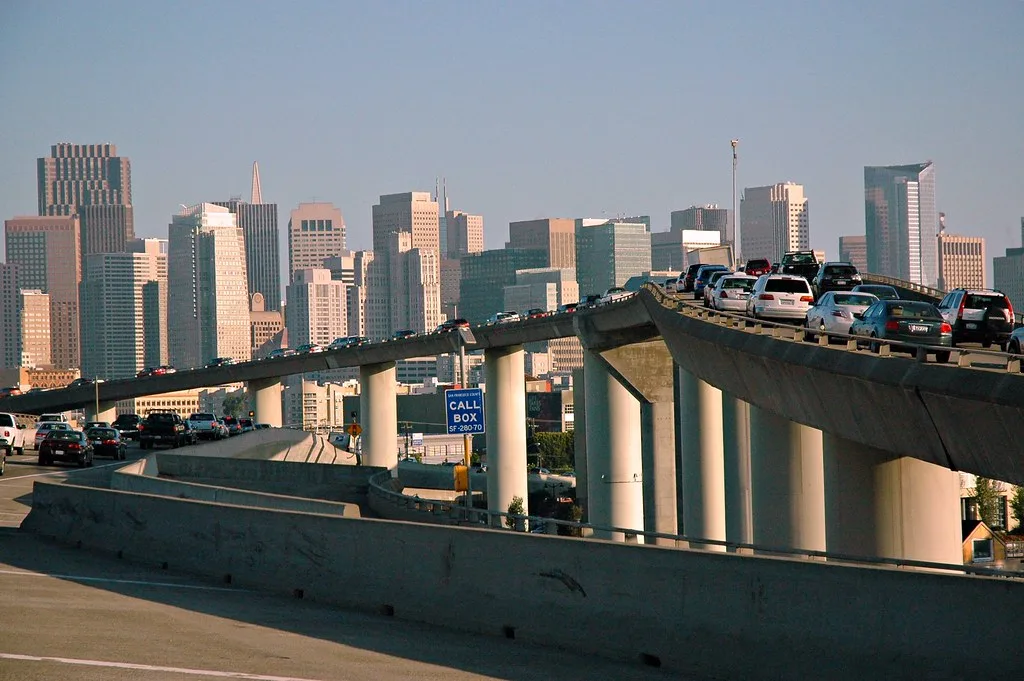
How long is an average car length?
An average car length is often taken as 13 feet, which is about 4 metres. That is a useful baseline for quick conversions and theory-test revision. It is not a fixed rule for every vehicle, because compact cars, sedans, SUVs, and trucks all fall at different points on the size scale.
Why 13 feet is a useful baseline
Thirteen feet works as a clean memory figure because it is widely used as a general average. It gives a practical starting point for car-length estimates when you are reading a road question or judging space in traffic. If the exact vehicle class matters, switch to the real length instead of the average.
Why compact cars, sedans, SUVs, and trucks differ
Compact cars are usually shorter than average. Many sedans sit near the middle. SUVs are often longer, and pickups can be longer again. That is why 200 feet may look like nearly 14 small-car lengths, about 13 SUV lengths, or 10 pickup lengths. The road does not change; the measuring stick does.
What do thinking distance, braking distance, and stopping distance mean?
Thinking distance is the distance travelled before braking begins, and the rough guide is about 1 foot for every mph. Braking distance starts once the brakes are applied and rises with speed. Stopping distance is the total of both. It is a general guide only, because road and vehicle conditions change the result.
Thinking distance
Thinking distance is the space covered while the driver notices a hazard, decides what to do, and moves to the brake. A common guide is approximately 1 foot per mph. Attention, fatigue, alcohol, drugs, and distraction can all increase that distance because they slow the reaction phase.
Braking distance
Braking distance is the distance travelled after the brakes are applied. It increases with speed, and it also changes with road and vehicle condition. A car on a dry road stops differently from one on a wet or icy road. Tyres, brakes, inflation, and wear matter too.
Stopping distance
Stopping distance equals thinking distance plus braking distance. That is the figure theory-test questions often point toward. The distances shown in test charts are a general guide, not a fixed rule. Picture a driver approaching a hazard at 40 mph: the total stopping distance is not just one number, because reaction time and grip both count.
Is 200 feet a safe following distance?
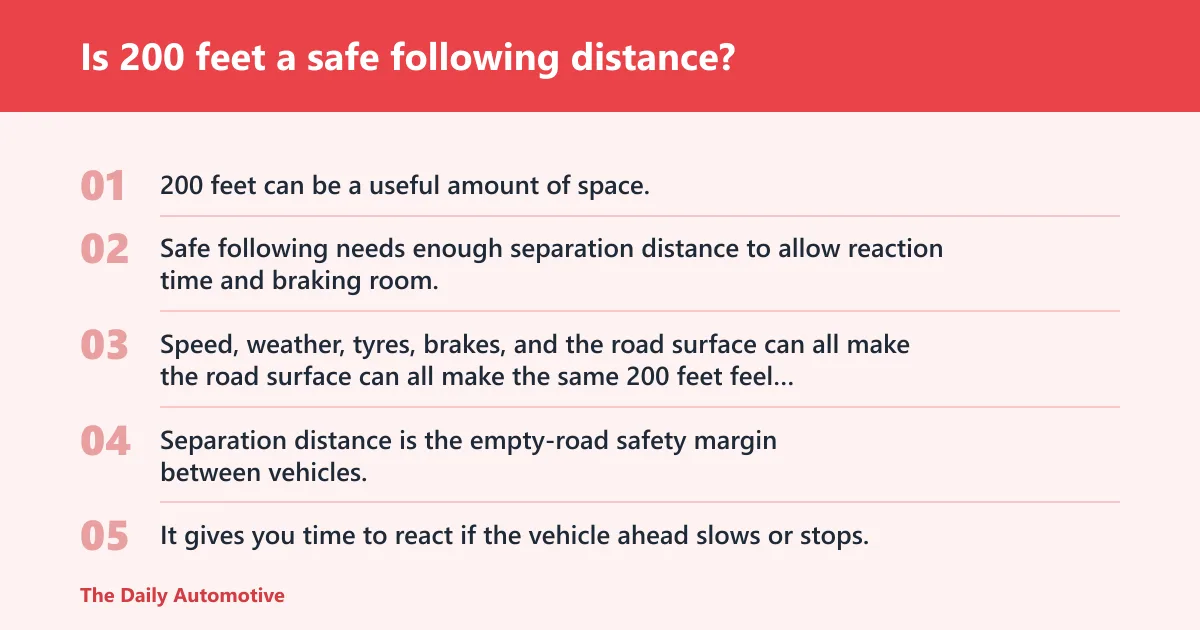
200 feet can be a useful amount of space, but it is not a fixed safe following distance in every situation. Safe following needs enough separation distance to allow reaction time and braking room. Speed, weather, tyres, brakes, and the road surface can all make the same 200 feet feel too short or more than enough.
How to think about separation distance
Separation distance is the empty-road safety margin between vehicles. It gives you time to react if the vehicle ahead slows or stops. At lower speeds, 200 feet may feel very large. At higher speeds, the same gap can disappear quickly. Visual judgment alone is unreliable if you do not know your speed.
Why speed, weather, tyres, and brakes change the answer
Dry road conditions usually allow shorter braking distances than wet road conditions, while icy road conditions can stretch stopping distance sharply. Tyre condition, tyre inflation, brake condition, and wear also affect stopping distance. A heavier vehicle may need more space as well. So 200 feet is only a snapshot, not a safety guarantee.
Suppose a learner driver is at 30 mph behind a hatchback on a wet road. The gap may look generous from inside the car, but the available stopping room drops once reaction time and reduced grip are counted. The same 200 feet feels very different at 30 mph than at 60 mph.
How many car lengths are 175 feet and 240 feet?
At the common 13-foot average car length, 175 feet is about 13.5 car lengths and 240 feet is about 18.5 car lengths. Rounded for quick use, that is about 13 car lengths for 175 feet and about 18 car lengths for 240 feet. These figures line up with standard stopping-distance memory questions.
175 feet converted to car lengths
175 feet is a familiar theory-test figure. Using 13 feet per car length, 175 ÷ 13 = 13.46. Rounded, that is about 13 car lengths. This also matches the common stopping-distance guide for 50 mph, which is 175 feet, or 13 car lengths.
240 feet converted to car lengths
240 feet ÷ 13 = 18.46. Rounded, that is about 18 car lengths. This also matches the common stopping-distance guide for 60 mph, which is 240 feet, or 18 car lengths. If the vehicle is longer than average, the car-length count falls even though the feet stay the same.
| Distance | Math using 13-foot average car | Approximate car lengths |
|---|---|---|
| 175 feet | 175 ÷ 13 = 13.46 | About 13 car lengths |
| 240 feet | 240 ÷ 13 = 18.46 | About 18 car lengths |
How can I remember stopping distances for the theory test?
Remember stopping distances by pairing the speed with the total distance, then converting that total into car lengths using 13 feet per car. Keep the units straight. The theory test usually wants the standard guide, not a real-world guess, so do not mix up metres, feet, and car lengths while revising.
Memorising the pattern without mixing units
The common guide runs like this: 20 mph is 40 feet, or 3 car lengths; 30 mph is 75 feet, or 6 car lengths; 40 mph is 120 feet, or 9 car lengths; 50 mph is 175 feet, or 13 car lengths; 60 mph is 240 feet, or 18 car lengths; 70 mph is 315 feet, or 24 car lengths.
A simple way to remember it is to focus on the sequence, not the exact arithmetic every time. The figures are a general guide, and they are designed for theory-test recall. If the question asks for a distance in feet, answer in feet. If it asks for car lengths, convert using the 13-foot baseline.
Reading the question carefully
Many misses come from not reading the wording closely. A question may ask for stopping distance, thinking distance, or braking distance, and those are not the same. It may also ask for a safety margin rather than a test-chart figure. Match the question to the right concept before you answer.
Frequently asked questions
How many car lengths is 200 feet?
Using the common 13-foot average car length, 200 feet is about 15.4 car lengths, which rounds to about 15 car lengths. If you use a 15-foot SUV, the same 200 feet is about 13 car lengths. With a 20-foot pickup, it is 10 car lengths.
How do you convert feet to car lengths?
Divide the distance in feet by the vehicle length in feet. For the common average-car baseline, use 13 feet, so 200 ÷ 13 gives about 15 car lengths. The method stays the same for other vehicles; only the length in the divisor changes.
How long is an average car length?
An average car length is commonly treated as 13 feet, or roughly 4 metres. That is a useful baseline for quick conversions, especially in theory-test prep. It is still only an average, so compact cars, sedans, SUVs, and trucks can sit above or below that figure.
Is 200 feet a safe following distance?
200 feet may be enough in some conditions and too little in others. Safe following depends on speed, weather, road grip, tyres, brakes, and the reaction time built into your separation distance. Treat 200 feet as a rough measure, not a universal rule for safe driving.
What affects stopping distance in feet?
Stopping distance changes with speed, road surface, driver reaction, tyres, brakes, inflation, wear, and vehicle condition. Thinking distance grows as speed rises, while braking distance also increases and can be stretched further by wet or icy roads. That is why theory-test figures are only a general guide.
How do thinking distance and braking distance differ?
Thinking distance is the space covered before braking begins. Braking distance is the space covered after the brakes are applied. Thinking distance depends on reaction time, while braking distance depends on speed and grip. Add them together and you get stopping distance, which is the full halt from hazard to standstill.
Products related to this article
Sponsored / affiliate links. As an Amazon Associate I earn from qualifying purchases. I may earn additional commission from eligible campaigns.
 4G GPS Tracker Car Anti-Theft Long Battery Life 20000mAh Real Time GPS Tracking Device Magnet No Geographic Restriction Car Tracker with Alerts, Geo Fence, History Playback TK905C
 200 Bottles of cleaning tablets available, Car Windshield Washer Tablets, Glass Cleaner, Concentrated Effervescent Tablets, Solid Windshield Effervescent Wiper Tablet for Car Window Glass Cleaning