Karcher Car Vacuum Review
For most car owners, Kärcher’s compact wet/dry vacs are the practical middle ground: choose a WD 3-class model for crumbs and pet hair, and buy a wet/dry unit only if you need liquid cleanup. Go too small and grit stays in seams; go too large and you pay for bulk, noise, and hose length you may never use. This guide compares Kärcher’s car-use options by suction, attachments, wet pickup, and value so you can choose the right model type for your car.
Which kärcher model fits your car interior mess?
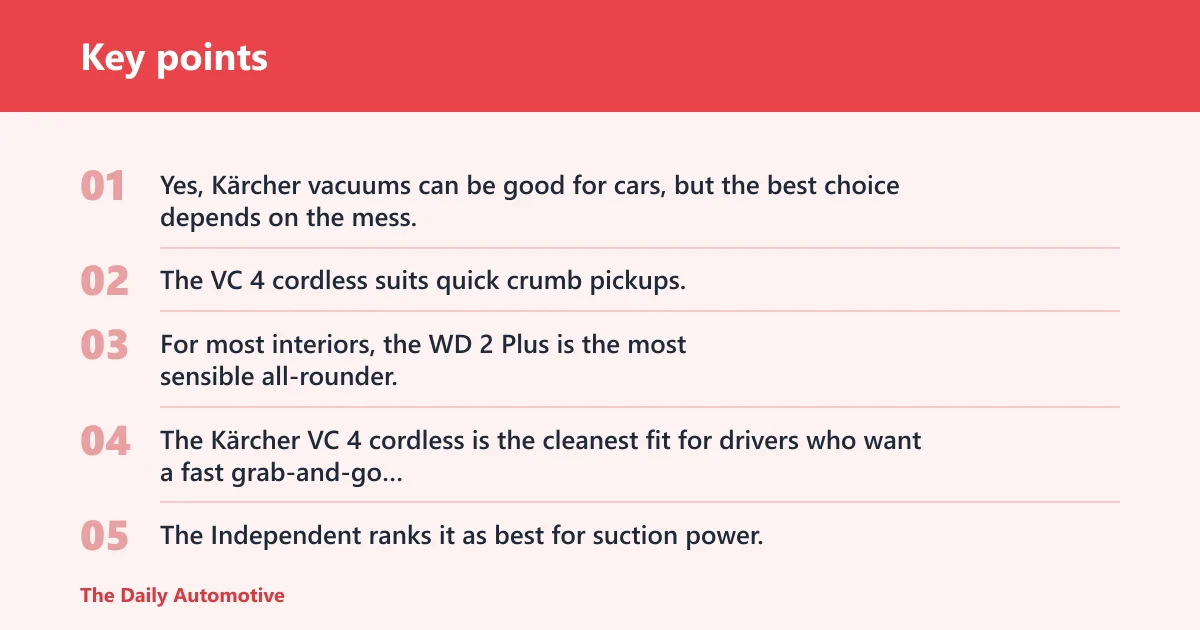
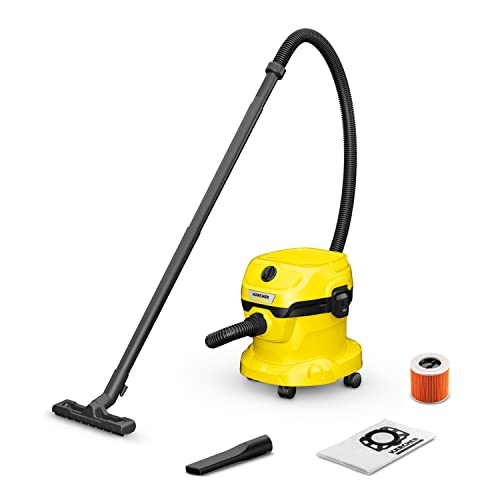
Yes, Kärcher vacuums can be good for cars, but the best choice depends on the mess. The VC 4 cordless suits quick crumb pickups, the WD 2 Plus suits mixed debris and wet spills, and the SE 4001 suits deeper fabric cleaning where bulk is acceptable. For most interiors, the WD 2 Plus is the most sensible all-rounder.
Best pick for quick car cleanups
The Kärcher VC 4 cordless is the cleanest fit for drivers who want a fast grab-and-go tool. The Independent ranks it as best for suction power, which matters when you are pulling crumbs from seat rails, cup holders, and floor-mat edges. It is the most car-friendly Kärcher form factor here.
Best pick for wet spills and heavy dirt
The WD 2 Plus is often a better fit when sand, muddy residue, or drink spills are part of the job. It has 1000 watts of power, a 12-litre liquid capacity in wet mode, a 1.8m suction hose, blowing function, and bagged debris collection. That combination beats a small handheld for messy interiors.
Best pick if you want deeper interior cleaning
The SE 4001 makes sense for cloth seats, floor mats, and heavier fabric cleaning, not for casual top-ups. Trusted Reviews describes it as both a wet and dry vacuum cleaner and carpet cleaner. It has an 18-litre internal capacity and a 4.8-litre tank for carpet cleaning solution, but no motorised brush bar.
Are Karcher vacuums any good for cars?
Yes, but only if you match the model type to the job. Kärcher does well on suction-led cleanup, wet-and-dry use, and attachment support for narrow interior spaces. It loses ground when the vacuum is too bulky for quick storage, too heavy for carry-around use, or too awkward to convert between tasks.
What Kärcher does well in a vehicle
Kärcher’s strength is that it offers several formats instead of one generic car vacuum. A cordless handheld suits fast tidying. A wet-and-dry vac suits heavier dirt and liquid pickup. A carpet-cleaner unit suits more involved fabric cleaning. That range matters because car messes are not all the same.
Say your rear footwell has dry cereal, fine dust, and a little tracked-in grit. A compact cordless unit is usually the easiest first pass. Now suppose the same car also has a spilled coffee on the mat. That is where a wet-and-dry Kärcher makes more sense than a small handheld.
Where Kärcher models lose ground to smaller car vacuums
The trade-off is size. A bigger Kärcher unit can be more capable, but that does not help if you want something stored in the boot or a garage shelf without fuss. The SE 4001, for example, is built for more involved cleaning and is less convenient to treat as a simple in-car tool.
How power source affects car use
Cordless Kärcher models are easier for short jobs because there is no mains lead to route around the car. Mains-powered models usually bring better sustained cleaning and larger capacity, but they are less convenient for roadside use or quick interior resets. That difference matters more than brand name alone.
Karcher car vacuum decision table
This table compares the main Kärcher model types by car use case. It is the quickest way to separate a handy car tool from a machine that only makes sense if you also clean carpets, mats, or wet messes outside the car.
| Model type | Best car use case | Suction and power | Portability and storage | Wet spill handling | Attachments, cleaning time, trade-offs |
|---|---|---|---|---|---|
| VC 4 cordless | Crumbs, dust, seat rails, quick touch-ups | Suction-focused handheld format; ranked by The Independent as best for suction power | Best for quick carry and small storage spaces | Not the right choice for liquid cleanup | Works well with crevice and upholstery tools; fastest for small jobs, but limited for heavy dirt and larger debris |
| WD 2 Plus | Pet hair, sand, muddy grit, mixed messes | 1000 watts; stronger all-round pickup than a small handheld | Less compact, but still practical for garage or boot storage | Wet and dry use; 12-litre liquid capacity in wet mode | 1.8m suction hose helps reach footwells; bagged debris collection keeps dry waste contained; better for longer sessions than for quick carry-around cleaning |
| SE 4001 | Cloth seats, floor mats, deeper fabric cleaning | Wet and dry vacuum cleaner plus carpet cleaner | Largest and least car-friendly to store or move around | Designed for wet cleaning and extraction-style jobs | 18-litre internal capacity and 4.8-litre cleaning-solution tank; no motorised brush bar; mode changes are fiddly, so setup takes longer |
Which Karcher vacuum works best for your car?
The right Kärcher depends on whether you clean crumbs, hair, or soaked fabric. For fast interiors, the VC 4 cordless is the easiest fit. For mixed dirt and pet hair, the WD 2 Plus is the better pick. For deeper fabric work, the SE 4001 is more capable, but it asks more from the user.
Kärcher VC 4 cordless for quick crumb pickup
The VC 4 cordless is the best of these for light, frequent car use. Its handheld format makes it easy to pull out for seat seams, console gaps, and boot-floor dust. If your main problem is snack crumbs and dry debris, this is the model family that feels closest to a true car tool.
One common first-timer mistake is buying a bigger wet-and-dry unit for a car that only needs weekly crumb cleanup. That usually means more setup than the job needs. A compact cordless vac is a better fit when the mess is small, dry, and frequent.
Kärcher WD 2 Plus for pet hair and mixed mess
The WD 2 Plus is the practical step up when hair, grit, and occasional wet messes appear in the same car. Its 1000 watts, 1.8m suction hose, and bagged debris collection make it more usable on seat fabric and floor mats than a tiny handheld. It is the best balance of power and versatility here.
Does the Karcher WD2 Plus work well on pet hair in cars? It should be the stronger choice in this lineup for that task, especially on mats and upholstery where hair sits with dust and grit. A brush attachment will matter here, because suction alone rarely lifts every strand from fabric texture.
Kärcher SE 4001 for deeper interior cleaning
The SE 4001 is the specialist. It is a wet and dry vacuum cleaner plus carpet cleaner, with 18-litre internal capacity and a 4.8-litre tank for cleaning solution. That makes it better for larger jobs, but the lack of a motorised brush bar limits how aggressively it can work on embedded fibres.
Is the Karcher SE 4001 good for car detailing? It can be, if your definition of detailing includes wet fabric cleaning and mat extraction more than fast vacuuming. It is less appealing if you want a compact, simple, all-day interior vacuum, because setup and mode conversion are more involved.
What Karcher vacuum accessories matter most for cars?
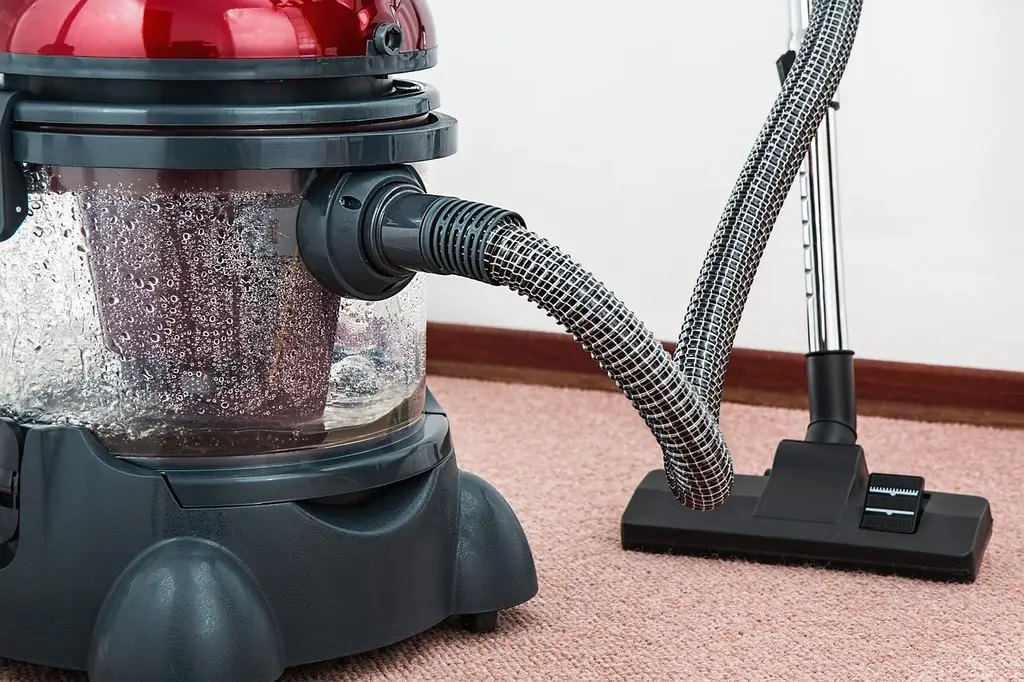
For car interiors, the most useful Kärcher accessories are the ones that solve narrow spaces and soft surfaces. Crevice tools matter most for rails and gaps, upholstery tools help on cloth seats and mats, brush tools are useful on vents and trim, and hose length determines whether you can reach the rear floor without moving the machine.
Crevice tools for seats, consoles, and rails
Crevice tools are the first attachment to look for. They reach between seat cushions, around parking-brake housings, under cup holders, and along seat rails where crumbs settle. On any Kärcher model, a narrow nozzle turns a general vacuum into a proper interior-cleaning tool.
Upholstery tools for cloth seats and floor mats
Upholstery tools matter most when dirt is spread across larger fabric areas. They help cover seat bolsters, rear bench cushions, and carpeted mats without dragging the hose across the cabin. On the WD 2 Plus and SE 4001, they are more useful than raw suction alone for car interiors.
Brush tools for vents and trim
Brush tools are best for air vents, textured plastic, and stitched trim. They loosen dust without scuffing surfaces as easily as a harder nozzle might. In a car, that is useful around dashboard edges and control surfaces where a straight vacuum head can miss fine dust.
Hose reach and storage fit
Hose reach is a bigger deal in cars than many buyers expect. The WD 2 Plus has a 1.8m suction hose, which is a clear advantage over very short setups. If the hose is too short, the vacuum stays on the floor and the rear cabin becomes harder to clean without repositioning the machine.
Pros and cons
Pros
- VC 4 cordless is the easiest Kärcher option for quick car touch-ups.
- WD 2 Plus gives you 1000 watts, wet and dry use, and a 1.8m suction hose.
- SE 4001 adds carpet-cleaning ability for deeper fabric jobs.
- Kärcher’s range covers crumbs, pet hair, and wet spills across different budgets and spaces.
Cons
- The SE 4001 is bulky for simple interior cleanup.
- No motorised brush bar on the SE 4001 limits aggressive hair lifting.
- Mode conversion on the SE 4001 is fiddly.
- Handheld cordless models are easier to store, but they are not the best answer for liquid mess.
Who is each Karcher vacuum for?
If you park in a flat, keep a small hatchback, or want a car vacuum for weekly crumbs, the VC 4 cordless is the cleaner fit. If you live with pets or deal with muddy shoes, the WD 2 Plus is the better pick. If you want deeper fabric cleaning, the SE 4001 is the specialist option.
Apartment owners and commuters
Apartment owners and commuters usually need a vacuum that is easy to store and quick to deploy. That makes the VC 4 cordless the most sensible Kärcher choice if the interior problems are light and frequent. It is less about maximum capacity and more about convenience you will actually use.
Pet owners
Pet owners should look first at the WD 2 Plus. Hair on cloth seats and mats tends to cling with dust and grit, which benefits from stronger suction and a better attachment set. A small handheld may cope with crumbs, but it often struggles with a full car of fur.
Detailing-minded buyers
Detailing-minded buyers are the best fit for the SE 4001, provided they accept the size and setup burden. Its cleaning-solution tank and wet cleaning ability are aimed at deeper fabric work. If your focus is quick vacuuming, this model is more machine than car tool.
Drivers who need wet spill cleanup
Drivers who need wet spill cleanup should skip the handheld-first mindset and move to a wet-and-dry model. The WD 2 Plus is the practical choice for liquid pickup in a vehicle, while the SE 4001 makes sense when the spill is part of a broader seat or carpet clean.
Can a Karcher vacuum clean wet spills in a car?
Yes, but only the wet-and-dry Kärcher models are meant for that task. A handheld cordless vacuum is not the right tool for drink spills, damp mud, or standing moisture. If wet mess is part of your car-cleaning routine, the WD 2 Plus is the more sensible buy.
When wet-and-dry models make sense
Wet-and-dry Kärcher vacuums make sense when spills are real, not occasional hypotheticals. A tipped water bottle on a rubber mat, rainwater tracked into the footwell, or damp sand from a beach trip all justify a unit that can handle liquids as well as dry debris.
What the SE 4001 adds for fabric cleaning
The SE 4001 adds carpet-cleaning ability, which matters if the stain has soaked into fabric instead of sitting on a mat. Its 18-litre internal capacity and 4.8-litre solution tank support larger jobs, but the lack of a motorised brush bar means it is not the most aggressive extractor.
When a handheld model is the better buy
When the job is dry and small, a handheld is still better. A VC 4 cordless is easier to store, quicker to grab, and more realistic for everyday crumbs than a wet-and-dry machine. If you do not need liquid cleanup, do not pay for liquid cleanup hardware.
Frequently asked questions
Are Karcher vacuums any good?
Yes, if you choose the right type for the job. Kärcher’s car-friendly range covers cordless handhelds, wet-and-dry vacuums, and a carpet-cleaner model. The best fit depends on whether you need fast crumb pickup, pet-hair removal, or liquid cleanup, not on brand alone.
Is a Karcher car vacuum worth it for car interiors?
It is worth it if you want model choice instead of a one-size-fits-all car vac. The VC 4 cordless suits quick cleanups, the WD 2 Plus suits mixed dirt and wet spills, and the SE 4001 suits deeper fabric work. If you only need crumbs, a smaller unit is easier.
Which Karcher vacuum is best for cleaning car seats?
For cloth seats, the WD 2 Plus is the safest all-round pick because it combines stronger suction with a hose and wet-and-dry use. For deeper fabric cleaning, the SE 4001 goes further, but it is bulkier and lacks a motorised brush bar. The right choice depends on how dirty the seats are.
Does the Karcher WD2 Plus work well on pet hair in cars?
Yes, it is the better Kärcher choice here for most pet owners. Its 1000 watts, 1.8m suction hose, and bagged debris collection make it more suitable than a compact handheld for hair in mats and upholstery. Add a brush or upholstery tool to improve pickup on fabric.
How much does a Karcher handheld vacuum cost?
Pricing varies by model and retailer, and Kärcher handhelds sit well below the larger wet-and-dry units in typical market positioning. The WD 2 Plus price fluctuates between £50 and £70, which shows how quickly Kärcher steps up in size and capability once you move beyond the smallest formats.
Products related to this article
Sponsored / affiliate links. As an Amazon Associate I earn from qualifying purchases. I may earn additional commission from eligible campaigns.