How Much Do Automotive Service Technicians Make, Really?
For the Bureau of Labor Statistics benchmark, automotive service technicians and mechanics have a national median salary of $50,620, with a national average annual salary of $44,050 and an average hourly wage of $21.18. Actual pay can land well above or below that figure, depending on flat-rate hours, certifications, job type, and local labor markets.
How much do automotive service technicians make?
The BLS national benchmark for automotive service technicians and mechanics is a median annual salary of $50,620, with a national average hourly wage of $21.18. Top earners in the 90th percentile make $84,000 annually, which shows how much the upper end can outpace the middle when workload and specialization line up.
What the title covers
“Automotive service technician,” “automotive mechanic,” “auto tech,” and “service technician” often point to the same occupation category in wage data. Job ads may sound similar, but pay can change sharply based on whether the role is general repair, diagnostics, fleet maintenance, or flat-rate line work.
Why the median matters more than a headline wage
The median tells you what the middle worker makes, not what the best-paid technician earns. A wage quote like $21.18 an hour is useful, but it does not automatically translate to annual income unless you know whether the shop guarantees hours, pays flat rate, or has slow periods.
What counts as an automotive service technician job?

An automotive service technician inspects, diagnoses, repairs, and maintains vehicles. That job title can cover oil changes, brake work, electrical diagnosis, engine repair, diesel service, fleet maintenance, and advanced diagnostics, so pay differences are often driven more by task complexity than by the title alone.
Common technician types
- Lube or express tech: basic maintenance, inspections, tires, fluids, and quick-turn work.
- Line tech: general repair work, often centered on brakes, suspension, steering, and drivability complaints.
- Diagnostic tech: electrical faults, intermittent problems, scan-tool work, and advanced troubleshooting.
- Diesel or fleet tech: trucks, vans, and commercial equipment, often with different tooling and pay bands.
- Master tech: advanced diagnosis and complex repairs, usually the top end of a shop’s pay scale.
Why title alone can hide pay differences
A “mechanic” who does quick-service work may earn far less than a diagnostic technician with years of training, even inside the same store. That is why a wage offer should be judged against actual duties, not just a posted job title.
Say your job ad says “automotive technician” at $24 an hour. If that role is flat-rate line work with warranty-heavy jobs, your yearly income may still trail a lower advertised hourly rate at a shop that guarantees more clocked hours.

How pay changes by experience level
Entry-level automotive technicians often start around $30,000 to $45,000 a year, while mid-level technicians commonly reach $50,000 to $70,000. Master technicians can earn $70,000 and up, and OrtoTech places master-tech earnings anywhere from $80,000 to $100,000+ per year.
Entry-level technician pay
Entry-level technicians usually spend their first years learning inspection routines, basic maintenance, and shop workflow through training or apprenticeship. Pay is typically lower because speed, diagnosis, and comebacks matter as much as mechanical ability, and new techs are still building those habits.
Mid-level technician pay
After about 3 to 5 years, many technicians can move into the mid-level band, where pay often improves with productivity and certification. OrtoTech lists mid-level technicians at $50,000 to $70,000 per year, which is a more realistic target once a tech can handle regular line work without heavy supervision.
Master technician pay
Master technicians tend to earn the most because they can diagnose difficult problems, manage comebacks, and take on high-value repair work. OrtoTech says ASE Certified Master Technicians can command $70,000 to $95,000+ a year, and the article notes master technicians can earn upwards of $70,000 per year.
Does ASE certification raise pay?
ASE certification usually helps because it signals verified knowledge, but the pay lift is strongest after a technician already has core experience. Early on, certificates can help with hiring and promotion; later, they become more valuable when paired with speed, accuracy, and the ability to solve complex faults.
Which credentials matter most
ASE credentials matter most when they match the actual work a shop needs done. General service and brakes may help an early-career tech get in the door, while advanced engine performance, electrical, and automatic transmission credentials tend to matter more once a technician is handling tough diagnostics.
What certification does and does not do
ASE certification is a strong signal, not an automatic raise. A shop still pays for output, reliability, and the ability to produce billed hours. Without those, certification alone usually will not move earnings as much as a tech expects.
How flat-rate pay changes your annual income
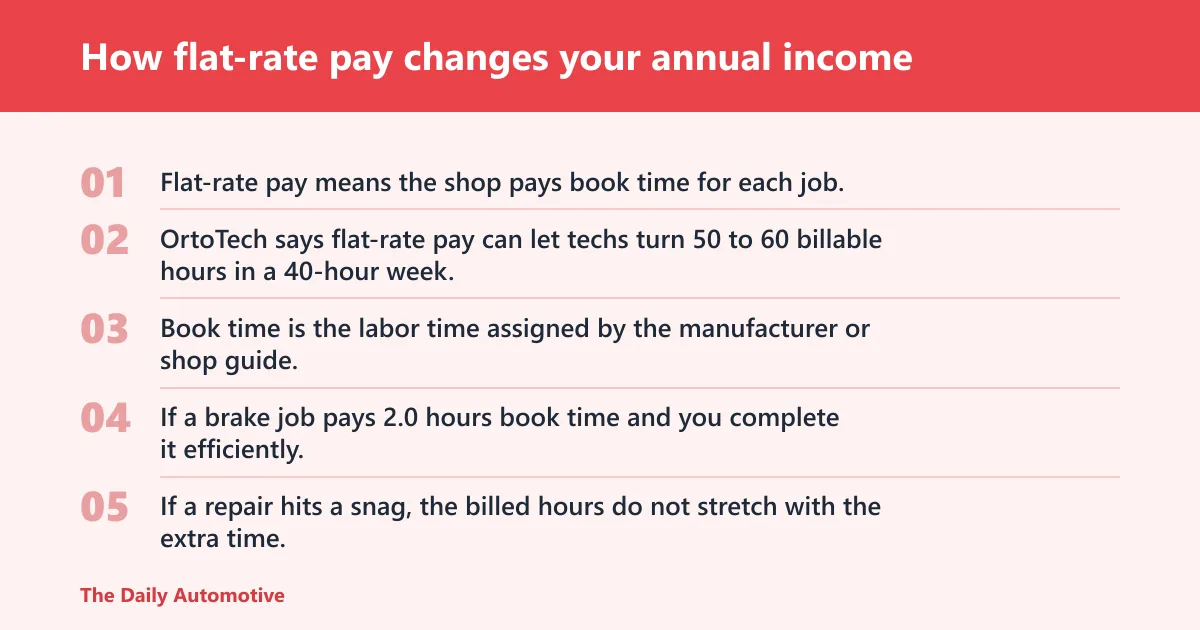
Flat-rate pay means the shop pays book time for each job, not simply the hours spent at work. OrtoTech says flat-rate pay can let techs turn 50 to 60 billable hours in a 40-hour week, which is why income can rise quickly in a busy shop and shrink during slow weeks or warranty-heavy work.
Book time versus clock time
Book time is the labor time assigned by the manufacturer or shop guide. If a brake job pays 2.0 hours book time and you complete it efficiently, you can bill more than the actual time spent. If a repair hits a snag, the billed hours do not stretch with the extra time.
Why warranty work can hurt pay
Warranty jobs often pay less than customer-pay work, and some shops pay reduced flat-rate time on those repairs. That matters because a technician can be busy all day but still bill fewer hours than expected if the work mix is warranty-heavy or the stall is waiting on parts.
Other parts of compensation
Benefits, bonuses, overtime, and tool allowances can change the real value of an offer. A lower hourly rate with a good bonus plan, paid training, or a tool stipend may beat a slightly higher wage with no paid downtime and no support for the cost of tools.
Do dealerships or independent shops pay automotive technicians more?
Neither side always pays more. Dealerships can pay between $55,000 and $90,000+ according to OrtoTech, while independent shops may offer more flexibility, broader job variety, and stronger local upside in busy markets. The better offer depends on pay structure, workflow, and how much billed time you can capture.
Dealership pay
Dealerships often provide brand training, more structured procedures, and a steadier stream of same-make repairs. That can help technicians specialize faster, but it can also mean more warranty work and tighter process controls, which may lower effective pay if billed hours lag behind clock time.
Independent-shop pay
Independent shops may pay less on paper or more aggressively on production, depending on the market. They often provide more variety and faster exposure to different vehicles, which can help a technician build skill sooner. In a high-volume local market, that can translate into strong earnings.
How location changes technician wages
Location matters because labor rates track local demand, cost of living, and shop mix. Metro areas usually pay more than rural areas, but the real buying power of the wage may still be lower if rent, insurance, and transportation costs are much higher.
California, Texas, and Ontario
Regional searches show how much local numbers can matter. In Austin, Texas, the average annual salary is $46,270 and the hourly wage is $22.24. For Ontario and other Canadian searches, pay depends heavily on city size, labor market, and whether the role is independent, dealership, or fleet-based.
How to judge a local offer
- Check whether the posted rate is hourly, flat-rate, or a mix of both.
- Ask how warranty labor is paid.
- Find out whether training time is paid.
- Ask how many billed hours a busy tech actually averages.
- Compare tools, benefits, overtime, and bonuses before judging the wage alone.
A common first-timer mistake is comparing two posted hourly rates without asking about billed hours. A $25 flat-rate job with strong throughput can beat a $28 straight-time role with weak overtime, especially if the first shop feeds enough work to keep the bay full.
Earnings estimator: three technician pay examples
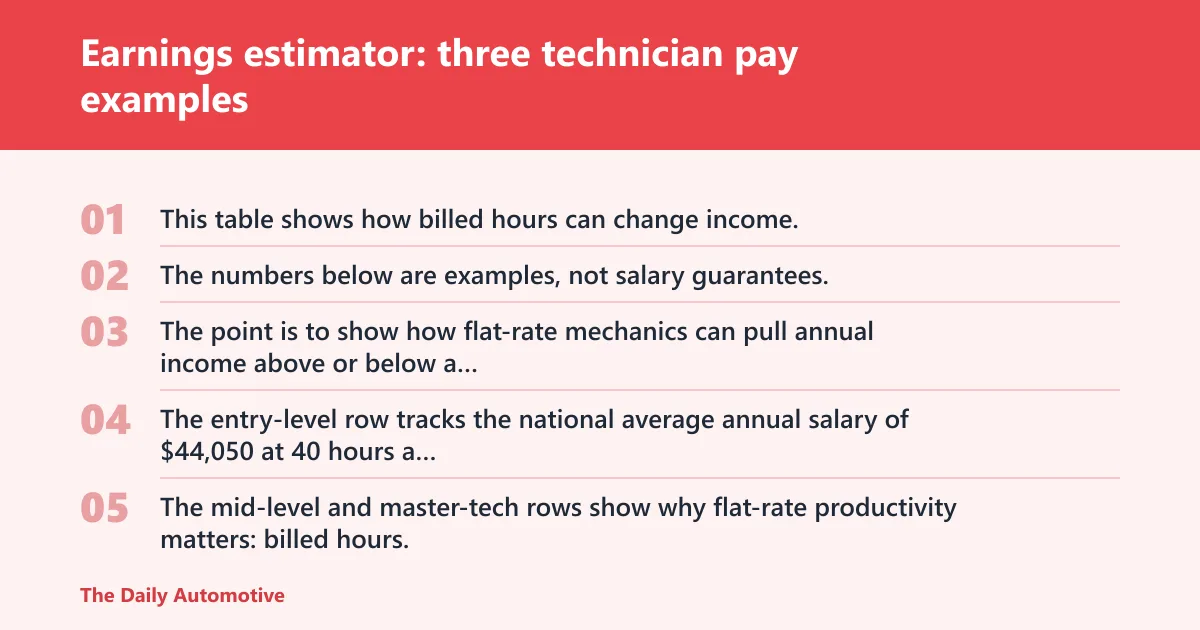
This table shows how billed hours can change income. The numbers below are examples, not salary guarantees, and they assume consistent throughput across the month. The point is to show how flat-rate mechanics can pull annual income above or below a simple hourly headline.
| Technician profile | Low billed hours | Average billed hours | High billed hours |
|---|---|---|---|
| Entry-level hourly tech at $21.18/hour | $3,388/month; $40,656/year | $3,670/month; $44,050/year | $4,520/month; $54,240/year |
| Mid-level flat-rate tech at $25/hour book time | $4,000/month; $48,000/year | $5,000/month; $60,000/year | $6,000/month; $72,000/year |
| Master tech at $32/hour book time | $5,120/month; $61,440/year | $6,400/month; $76,800/year | $7,680/month; $92,160/year |
How to read the table
The entry-level row tracks the national average annual salary of $44,050 at 40 hours a week and shows how overtime or extra billed time can move pay higher. The mid-level and master-tech rows show why flat-rate productivity matters: billed hours, not just attendance, drive annual income.
What this means in practice
Suppose a mid-level technician spends two slow weeks waiting on parts and then one very busy week turning fast jobs. The average monthly result may still trail the posted hourly rate if too much time is spent waiting, helping with non-billable work, or chasing warranty callbacks.
Frequently asked questions
How much do automotive service technicians make a year?
The BLS benchmark puts automotive service technicians and mechanics at a median annual salary of $50,620, with a national average annual salary of $44,050. Actual pay can be lower or higher depending on flat-rate hours, shop volume, experience, and location.
How much do auto repair technicians make?
Auto repair technician pay overlaps heavily with automotive service technician pay. A realistic range is shaped by experience and work type, with entry-level roles often around $30,000 to $45,000 and stronger mid-career earnings in the $50,000 to $70,000 band.
How much do automotive mechanics make in Canada?
Canadian automotive mechanic pay changes by province, city size, and employer type, so a single national number is less useful than a local offer. Ontario and larger metro markets usually pay more than small towns, but cost of living can quickly narrow the benefit.
How much do automotive mechanics make in California?
California wages are usually higher than many states because labor demand, shop rates, and cost of living run high. A posted wage still needs to be checked against the pay structure, since flat-rate work, warranty time, and benefits can change the real annual value.
How much do automotive mechanics make in Texas?
Texas pay changes a lot by city. In Austin, the average annual salary is $46,270 and the hourly wage is $22.24. Other Texas markets may run above or below that depending on dealership traffic, independent-shop demand, and local labor supply.
What do entry-level automotive technicians make versus master technicians?
Entry-level technicians commonly start around $30,000 to $45,000 annually, while master technicians can earn $70,000 and up. OrtoTech places master technicians at $80,000 to $100,000+ per year, especially when advanced diagnostics and high billed hours support that pay.
how much do automotive service techs make in ontario
Ontario pay depends on city, employer type, and whether the role is flat-rate or hourly. Larger metro shops usually pay more than smaller towns, but a strong service drive, paid training, and better throughput can matter more than the base wage alone.
how much do automotive service techs make
Automotive service tech pay spans a wide range because the job can mean anything from basic maintenance to advanced diagnostics. The best starting point is the BLS median of $50,620, then adjust for experience, ASE credentials, flat-rate productivity, and local labor conditions.
Products related to this article
Sponsored / affiliate links. As an Amazon Associate I earn from qualifying purchases. I may earn additional commission from eligible campaigns.