4WD System Review: Is It Worth It?
4WD is worth the extra cost only if you regularly face low-traction terrain, steep trails, deep snow, heavy towing, or recovery work that benefits from low-range gearing and part-time traction control. Buy it for the wrong use case, and you pay more upfront, add weight, and lose efficiency for capability you rarely use. This guide breaks down 4WD benefits, tradeoffs, and the buying cues that tell you when to choose it or skip it.
What 4WD actually does
4WD sends power to all four wheels for more traction. It is also called 4×4, and it can stay active all the time or switch between 2WD and 4WD. That makes it useful when grip changes often, especially on rugged off-road-capable trucks and SUVs.
4WD and 4×4 explained
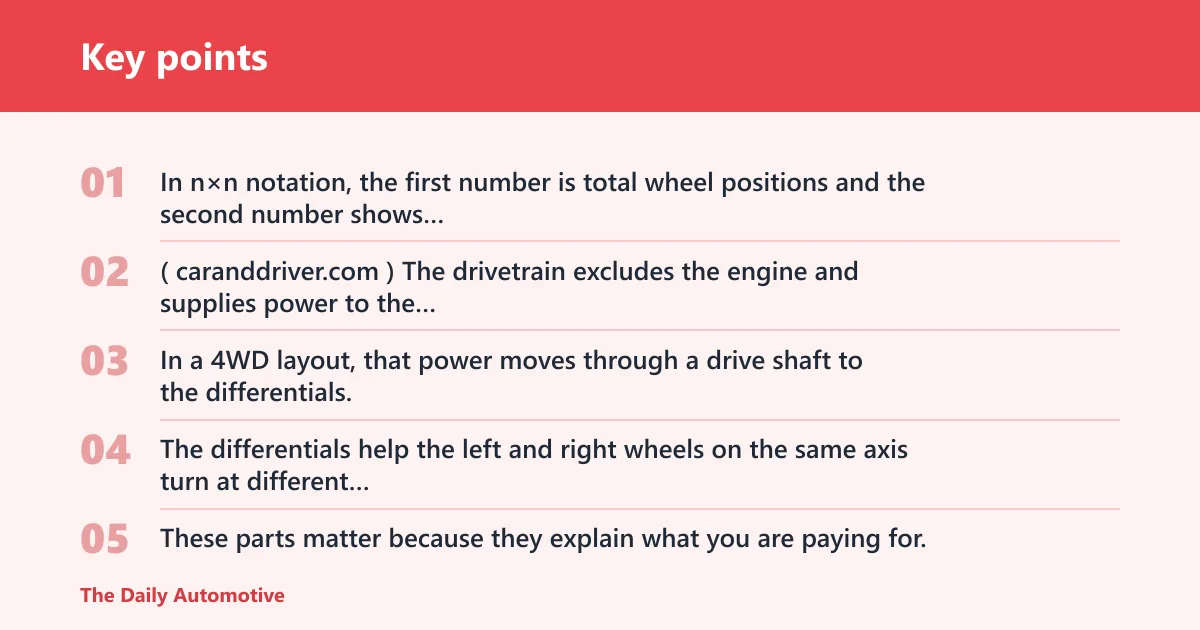
4WD and 4×4 are interchangeable terms. In n×n notation, the first number is total wheel positions and the second number shows how many wheel positions are driven, so a 4×4 means a four-wheeled vehicle in which all four wheels can be driven. (Caranddriver)
How power reaches all four wheels
The drivetrain excludes the engine and supplies power to the driving wheels. In a 4WD layout, that power moves through a drive shaft to the differentials, then through the drive axles to the wheels. The differentials help the left and right wheels on the same axis turn at different speeds, which keeps cornering smooth and reduces axle loading.
Core parts: drivetrain, differential, drive shaft, and drive axles
These parts matter because they explain what you are paying for. A differential is not a badge item; it is what lets the wheels on one axle turn at different speeds. The drive shaft transfers power between components, and the drive axles deliver that power to the wheels on both the front and rear axles in a 4WD setup.
Say your pickup is pulling a trailer up a wet boat ramp. 4WD can help the tires find grip as the load shifts rearward. If the same truck spends most of its life on dry suburban streets, the extra hardware may add cost without changing daily driving much.
4WD vs AWD vs 2WD: what changes
AWD is often the better fit for mixed-weather commuting, while 4WD can make more sense when part-time capability, low-range traction, or stronger off-pavement control is needed. 2WD still works well for many drivers who stay on paved roads and do not need the extra system weight or complexity.
When AWD is enough
AWD is often the lighter system, built mainly for wet roads and occasional slick pavement. It can be the right choice if you want extra traction for rain, slush, and light snow, but do not plan to crawl over rocks, pull out of mud, or manage steep loose grades.
When 4WD has the edge
4WD has the edge when the surface is loose, uneven, or deeply slippery. It is the better match for rugged trails, steep driveways in heavy snow, farm roads, and recovery work where you may need low-range gearing and more controlled power delivery than a typical AWD system provides.
Where 2WD still makes sense
2WD sends engine power to only two wheels, either the front pair or the rear pair. That is still enough for many city, highway, and light-duty owners. If your trips stay on dry pavement and you do not tow heavy loads or leave maintained roads often, 2WD can be the simpler choice.
What changes in practice: 4WD is built around traction and control in hard conditions. AWD is usually better for everyday bad weather. 2WD is the least complex path when your driving stays predictable.
4WD value calculator
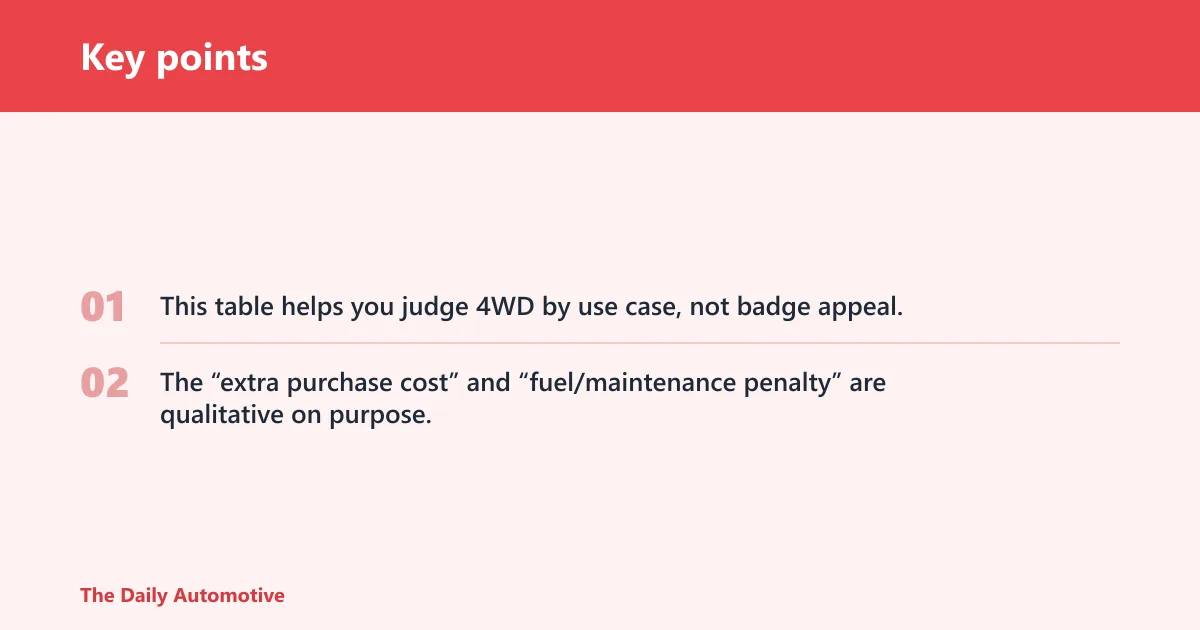
This table helps you judge 4WD by use case, not badge appeal. The “extra purchase cost” and “fuel/maintenance penalty” are qualitative on purpose, because the right answer depends on the vehicle, trim, and how often you use the system.
| Driving scenario | Expected benefit | Extra purchase cost | Fuel/maintenance penalty | Likely failure risks | Verdict |
|---|---|---|---|---|---|
| Snow-belt commuting | Better pull-away traction in snow, slush, and icy start points | Moderate | Higher than 2WD; often similar concern to AWD if the system stays engaged often | Low if used correctly; higher if part-time 4WD is left engaged on dry pavement | Worth it only if winter roads are frequent and steep |
| Towing and hauling | Improved traction when loading ramps, boat launches, or soft shoulders are involved | Moderate to high | More moving parts than 2WD, so more service exposure | Transfer case wear, driveline stress, and binding if misused | Strong case for trucks that tow on uneven or slick surfaces |
| Off-road recreation | Best control on loose dirt, mud, rocks, ruts, and steep climbs | High, but easier to justify | Fuel use and tire wear can rise with heavier hardware and aggressive driving | Front driveline damage, transfer case wear, and heat from misuse | Usually worth paying extra |
| Rural unpaved driving | More confidence on washboard roads, gravel, mud, and spring thaw | Moderate | More repair exposure than 2WD if the system is used hard | Binding, axle wear, and selector faults | Often worth it if roads stay loose for long stretches |
| City and highway use | Limited unless severe weather is routine | Usually not justified | Higher than 2WD, with little daily payoff | More system parts to maintain without much use | Skip it unless winter or towing needs are real |
Is 4WD worth paying extra for?
4WD is worth paying extra for when the added traction, low-range control, and part-time capability solve a real job you do often. If you need it for snow, towing, trails, or rural access, the extra cost can make sense. If you mostly drive pavement, 2WD or AWD is usually the better value.
Upfront price tradeoff
The upfront price often rises because 4WD can add hardware and complexity. That cost can be reasonable in a truck or SUV built to work hard. In a vehicle that never leaves pavement, though, you are paying for capability that may never matter outside a rare storm or trip.
Fuel and tire wear
4WD can add weight and rotating parts, which can hurt efficiency more than 2WD. Tire wear can also rise if the system is misused or if tires are mismatched in size or tread depth. AWD may be less demanding for everyday use, but it is not free of those costs either.
Maintenance and repair exposure
More parts mean more things to inspect. A 4WD system brings transfer case service, additional driveline components, and more points where wear can appear over time. That does not make it fragile. It does mean the repair bill can be higher than a simpler 2WD layout, and sometimes higher than AWD, depending on the vehicle.
A common first-timer mistake is buying 4WD for a commuter sedan-sized use case and then leaving it in 4WD on dry pavement because the dashboard button feels like extra safety. That can create binding and wear without giving the driver any real advantage.
How and when to use 4WD
Use 4WD when the surface is loose or slippery enough that extra traction matters more than efficiency. Part-time systems belong on snow, mud, gravel, sand, and other low-grip surfaces. On dry pavement, the front and rear driveline parts can fight each other if the system is not meant for constant use.
Part-time 4WD on snow, mud, and loose ground
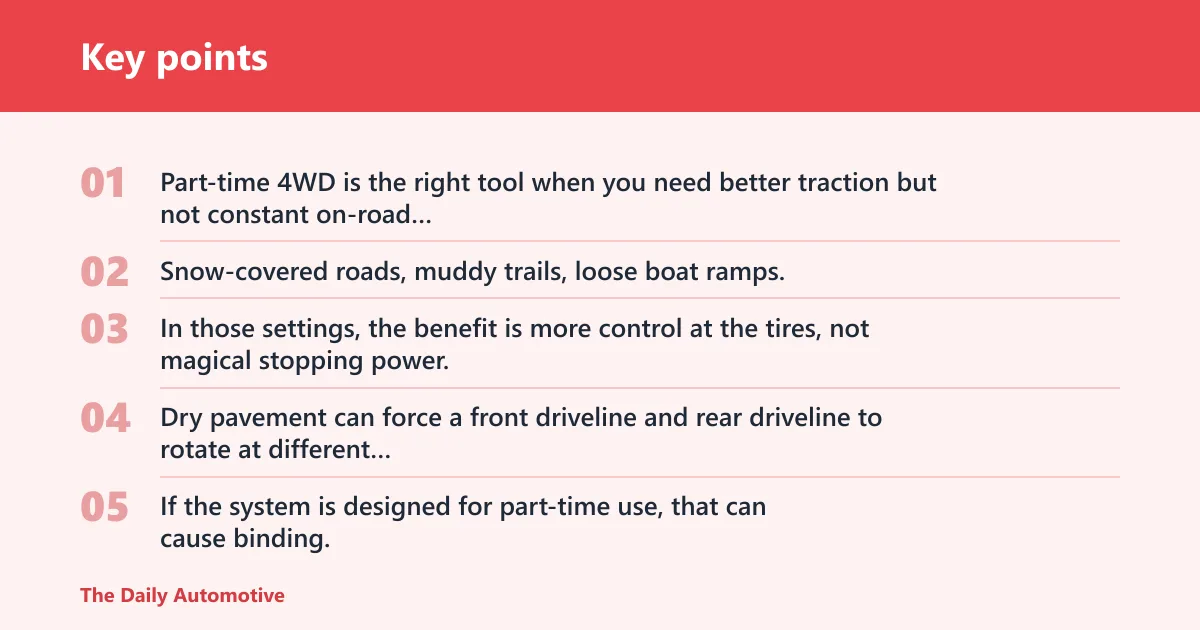
Part-time 4WD is the right tool when you need better traction but not constant on-road use. Snow-covered roads, muddy trails, loose boat ramps, and uneven dirt roads are its home territory. In those settings, the benefit is more control at the tires, not magical stopping power.
Why dry pavement can be a problem
Dry pavement can force a front driveline and rear driveline to rotate at different speeds during turns. If the system is designed for part-time use, that can cause binding. Over time, binding can load the transfer case and related parts, which is why many owners keep part-time 4WD out of dry-road use.
Low-range use for towing and recovery
Low-range gearing matters when you need careful wheel control at low speed. That helps during steep climbs, descending loose grades, backing a trailer into a slippery spot, or recovering a stuck vehicle. It is not for normal cruising. It is for controlled force.
4wd system review checklist
Use this checklist before you decide to pay extra for 4WD. The goal is to match the system to the job, then confirm that the hardware works as advertised.
- List the surfaces you drive most often: dry pavement, snow, gravel, mud, steep dirt, or boat ramps.
- Note whether you need low-range gearing for towing, recovery, or slow off-road control.
- Compare the 4WD price against a 2WD or AWD version of the same vehicle.
- Ask whether the added fuel use and tire wear matter in your annual mileage.
- Check whether the vehicle uses full-time 4WD or a switchable part-time setup.
- Confirm that the system matches your roads. If not, skip it.
Used 4WD checklist
Before you buy a used 4WD vehicle, verify that the selector works, the front driveline is intact, and the truck or SUV can actually shift in and out of the modes it claims. A clean exterior does not tell you whether the transfer case or axle parts are healthy.
Transfer case and selector checks
- Look for a 4WD indicator that changes when the mode selector is moved.
- Check for fluid leaks around the transfer case.
- Ask whether the vehicle has part-time, full-time, or selectable 4WD.
- Confirm that low-range engages if the vehicle is supposed to have it.
- Listen for grinding, clunking, or hesitation while shifting modes.
Front driveline and axle checks
- Inspect the front driveshaft for rust, damage, or missing balance weights.
- Check axle boots and joints for tears, grease loss, or visible play.
- Look for uneven tire wear that could point to neglected alignment or driveline problems.
- Make sure the front hubs, if applicable, are functioning as intended.
Road-test signs that 4WD is working
- Engage and disengage 4WD at the speeds the owner’s manual allows.
- Confirm that the vehicle pulls evenly and does not bind in a tight turn on a loose surface.
- Watch for dashboard warnings tied to the transfer case or traction system.
- Feel for shudder, vibration, or delay when power is applied in 4WD.
Suppose a buyer is checking a used body-on-frame SUV with a selector labeled 2H, 4H, and 4L. If the lever moves but the indicator never changes, that is a red flag. If the indicator changes and the vehicle binds in a parking-lot circle, that suggests the system needs deeper inspection before any deal is signed.
Frequently asked questions
Is 4wd worth it?
4WD can be worth the extra cost when traction is regularly needed on snow, mud, loose gravel, steep trails, or slippery launch points. It is less worthwhile for pure pavement driving, where 2WD or AWD often gives enough traction with less cost and complexity.
What are the advantages of 4wd?
The main advantages are better traction, part-time capability, and low-range control for tough surfaces. 4WD also helps when towing or recovering a stuck vehicle. Those benefits matter most when grip is limited and slow, controlled movement is more useful than speed.
Awd vs 4wd which is better
Neither is better in every case. AWD is usually the better fit for wet roads and everyday mixed weather. 4WD is better when you need rugged off-road ability, low-range gearing, or a system that can be switched for specific traction conditions.
What’s the difference between 4×4 and 4wd
There is no practical difference in common use. 4×4 is a synonym for 4WD. In n×n notation, the first number is the total wheel positions and the second number is the number of driven wheel positions, so 4×4 means all four wheels can be driven.
How and when to use 4wd: use 4WD
Use 4WD on snow, mud, gravel, sand, and other low-traction surfaces, and use low range for slow towing or recovery work. Avoid part-time 4WD on dry pavement if the vehicle is not designed for that kind of use, because binding and wear can follow.
Is awd as good as 4wd?
AWD is not as good as 4WD for every job. It is often excellent for rain, slush, and light snow. 4WD is usually the better tool for low-range work, steep loose climbs, rugged trails, and situations where part-time control matters more than all-weather convenience.
Products related to this article
Sponsored / affiliate links. As an Amazon Associate I earn from qualifying purchases. I may earn additional commission from eligible campaigns.