5 Best Car Seat Cushions for Long Drives (2026): We Compared
For long drives, the best car seat cushion is the one matched to your pain pattern and seat geometry: cutout cushions help tailbone pain, contoured memory foam often suits hip pressure, and firm wedges can help back pain if they keep your hips level. Pick wrong and you can trade pressure relief for worse posture, numb legs, or more lower-back strain. This guide compares the right cushion shapes, materials, and fit checks so you can choose one that works in your car.
Quick comparison
| Product | Badge | Best for | Price | ||
|---|---|---|---|---|---|
 |
Everlasting Comfort Doctor Recommended Memory Foam SeatEverlasting Comfort | Our pick | Large memory foam cushion with a breathable cover. | $47.99
Price as of 16 Oct 2026
|
View |
 |
Gel Seat Cushion for Long Sitting, (Thick & Large) CushionHvllyan | Budget pick | Thick and large gel cushion with non-slip cover. | $29.99
Price as of 16 Oct 2026
|
View |
 |
ComfiLife Car Seat Cushion–Premium Wedge 100% PolyurethaneComfiLife | Also great | Polyurethane foam wedge cushion for driving posture. | $35.95
Price as of 16 Oct 2026
|
View |
 |
CARSHION Back Massager with Heat,Heated Seat Cover CushionCARSHION | Upgrade pick | Heated seat cover cushion with 5 vibration motors. | $39.99
Price as of 16 Oct 2026
|
View |
 |
Qticare Airplane Seat Cushion, Air-Cell Travel Cushion forQticare | Pair with it | Inflatable portable seat pad with built-in pump. | $59.99
Price as of 16 Oct 2026
|
View |
The fastest way to narrow the field is to start with where you hurt, then check whether the cushion changes your seating height enough to affect pedal reach and dashboard visibility. Material comes next: some options stay cooler, while others spread pressure better and hold their shape longer.
How we chose
We compared cushions by pain pattern fit, not by broad comfort claims. Vehicle fit, seat height change, material behavior on long drives, and a stable base with a washable cover all counted.
The goal was simple: skip cushions that feel good for ten minutes and cause problems after an hour.
We also looked for clear use cases from the listed product details, because the best cushion for a tall driver in an SUV is rarely the best cushion for a shorter driver in a compact sedan.

Seat cushion decision matrix
| Pain type | Body size | Seat height tolerance | Climate | Vehicle type | Best cushion shape/material |
|---|---|---|---|---|---|
| Tailbone pain | Any | Low to moderate | Any | Sedan, SUV, truck | U-shaped coccyx cutout, usually memory foam with a breathable cover |
| Sciatica with seat-bone pressure | Average to larger build | Low | Warm or mixed | Compact car or sedan | Contoured foam that offloads the sit bones without lifting the hips too much |
| General hip pressure and fatigue | Average build | Moderate | Cool to warm | Sedan, SUV | Memory foam with medium rebound and a breathable mesh or fabric cover |
| Warm-climate short-to-medium drives | Any | Low to moderate | Warm | Any | Gel cushion with a stable non-slip base and breathable outer cover |
| Lower-back strain from poor posture | Shorter drivers often benefit most | Low | Any | Truck, SUV, sedan | Firm wedge plus separate lumbar support, not a thick seat pad alone |
| Short driver in a tall vehicle | Short to average | Very low | Any | Truck, full-size SUV | Thin wedge or low-profile contoured foam to preserve pedal reach and visibility |
Use the matrix as a filter, not a ranking. If the cushion raises your hips enough to change knee bend, shoulder position, or pedal reach, the wrong shape can make the drive worse even if the foam feels softer.
Memory foam: best for tailbone comfort
Everlasting Comfort’s memory foam cushion is the best fit for drivers who want pressure distribution and a coccyx cutout in one package. The large U shape helps offload the tailbone, while the foam’s rebound supports steady sitting on long stretches.
Its strength is balance. Memory foam usually spreads load across the seat better than a flat pad, which helps when the pain feels like a mix of tailbone irritation and general sitting fatigue.
The drawback is heat retention. Memory foam can run warmer than gel, and a thicker cushion may raise you high enough to affect sightlines in compact cars.
Why it fits tailbone pain
A cutout cushion helps when pain centers right at the coccyx, because it reduces direct contact with the tailbone. That matters more than soft padding alone, which can still load the painful spot if the seat surface stays flat.
What to watch
Check whether the added height changes thigh angle or keeps your knees bent more sharply than before. If your hips climb too far above the seat base, circulation and spinal alignment can suffer on longer drives.
Gel cushion: best for warmer drives
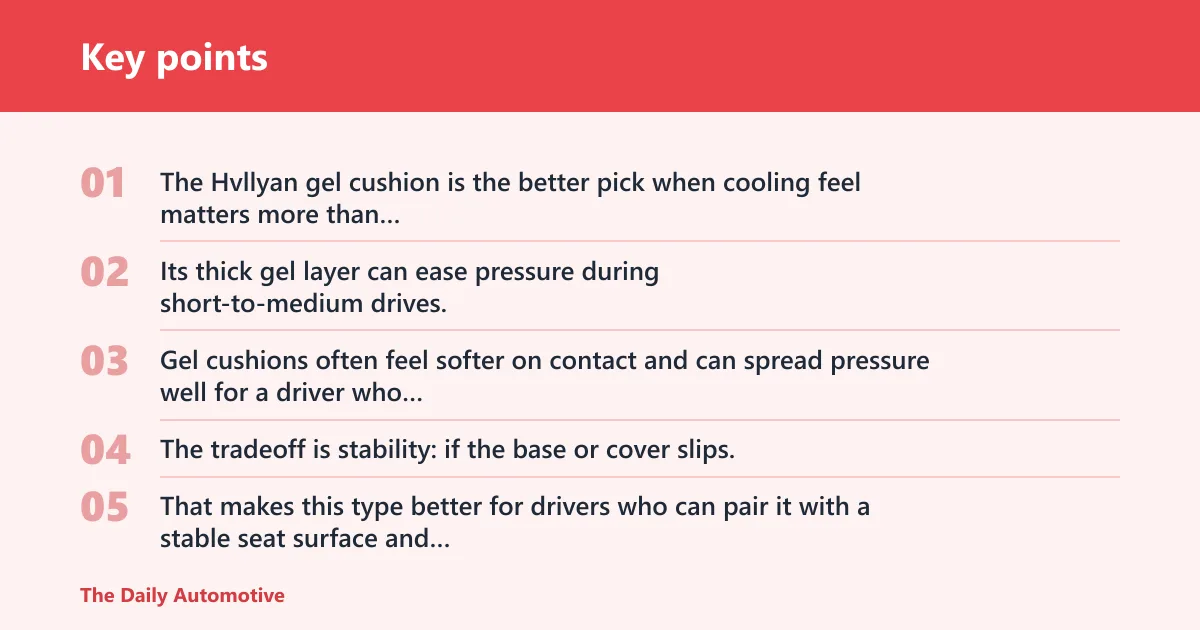
The Hvllyan gel cushion is the better pick when cooling feel matters more than aggressive contouring. Its thick gel layer can ease pressure during short-to-medium drives, especially in warm weather where heat buildup becomes part of the discomfort.
Gel cushions often feel softer on contact and can spread pressure well for a driver who wants a less rigid seat. The tradeoff is stability: if the base or cover slips, braking and cornering can make the cushion shift at the wrong time.
That makes this type better for drivers who can pair it with a stable seat surface and who do not need a deep coccyx cutout.
Why it fits warm climates
Gel generally feels cooler at first touch than dense foam. For drivers who are sensitive to heat and only need moderate support, that can be enough to make a commute or a two-hour trip more manageable.
Wedge foam: best for lower-back support
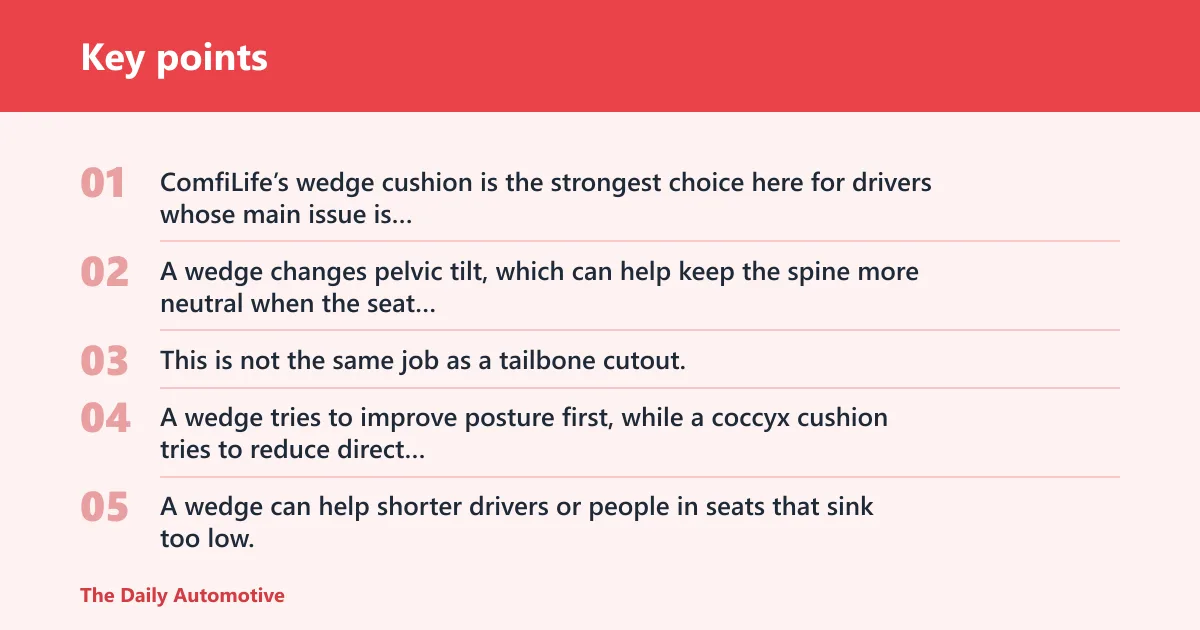
ComfiLife’s wedge cushion is the strongest choice here for drivers whose main issue is lower-back strain tied to poor hip angle. A wedge changes pelvic tilt, which can help keep the spine more neutral when the seat puts you in a slouched position.
This is not the same job as a tailbone cutout. A wedge tries to improve posture first, while a coccyx cushion tries to reduce direct pressure at the rear of the pelvis.
The drawback is fit. A wedge can help shorter drivers or people in seats that sink too low, but it can also make the sitting position feel too high if the cab already has limited headroom or the seat is narrow.
Why it fits posture-sensitive pain
If your pain begins in the lower back and gets worse when your pelvis rolls backward, a wedge may help more than a softer pad. By tilting the hips, it can reduce slumping and make it easier to keep shoulders and neck aligned over the spine.
Heated and vibrating cushion: best for mixed comfort
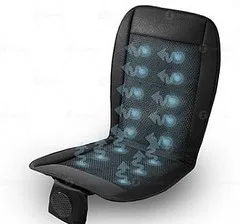
The CARSHION heated seat cover is best for drivers who want warmth and vibration more than a shaped orthopedic cushion. It can feel soothing on long trips, and the automatic shutoff is a useful safety feature on a seat accessory with heat.
This style may help with general stiffness, but it is not the best answer for a specific tailbone or sciatica pattern. Heat can feel good; it does not replace proper contour or lumbar support.
The drawback is obvious: heat, vibration, and a full seat-cover format can add bulk, and that can change how the seat supports your pelvis.
Why it fits general stiffness
Drivers who feel dull discomfort rather than a sharp pressure point may like heat and vibration for short relief. That is especially true on cold mornings or on trips where the goal is comfort, not orthopedic correction.
Air-cell cushion: best for adjustable firmness

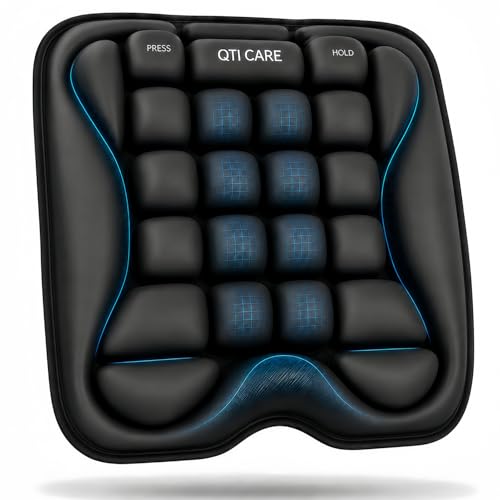
Qticare’s air-cell cushion is the most adjustable option in this set, which makes it useful when body size or seat shape varies a lot between drivers. Air level can be tuned to change firmness, so it can work for a user who does not want fixed foam density.
The drawback is that inflatable cushions depend heavily on proper inflation and stable placement. If air level is too low, support fades; if it is too high, the cushion can feel unstable and raise the hips more than expected.
It is most useful for drivers who want portable support and are willing to fine-tune it before a trip.
Why it fits variable needs
Air-cell padding can spread pressure without a dense foam block under the thighs. That can help when the main issue is general sitting fatigue and the driver wants a lighter, more adjustable feel.
Which one should you buy?
Choose the Everlasting Comfort memory foam cushion if your main complaint is tailbone pain and you can accept a bit more heat for better pressure distribution. Choose the Hvllyan gel cushion if your drive is shorter, your climate runs warm, and you want a cooler surface feel.
Choose the ComfiLife wedge if lower-back strain or a slouched driving position is the real issue. Choose the CARSHION heated seat cover only if warmth and vibration matter more than orthopedic contour. Choose the Qticare air-cell cushion if you need adjustable firmness and can check fit carefully before each trip.
If you drive a compact car, be cautious with any thick cushion that lifts you high enough to alter sightlines or pedal reach. If you drive a truck or SUV, a cushion that looks too thick on paper may still fit fine, but only if your knees, thighs, and steering wheel position stay natural.
A common first-timer mistake is buying a thick pad for “more comfort” and then discovering the hips sit too high, the shoulders round forward, and the lower back starts complaining after 45 minutes.
Suppose you are 5’4″ in a compact sedan and your tailbone hurts after an hour. A low-profile cutout cushion is usually safer than a tall wedge, because keeping pedal reach and dashboard visibility intact matters as much as pressure relief.
When lumbar support matters more than a seat cushion, start with the seatback. A strap-on lumbar pad with adjustable positioning can correct lower-back support without changing seat height, which makes it the better first step when the seat base already feels fine.
What is the best car seat cushion for long drives?
The best car seat cushion for long drives depends on where the discomfort starts. Tailbone pain usually points to a U-shaped cutout, hip pressure often does better with contoured memory foam, and lower-back strain may need a wedge plus lumbar support instead of a softer seat pad.
That means the “best” cushion is usually the one that changes pressure without changing driving position too much. If it lifts you high enough to alter pedal reach or shoulder posture, it may solve one problem and create another.
Do car seat cushions help with lower back pain?
They can help when the pain is tied to poor pelvis position or uneven seat support. A wedge can tilt the hips into a more neutral angle, but a flat soft cushion often does less for true lower-back support than a strap-on lumbar pad or a seat adjustment.
If lower-back pain worsens after your hips sink back and your spine rounds, look at posture first. Seat height, backrest angle, and lumbar support matter as much as cushion material.
Are memory foam seat cushions better than gel for driving?
Memory foam is usually better for contouring, tailbone relief, and steady pressure distribution. Gel feels cooler and can work well for warmer drives, but it often gives less posture support and may slip more if the base is not stable.
For long highway trips, memory foam often has the edge if heat is manageable. For shorter drives in hot weather, gel can be the easier comfort fix.
How thick should a car seat cushion be for long trips?
A practical comfort range is usually about 1.5 to 3 inches, but the right thickness depends on the car. Thicker cushions help when the seat is flat or hard, while thinner designs are safer in compact cars where extra height can hurt visibility and pedal reach.
If the cushion changes knee bend so much that circulation feels worse, it is too thick for that seat. Trucks and SUVs can often accept more height than sedans, but fit still depends on the driver’s torso and leg length.
Will a seat cushion make me sit too high in the car?
It can. Any cushion adds height, and that can reduce headroom, change how far you reach the pedals, and alter the angle of your knees and hips. Shorter drivers in compact cars are usually the most likely to notice the effect quickly.
Check whether you can still see clearly over the dashboard and move from brake to accelerator without stretching. If the cushion changes your driving posture, it may not be the right shape for that vehicle.
What cushion is best for sciatica during long drives?
For sciatica, the best cushion depends on whether the pain comes from seat-bone pressure, tailbone irritation, or a need for better pelvic position. A cutout helps if the tailbone is the trigger, while a contoured or wedge design may help more if the issue is hip angle or slumping.
If leg symptoms worsen, numbness increases, or pain extends beyond sitting discomfort, the cushion may be the wrong fix. In that case, seat adjustment or lumbar support is often the better next step.
Can I use a seat cushion with heated or ventilated seats?
Yes, but you should check the cushion material and thickness first. Thick foam or full-seat covers can block airflow from ventilated seats, and heated seats may take longer to warm through a dense pad. A thinner, breathable cushion is usually safer with either system.
If your car already has a good climate-controlled seat, avoid adding a bulky cover that cancels that benefit. Breathable mesh or fabric is the better choice when airflow matters.
What should I look for in a car seat cushion for driving?
Look for the match between pain pattern, seat height, and cushion shape before you look at softness. A non-slip base matters, but so do breathable covers, a thickness that does not ruin pedal reach, and a shape that keeps your pelvis and spine in a neutral position.
Also check whether the cushion solves the right problem. Tailbone pain, sciatica, hip pressure, and general fatigue do not call for the same shape, and a cushion that feels good in the driveway can still cause trouble after an hour on the road.
Products related to this article
Sponsored / affiliate links. As an Amazon Associate I earn from qualifying purchases. I may earn additional commission from eligible campaigns.
 FLORICH Leather Seat Cover, Car Seat Covers Front Set, Waterproof Car Seat Protectors, Front Seat Covers 2 Pack, Breathable Automotive Seat Covers Protector Fit for Most Cars Trucks SUV
 Coverado Car Seat Covers, Front Covers for Cars, Car Seat Cover Front Seats, Automotive Seat Cover, Waterproof, Leather Car Seat Cushion, Universal Interior Covers Seat Protectors for Most Cars