How Much Does a Race Car Seat Cost?
A race car seat usually costs about $300 to $1,500, but the out-the-door total often lands around $600 to $3,000 once mounts, side mounts, fitting, and fireproof accessories are added. Cheap setups can move in a crash or fail scrutineering, and a poor fit can leave you slower and less secure. This guide breaks down the full cost stack, the extra charges, and when paying more makes sense.
Race seat cost matrix
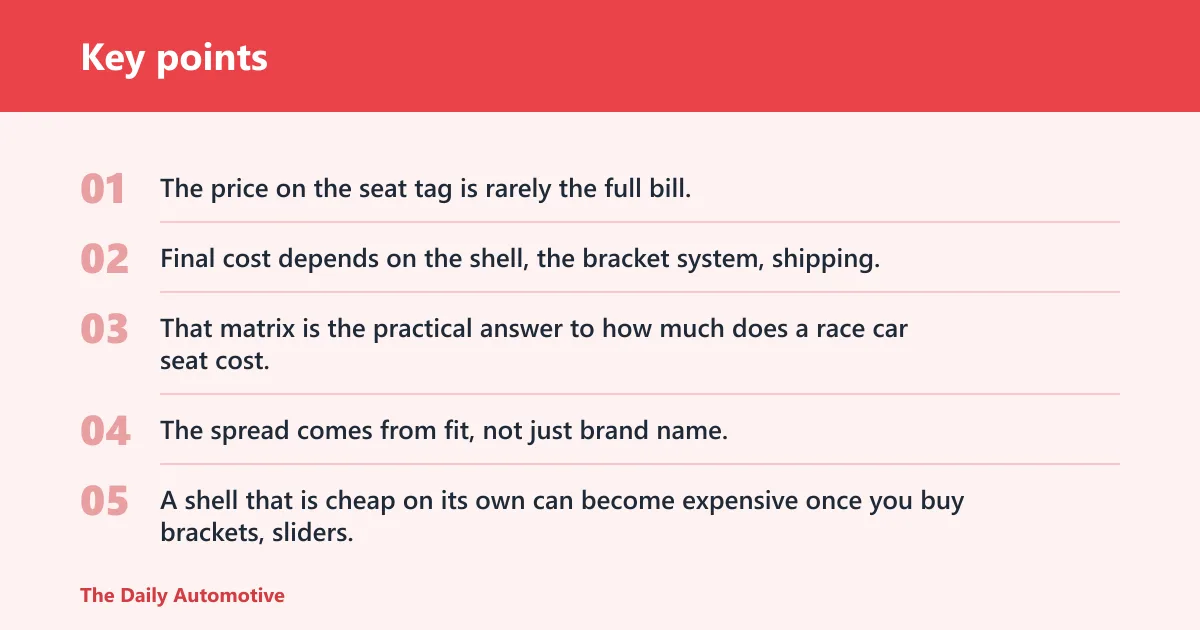


The price on the seat tag is rarely the full bill. Final cost depends on the shell, the bracket system, shipping, and whether the seat needs fitting work before it can pass inspection and hold you in place properly.
| Buying path | Typical seat cost | Mounting hardware | Labor / fitting cost | Realistic out-the-door total | Best-fit use case |
|---|---|---|---|---|---|
| Entry fixed-back seat | $300 to $500 | $100 to $250 | $0 to $150 | $400 to $900 | Budget club racing, track days, first-time fixed-back upgrade |
| Mid-range brand-name seat | $700 to $1,200 | $150 to $350 | $100 to $250 | $950 to $1,800 | Time attack, sprints, drivers who want a better shell shape and known fit |
| Custom moulded seat | $1,500 to $3,500 | $150 to $400 | $250 to $700 | $1,900 to $4,600 | Endurance, long stints, repeatable driver position, awkward cockpits |
| Fully installed package | $700 to $3,500 | $200 to $600 | $300 to $1,000 | $1,200 to $5,100 | Turnkey build, professional installation, compliance-sensitive classes |
That matrix is the practical answer to how much does a race car seat cost. The spread comes from fit, not just brand name. A shell that is cheap on its own can become expensive once you buy brackets, sliders, and the labor to make it work in your chassis.
What drives the price?
The main drivers are the shell, the mounting system, and the time needed to make the seat fit your body and cockpit. Add shipping, then add any fire-retardant or class-specific items your sanctioning body requires. That stack is why two seats with the same list price can end up far apart in final cost.
Seat shell material and shape
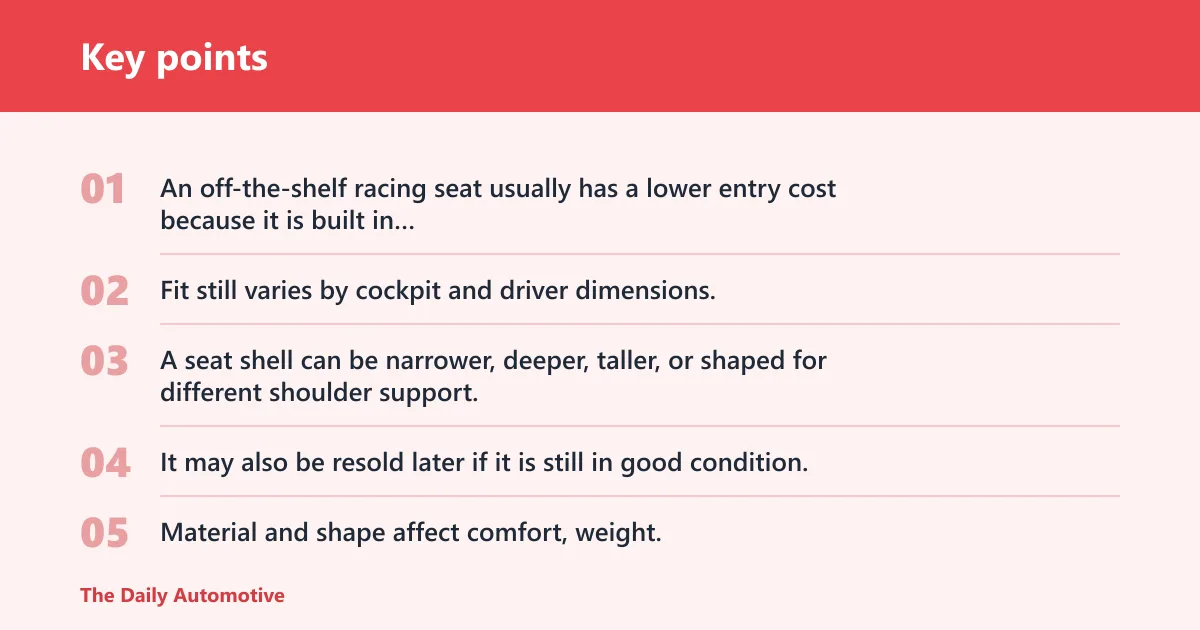
An off-the-shelf racing seat usually has a lower entry cost because it is built in standard shell sizes. Fit still varies by cockpit and driver dimensions. A seat shell can be narrower, deeper, taller, or shaped for different shoulder support, and those changes affect both comfort and price. It may also be resold later if it is still in good condition.
A seat shell’s material matters too. Material and shape affect comfort, weight, and how well the shell works with your car class. Some shells accept moulded inserts, while others do not. If the shell is too tall, helmet clearance can disappear fast in a coupe with a low roof.
Mounts, sliders, and brackets
Seat mounting hardware is not optional. Side mounts or base mounts set the driver’s height, angle, and fore-aft position, and they must attach to approved points with the right bracket compatibility. A seat that sits too high can hit a helmet on the roof or cage. One that sits too low can foul the steering wheel or pedals.
Labor time rises when the car needs custom brackets, modified slider placement, or trial fitting to clear a transmission tunnel or roll cage. Shipping can add another layer, especially for large shells or bulky hardware.
Labor, fitting, and shipping
Labor is often the hidden line item. A basic bolt-in seat can take little time, while a custom package may need measurements, mock-up, trimming, and final torque checks. Shipping matters because a large shell and mounting kit can arrive as separate boxes, and each box adds cost before a wrench touches the car.
Say your sedan has a wide transmission tunnel and a low roof. A seat that looks fine on a website may need a lower mount, which then changes pedal reach and steering clearance. That is how a $600 seat turns into a $1,200 installation without any luxury extras.
Off-the-shelf seats
Off-the-shelf racing seats cost less up front because the maker spreads development across a standard shell. They suit many budget builds, and some can be resold later. The tradeoff is that shell size and cockpit fit are fixed before you order, so you may still need brackets, sliders, or a second purchase to get the seating position right.
Where fit can miss the mark
Fit depends on the driver and the car. A seat can be too narrow at the hips, too short for torso height, or too low in the shoulder area for proper support. If the back angle is wrong, the belts can sit poorly on the body. If the seat-back angle forces your helmet into the cage line, the seat is wrong for the car.
A common first-timer mistake is buying the cheapest fixed-back shell and then discovering the seat-to-wheel distance is too tight for comfortable leg room. The seat itself may still be fine. The cockpit is the issue.
When resale matters
Off-the-shelf seats often have better resale potential than custom seats because another driver can use the same shell if the size is close enough. That matters if you change cars, change classes, or plan to sell the seat after one season. A custom moulded seat usually has less resale value because it is made for one driver and one cockpit.
Custom moulded seats
Custom moulded race seats are handmade, custom made, and built around a driver’s shape and car layout. AForm describes its seats as handcrafted and custom made, and says its seats are built to the highest standards. Pricing depends on options for each driver and car. That is why the number can move a lot from one build to the next.
For how much does a custom race seat cost, the realistic answer is usually in the $1,500 to $3,500 seat range before you count mounts and labor. If the installation needs extra fabrication or a more complex car-specific setup, the full bill rises from there.
How the fitting process works
A custom seat can fit in half a day. The process usually starts with measurements, then the seat is shaped to the driver and the cockpit. Many appointments are normally booked about 2 weeks out, so this is not a same-day add-on for most racers.
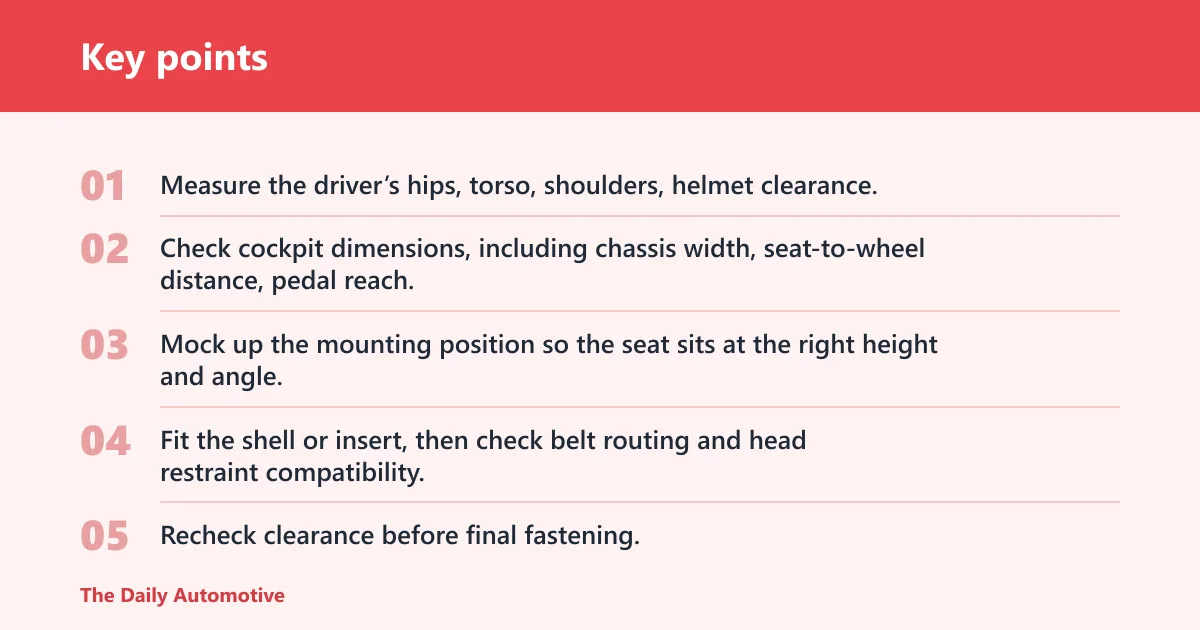
- Measure the driver’s hips, torso, shoulders, helmet clearance, and preferred seat-back angle.
- Check cockpit dimensions, including chassis width, seat-to-wheel distance, pedal reach, tunnel clearance, and roll cage interference.
- Mock up the mounting position so the seat sits at the right height and angle.
- Fit the shell or insert, then check belt routing and head restraint compatibility.
- Recheck clearance before final fastening.
Why pricing changes by driver and car
Pricing changes because no two interiors are identical. A small hatchback with a tight tunnel, a formula-style chassis, and a sedan with a wide cabin each ask for different mounting work. Driver measurements change the shape too. A taller torso may need more shoulder room, while a broad-shouldered driver may need a wider upper shell even if the hips are narrow.
Custom moulded seats can be worth it in endurance racing, long practice days, or any car where a fixed shell never quite lands in the right spot. Better support and less fatigue matter most when you need repeatable body position for a long stint. If you are doing short sprints in a roomy cockpit, the extra cost is easier to question.
Do custom seats fit every car?
No. A custom moulded seat is bespoke fit, but it still has to work inside the car. The seat may be handmade for the driver, yet chassis width, pedal layout, and cage location can limit where it can sit. That is why a custom seat can solve support problems and still need careful planning before purchase.
Driver measurements that matter
Hip width, torso height, shoulder width, helmet clearance, and seat-back angle all affect fit. A seat that is too narrow at the hips can pinch. One that is too tall at the shoulders can interfere with containment. If the helmet touches the halo, cage, or roof line, the setup is wrong even if the seat feels snug on the ground.
Cockpit dimensions that matter
Chassis width sets the outer limit. Seat-to-wheel distance controls steering reach. Pedal reach changes leg extension. Transmission tunnel clearance affects how low the base mount can sit. Roll cage interference can force a narrower shell or a different mounting point altogether. These are the dimensions that decide whether the seat fits cleanly or needs a compromise.
When bead seat systems help
A bead seat system uses poly beads inside a thin resin-bonded bag to conform to the cockpit shape. The material can be adjusted during fitting, which makes it useful for fine-tuning support. It is not a full seat replacement in every case, but it can improve contact points and reduce pressure spots inside an existing shell.
Mounting and safety rules
Seat cost means little if the installation misses safety rules. Seat mounting hardware is safety-critical, and the fit has to satisfy the vehicle manual, the product manual, and the sanctioning body. The seat must also work with the harness and head restraint system in your class.
Side mounts versus base mounts
Side mounts usually give more adjustment for height and angle. Base mounts can be simpler, but they may place the driver higher or lower than ideal depending on the chassis. Either way, the attachment points must be compatible with the seat shell and strong enough for racing use. A seat that is cheap but wrong for the chassis is not cheap for long.
Harness and head restraint fit
Harness routing has to match the seat and the driver position. Head restraint compatibility matters too, especially where the class rules require a specific restraint system. If the seat back is too upright or too reclined, harness geometry can suffer. That can turn a good seat into a bad installation.
Sanctioning-body and class rules
Racing seat regulations can require sanctioning-body compliance, class-specific legality, and fire-retardant materials where required. Some classes are strict about seat age, shell construction, and attachment method. Others care more about whether the seat works with the head restraint and cage. Always check your class rules before buying, because a seat can be physically compatible and still be illegal.
Follow the vehicle and product manual. Never work under a vehicle supported only by a jack; use jack stands on level ground. Keep dash and windshield items out of airbag zones and the driver’s view, and check local laws where applicable.
Frequently asked questions
How much is a race car seat?
A race car seat usually runs from about $300 to $1,500 before installation, but the installed total is often much higher. Once you add mounts, brackets, and any fitting work, many buyers end up around $600 to $3,000 depending on the shell, car, and class rules.
How much does a custom race seat cost?
A custom moulded race seat commonly starts around $1,500 and can reach about $3,500 or more for the seat itself. Because pricing depends on options for each driver and car, the installed total can move higher once you include hardware and labor. A custom seat can fit in half a day.
What does a racing seat cost installed?
Installed costs for simpler setups often fall around $600 to $3,000, while custom or fully installed packages can move into the $4,000-plus range. The total depends on seat shell price, brackets or side mounts, labor, shipping, and whether the car needs extra fitting for clearance or compliance.
Are custom moulded race seats worth it?
They are worth it when you need repeatable support, less fatigue, and a fit that stays consistent in long stints. Endurance, long practice sessions, and awkward cockpits are the strongest cases. If you race short events in a roomy car, a good off-the-shelf shell may be enough.
What affects the price of a race seat?
Seat shell material and shape, mounting hardware, labor, shipping, and rule compliance all change the price. Driver measurements and cockpit dimensions matter too, because a seat that fits the body may still need custom brackets or extra fitting to clear the tunnel, wheel, pedals, or cage.
What are the regulations for race car seats?
Rules vary by sanctioning body and class, but common requirements include compliance with the rulebook, belt and head restraint compatibility, and fire-retardant materials where required. A seat must also fit the car safely and leave enough clearance around the cage, cockpit, and occupant protection gear.
Products related to this article
Sponsored / affiliate links. As an Amazon Associate I earn from qualifying purchases. I may earn additional commission from eligible campaigns.
 PartsTo Adjustable Kids Travel Car Seat Headrest Pillow with Lean Support Cushion Sleeping Travel Neck Safeguard Cushion Suitable for Kids Children Teenagers and Adults
 Coverado Car Seat Covers, Front Covers for Cars, Car Seat Cover Front Seats, Automotive Seat Cover, Waterproof, Leather Car Seat Cushion, Universal Interior Covers Seat Protectors for Most Cars