Race Car Types and Specs Guide by Class and Hardware
Race car types are best identified by five specs: weight, power, aero, tire width, and drivetrain layout; those numbers separate stock cars, GT cars, touring cars, formula cars, prototypes, rally cars, and drag cars faster than series names do. Get that filter wrong and you misread pace, running costs, parts fit, and beginner suitability. I use those five first because they point straight to the hardware and setup choices that define each class, with spec ranges and buying cues to match.
Short answer: the main race car types are formula cars, sprint cars, prototypes, GT cars, stock cars, touring cars, rally cars, and drift cars. The quickest way to tell them apart is to match body style and wheel layout to a few defining specs.
- Formula car: open-wheel, single-seat, rear-wheel drive, very low mass, slicks, high aero sensitivity.
- Sprint car: open-wheel dirt-oval car, short wheelbase, rear-wheel drive, extreme power-to-weight, winged or wingless.
- Prototype: closed-wheel purpose-built endurance chassis, advanced aero, large brakes, fuel-efficiency focus, often hybrid in top classes.
- GT / sports car: closed-wheel, production-based shape, heavier than formula cars, endurance-ready cooling and brakes, commonly rear-wheel drive.
- Stock car: closed-wheel full-body oval-focused racer, robust for traffic and contact, rear-wheel drive, drafting and tire-wear emphasis.
- Touring car: sedan or hatchback silhouette, tighter aero and tire rules, parity-focused setup, close-contact circuit racing.
- Rally car: mixed-surface stage car, long-travel suspension, underbody protection, class-dependent drivetrain with AWD common in upper tiers.
- Drift car: closed-wheel, rear-drive bias, steering-angle-heavy setup, throttle response and rear tire control prioritized over lap time.
How to identify a race car type from its hardware
A race car type is easiest to classify by hardware that changes how the car works: wheel layout, drivetrain, aero load, tire and brake package, wheelbase, surface setup, and safety structure. Series names can hide those basics. I have found it works better to sort the engineering needs from the rulebook limits, then read the car from the outside in.
The specs that separate categories faster than series names do
Start with the wheel layout. Open-wheel cars keep the tires exposed, and that changes airflow, contact risk, suspension packaging, and steering response. Closed-wheel cars cover the tires with bodywork, which changes drag, cooling paths, and how wheel-to-wheel contact gets absorbed.
Then check seat count and cockpit shape. A single-seat, narrow-tub chassis points toward formula or sprint-car thinking. A wider cockpit with passenger-space roots, door bars, and a roof points toward GT, touring, stock car, or rally.
Drivetrain is the next strong clue. Rear-wheel drive is common in formula, prototype, stock, drift, and many GT builds. All-wheel drive often points toward rally, though some classes allow other layouts.
Rulebook-driven specs versus engineering-driven specs
Some specs exist because physics asks for them. Dirt cars need compliance and traction. Endurance cars need brake life, cooling margin, and fuel discipline. Drift cars need steering angle and rear tire control.
Other specs exist because the class says so. Balance of Performance in GT can shape power, mass, and aero setup. Spec chassis rules can define a stock car more than its body shell does. Homologation rules can force a touring car or prototype into dimensions and safety layouts that are not the pure engineering ideal.
That distinction matters when comparing cars for purchase or classification. A car can look close to another category and still drive nothing like it because one package is built around rule compliance while the other is built around raw surface needs.
Why surface, stint length, and contact level change the whole build
Surface tells you what the suspension, tires, and underbody must survive. Gravel demands ride height, travel, and protection. A paved road course rewards tire platform control and aero stability. Dirt ovals ask for bite on a changing surface, while paved ovals add curb loads, drafting forces, and long high-speed stability.
Stint length is just as important. A sprint-format formula car can chase low mass and peak grip. A GT or prototype meant for long runs must carry extra cooling resilience, brake capacity, and cockpit safety provisions. Contact level matters too. Touring and stock cars handle close body contact better than exposed-wheel cars ever can.
According to FIA, ACO/Le Mans, IMSA, NASCAR, and WRC technical regulations — modern race-car categories are best separated by chassis type, wheel layout, drivetrain, surface, and homologation rules rather than by loose historical trivia. Those rulebooks are the most reliable way to verify what each class is allowed to be.
Budgeting for a CAN-Based Dash Logger in Race Cars
A MoTeC C127 delivers professional-grade data logging and display, but the true cost extends far beyond the unit itself. Budget roughly $4,000 to $7,000 all-in before adding sensors, keypads, GPS modules, and custom loom fabrication. Without that supporting hardware, you are paying for a bright screen while receiving thin telemetry.
This MoTeC C127 review breaks down exactly what the dash logger does, compares it against the C125, C1212, and C187 models, and provides a decision matrix for your specific racing class. Understanding these real installation costs prevents overspending on capabilities your build cannot yet support or utilizing cheaper alternatives that lack necessary CAN-bus integration.
What are the main race car types?
The main race car types break into three hardware families: open-wheel cars, closed-wheel circuit cars, and mixed-surface or judged-discipline cars. Formula cars and sprint cars are open-wheel. GT, prototypes, stock cars, and touring cars are closed-wheel. Rally and drift cars sit apart because the surface and scoring method shape the package.
Open-wheel types: Formula cars and sprint cars
Formula cars are single-seat open-wheel cars built around a narrow tub, exposed suspension, slicks, and very low mass, with enough wing and floor work that ride height changes can matter a lot in lap time. Depending on class, engine displacement or power band may vary widely, but the chassis idea stays consistent: package the driver, suspension, and aero surfaces for road-course precision.
Sprint cars also run exposed wheels, but the job is different. They are short-wheelbase dirt-oval machines with very high power-to-weight, lightweight chassis construction, and often top-wing or wingless setups. They may look loosely related to formula cars from a distance, yet the suspension, tire use, and yaw attitude are completely different.
Closed-wheel circuit types: GT, prototypes, stock cars, and touring cars
GT and sports cars use closed-wheel bodywork and usually start from production-based or silhouette-based ideas. Prototypes are purpose-built from the floor up, with safety cell, seating position, aero tunnels, and fuel strategy centered on endurance efficiency.
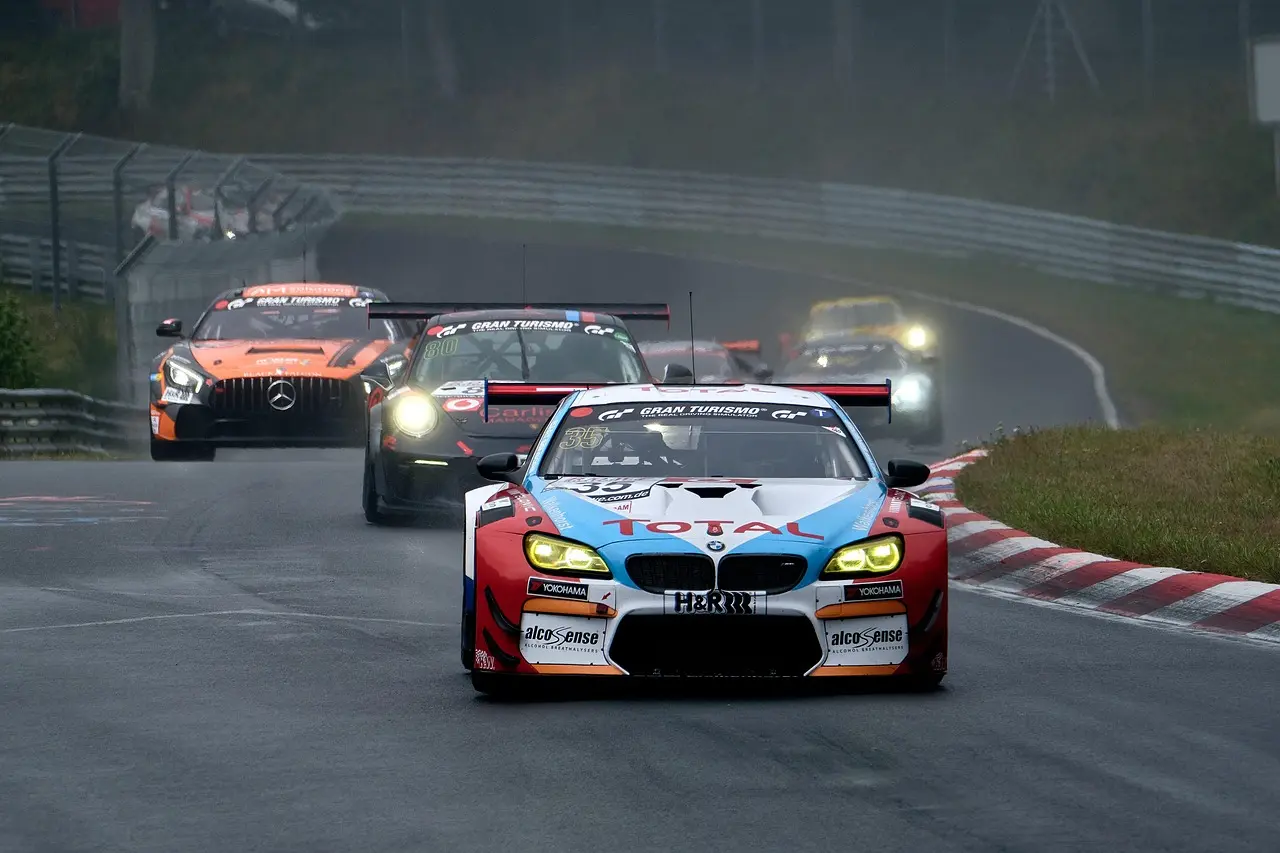
Stock cars are full-body closed-wheel race cars, often front-engine and rear-drive in many rule sets, built to handle traffic, carry load through long banked turns, and cope with fender contact and drafting on ovals. Touring cars are usually sedan- or hatch-based, with tighter aero and tire limits that keep the racing close and setup windows narrower.
Mixed-surface and judged-discipline types: rally and drift cars
Rally cars are stage-racing machines for public-road stages, often with all-wheel drive in higher classes, long-travel suspension, underbody protection, and cooling systems built to survive dust, stones, and repeated low-speed-to-high-load transitions. They also integrate roadbook or pacenote needs into the cockpit.
Drift cars are judged more on style, angle, and control than on lap time alone. Rear-wheel-drive bias, steering angle kits, clutch durability, rear grip management, and immediate throttle response matter more than lap-time efficiency. The hardware is there to hold angle on command, not to minimize slip.
Which specs matter most on a race car?
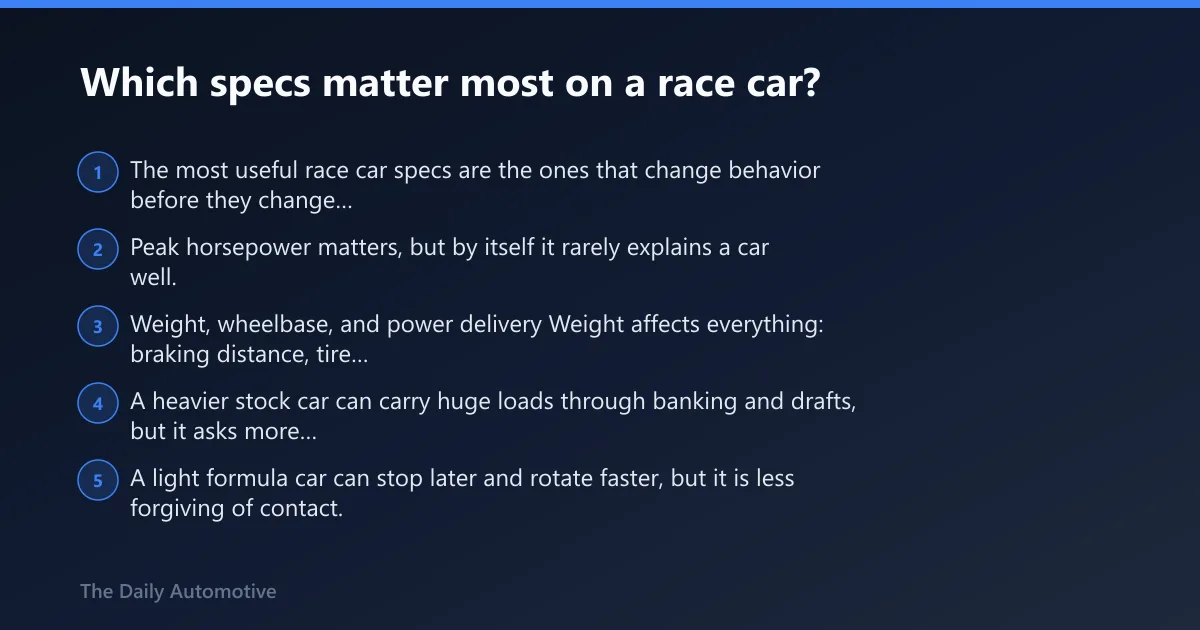
The most useful race car specs are the ones that change behavior before they change bragging rights: weight, wheelbase, power delivery, tire size, brake package, suspension travel, aero load, drag, cooling, and drivetrain layout. Peak horsepower matters, but by itself it rarely explains a car well.
Weight, wheelbase, and power delivery
Weight affects everything: braking distance, tire load sensitivity, direction change, and consumable life. A heavier stock car can carry huge loads through banking and drafts, but it asks more from brakes and tires. A light formula car can stop later and rotate faster, but it is less forgiving of contact.
Wheelbase is a quietly important defining spec. Short wheelbases suit sprint cars and many drift builds because they rotate quickly. Longer wheelbases generally calm the platform at speed, can help aero stability, and suit prototypes, GT cars, and some stock-car applications.
Power delivery beats headline power in many comparisons. Rally and drift both care about response, but for different reasons. Rally needs traction and recoverable torque on changing surfaces. Drift needs a throttle map and torque curve that make angle easy to meter mid-corner.
Tire size, brake package, and suspension travel
Tire width tells you a lot about the load case. A formula car on slicks uses tire temperature and aero load as part of the package. A touring car often works within tighter tire rules, so setup leans harder on balance and tire management. Sprint cars and rally cars live in a different world, where carcass compliance and surface bite matter as much as raw width.
Brake package choice follows speed, weight, and stint length. Endurance GT and prototype cars need repeated stops without losing pedal consistency. Rally cars need brakes that work when dirty, wet, and hot. Drift cars punish clutches and rear tires more than they punish big road-course brake systems.
Suspension travel is one of the fastest category tells. Road-course formula and prototype cars run low and controlled. Rally cars need travel and underbody clearance. Dirt sprint cars need a platform that can find bite while the car spends much of the corner in slip.
Downforce, drag, cooling, and drivetrain layout
Aero load matters once speed rises enough to use it. Formula cars and prototypes chase downforce aggressively. Stock cars live in a constant trade between drag and stability, especially where drafting matters. Touring cars usually operate under tighter aero limits, so mechanical grip and tire life carry more weight.
Cooling exposes a car’s real job. Endurance cars need reliable airflow to engine, brakes, and cockpit systems over long runs. Rally cars need resilience when the car sees low road speed, high engine load, debris, and repeated altitude or weather changes. Drift cars need cooling that tolerates long high-rpm slides with inconsistent direct airflow.
Drivetrain layout often decides the rest of the build. Rear-drive favors steering precision and slip-angle control. All-wheel drive changes front-end packaging, differential tuning, and cooling loads, but it transforms launch and low-grip traction on rally surfaces.
Evaluating BBS Racing Wheels for Track Car Builds
BBS racing wheels deliver repeatable fitment and low unsprung weight, but they only justify their cost when matched precisely to your car, brake package, and track usage. If the sole goal is finding the cheapest strong wheel, cheaper alternatives usually win.
The real value emerges in how manufacturing methods—forged, flow-formed, or cast—affect durability and performance under sustained cornering loads. Understanding these differences prevents costly fitment headaches and ensures the wheel choice supports consistent lap times rather than just adding badge appeal. A detailed breakdown of construction types, fitment considerations, and a decision matrix comparing BBS against other options helps builders choose correctly. Evaluating BBS racing wheels before purchase keeps budgets aligned with actual on-track requirements.
Selecting a Sparco Racing Seat for Street and Track Use
A Sparco racing seat delivers significantly more lateral support than factory seating, but choosing the correct model is critical. The wrong selection leads to poor ergonomics, excessive cabin noise, and unexpected installation costs. Budgets typically range from the mid-hundreds to low-thousands per seat before factoring in mounting brackets.
Matching the seat to your specific application—whether daily street driving, dedicated track safety, or simulator rig integration—determines long-term satisfaction. A detailed breakdown of Sparco racing seats covers model specifications, total installation expenses, use-case decision tables, and comparable alternatives to help builders avoid costly fitment mistakes.
Oil Cooling Requirements for Turbocharged Track Cars
Turbocharged engines generate extreme heat, and without proper oil cooling, that heat thins the oil, drops pressure, and accelerates bearing wear. A stacked-plate 19-row cooler with a thermostat handles mixed street and track duty, while a 25-row unit suits long road-course sessions where sustained heat is the primary concern.
Choosing the wrong setup creates its own problems: an oversized cooler without a thermostat can overcool the engine during street driving, increasing wear. The guide to racing oil coolers breaks down failure modes, sizing requirements, thermostatic setups, and specific kit recommendations—from budget-friendly street builds to track-heavy applications—so you can manage temperatures without introducing flow restriction.
How do Formula cars differ from sports cars and stock cars?
Formula cars differ from sports cars and stock cars through packaging first, not branding. They are single-seat open-wheel machines built around low mass, exposed suspension, and heavy aero dependence. Sports cars carry enclosed bodywork and endurance needs. Stock cars trade some precision for contact tolerance, drafting behavior, and heavier-load stability.
Formula versus GT: aero load, chassis style, and endurance demands
A formula car uses a narrow single-seat chassis with exposed wheels and slick tires. The airflow is dirtier around the wheels, but the car can produce major downforce with a small frontal area and low mass. The driver sits in a compact tub with little excess structure beyond what the rules require.
A GT car wraps the wheels and cockpit inside bodywork. That gives more space for cooling, lighting, fuel-system packaging, and endurance safety equipment. It also changes how aero is made: less pure than a formula car in many cases, but better suited to long runs, traffic, and body-contact risk.
GT cars also live under Balance of Performance in many classes. That means some of the visible spec is rule-managed rather than purely chosen for speed.
Formula versus stock car: body shape, draft behavior, and curb weight
Stock cars are full-body, closed-wheel race cars with strong oval roots. Their body shape matters for drag, side force, and drafting, especially on big ovals. They also tend to carry more mass and see sustained high loads through banking and traffic than a typical formula car setup is built for.
Formula cars are usually less tolerant of contact because exposed wheels can interlock. Stock cars can trade paint and survive minor body contact that would end an open-wheel race. That contact tolerance drives stronger fender structures, different suspension protection, and a different racecraft style.
What the driver feels: braking zones, steering response, and contact tolerance
A formula car usually rewards late braking, clean aero platform control, and delicate curb use. A GT car asks for patience over a stint, brake care, and tire management under a heavier enclosed package. A stock car often asks the driver to manage yaw, tire wear, and air effects in traffic while carrying load for long periods.
Formula cars and sprint cars: open-wheel builds with very different jobs
Formula car specs: single seat, slicks, low mass, and downforce
Formula cars are defined by the single-seater layout, open wheels, lightweight chassis, and slick tires. Power band or displacement changes by class, but the recipe stays familiar: low frontal area, quick response, high brake authority, and aero surfaces that matter once speed comes up.
Because the wheels sit in the airflow, suspension geometry and wheel wake become part of the aero story. That is why these cars react sharply to ride height, rake, and front-wing balance in ways a heavier closed-wheel class may mask.
Sprint car specs: short wheelbase, dirt grip, winged versus wingless
Sprint cars are short-wheelbase dirt machines with huge power-to-weight for the tire and surface available. A top wing can load the rear and calm the car at speed, while wingless setups ask more from the driver to manage throttle and steering input. The chassis is light, direct, and built for bite on loose oval dirt.
The tire and wheel package is part of the visual clue. So is the stance. A sprint car looks ready to rotate before turn-in because that is exactly its job.
Why exposed wheels change contact, setup, and driver workload
Exposed wheels raise the risk of wheel-to-wheel contact launching or climbing one car over another. That alone changes racecraft. They also leave tires more vulnerable to debris and direct impact, and they limit how much bodywork can calm airflow around the rotating tire.
For the driver, that means less tolerance for door-handle racing and more attention to placement, wake sensitivity, and surface changes.
Prototype, GT, stock car, and touring car: the closed-wheel classes decoded
Prototype specs: purpose-built chassis, fuel strategy, and hybrid packaging
Prototype race cars are purpose-built chassis first. The seat, safety cell, suspension points, underfloor aero, and fuel system are designed as one package. They chase low drag and high downforce together, while also protecting fuel economy and stint length for endurance racing.
Hybrid and non-hybrid variants exist depending on class rules. That creates major packaging differences in cooling, battery location, motor integration, and brake blending. Class-specific homologation limits also matter, so some prototype shapes are as much compliance work as they are speed work.
GT car specs: production roots, Balance of Performance, and long-run durability
GT cars keep more visual and structural connection to road-car shapes, even when heavily reworked. Cockpit safety is a major part of the package, and endurance brake and tire demands are central. Long-run stability matters more than one-lap aggression.
In practice, modern GT3 and GT4 logic is easy to spot in the paddock: production-derived silhouette, enclosed cockpit, BoP-managed performance, and serviceability for sprint or endurance stints. That class logic matters more to this topic than broad historical anecdotes.
Stock car and touring car specs: spec rules, aero limits, tire management, and close racing
Stock cars often use series-defined chassis architecture and body templates shaped around drag and downforce tradeoffs. Their technical identity comes from oval loads, drafting behavior, and contact tolerance more than from any road-car relationship.
Touring cars are usually sedan- or hatch-based with cages, tighter aero limits, and class-based engine rules. They are excellent examples of rulebook-driven parity mixed with engineering-driven balance. From what I have seen in club paddocks, tire management and repeatable braking under traffic often decide more than outright aero load.
What makes a rally car different from a drift car?
Rally cars and drift cars both spend time at slip angle, but the reason is completely different. Rally cars chase stage time across rough surfaces and changing grip, so they need traction, protection, and travel. Drift cars are judged on angle, line, and style, so they need steering angle, response, and tire control.
Rally car specs: AWD options, ride height, protection, and cooling for rough stages
Rally cars are built around mixed surfaces. Gravel and rough tarmac require suspension travel, ride height, underbody protection, resilient cooling, and driveline durability. Upper classes often use all-wheel drive, but class rules can permit other layouts, especially lower down the ladder.
Cockpit layout also differs from circuit cars. Roadbook or pacenote integration matters. The crew needs secure visibility, communication, and switchgear that still works after dust, vibration, and impact loads.
Drift car specs: rear-drive bias, steering angle, clutch life, and throttle response
A drift car typically carries rear-wheel-drive bias, a steering angle kit, a differential setup built for lock and drive, strong cooling, and a clutch that can survive repeated clutch-kick or transition abuse. Rear grip is managed, not maximized. The target is controlled oversteer on demand.
Power is useful, but the shape of the power band matters more than a headline figure. Immediate response lets the driver catch angle, extend angle, and hold line with small throttle changes.
Gravel, tarmac, and judged runs: why the setup targets split so sharply
On gravel, a rally car wants compliance, bite, and impact resistance. On tarmac, it drops ride height and tightens the platform while keeping enough travel to survive real roads. A drift car, by contrast, is usually tuned around transient yaw control, steering lock, and rear tire behavior on a prepared paved course.
Rally versus drift car setup and performance trade-offs
Rally cars prioritize regaining speed on loose surfaces, while drift cars are engineered to sustain high slip angles for style and control. Choosing the wrong platform for your discipline leads to slow stage times, excessive tire wear, or suspension damage because each build targets fundamentally different traction management strategies.
Understanding these mechanical distinctions prevents costly setup errors and ensures your vehicle performs as intended when grip breaks. Our detailed breakdown of rally vs drift differences covers chassis geometry, drivetrain configuration, tire selection, and driving technique so you can identify which platform suits your competitive goals and avoid mixing incompatible components.
Technical comparison table: race car types side by side
Legend: Open-wheel means the tires sit outside the bodywork. Closed-wheel means bodywork covers the tires. RWD = rear-wheel drive, FWD = front-wheel drive, AWD = all-wheel drive, and hybrid-assisted means the class permits electric motor support in addition to the combustion engine.
| Category | Wheel layout | Drivetrain | Typical use case | Surface | Key spec priorities | First three parts a builder upgrades |
|---|---|---|---|---|---|---|
| Formula car | Open-wheel, single-seater | Usually rear-wheel drive | Road-course sprint racing | Smooth tarmac circuits | Low weight, slick tires, aero balance, brake feel, wheelbase stability | Dampers, brake package, data system |
| Sprint car | Open-wheel, short-wheelbase | Rear-wheel drive | Dirt-oval sprint racing | Dirt oval | Power-to-weight, traction, rotation, wing setup or wingless balance | Shocks, torsion or spring hardware, seat position |
| Prototype | Closed-wheel, purpose-built chassis | Rear-wheel drive or hybrid-assisted layouts | Endurance racing | High-speed road courses | Low drag, high downforce, fuel use, brake cooling, safety-cell packaging | Brake cooling, damper package, aero trim tools |
| GT / sports car | Closed-wheel coupe style | Usually rear-wheel drive, some class variance | Sprint and endurance circuit racing | Tarmac road courses | Tire life, brake endurance, cockpit safety, BoP compliance, cooling margin | Pads and rotors, dampers, seat and driver cooling |
| Stock car | Closed-wheel full-body | Usually rear-wheel drive | Oval racing, some road-course use | Paved oval, some road courses | Drag versus downforce, drafting stability, curb-load strength, tire wear | Shocks, brake cooling, steering box or rack setup |
| Touring car | Closed-wheel sedan or hatch | Class-dependent | Door-to-door circuit racing | Tarmac road courses | Balance, tire management, homologation fit, cage stiffness, aero within tight limits | Dampers, brake pads, differential tuning |
| Rally car | Closed-wheel production-based shell | AWD or class-dependent layouts | Stage rally competition | Gravel, tarmac, mixed surfaces | Suspension travel, protection, cooling resilience, traction, visibility and notes integration | Skid plates, dampers, cooling guards |
| Drift car | Closed-wheel coupe or sedan | Rear-wheel-drive bias | Judged drift runs and tandems | Paved drift course | Steering angle, throttle response, clutch durability, rear tire behavior, cooling | Angle kit, differential, radiator and oil cooling |
For quicker spec work, I use this tighter guide. The ranges below are broad category norms, not universal limits, because club rules and homologation can move the numbers.
| Category | Typical weight | Typical power | Aero level | Tire/brake package | Notes you can verify at a glance |
|---|---|---|---|---|---|
| Formula car | ~420-800 kg depending on class | ~120-1,000+ hp depending on class | High to very high on road-course classes | Slicks; large ventilated brakes for vehicle mass | Single-seat tub, exposed wheels, low ride height, wing/floor dependence |
| Sprint car | ~600-650 kg | ~700-900+ hp in top winged classes | Mechanical grip plus top-wing load where allowed | Large dirt tires; oval-specific brake and setup choices | Offset stance, short wheelbase, dirt-only intent, winged or wingless body |
| Prototype | ~950-1,100 kg in current top endurance classes | Rule-limited combined outputs, commonly ~500-700+ hp class-dependent | Very high, with low-drag efficiency | Wide slicks; endurance-grade carbon brake systems in top classes | Purpose-built chassis, enclosed body, endurance lighting/cooling/service access |
| GT / sports car | ~1,200-1,400+ kg | BoP-managed, commonly ~400-600+ hp | Moderate to high, but lower than top prototypes | Wide slicks or control tires; large endurance-capable brakes | Production-based silhouette, roofed cockpit, refueling/service-friendly layout |
| Stock car | ~1,450-1,600 kg in major paved-oval classes | ~600-750+ hp class-dependent | Moderate; drag/stability tradeoff matters | Wide slicks; heavy-duty brakes for ovals and road courses | Full body, robust contact structure, oval geometry cues, big drafting emphasis |
| Touring car | ~1,100-1,300+ kg | ~300-380+ hp in many international touring formulas | Low to moderate by rule | Control tires common; steel or class-limited brake packages | Sedan/hatch profile, tighter aero, parity-focused stance, less extreme ride height |
| Rally car | ~1,080-1,260+ kg by class and surface spec | ~160-380+ hp from entry to top classes | Low to moderate; cooling and durability first | Gravel or tarmac rally tires; durable brakes with debris tolerance | Raised ride height, mud flaps, sump protection, lamp pods/vents on some builds |
| Drift car | Usually ~1,100-1,400+ kg | Often ~300-1,000+ hp depending on level | Low; body aero is secondary to angle and cooling | Front grip and rear tire management dominate; hydraulic handbrake common | Large steering lock, rear-drive setup, cooling upgrades, lock-focused differential |
How to use the table when buying, building, or classifying a car
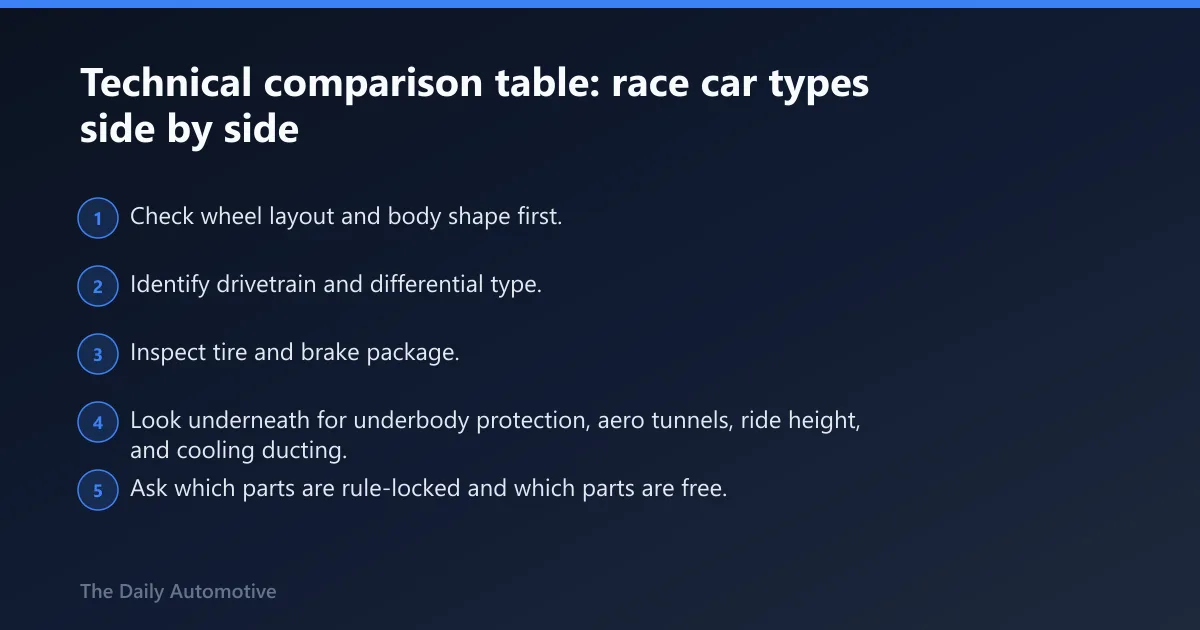
- Check wheel layout and body shape first. Open wheels versus closed wheels narrow the field immediately.
- Identify drivetrain and differential type. Rear-drive, AWD, and hybrid packaging each point to different intended use.
- Inspect tire and brake package. Endurance-capable hardware looks different from drift, dirt, or light sprint hardware.
- Look underneath for underbody protection, aero tunnels, ride height, and cooling ducting.
- Ask which parts are rule-locked and which parts are free. That reveals whether the class is spec-heavy or engineering-led.
How fast are different race car categories, and what does fast really mean?
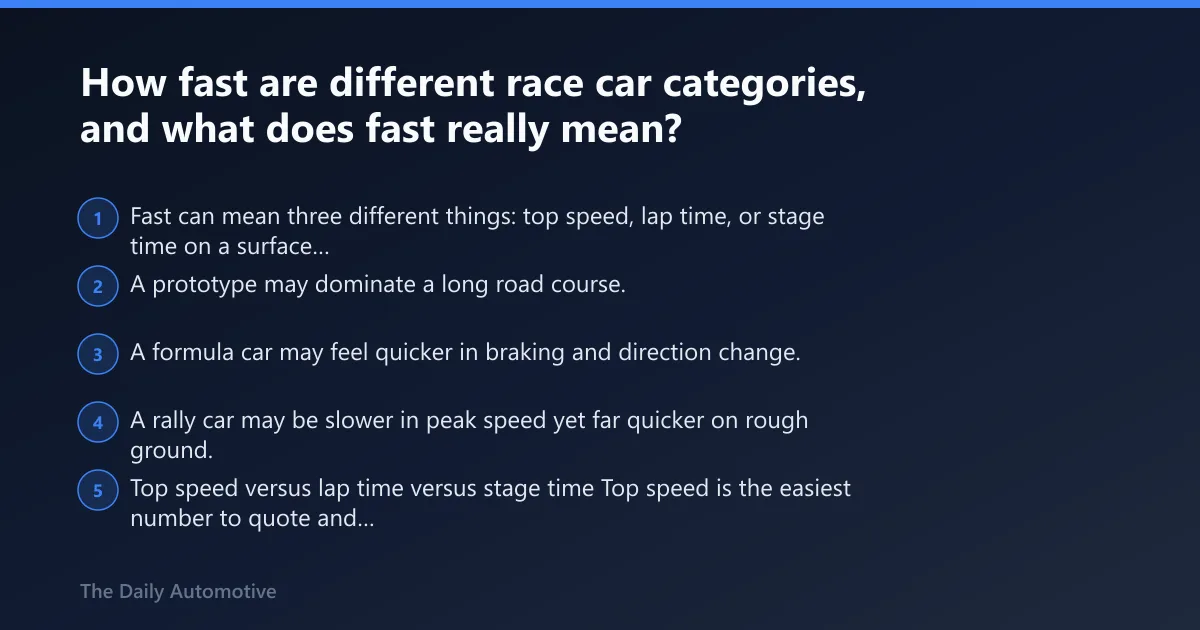
Fast can mean three different things: top speed, lap time, or stage time on a surface that fights back. A prototype may dominate a long road course. A formula car may feel quicker in braking and direction change. A rally car may be slower in peak speed yet far quicker on rough ground.
Top speed versus lap time versus stage time
Top speed is the easiest number to quote and the least useful by itself. Lap time blends acceleration, braking, corner speed, tire grip, and aero efficiency. Stage time in rally adds surface reading, traction, and suspension survival to that mix.
On a superspeedway, a stock car’s drag profile and draft behavior can matter more than a formula car’s low-speed agility. On a short technical circuit, the order can reverse quickly. That is why I separate “fastest” into venue-specific questions before comparing classes.
Why weight, aero, and tires often matter more than peak horsepower
A car with less power can be quicker if it is lighter, carries better tire load, and uses its aero platform well. Tire width and construction often decide usable pace. So do brake temperature control and wheelbase stability.
That is why comparing categories by horsepower alone leads people astray. A drift car, a rally car, and a GT car can share a broad power neighborhood and still have nothing in common once the surface and scoring format change.
Track, oval, dirt, and rally examples that change the pecking order
Track layout decides what “fast” means. On a dirt oval, a sprint car’s bite and rotation can make it the right tool. On a long endurance circuit, a prototype’s drag-to-downforce ratio and fuel use matter more. On gravel, rally hardware wins because it can keep the tire on the ground and the sump off the rocks.
Those examples are more useful than generic historical firsts because they connect directly to the buyer or beginner question: choose the tool that matches the surface, speed range, and contact level.
Which race car type is best for a beginner?
The best beginner race car type is usually the one with the lowest setup complexity, strongest parts support, and widest access to legal places to run. That often means touring-car style builds, entry-level stock-car classes, or simple drift and rally school cars, rather than fragile open-wheel or high-downforce packages.
| Beginner need | Best fit | Why it works | Watch for |
|---|---|---|---|
| Lowest budget, paved circuit, novice skill | Touring-car style or entry club sedan | Good parts supply, easier body repair, less aero sensitivity | Brake heat, tire wear, class legality |
| Oval beginner, modest budget | Lower-spec stock-car class | Teaches traffic, restarts, tire saving, and contact awareness | Chassis setup discipline and safety gear cost |
| Dirt beginner | Simple local dirt class before sprint cars | Cheaper mistakes, better learning curve, more forgiving speed | Surface changes and maintenance workload |
| Rally-curious beginner | Basic class-legal rally training car | Teaches notes, surface reading, and durability basics | Logistics, safety prep, event travel |
| Drift beginner | Modest rear-drive platform | Seat time matters more than big power at first | Rear tire budget and cooling |
| High skill, high budget, not first race car | Formula or advanced GT | Huge learning reward once fundamentals are already there | Fragility, consumables, setup complexity |
Budget, access, and consumable costs by category
Formula cars can look simple but often punish mistakes with bodywork, floor, or suspension damage. GT and prototype consumables rise quickly because brakes, tires, cooling systems, and safety gear must support longer, faster runs. Rally adds travel, protection, and logistics. Drift can burn rear tires and driveline parts at a surprising rate.
Touring-car and beginner stock-car formats often make more sense because track access is better and replacement parts are easier to source within the class logic.
Learning curve: setup sensitivity, fragility, and driver aids
High-downforce cars are demanding because small setup errors change the whole platform. Open-wheel cars are also fragile in wheel contact. Rally is mentally heavy because the driver must trust notes and surface reading. Drift is technique-heavy because the car is intentionally driven beyond neutral grip.
A beginner usually learns faster in a car that tolerates traffic, rides curbs without drama, and does not require constant aero tuning.
Best entry paths for circuit, oval, dirt, rally, and drift newcomers
For paved circuits, touring-car style builds are the cleanest classroom. For ovals, lower-spec stock cars teach racecraft and traffic. For dirt, simpler local classes usually beat jumping straight into sprint-car speed. For rally, start with class-legal basic cars and proper safety prep. For drift, begin with a modest rear-drive platform and focus on cooling, seat time, and steering setup before chasing power.
Choosing the right racing helmet for your first events
Your series rulebook dictates which helmet certification you need—typically SA2020 or FIA 8859-2015—before fit and budget even matter. Buying a helmet that fails tech inspection wastes money and leaves you unprotected on track.
A proper beginner setup prioritizes the correct safety standard, then ensures the shell fits without pressure points, leaving enough budget for a HANS device. Our guide to beginner racing helmets breaks down certification requirements, fit checks, and specific models suited for track days, autocross, drift, rally, and entry-level club racing so you buy exactly what your discipline demands.
What are the main FIA racing categories?
The main FIA racing categories map cleanly to five buckets relevant here: Formula, GT, Touring, Prototype, and Rally. In FIA terms, those buckets are defined by homologation, safety cell requirements, drivetrain allowances, aero limits, and whether the rules prioritize outright speed, parity, endurance, or mixed-surface durability.
How FIA labels map to hardware, not the other way around
Formula maps to single-seater, open-wheel circuit cars. Class examples include Formula 1, Formula 2, Formula 3, and Formula Regional. The rules emphasize driver safety cell design, wheel-to-wheel dimensions, underfloor and wing limits, minimum mass, and tire specification.
GT maps to closed-wheel sports cars with production roots. Class examples include GT3 and GT4. The rules emphasize homologated body shapes, safety structures, controlled aero, serviceability, and Balance of Performance so different engine layouts can race together.
Touring maps to sedan- and hatch-based circuit cars. Class examples include FIA-style touring formulas such as TCR-based racing. The rules emphasize parity, cost control, production-car relationship, limited aero, and close racing more than maximum downforce.
Prototype maps to purpose-built sports racers for endurance competition. FIA-linked examples include Hypercar and LMP-class concepts depending on championship structure. The rules emphasize safety-cell integrity, hybrid packaging where permitted, aero efficiency, fuel or energy deployment, and long-run durability.
Rally maps to stage cars built for gravel, tarmac, snow, and mixed surfaces. Class examples include Rally1, Rally2, Rally3, and junior ladder classes. The rules emphasize homologated bodyshells, suspension travel, drivetrain allowances, protection, and reliability over repeated impacts and rough-road loads.
Why sanctioning labels should never be your first comparison tool
The sanction label tells you who wrote the rules; the hardware tells you what the car is. I have seen cars from different championships look far apart on paper yet sit close together in real engineering terms once you compare weight, tire size, aero freedom, and drivetrain.
That is why my first comparison pass stays simple: open-wheel or closed-wheel, tarmac or dirt, sprint or endurance, contact-tolerant or contact-fragile, spec-heavy or development-heavy. After that, FIA labels start to become useful.
Frequently asked questions
How fast are different race car categories?
Different categories are fast in different ways. A prototype may be quickest over a long circuit lap, a formula car may feel faster in braking and direction change, and a rally car may post the best time on rough roads where a circuit car cannot cope. Surface and stint length decide the answer.
What is the difference between a prototype and a GT car?
A prototype is purpose-built around a dedicated chassis, safety cell, low drag, downforce, and endurance fuel strategy. A GT car keeps stronger links to production-based body shapes, carries Balance of Performance in many classes, and places more emphasis on cockpit safety, tire life, brake life, and long-run durability.
Products related to this article
Sponsored / affiliate links. As an Amazon Associate I earn from qualifying purchases. I may earn additional commission from eligible campaigns.