How Much to Ship a Car to Hawaii: $1,000-$1,500 Base Cost
Shipping a car to Hawaii usually starts at about $1,000-$1,500 for port-to-port ocean transport, but the all-in total often lands around $1,500-$3,500 once inland trucking, island fees, and paperwork are added. Miss the extra charges and your quote can jump by hundreds, or your car can sit at the port waiting for payment or missing documents. This guide breaks down every common fee, what changes the final price, and how to compare quotes without a surprise bill.
For most operable cars, the best-value pick is RoRo from a West Coast port to Honolulu, because it usually has the lowest base ocean rate and the fewest add-on costs.
Quick picks for Hawaii shipping
If you want the cheapest practical setup, start with West Coast port-to-port RoRo to Honolulu. If your vehicle does not run, container shipping is the safer fit, but it usually costs more. Neighbor-island delivery, oversized vehicles, and door-to-door service all push the total up.
Best for the lowest cost
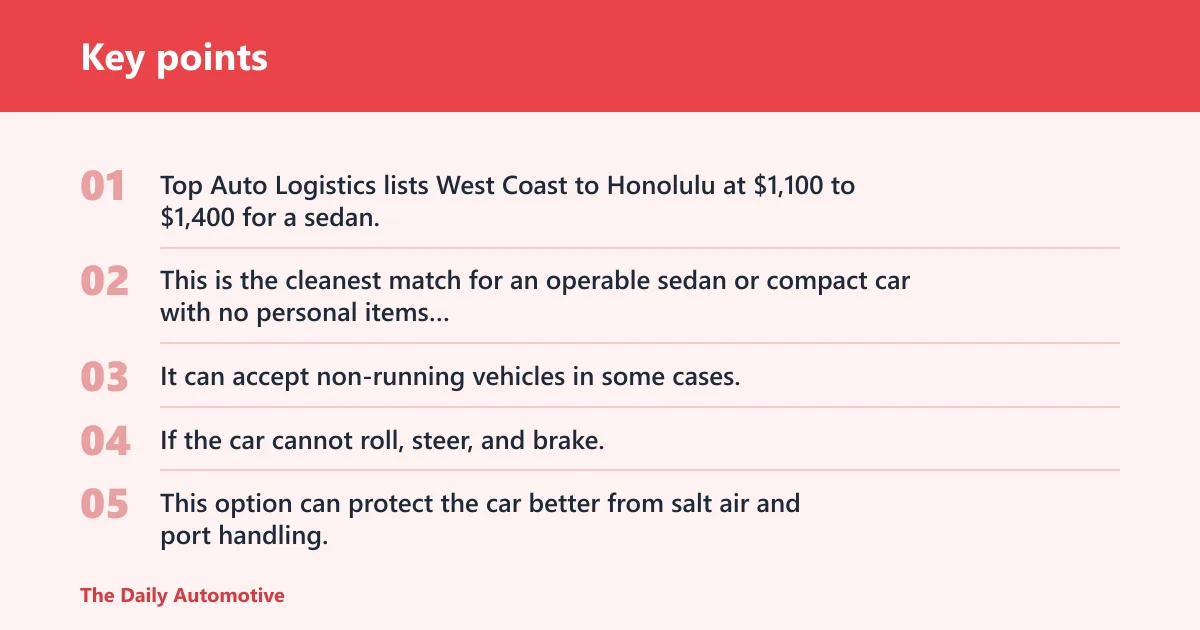
West Coast RoRo to Honolulu. Top Auto Logistics lists West Coast to Honolulu at $1,100 to $1,400 for a sedan, while other Hawaii guides place similar lanes higher depending on carrier and season. This is the cleanest match for an operable sedan or compact car with no personal items inside.
Best for a non-running vehicle
Container shipping. It can accept non-running vehicles in some cases, but carrier rules vary and the quote usually rises because handling is more involved. If the car cannot roll, steer, and brake, ask about winching or special loading before you book.
Best for added protection
Container shipping with strict cargo limits. This option can protect the car better from salt air and port handling, and some carriers may allow personal belongings depending on their rules. That said, do not assume storage space is automatically included.
Best for neighbor-island delivery
Ship to Honolulu first, then transfer inter-island. Maui, the Big Island, and Kauai usually cost more than Oahu because of the extra transfer leg. Enterprise Auto Transport says neighbor islands add $400 to $900, and that premium is separate from the mainland ocean leg.
What the base cost covers
The advertised $1,000-$1,500 figure usually covers only the ocean move from a mainland port to Hawaii, not the full bill. That base rate can look low because it excludes inland trucking, port processing, fuel surcharges, and island-specific fees that often decide the final total.
Base ocean rate versus all-in total
Top Auto Logistics lists Hawaii car shipping at $1,100 to $2,500+ and says West Coast to Honolulu runs $1,100 to $1,400 for a sedan. Dantful puts the average cost in 2025 to 2026 at $1,200 to $2,700. Those wider ranges are closer to what you pay once the extra line items are added.
That is why a quote can look cheap at first and then rise later. If you compare only the ocean rate, you may miss the real cost by several hundred dollars.
Why quotes look low at first glance
Many quotes are built around the port-to-port ocean leg only. Door-to-port service adds mainland pickup and delivery to the departure terminal. Neighbor-island delivery adds another transfer. Those are different services, and they should be priced separately.
Cheapest ways to ship to Hawaii
The cheapest mainstream setup is usually RoRo from a West Coast departure port to Honolulu Harbor, with an operable sedan or compact car. West Coast rates are cheaper than East Coast rates, and Honolulu is the lowest-cost Hawaii destination in most pricing tables because it has the most frequent sailings and the most schedule depth.
West Coast origin ports
Los Angeles, Oakland, and Seattle/Tacoma are the common low-cost departure points. Weekly or regular sailings are common from these ports, which helps keep pricing lower and scheduling simpler than less frequent routes.
The same source says East Coast to Honolulu can reach $1,800 to $2,200 for a sedan, while Cartipsdaily says East Coast to Honolulu costs $2,200 to $3,500. Those figures show the gap plainly: the farther the car has to move on the mainland, the more the total climbs.
Honolulu Harbor as the low-cost endpoint
Honolulu Harbor is the primary destination port for Hawaii car shipments. It is usually the cheapest Hawaii endpoint in pricing tables and has the most frequent sailing schedules, which keeps both base rates and timing more predictable.
Why RoRo usually beats container shipping on price
RoRo is the cheapest mainstream method for operable vehicles because the car is driven on and off the vessel. It requires working brakes and steering, and personal items are not allowed inside the vehicle. Container shipping costs more because the vehicle is enclosed and handled differently.
Hawaii car shipping worksheet
Use this planning sheet to separate the ocean base rate from the add-ons that change the final bill. The ranges below are realistic planning numbers, not promises. Oahu usually sits at the low end, while Maui, the Big Island, and Kauai need an extra transfer leg and can move the total higher.
| Origin lane | Vehicle type | Base ocean rate | Add-on fees |
|---|---|---|---|
| Los Angeles to Honolulu | Sedan/compact | $1,100 to $1,400 | Mainland trucking $0 to $300; terminal fees $75 to $200; storage risk $0 to $150; total planning range $1,175 to $2,050 |
| Oakland to Honolulu | SUV/crossover | $1,300 to $1,700 | Mainland trucking $0 to $350; terminal fees $75 to $200; storage risk $0 to $150; total planning range $1,375 to $2,400 |
| Seattle/Tacoma to Honolulu | Minivan/full-size SUV | $1,400 to $1,900 | Mainland trucking $100 to $500; terminal fees $75 to $200; storage risk $0 to $150; total planning range $1,575 to $2,750 |
| West Coast to Maui | Sedan/compact | $1,100 to $1,400 | Mainland trucking $0 to $300; terminal fees $75 to $200; neighbor-island surcharge $400 to $900; storage risk $0 to $150; total planning range $1,575 to $2,950 |
| West Coast to Big Island | Pickup truck | $1,400 to $2,000 | Mainland trucking $0 to $450; terminal fees $75 to $200; neighbor-island surcharge $400 to $900; storage risk $0 to $150; total planning range $1,875 to $3,700 |
| West Coast to Kauai | Lifted or oversized vehicle | $1,600 to $2,400 | Mainland trucking $100 to $600; terminal fees $75 to $200; neighbor-island surcharge $400 to $900; storage risk $0 to $150; total planning range $2,175 to $4,250 |
How to read the worksheet
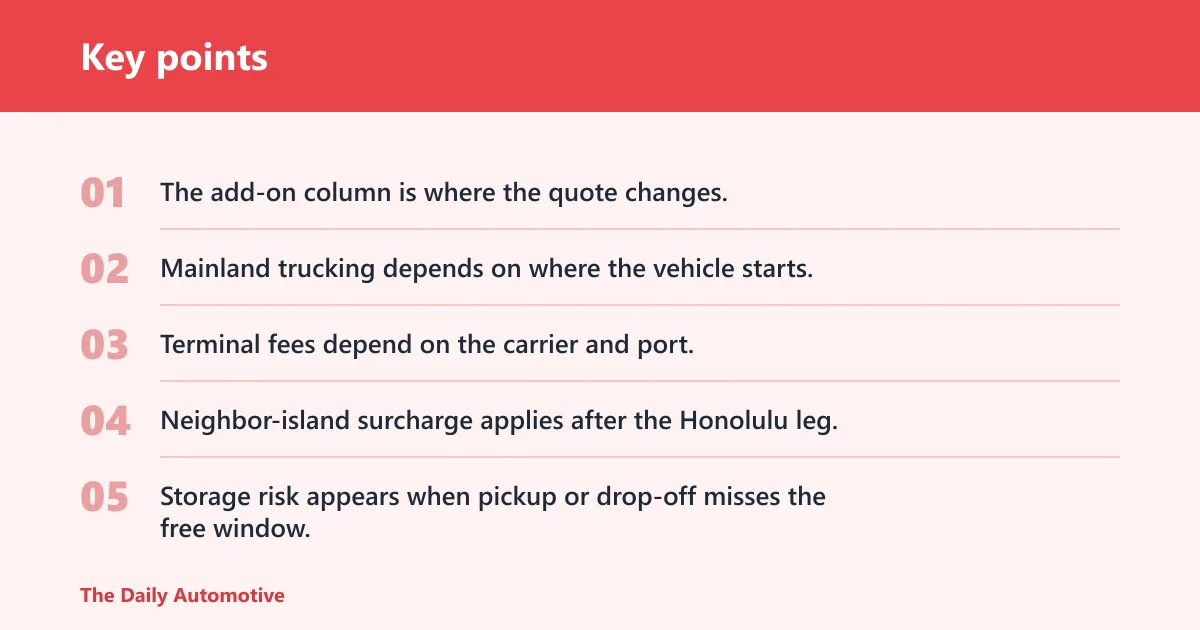
The add-on column is where the quote changes. Mainland trucking depends on where the vehicle starts. Terminal fees depend on the carrier and port. Neighbor-island surcharge applies after the Honolulu leg. Storage risk appears when pickup or drop-off misses the free window.
Say your sedan ships from Los Angeles to Honolulu, and the carrier quotes $1,250 for the ocean leg. If you need $180 in mainland trucking and $95 in terminal fees, the real planning number is $1,525 before any fuel surcharge or storage issue is added.
What adds to the final bill?
These are the line items that usually separate the advertised base rate from the true total. Terminal handling, wharfage, documentation, fuel surcharge, and storage can all move the price, and some carriers quote them separately while others fold parts of them into the final invoice.
Terminal, wharfage, and documentation fees
Port terminal handling charges, wharfage, and documentation fees are common on Hawaii shipments. They are not always listed in the headline price. If the car sits past the free period, storage fees can start too, and that is one of the easiest ways to turn a good quote into an expensive one.
Fuel surcharge and BAF swings
Fuel surcharge, often labeled BAF, can change monthly. It is often not included in the base quote. If you are comparing two carriers, make sure you know whether the fuel line is already included or still outside the quoted rate.
Storage charges after the free period
Storage charges matter because missed pickup windows are common failure points. A late arrival, a paperwork mismatch, or a scheduling change can leave the car at the terminal long enough to trigger daily storage.
Door-to-port and mainland trucking add-ons
Door-to-port service includes pickup from your starting address and delivery to the mainland terminal. That convenience costs extra. If you can drive the car to the port yourself, you may avoid one of the largest add-ons in the quote.
Which shipping method fits your car?
RoRo is the cheapest mainstream option for operable vehicles, while container shipping costs more and is better for protection or non-running cars. Vehicle size also changes the quote. A sedan is one price bucket, and a lifted truck or dually can move into a much higher one.
RoRo for operable vehicles
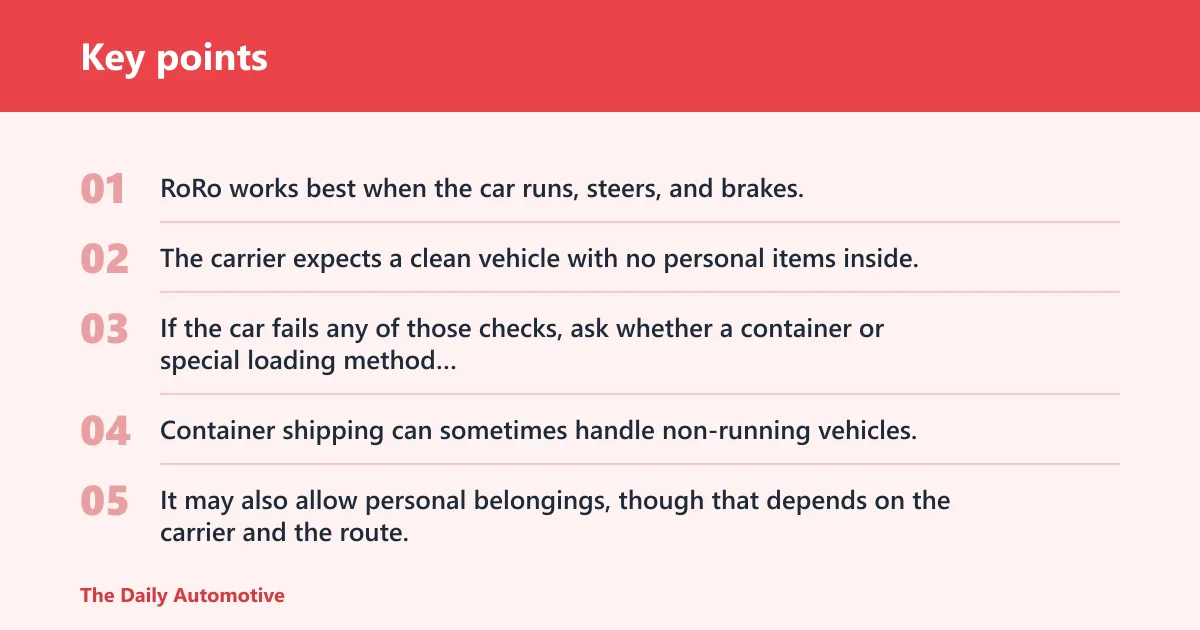
RoRo works best when the car runs, steers, and brakes. The carrier expects a clean vehicle with no personal items inside. If the car fails any of those checks, ask whether a container or special loading method is even available on that lane.
Container shipping for protection or non-running vehicles
Container shipping can sometimes handle non-running vehicles, but the carrier has to approve the move. It may also allow personal belongings, though that depends on the carrier and the route. Do not assume the same rules apply on every shipment.
Picture a lifted SUV with oversized tires and roof racks. That setup can move the vehicle into a larger size bucket even if the badge says “SUV,” because height, width, and loading limits matter more than model name alone.
Vehicle size buckets and modifications
Sedan/compact, SUV/crossover, minivan/full-size SUV, pickup truck, and lifted, dually, or oversized vehicle are the common pricing buckets. Roof racks, lift kits, and oversized tires can change the class. That is why two vehicles with the same base model can receive different quotes.
EV and plug-in hybrid acceptance can be carrier-specific. Some carriers accept them with limits on charge level or loading procedures, while others do not. Check the carrier’s rule set before you assume an electrified vehicle will move on the same terms as a gasoline sedan.
How to choose the right quote
Choose the quote that matches the service level you actually need. Port-to-port is usually the cheapest. Door-to-door is easier, but it costs more. Compare the mainland pickup charge, terminal fees, destination surcharge, fuel line, and storage terms before you sign anything.
- Confirm whether the quote is port-to-port, door-to-port, or full door-to-door.
- Ask for the base ocean rate and the separate fee lines.
- Check whether the price includes terminal handling, wharfage, documentation, and fuel surcharge.
- Verify whether the car fits the quoted size bucket, especially if it has racks, a lift kit, or oversized tires.
- Ask what happens if the car is not running, and whether the carrier accepts EVs or plug-in hybrids.
- Book early enough to avoid storage fees and missed sailings.
Paperwork and prep before booking
Have the title or registration ready if the carrier asks for it, and confirm any lender or lienholder requirements before the vehicle moves. Clean the car so soil and debris do not trigger a rejection. Remove prohibited items. Keep fuel low, because carriers usually want only a small amount in the tank for loading and unloading.
A common first-timer mistake is leaving loose cargo in the trunk and then learning at check-in that the carrier will not load it. The car may still ship, but the extra stop to unload items can cost time and create a missed window for the sailing.
Frequently asked questions
How much does it cost to ship a car to Hawaii from the West Coast?
For a sedan on a West Coast to Honolulu lane, Top Auto Logistics says $1,100 to $1,400, while other sources land higher depending on the carrier and service level. Once you add mainland trucking, terminal fees, and possible storage, a realistic all-in plan often moves above the headline ocean rate.
What is the cheapest way to ship a car to Hawaii?
The cheapest mainstream option is usually RoRo from a West Coast port to Honolulu Harbor with an operable sedan or compact car. That setup avoids container handling costs and usually uses the lowest-cost destination port. The price rises if the car is larger, non-running, or headed to a neighbor island.
How much more does it cost to ship to Maui, the Big Island, or Kauai?
The same source says neighbor islands add $400 to $900. That extra cost reflects the inter-island transfer and extra transit days, so Maui, the Big Island, and Kauai usually cost more than Oahu even when the mainland origin and vehicle are the same.
What fees are usually not included in a Hawaii car shipping quote?
Common exclusions include mainland trucking, terminal handling, wharfage, documentation fees, fuel surcharge or BAF, and storage after the free period ends. Some quotes also leave out the neighbor-island leg. Always ask for the fee stack, not just the headline ocean price.
How long does it take to ship a car to Hawaii?
The same source says West Coast to Oahu transit is typically 7 to 14 days. East Coast origin points usually take longer, and neighbor-island delivery adds more time because of the extra transfer. Door-to-port or door-to-door service also adds scheduling time on the mainland.
What paperwork do you need to ship a car to Hawaii?
Most carriers want proof of ownership or registration, and some want additional lender or lienholder approval. You should also confirm the pickup appointment, vehicle condition, and any carrier-specific forms before drop-off. If paperwork is incomplete, the vehicle can sit at the port until the issue is fixed.
Products related to this article
Sponsored / affiliate links. As an Amazon Associate I earn from qualifying purchases. I may earn additional commission from eligible campaigns.