How to Be a Better Automotive Technician: 5-Step Guide
Be a better automotive technician by using a repeatable diagnostic process, documenting your tests, and verifying the fix before the car leaves. Skip that system, and you get repeat comebacks, wasted labor, low confidence, and shop reputations that suffer. This guide shows how to diagnose faster, write cleaner notes, prevent comebacks, and measure your daily performance with simple shop metrics.
How do you become a better automotive technician?



Start with the complaint, not the part. A stronger technician verifies the symptom, checks scan data and service information, repairs to spec, confirms the fix, and writes notes that let the next person understand the job without guessing. That process beats random experience alone.
Use a repeatable diagnostic sequence on every RO
Use a consistent order on each repair order: verify the complaint, scan for DTCs, review freeze frame data, inspect service information, test the fault, repair the root cause, and confirm the repair. Repeatable structure lowers missed steps and makes your work easier to audit.
- Verify the customer complaint under the same conditions described on the RO.
- Pull DTCs and freeze frame before clearing anything.
- Check live data and relevant service information.
- Test the suspected circuit or component with the right tool.
- Repair the root cause, then recheck for return of the symptom.
Measure success by comebacks, accuracy, and documentation
Skill improves when it is measured. Track comeback rate, time spent before the first accurate test, estimate accuracy, and note quality. If a job comes back, ask whether the failure was in symptom verification, diagnosis, repair execution, or verification. That question finds weak points faster than vague self-criticism.
What skills make a good automotive technician?
A good automotive technician combines diagnostic thinking, clean repair execution, and disciplined verification. Technical knowledge matters, but the daily difference comes from knowing which test to run first, how to repair to specification, and how to confirm the vehicle is actually fixed before release.
Diagnostic thinking and root-cause analysis
Strong technicians think in systems, not guesses. A misfire may involve ignition, fuel, air, mechanical condition, wiring, or software logic. Root-cause analysis means stopping at the failure point that explains the symptom, not the easiest part to replace.
Repair execution to specification
Repair quality depends on torque specs, fastener reuse rules, connector fitment, and correct procedures. A loose wheel, over-torqued caliper bolt, or reused one-time-use fastener can create another failure. Good execution is quiet, repeatable, and documented.
Verification habits that catch mistakes before release
Verification is not optional. It includes clearing codes only after data is saved, road testing under the complaint conditions, checking for return symptoms, and confirming no new faults were created. A technician who verifies well catches the mistake before the customer does.
How can I diagnose cars faster and more accurately?
Diagnose faster by narrowing the problem before touching parts. Use live data, DTCs, freeze frame, and a targeted road test, then move to a circuit or component test only after the evidence points there. Speed comes from fewer wrong turns, not from rushing.
Use the scan tool for live data, DTCs, and bi-directional checks
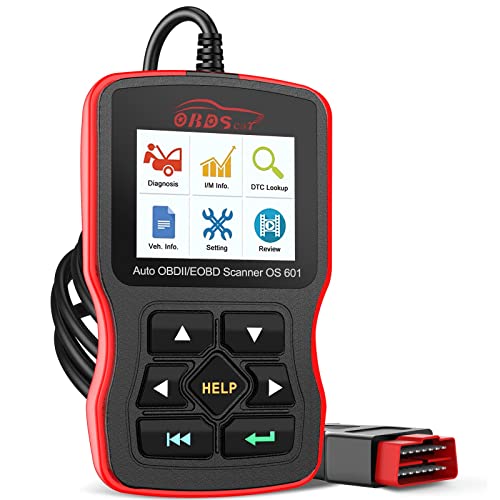
A scan tool should do more than read codes. Look for live data, mode $06 where appropriate, bi-directional controls, and vehicle-specific coverage that matches the system you are testing. Keep software updated, because weak coverage or stale software can waste hours on the wrong path.
Read freeze frame data before you clear codes
Freeze frame tells you what the module saw when the fault set. Engine load, RPM, temperature, and vehicle speed can separate a true hard fault from an intermittent condition. Clear codes too early, and you erase evidence that may save a return visit.
Switch to an oscilloscope when the symptom lives in the waveform
Use an oscilloscope when the scan tool cannot show what the signal is actually doing. That includes sensor waveform analysis, ignition patterns, injector command checks, and parasitic draw diagnosis. If a sensor reports “plausible” data but the waveform is irregular, the scope can expose the failure.
Picture a crank-no-start on a late-model engine where the scan tool shows engine speed during cranking. That does not prove the crank sensor signal is clean. A scope trace can reveal a drop-out every few revolutions that the scan tool averages away.
What should you use from service information and calibration data?
Use service information as a primary diagnostic tool, not a backup. Wiring diagrams, bulletins, repair procedures, torque specs, and calibration steps keep the job tied to the manufacturer’s intent. OEM data usually matters most for procedure and calibration; aftermarket data can be useful, but it should be checked carefully.
Wiring diagrams, TSBs, and OEM repair steps
Wiring diagrams show power, ground, splice points, and module paths. TSBs can point to known faults, software updates, or revised procedures. OEM repair steps matter because they describe the sequence, special tools, and setup conditions that keep you from repeating the same fault.
Torque specs, angle tightening, and fastener reuse rules
Torque wrench use is basic discipline, not ceremony. Some fasteners may require angle tightening after an initial torque value, and some may not be reusable. Cross-pattern tightening matters on wheels, manifolds, and many covers. Record torque-critical steps in the RO notes when the job is complete.
ADAS calibration and alignment dependencies after repair
ADAS work changes the repair order. Camera and radar calibration may depend on wheel alignment, ride height, tire size, or a completed road test. Safety implications are real, because a miscalibrated system can affect braking, steering, or lane-support functions. Document the calibration method and post-repair verification clearly.
How do certification and safety habits improve your work?
Certification and safety habits improve consistency. ASE certification gives a recognized skill benchmark, while high-voltage and ADAS procedures protect the vehicle, the technician, and the customer. Better technicians treat both as part of the job, not as separate tasks.
Use ASE as a benchmark for study priorities and recertification
ASE test areas help identify gaps in engine repair, brakes, electrical/electronic systems, steering and suspension, heating and air conditioning, and more advanced categories. Recertification cycles force regular review, which helps keep knowledge current and tells you where your weakest areas still are.
Build EV and hybrid safety into every high-voltage job
EV and hybrid work requires high-voltage PPE, lockout/tagout habits, battery isolation, insulated tools, and training specific to the platform. Treat orange cabling and service disconnects with the same seriousness as live mains power. If the procedure calls for disabling the system, follow it exactly.
Suppose a hybrid arrives with a charging fault and an open cooling concern. A technician who skips isolation can create a dangerous situation before the fault is even diagnosed. The right workflow starts with shutdown, verification of zero-energy conditions, and the correct service manual steps.
How do you reduce comebacks and work cleaner?
Reduce comebacks by writing better RO notes, confirming the repair under load, and handing the job off in a way that keeps the next step clear. Clean work is measurable: fewer repeat visits, fewer missed details, and fewer questions from the advisor or the next technician.
Document the complaint, the fix, and the verification step
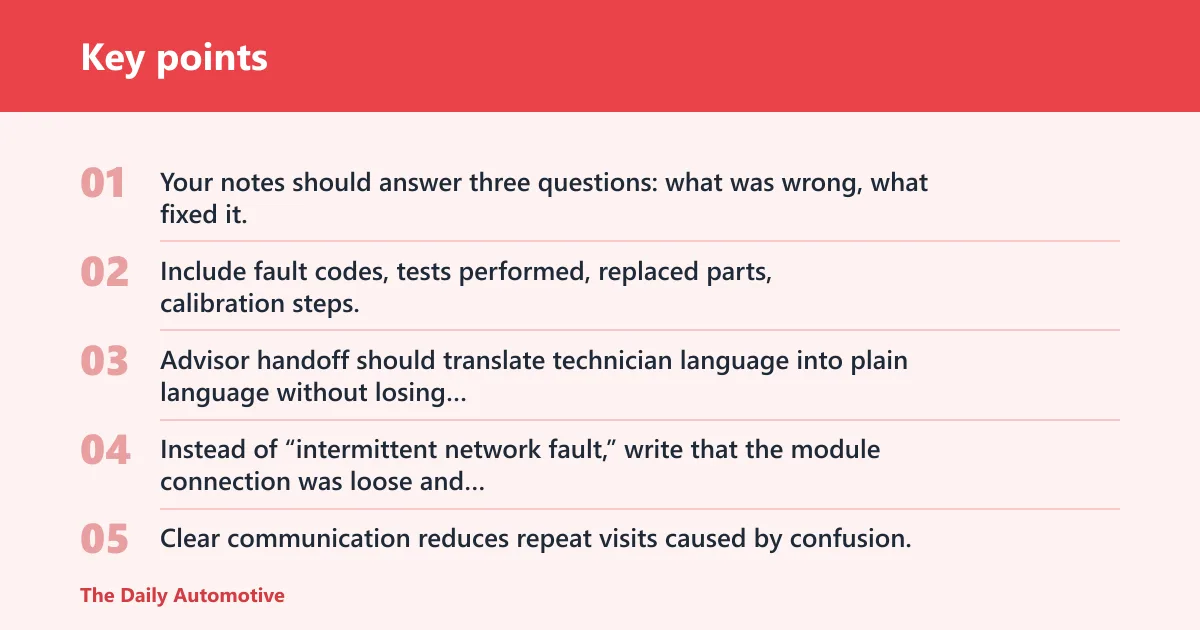
Your notes should answer three questions: what was wrong, what fixed it, and how was it confirmed. Include fault codes, tests performed, replaced parts, calibration steps, torque-critical items, and the result of the final road test. Short notes are fine if they are complete.
Use advisor handoff notes that a customer can understand
Advisor handoff should translate technician language into plain language without losing accuracy. Instead of “intermittent network fault,” write that the module connection was loose and was corrected, then note the conditions used to confirm the repair. Clear communication reduces repeat visits caused by confusion.
Track time, flagging, and handoff quality so problems show up early
Time management affects skill growth. If jobs are flagged poorly, estimates miss labor, and handoffs are sloppy, hidden problems pile up. Track whether your initial estimate matched reality, whether the bay stayed organized, and whether the final paperwork made the repair easy to follow.
| Area | What to track | Good target | Why it matters |
|---|---|---|---|
| Diagnosis | Verified complaint before parts | 100% of RO’s | Prevents guesswork |
| Repair execution | Torque, reuse, and procedure compliance | No skipped specs | Reduces mechanical failures |
| Verification | Road test and post-repair scan | Every relevant job | Catches repeat faults early |
| Communication | RO notes and advisor handoff quality | Clear enough for another tech | Prevents repeat questions and missed context |
Technician self-audit checklist and comeback-prevention workflow
Use this checklist after each repair to score the job, then apply the five-RO workflow to spot patterns. The goal is not perfection on one ticket. The goal is steady improvement across diagnosis, repair, verification, and communication.
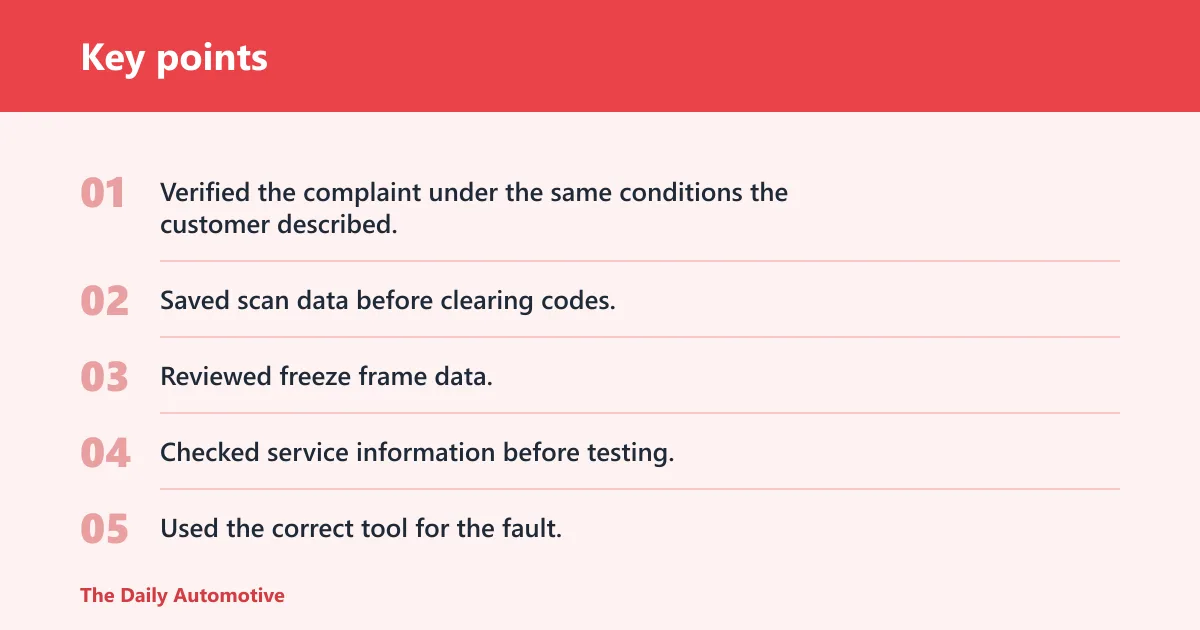
15-point technician self-audit checklist
- Verified the complaint under the same conditions the customer described.
- Saved scan data before clearing codes.
- Reviewed freeze frame data.
- Checked service information before testing.
- Used the correct tool for the fault.
- Confirmed root cause before replacing parts.
- Followed the repair procedure exactly.
- Used torque specs and angle tightening where required.
- Observed fastener reuse rules.
- Completed any required calibration or initialization.
- Confirmed the repair with a road test or functional test.
- Checked for returned codes or pending faults.
- Wrote clear RO notes with tests, results, and parts used.
- Updated the advisor with a customer-friendly summary.
- Closed the job with a clean bay and clear next-step status.
Score it
Give each item 1 point for yes and 0 for no. A score of 13 to 15 means the repair process was strong. A score of 10 to 12 means one step was weak. Below 10 means the job should be reviewed before the pattern turns into a comeback.
Apply this workflow to your next few RO’s
- RO 1: focus only on complaint verification.
- RO 2: add complete freeze frame review before clearing any codes.
- RO 3: document every test and result in the RO notes.
- RO 4: include a deliberate verification step, such as a road test or output check.
- RO 5: compare all five jobs and identify the step where errors repeat.
At the end of those five RO’s, look for the same failure point. If missed verification appears twice, fix that habit first. If notes are thin, make documentation the priority. Improvement becomes easier when the weak link is visible.
Frequently asked questions
Is being an automotive technician worth it?
It can be worth it if you want a skill-based career with clear feedback and room to improve. The work rewards accuracy, discipline, and continuous learning. Long-term value depends on whether you can build efficient habits, reduce comebacks, and keep pace with changing vehicle systems.
Is automotive technician a good career?
It can be a good career for people who like problem-solving and practical work. The best outcomes usually come from strong diagnostics, clean documentation, and steady training. The field keeps changing with software, ADAS, and EV systems, so ongoing learning is part of the job.
How do I reduce comebacks and repeat repairs?
Reduce comebacks by verifying the complaint, repairing the root cause, and confirming the fix under the same conditions that set the fault. Write notes that describe the test and the result, not just the part replaced. Most repeat repairs come from skipped verification or thin documentation.
Products related to this article
Sponsored / affiliate links. As an Amazon Associate I earn from qualifying purchases. I may earn additional commission from eligible campaigns.