Driver Attention Monitor Review: Is It Worth It?
Yes, driver attention monitoring is worth paying for only if you want a real safety aid and the price is modest; as a stand-alone option, it rarely pays off unless it adds hands-on-wheel detection, camera-based monitoring, or a broader safety package. Skip it, and you may end up with a system that nags at the wrong times, misses real distraction, or adds cost without reducing crash risk much. Here’s how these systems work, where they fall short, what regulations do and do not require, and when the option makes financial sense.
Driver attention monitor review: the trade-off
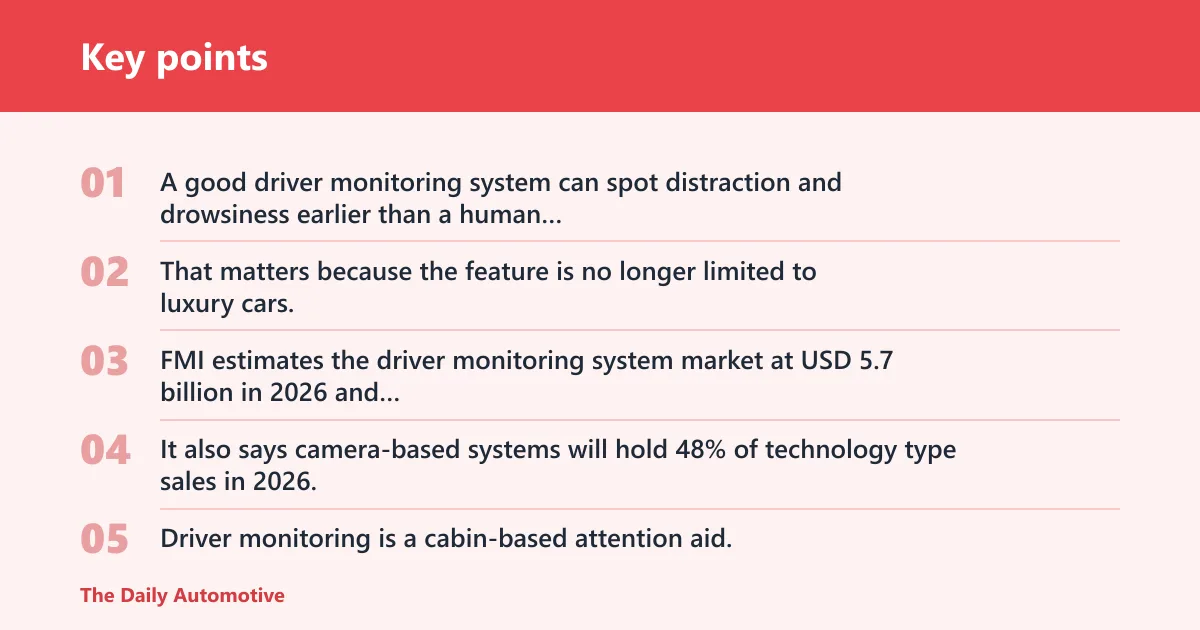


The trade-off is plain. A good driver monitoring system can spot distraction and drowsiness earlier than a human self-check, but a weak one can be too tolerant, too sensitive, or too dependent on how you sit and what you wear.
That matters because the feature is no longer limited to luxury cars. FMI estimates the driver monitoring system market at USD 5.7 billion in 2026 and forecasts USD 12.4 billion by 2036. It also says camera-based systems will hold 48% of technology type sales in 2026, passenger cars will account for 54% of 2026 vehicle-type sales, and distraction monitoring will hold an estimated 44% of application demand in 2026.
What the system detects
Driver monitoring is a cabin-based attention aid. In its better form, it watches head and eye movement, then looks for signs that you are not watching the road or that you are too drowsy to respond well. It usually warns with visual and/or audible alerts, and it is often bundled with other ADAS features.
Two jobs matter most. Distraction monitoring looks for attention loss during active driving. Drowsiness detection looks for sleepiness, slow reactions, or repeated signs that the driver may be losing alertness.
What it cannot fix
It does not make a bad driver good. It cannot stop a crash if the driver ignores repeated alerts, and it cannot make up for poor road judgment, bad weather, or a broken sensor setup.
A warning chime alone is not proof of a strong system. Camera placement, software logic, and how the car ties the feature into the rest of the safety stack matter more than the noise it makes.
Why the bundle matters
Driver monitoring is often bundled with lane-keeping support, emergency braking, and hands-off highway assist. That bundle can make the option worth paying for if the price gap is small. If the package is mostly filler, the value drops fast.
Hands-off highway assist usually depends on the cabin camera and the rest of the vehicle’s safety architecture. If the monitor is only there to keep the car’s own driving aid honest, you should judge the whole package, not the camera alone.
How driver monitoring works
Camera-based driver monitoring tracks the driver’s face, head position, and often eye movement. Steering-input systems estimate attention by watching steering corrections, wheel torque, or lane-keeping behavior. The first can see where you appear to be looking; the second infers attention from how the vehicle is being guided.
Camera-based DMS
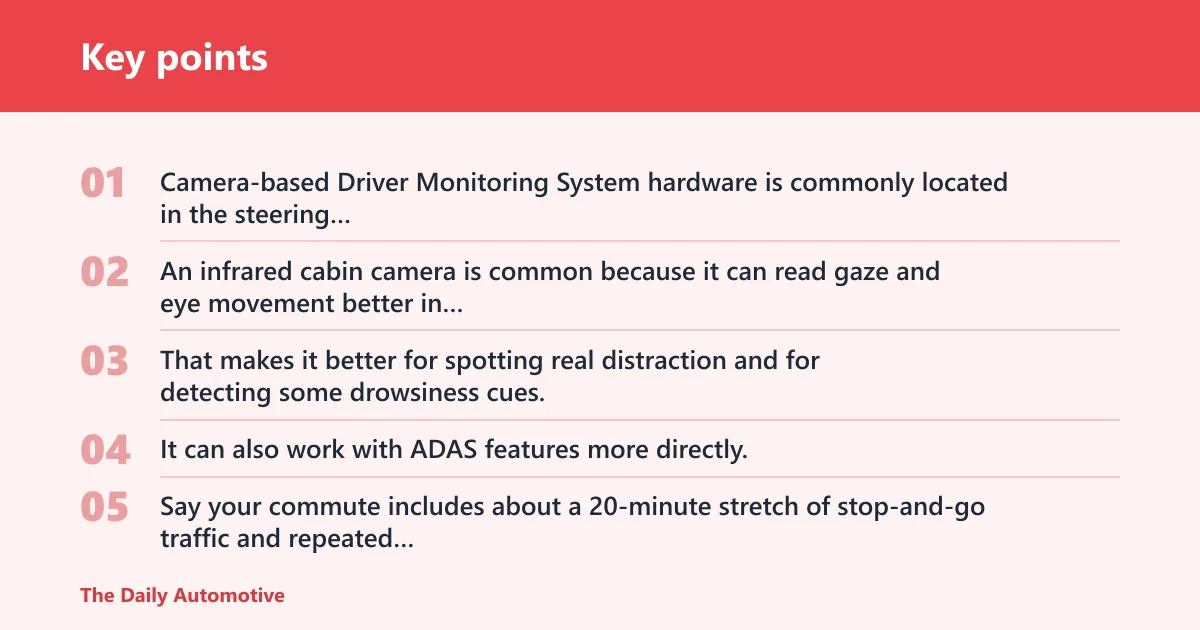
Camera-based Driver Monitoring System hardware is commonly located in the steering column or near the rearview mirror. An infrared cabin camera is common because it can read gaze and eye movement better in dim light than a visible-light camera.
That makes it better for spotting real distraction and for detecting some drowsiness cues. It can also work with ADAS features more directly, since the system can tell whether the driver is present, alert, and watching the road.
Say your commute includes about a 20-minute stretch of stop-and-go traffic and repeated phone prompts. A camera-based system is more likely to catch your eyes leaving the road than a steering-only system, especially if you are holding the wheel lightly and the car is still tracking its lane.
Steering-input approximation
Steering-input systems are simpler, and that simplicity is their weakness. They can miss distraction when the driver keeps the car centered with small corrections, and they can produce warnings when the driver is attentive but driving smoothly.
They are still useful as a lower-cost approximation. They can be better than nothing, especially if the car is older or the trim level does not justify a full camera setup.
Infrared cabin camera placement
Placement matters. A camera buried too low, blocked by the steering wheel, or aimed poorly can miss eye movement or lose track when the driver shifts posture. Sunglasses, hats, and a tilted seat can also confuse the system.
A common first-timer mistake is assuming any cabin camera equals good monitoring. If the camera cannot see the driver’s eyes cleanly, the alerts may come late or too often.
Driver attention decision table
Use this table to judge whether the feature fits your driving pattern. The best system type depends less on brand name and more on where you drive, how often you drive at night, and whether other family members will use the car.
| Use case | Worth paying for? | Best system type | Why it fits | One honest drawback |
|---|---|---|---|---|
| City commuting | Often yes | Camera-based DMS | Frequent stops, phone temptations, and low-speed congestion make distraction alerts useful. | False alerts can become annoying in busy traffic. |
| Highway driving | Yes, if bundled with highway assist | Camera-based DMS | Long, steady drives are where drowsiness detection matters most. | It is only as good as the cabin camera’s view of the driver. |
| Night driving | Often yes | Infrared camera-based DMS | Infrared cabin cameras are better suited to low-light monitoring. | Glasses, glare, or poor seating position can still reduce accuracy. |
| Sunglasses or hat use | Maybe | Steering-input approximation if budget is tight | Some camera systems struggle when eyes are hidden or the brow is shaded. | Steering-only systems are a weaker proxy for real attention. |
| Shared-family driving | Yes, if multiple drivers use the car | Camera-based DMS | It can adapt to different drivers and catch fatigue after long swaps. | Frequent seat changes can expose bad camera placement. |
What regulation is changing
Advanced Driver Distraction Warning, or ADDW, is the regulation-driven push behind much of this feature’s spread. In the EU, it is expected to become mandatory in all new vehicles sold from 7 July 2026, and it involves camera-based gaze monitoring for driver attention detection.
That rule matters because it changes how automakers spec cars. More models will ship with a cabin camera, more trims will bundle attention warnings with ADAS, and shoppers will see the feature outside premium segments.
Why adoption is spreading beyond luxury cars
Regulation is only part of the story. Passenger cars make up a large share of the market, and distraction monitoring is a major application for the technology. That combination pushes the feature into mainstream trim walks, not just top-line luxury packages.
Fewer cars will treat attention monitoring as a niche add-on. More will treat it as standard safety hardware, especially when the same camera can support hands-off highway assist and related warnings.
What the rule means for shoppers
- Expect more cars to include a cabin camera even in mid trims.
- Check whether the car uses real gaze monitoring or only steering-based inference.
- Ask where the warning appears and how loud the chime is.
- Confirm whether the system stays usable with your glasses, hat, or seating position.
Does it actually detect distraction and drowsiness?

Yes, but not equally well in every car. The best systems do detect distraction and drowsiness, yet their results depend on camera quality, camera angle, lighting, and whether the driver’s face is visible enough for the software to read it correctly.
Distraction alerts
Distraction detection is the cleaner use case. If your gaze leaves the road for too long, a camera-based system can react faster than a lane departure alarm or a simple wheel-torque monitor. That makes it useful in traffic, at intersections, and during routine commuting.
Drowsiness detection
Drowsiness detection is harder. The system may look for eye closure, head nods, or repeated signs that attention is fading. It is helpful on long highway drives, but it is not a perfect substitute for rest.
Suppose a driver takes about a 90-minute night trip after a full workday. A good camera-based monitor may flag the driver before lane drifting becomes obvious. A steering-input system may stay quiet until the vehicle begins to wander.
False alerts and sensor limits
Sunglasses, a brimmed hat, heavy side lighting, or a camera mounted at a poor angle can trigger false warnings or missed warnings. That is why the cabin camera’s placement matters so much.
Older drivers managed without this tech for decades. That does not make the feature useless; it means the real question is whether a specific system helps enough to justify its cost and its failure points.
What should you look for in a good system?
Look for a true camera-based Driver Monitoring System if the car will be used often, especially for commuting or highway trips. Then check where the camera is mounted, what kind of alerts it uses, and whether the system is tied into other safety features that you actually want.
Camera placement and gaze tracking
Prefer a system with a clearly positioned infrared cabin camera that has a direct view of the driver’s face. That setup is more likely to read gaze and eye movement reliably, especially at night.
If the vehicle hides the camera behind trim, places it too low, or aims it awkwardly, treat that as a warning sign. A good spec sheet can still hide a poor field of view.
Warning type and chime volume
Check where the warning light appears and how loud the chime is. A warning buried in the cluster or a chime you cannot hear over road noise is less useful than a clear, well-timed alert.
Integration with lane-keeping and emergency braking
Bundled systems can be worth more than standalone ones if they share data with lane-keeping, emergency braking, and hands-off highway assist. That is where the added cost can make sense.
But the bundle still has to be judged on its own terms. If the extra package mostly adds features you will not use, the price may outrun the benefit.
Choose camera-based systems if… / Choose steering-input systems if…
Choose camera-based monitoring if you drive often, drive at night, share the car with other family members, or want the strongest attention check the market can offer. Choose steering-input systems if you want a lower-cost safety aid, your budget is tight, or the car you want only offers a basic approximation.
Best fit for camera-based DMS
- You want real gaze and head-movement tracking.
- You drive long highway routes or late at night.
- You want the feature to work with broader ADAS.
- You are comparing trim packages and the price jump is modest.
Best fit for steering-input systems
- You want some warning support without paying for a camera stack.
- You are shopping an older or lower-trim vehicle.
- You mainly want a backup alert, not a full attention monitor.
- You can accept weaker detection of true distraction.
Frequently asked questions
What is a driver attention monitor and how does it work?
A driver attention monitor is a cabin-based safety aid that watches for distraction or drowsiness. Better systems use a camera to track head and eye movement; simpler ones infer attention from steering input. Both can trigger visual or audible warnings, but camera-based systems are more precise.
Is driver attention monitoring worth it on a new car?
It is worth paying for when the price is modest and the system is camera-based or bundled with useful ADAS. If the feature is only a steering-input approximation, or if the package adds little beyond a warning chime, the value is weaker.
Does driver monitoring actually detect drowsiness or distraction?
Yes, though not perfectly. Distraction is usually easier to detect because the camera can see where attention goes. Drowsiness detection is harder and more dependent on lighting, seating position, and whether the system can still read the driver’s face clearly.
What features should I look for in a good driver monitoring system?
Look for an infrared cabin camera, a clear view of the driver’s face, real gaze tracking, and alerts that are easy to hear and see. Also check whether the system is camera-based or only steering-based, and whether it integrates with lane-keeping or emergency braking.
Can driver monitoring help if I drive mostly on highways or in heavy traffic?
Yes. Highway driving is where drowsiness detection matters most, and heavy traffic is where distraction alerts can matter most. In both cases, a camera-based system is preferable because it can monitor the driver directly rather than guessing from steering behavior.
Which cars offer driver attention monitoring as standard equipment?
More cars offer it now than before, especially as regulation pushes it into mainstream models. In the EU, ADDW will be mandatory in all new vehicles sold from 7 July 2026, so standard fitment will keep spreading beyond luxury cars and into more passenger vehicles.
Products related to this article
Sponsored / affiliate links. As an Amazon Associate I earn from qualifying purchases. I may earn additional commission from eligible campaigns.