How to Get an Automotive Repair Shop License
You usually need zoning approval first, then city or county business licensing, state tax registration, environmental permits for waste oil or hazardous materials, and EPA refrigerant compliance if you service A/C. Miss one step and your shop can face delays, fines, or a shutdown before opening. This guide lays out the licensing order, names the agencies involved, and points to the most common application failures.
What license do you need to open a mechanic shop?
There is generally no single national mechanic shop license. Starting an auto repair shop involves 10 connected steps, and step 5 is obtaining permits and licenses. The approvals split into federal, state, county, and city layers, so the right order matters as much as the forms themselves.
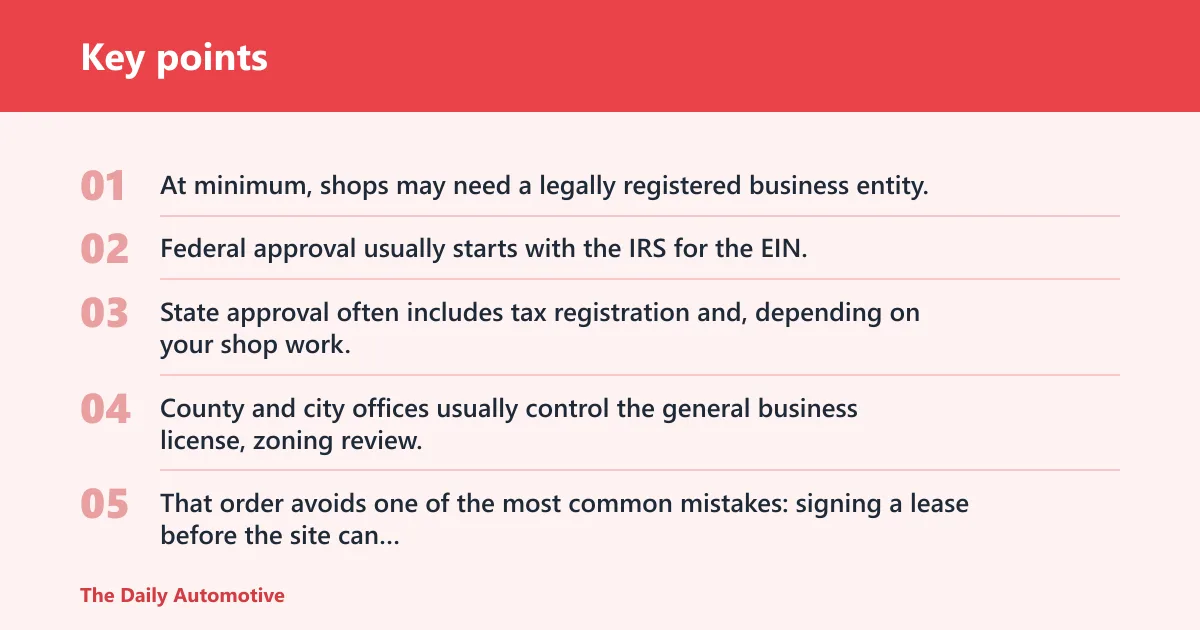
At minimum, shops may need a legally registered business entity, an Employer Identification Number, local operating approval, a Certificate of Occupancy, state tax registration if parts or tires are sold, and environmental approvals for waste streams such as oil, batteries, and tires. In many cases, zoning comes first.
Separate the approval layers before you apply
Federal approval usually starts with the IRS for the EIN. State approval often includes tax registration and, depending on your shop work, environmental rules for waste handling. County and city offices usually control the general business license, zoning review, and occupancy approval.
That order avoids one of the most common mistakes: signing a lease before the site can legally operate as an auto repair use.
📊 Starting an auto repair shop involves 10 connected steps. Source: Autoleap.
How do I get an automotive repair shop license?
You get it by stacking approvals in the right order, not by filing one form. Start with the legal entity, get the EIN, confirm zoning, secure the lease only if the site fits repair use, then apply for the local business license, occupancy approval, tax registration, and waste permits that match your services.
For a one-bay shop, the list can be shorter, but the order stays the same. A larger facility usually faces more parking, staffing, fire-safety, and environmental review because more vehicles, fluids, and stored parts change the risk profile.
Use this order
- Choose and register the legal structure.
- Get the EIN from the IRS website.
- Check zoning and use approval for the site.
- Apply for the general business license.
- Obtain the Certificate of Occupancy after building review.
- Register for sales tax if you sell parts or tires.
- Apply for environmental permits tied to waste handling.
Set up the business entity
The business should be registered as a legal entity before opening. Common choices include a sole proprietorship, partnership, or limited liability company. The choice affects liability, tax filings, and which registration documents you need for city, county, and state offices.
That step matters before you file permits because many applications ask for the exact legal name, owner details, and tax ID tied to the shop. If the entity name changes later, some offices require updates or amended filings.
Get the EIN from the IRS
You should usually apply for an Employer Identification Number through the IRS website before opening bank accounts or submitting many permit applications. The EIN is used for tax filings, bank accounts, and other permits, and the confirmation letter can be received instantly.
Say your shop is an LLC with one service bay and a planned parts counter. The city may still ask for the EIN on the business license form, and the state may want it on tax registration before it issues a seller account.
Check zoning and location first
Check zoning before you sign a lease or buy equipment. A site can fail later if the zoning district does not allow auto repair, if parking is short, or if the building layout cannot support the intended use. That is a costly problem once tools, lifts, and compressors are already ordered.
A Certificate of Occupancy is issued after a building safety review and confirms compliance with building codes. It is required before using the building for business operations. If the space was once a retail store or warehouse, you may need a new review before a repair shop can move in.
One-bay shops and larger facilities are not treated the same
A one-bay mechanic shop can face a lighter parking load and fewer employee-related conditions, but the occupancy review still matters. Larger repair facilities may trigger stricter fire access, customer parking, ventilation, and waste storage standards because the building holds more vehicles, more staff, and more materials.
A common first-timer mistake is leasing a building that looks ready, then learning the site cannot pass occupancy for repair use without costly work. That delay often shows up only after the lease is signed.
Do you need a general business license for an auto repair shop?
A general business license is usually required by the city or county before opening. It is the basic local operating permit, and it often comes before signage permits and some insurance steps. The fee is usually about $50 to $500, depending on the local office and business classification.
This permit is not the same as the EIN or sales tax registration. It is the local permission to do business at a named location, and it may ask for the legal entity, federal tax ID, lease information, and zoning confirmation.
Common reasons local applications fail
- Zoning mismatch between the address and repair use.
- Missing lease or property-owner authorization.
- Unresolved building code issues.
- Wrong business name or entity details.
- Applying before the site can pass occupancy review.
Licensing checklist table
| Approval type | Issuing authority | When to apply | Typical document needed | Common failure reason |
|---|---|---|---|---|
| EIN | IRS | Before bank setup and permit filing | Business legal name and owner details | Mismatched entity name |
| General business license | City or county | After entity setup and zoning check | Entity papers, EIN, location address | Zoning mismatch or missing location approval |
| Certificate of Occupancy | Local government after building safety review | Before operating from the building | Inspection request and site plans | Building code or fire-safety defects |
| Sales tax permit | State revenue department | Before selling parts or tires | Entity info, EIN, business address | Not registering before invoicing taxable items |
| Environmental permits | State or local environmental agency | Before handling regulated waste | Waste handling and storage plan | Improper disposal or storage plan |
Do you need sales tax registration?
Sales tax registration is often needed if auto parts or tires are sold. A sales tax permit is needed in that case, and it is usually obtained through the state revenue website. After approval, you can charge sales tax on invoices for taxable items, while labor may be treated differently depending on the state.
Do not confuse this with the general business license. A city can approve local operation while the state still expects a separate seller registration for retail parts. If you skip this step, tax collection problems can start on the first invoice.
Picture a shop that opens with tire sales on day one but never registers for sales tax. The customer invoices look normal, but the state can treat the missing permit as a filing error and assess back tax, penalties, or both.
What environmental permits apply?
Environmental permits are needed for waste disposal like used oil and old tires, and they may also apply to fluids, filters, batteries, and similar waste streams. EPA small business environmental guidance matters here because storage, labeling, and disposal errors can turn routine shop waste into a compliance problem.
The main issue is not only hauling trash away. Used oil, oily filters, batteries, and tire piles can trigger storage and disposal rules that normal municipal trash pickup does not cover. Improper disposal is a common reason shops get cited early.
What to control on day one
- Separate used oil from normal trash.
- Store batteries and fluids in approved containers.
- Track pickup records for regulated waste.
- Keep tires out of ordinary trash streams.
- Confirm whether refrigerant handling adds another compliance step.
How much will it cost?

Startup costs are estimated at $70K to $150K+. The total depends on location, equipment, and staffing, so a downtown site with a lift and more employee capacity can cost far more than a small neighborhood bay with limited service lines. Compliance costs sit inside that budget, not outside it.
The license and permit stack is usually smaller than the equipment bill, but it still needs a line item. The general business license is around $50 to $500, while occupancy review, tax registration, entity filing, and environmental compliance can add more depending on the city and state.
Plan financing around timing. If you need a lease deposit, buildout, equipment deposits, and permit waits at the same time, cash runs thin fast. A lender or investor will usually want to see the business plan, expected services, target audience, and marketing approach before approving funds.
What the business plan should cover
The plan should define the services, capital needs, target audience, and marketing approach. It also helps set success measures during shop setup, because the permit path often changes with the type of work you offer, such as brakes only, general repair, or tire and parts sales.
Frequently asked questions
What permits and licenses are required to start an auto repair shop?
You usually need a legally registered business entity, an EIN, a general business license, zoning approval, a Certificate of Occupancy, sales tax registration if you sell parts or tires, and environmental permits for waste streams. Some shops also need additional fire, building, or refrigerant-related approvals depending on services.
Do I need an EIN before opening a mechanic shop?
Yes, in most cases you should get the EIN before opening bank accounts and before filing many permits. The IRS website issues it, and confirmation can arrive instantly. It is one of the first filings because later applications often ask for it directly.
Do auto repair shops need a Certificate of Occupancy?
Yes. A Certificate of Occupancy is issued after a building safety review and confirms the site can be used for business operations. If the property was not already approved for repair use, the city or county may require corrections before the certificate is issued.
What environmental permits does an auto repair shop need?
That depends on the waste your shop generates, but used oil, old tires, batteries, filters, and fluids are the usual triggers. EPA small business environmental guidance applies to storage and disposal practices, and many shops need state or local approvals for hauling or handling regulated waste.
How much does it cost to get the required business license?
The general business license fee is around $50 to $500 in many local jurisdictions. That fee is only one part of the full budget, because entity registration, occupancy review, tax registration, waste compliance, and buildout costs can easily exceed the permit fee itself.
Products related to this article
Sponsored / affiliate links. As an Amazon Associate I earn from qualifying purchases. I may earn additional commission from eligible campaigns.