
Is A Dodge Charger A Sports Car
Many car fans wonder Is a Dodge Charger a Sports Car?. It can be a bit tricky because it looks sporty and fast, but sometimes people aren’t sure if it fits the sports car label. This is a common question, especially for folks just getting into cars.
Don’t worry, we’ll break it down simply, step by step, so you can get a clear answer. Let’s find out what makes a car a sports car and how the Charger measures up.
What Makes a Sports Car
Defining a sports car can be more about what a car does and how it feels to drive than just its looks. A sports car is typically built for speed, quick handling, and an exciting driving experience. These cars often have powerful engines, are lightweight, and have a low center of gravity to stick to the road.
The focus is on performance and driver engagement, making every trip feel a bit more thrilling. We’ll explore the key features that car makers use to classify their vehicles.
Performance Metrics
Performance metrics are key numbers that tell us how well a car performs. For sports cars, these numbers are usually very good. We look at things like how fast the car can go from zero to sixty miles per hour, its top speed, and how well it brakes.
These figures show how powerful the engine is and how well the car is engineered for speed.
Acceleration This is how quickly a car can speed up. A fast acceleration means the car can reach high speeds in a short amount of time. Sports cars are known for rapid acceleration, often achieved through powerful engines and efficient transmissions. For example, a sports car might go from 0 to 60 mph in under 5 seconds, making it feel very quick.
Top Speed This is the maximum speed a car can achieve. Sports cars are designed to reach high speeds safely. While not always practical for everyday driving, a high top speed indicates the car’s engineering for performance. Many sports cars can exceed 150 mph, showing their capability for speed.
Braking Performance How quickly a car can stop is just as important as how fast it can go. Sports cars have advanced braking systems, often using larger discs and high-performance pads. This allows them to slow down rapidly and safely, especially after high-speed driving. Good braking is crucial for control and driver confidence.
Handling and Agility
Handling and agility refer to how a car responds to steering and how easily it can change direction. Sports cars are built to be nimble and precise. They feel connected to the road, allowing the driver to make sharp turns with confidence.
This is achieved through careful design of the suspension, steering, and chassis.
Suspension System The suspension connects the wheels to the car’s body. In sports cars, it’s usually tuned to be firm. This helps reduce body roll during turns, keeping the car more level. A firm suspension means less leaning when you go around corners, providing a more stable and responsive feel.
Steering Response How quickly and accurately the car turns when you move the steering wheel is its steering response. Sports cars have direct and responsive steering. This makes the car feel like an extension of the driver’s will. A quick steering response means small movements of the wheel result in immediate changes in direction.
Weight Distribution The way a car’s weight is spread out affects its balance. Sports cars often have a near 50/50 weight distribution between the front and rear. This balance helps with traction and handling. It allows the car to feel more predictable and stable when cornering.
Design and Aerodynamics
The way a sports car looks and how air flows around it also plays a big role. Sports cars often have a sleek, low profile. This design isn’t just for looks; it helps the car move through the air efficiently.
Aerodynamics helps with both speed and stability.
Low Profile Body Sports cars typically have a low-slung body. This reduces air resistance and lowers the center of gravity. A lower center of gravity makes the car more stable, especially at high speeds and during turns. It contributes to the car’s sporty appearance as well.
Aerodynamic Features Features like spoilers, diffusers, and splitters are common on sports cars. These parts are designed to manage airflow. They can increase downforce, which pushes the car onto the road for better grip. Some designs also help cool the engine and brakes more effectively.

Is a Dodge Charger a Sports Car
Now, let’s look at the Dodge Charger and see if it fits the definition of a sports car. The Charger is known for its powerful engines and aggressive styling, which many people associate with sports cars. It has a strong presence on the road and offers high-performance variants that can achieve impressive speeds.
However, its size and weight sometimes lead to debate.
Engine Power and Performance
The Dodge Charger is famous for its powerful V8 engines. These engines deliver a lot of horsepower and torque, giving the car strong acceleration. Models like the Hellcat and Redeye are among the most powerful production cars ever made, with horsepower figures reaching over 700.
This raw power is certainly a hallmark of many sports cars.
Horsepower Figures The Charger offers a wide range of engines, from more modest V6 options to monstrous V8s. High-end models boast power levels comparable to or exceeding many dedicated sports cars. For instance, the SRT Hellcat can produce 707 horsepower. This level of power is designed for thrilling performance.
Torque Output Torque is the rotational force that helps a car accelerate from a stop or climb hills. Chargers, especially those with V8 engines, have very high torque figures. This means they can launch off the line with incredible force. This strong pull is a key part of the exciting driving experience.
Acceleration Times While perhaps not always as sharp as smaller, lighter sports cars, Charger variants offer very competitive acceleration. Some models can reach 60 mph in the low 3-second range. This performance is certainly in the sports car category.
Size and Weight
One of the main points of discussion when asking Is a Dodge Charger a Sports Car? is its size and weight. The Charger is a full-size sedan, meaning it’s longer and heavier than most traditional sports cars.
This larger footprint can affect its agility in tight corners compared to smaller, lighter competitors.
Vehicle Class The Charger is officially classified as a full-size sedan or a muscle car. Sedans are typically designed for comfort and passenger space, while muscle cars emphasize straight-line speed and power. Sports cars, on the other hand, often prioritize nimbleness and handling on twisty roads.
Curb Weight Sports cars are often built with lightweight materials to improve performance. The Charger, due to its size and features like a full back seat and trunk, has a higher curb weight. Some Charger models can weigh over 4,500 pounds. This weight can influence its agility and braking distances.
Chassis Design While modern Chargers have advanced chassis and suspension, their design is based on a platform that accommodates a larger vehicle. This can limit the degree of sports car-like handling compared to cars built from the ground up as pure sports cars with a lower stance and lighter construction.
Handling Characteristics
Chargers offer impressive handling for their size, especially in their performance trims. Engineers have worked hard to make them corner well and feel stable. However, the laws of physics regarding weight and size mean they might not feel as precise as a smaller, lighter sports car.
Cornering Ability Performance models of the Charger, equipped with sport-tuned suspensions and wider tires, can handle corners with considerable grip. The car feels planted and capable on winding roads. However, its larger size means it might lean a bit more than a compact sports car during aggressive cornering.
Ride Comfort Sedans often prioritize ride comfort for everyday driving. The Charger balances performance with a relatively comfortable ride for a car with its performance capabilities. This means it’s not as stiff as some track-focused sports cars, making it more practical for daily use.
Driver Engagement The driving experience in a high-performance Charger is certainly engaging. The powerful engine, responsive steering, and sporty feel behind the wheel create excitement. For many, this level of engagement, combined with its power, is enough to consider it a sports car.
The Muscle Car vs. Sports Car Debate
The line between muscle cars and sports cars can be blurry. Historically, muscle cars focused on straight-line acceleration with large engines, while sports cars emphasized cornering and handling. Modern interpretations often blend these characteristics.
The Dodge Charger, with its powerful engines and rear-wheel-drive layout, embodies many muscle car traits.
Historical Context Muscle cars emerged in the 1960s, characterized by powerful V8 engines in mid-size coupes, built for drag racing. Sports cars, on the other hand, have a longer history and have always focused more on a balance of speed, handling, and driver feedback.
Performance Focus Today, the distinction is less strict. Many vehicles offer attributes of both. The Charger’s ability to accelerate quickly and its sporty styling lean towards sports car territory. However, its roots and dimensions are firmly in the muscle car segment.
Marketing and Perception Car manufacturers and consumers often decide what a car “is” through marketing and public perception. Dodge markets the Charger as a performance sedan with muscle car DNA. This positioning influences how people view its place in the automotive spectrum.
Comparing the Charger to Traditional Sports Cars
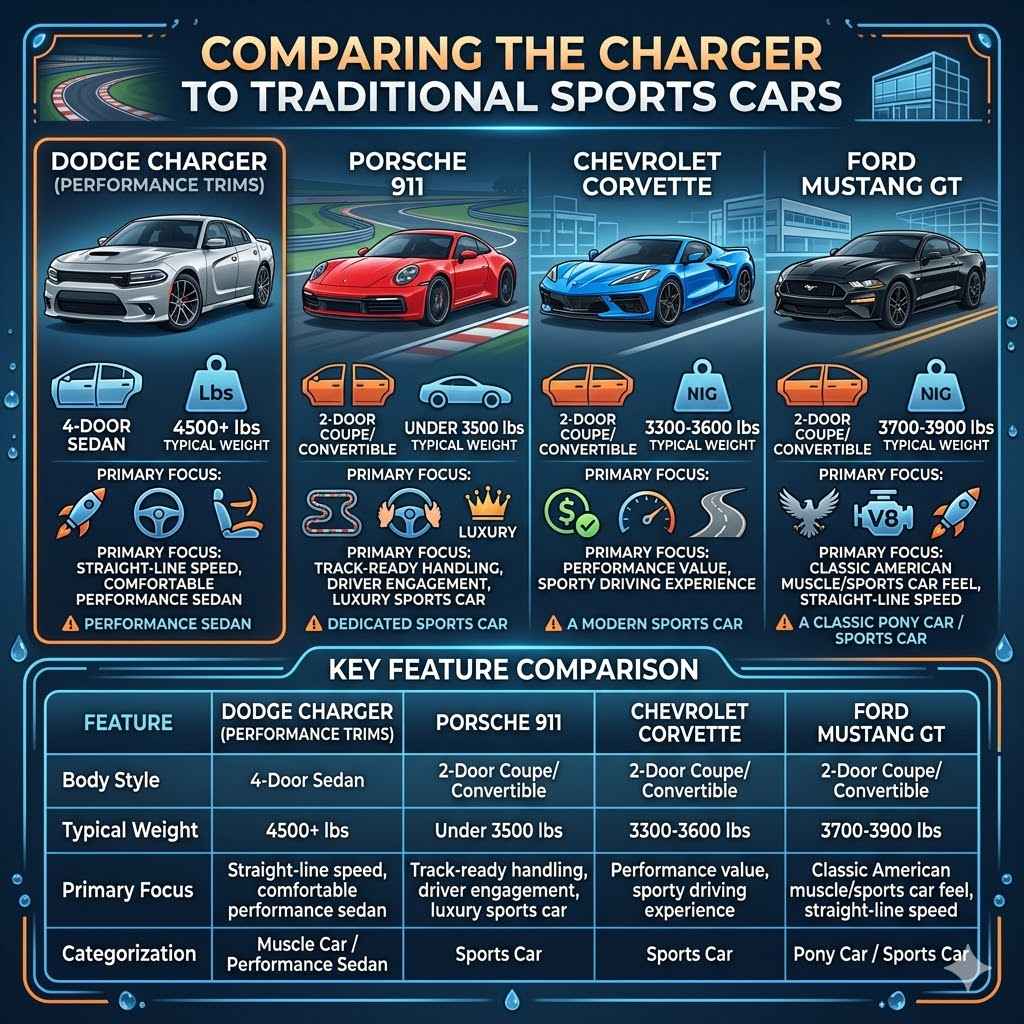
To truly answer Is a Dodge Charger a Sports Car?, it’s helpful to compare it directly with cars widely accepted as sports cars. Think about vehicles like a Porsche 911, a Chevrolet Corvette, or even a Ford Mustang GT. These cars are often lighter, more compact, and designed with a specific focus on dynamic driving and handling.
Porsche 911
The Porsche 911 is a benchmark for sports cars. It features a rear-engine layout for exceptional balance, a low center of gravity, and precise handling. Its focus is almost entirely on driving dynamics and performance, with less emphasis on passenger comfort or cargo space.
Engine Placement The 911’s rear-engine design provides unique handling characteristics and weight distribution. This contributes to its distinctive feel and exceptional traction out of corners.
Size and Weight The 911 is significantly smaller and lighter than the Charger, typically weighing under 3,500 pounds. This difference is crucial for agility and responsiveness on winding roads.
Driving Experience Porsche 911s are renowned for their raw, connected driving experience. Every input from the driver is met with immediate and precise feedback from the car, making it feel like an extension of the driver.
Chevrolet Corvette
The Chevrolet Corvette is another iconic sports car, known for its performance value. It has a front-engine, rear-wheel-drive setup (though recent models have moved to a mid-engine design). It prioritizes speed, handling, and a sporty aesthetic, often at a price point more accessible than some European exotics.
Body Style Traditionally a two-door coupe or convertible, the Corvette offers a classic sports car silhouette. The Charger’s four-door sedan body is a significant difference in terms of its intended use and classification.
Performance Focus The Corvette is engineered for sports car performance, with powerful engines and chassis tuned for dynamic driving. Its lighter weight compared to the Charger also aids in its athletic capabilities.
Target Audience While both are performance vehicles, the Corvette targets buyers seeking a dedicated sports car experience, whereas the Charger appeals to a broader audience looking for performance in a more practical sedan package.
Ford Mustang GT
The Ford Mustang GT is often compared to the Charger as they are both American performance cars with V8 engines. However, the Mustang is typically a two-door coupe or convertible and is generally lighter and more compact than the Charger sedan. This makes it lean more towards a traditional sports car or pony car persona.
Number of Doors The Mustang is primarily a two-door vehicle, aligning more with the typical sports car form factor than the four-door Charger. This affects its overall proportions and perceived sportiness.
Weight and Dimensions While also a powerful car, the Mustang GT is generally lighter and has smaller overall dimensions than the Charger sedan. This can translate to more agile handling and a more nimble feel in corners.
Categorization The Mustang is often categorized as a “pony car” or a sports car, whereas the Charger is most commonly labeled as a “muscle car” or a “performance sedan.” These distinctions highlight their differing design philosophies.
| Feature | Dodge Charger (Performance Trims) | Porsche 911 | Chevrolet Corvette | Ford Mustang GT |
|---|---|---|---|---|
| Body Style | 4-Door Sedan | 2-Door Coupe/Convertible | 2-Door Coupe/Convertible | 2-Door Coupe/Convertible |
| Typical Weight | 4500+ lbs | Under 3500 lbs | 3300-3600 lbs | 3700-3900 lbs |
| Primary Focus | Straight-line speed, comfortable performance sedan | Track-ready handling, driver engagement, luxury sports car | Performance value, sporty driving experience | Classic American muscle/sports car feel, straight-line speed |
Conclusion on Is a Dodge Charger a Sports Car
So, Is a Dodge Charger a Sports Car? It’s complicated, but most would say it’s more of a muscle car or a performance sedan. It has the power and speed that sports cars boast, especially in its high-performance versions.
The Charger offers thrilling acceleration and a commanding road presence. However, its larger size and heavier weight mean it doesn’t quite match the agility and pure handling dynamics of dedicated sports cars. It offers a unique blend of muscle car might and everyday usability.
Frequently Asked Questions
Question: Can a Dodge Charger be considered a sports car if it has a powerful engine?
Answer: Having a powerful engine is a key trait of sports cars, and the Charger certainly has those. However, the definition of a sports car also includes factors like lightweight construction and nimble handling, which the Charger might not fully match due to its size.
Question: Is the Dodge Charger a muscle car or a sports car?
Answer: Most people consider the Dodge Charger to be a muscle car or a performance sedan. It’s known for its powerful engines and straight-line speed, which are classic muscle car characteristics.
Question: Does the Charger handle as well as a sports car?
Answer: Performance versions of the Charger handle very well for a large car. They offer good grip and stability, but they may not feel as sharp or agile in tight corners as smaller, lighter vehicles that are designed purely as sports cars.
Question: Why is the Charger’s size a factor in calling it a sports car?
Answer: Sports cars are often built to be smaller and lighter to improve their ability to change direction quickly and feel more connected to the road. The Charger’s larger dimensions and higher weight mean it behaves differently during aggressive maneuvers.
Question: Can a four-door car be a sports car?
Answer: While most traditional sports cars are two-door vehicles, there are exceptions. Some four-door cars offer high performance and sporty driving dynamics, but they are often categorized differently, like performance sedans or grand tourers, to acknowledge their practicality.
Final Thoughts
The Dodge Charger offers incredible power and a thrilling driving experience, much like a sports car. It excels in acceleration and straight-line speed. However, its larger build and weight mean it doesn’t offer the same sharp handling as many dedicated sports cars.
It’s a fantastic muscle car that delivers performance in a practical package.