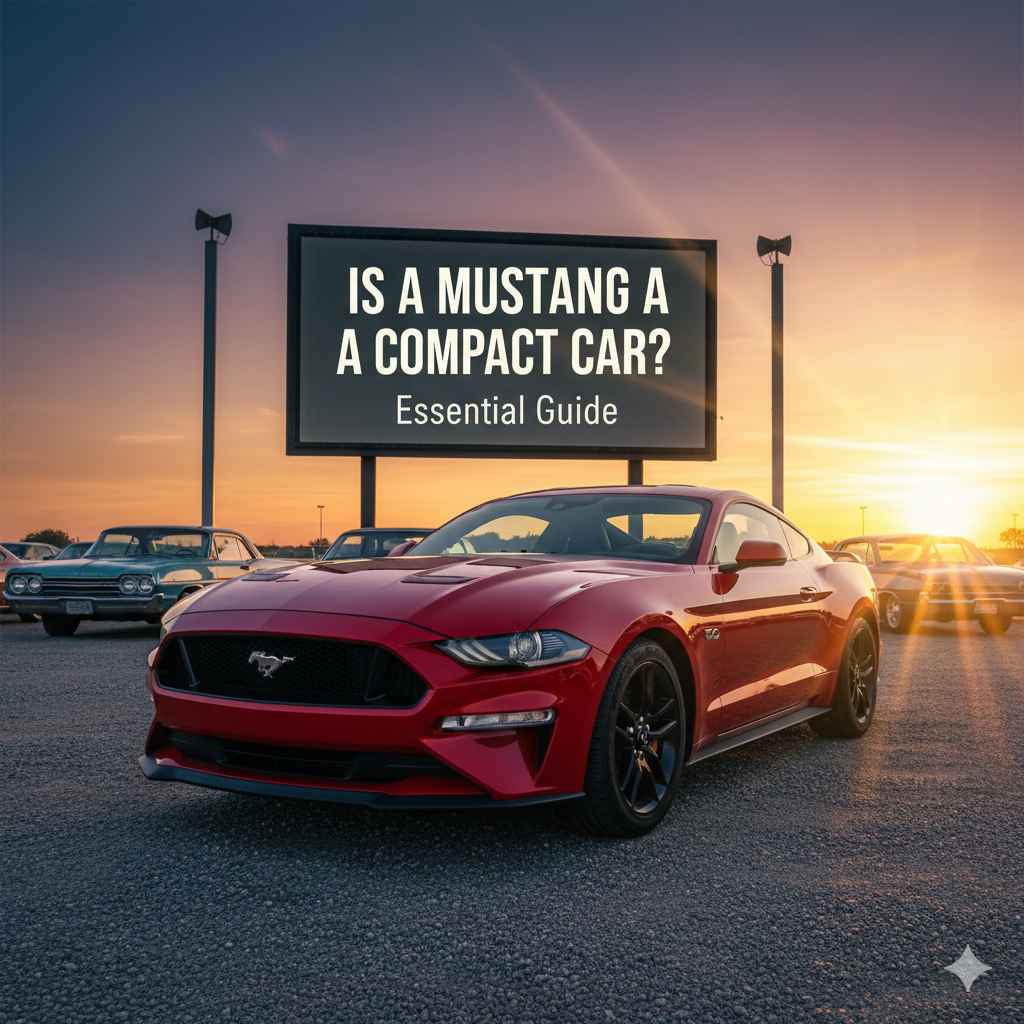
Is A Mustang A Compact Car: Essential Guide
No, a Ford Mustang is not a compact car. It’s a classic American “pony car,” known for its sporty design and performance. Compact cars are generally smaller, more fuel-efficient, and designed for everyday practicality, which isn’t the Mustang’s primary focus.
Thinking about buying a Ford Mustang or just curious about what makes it tick? You might wonder: “Is a Mustang a compact car?” It’s a fair question, especially when you see so many different types of cars on the road. Sometimes, car names can be a bit confusing, and the Mustang definitely stands out from the crowd.
But don’t worry! Understanding where the Mustang fits in the automotive world is simpler than you might think. We’re here to break down exactly what a Mustang is, how it compares to other car types, and what makes it such a beloved icon. You’ll get a clear picture by the end of this guide, helping you make informed decisions or just satisfy your automotive curiosity.
What Exactly is a Ford Mustang?
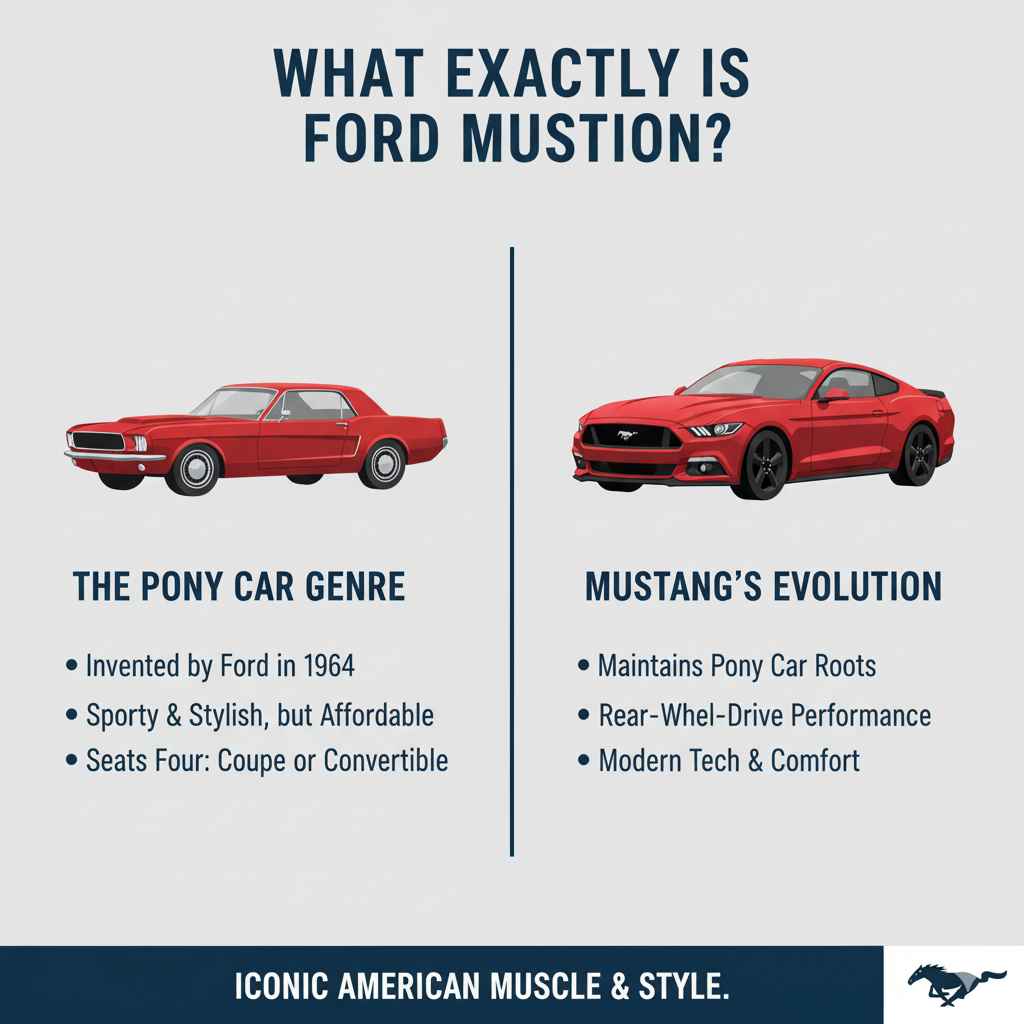
The Ford Mustang is best described as a “pony car.” This is a specific American automotive genre that Ford pretty much invented with the very first Mustang in 1964. The idea was to create a car that was sporty and stylish, more affordable than a traditional sports car, and could comfortably seat four people. It offered a long hood, a short rear deck, and a powerful engine, all wrapped up in an attractive package.
Over the decades, the Mustang has evolved, but it has always stayed true to its pony car roots. It’s known for its distinctive styling, rear-wheel-drive setup, and a focus on performance and driving excitement. While modern Mustangs have grown slightly in size and incorporate more technology for safety and comfort, their core identity remains that of a stylish, performance-oriented coupe or convertible.
Defining Different Car Types
To truly understand if a Mustang is a compact car, we need to know what defines different car categories. Automakers and enthusiasts use these classifications to help consumers understand the general size, purpose, and characteristics of various vehicles.
Compact Cars
Compact cars are typically smaller vehicles designed for efficient everyday use. They prioritize fuel economy, maneuverability in urban environments, and affordability. They usually have a two-box or three-box configuration, seating for four to five passengers, and a focus on utility over outright performance.
Key characteristics of compact cars include:
- Size: Shorter wheelbase and overall length compared to larger sedans or SUVs.
- Engine: Generally smaller, more fuel-efficient engines (often 4-cylinder).
- Interior Space: Designed for practicality, with adequate but not luxurious passenger and cargo space.
- Price: Often one of the most affordable new car segments.
- Examples: Honda Civic, Toyota Corolla, Mazda3, Hyundai Elantra.
Mid-Size Cars
Mid-size cars are a step up from compacts, offering more interior space, comfort, and often more powerful engine options. They are a popular choice for families and individuals who need a balance of practicality and comfort for daily driving and longer trips.
Key characteristics of mid-size cars:
- Size: Longer wheelbase and overall length than compacts.
- Engine: Typically offer a choice of 4-cylinder or V6 engines.
- Interior Space: More legroom and shoulder room for passengers, larger trunk space.
- Comfort: Often feature more premium amenities and a smoother ride.
- Examples: Toyota Camry, Honda Accord, Ford Fusion (discontinued but a good reference), Chevrolet Malibu.
Sports Cars
Sports cars are all about performance, handling, and an engaging driving experience. They often have two doors, a sleek aerodynamic design, powerful engines, and sophisticated suspension systems. While some sports cars can be small, the defining factor is their sporting intent.
Key characteristics of sports cars:
- Performance: Emphasis on acceleration, braking, and cornering abilities.
- Design: Aerodynamic, low-slung bodies, often with two seats or a 2+2 configuration (two small rear seats).
- Handling: Tuned for responsive steering and a connected feel to the road.
- Engine: Powerful engines are common, prioritizing performance over fuel efficiency.
- Examples: Porsche 911, Chevrolet Corvette, Mazda MX-5 Miata, Nissan Z.
Pony Cars
This is where the Mustang proudly sits! Pony cars emerged in the 1960s as a distinct American category. They are essentially sporty, affordable, personal cars with a focus on style and performance, often featuring a long hood and a short deck lid, and typically with seating for four.
Key characteristics of pony cars:
- Style: Distinctive, sporty, and often aggressive styling.
- Performance: Offered powerful V8 engine options from the start, emphasizing acceleration.
- Seating: Usually a 2+2 seating configuration (two comfortable front seats, two smaller rear seats).
- Price: Intended to be more accessible than traditional European sports cars.
- The “Originals”: Ford Mustang, Chevrolet Camaro, Dodge Challenger, Pontiac Firebird.
Is a Mustang a Compact Car? A Direct Comparison
Now let’s directly compare the Ford Mustang to the typical characteristics of a compact car. This will make it crystal clear.
Size and Dimensions
Compact cars are defined by their smaller exterior dimensions. They are generally easier to park in tight spots and navigate busy city streets. The Mustang, while not a massive vehicle, is designed with a longer wheelbase and overall length to accommodate its performance-oriented drivetrain and styling.
Let’s look at some general dimensions. Keep in mind that these can vary slightly between model years and specific trims. We’ll use a recent model Mustang (e.g., the S550 generation) and a popular compact car for comparison.
| Vehicle | Overall Length (inches) | Wheelbase (inches) | Width (inches, excluding mirrors) | Height (inches) |
|---|---|---|---|---|
| Ford Mustang GT (Recent Model) | 188.3 | 107.0 | 75.4 | 54.9 |
| Honda Civic Sedan (Recent Model) | 184.0 | 107.9 | 70.9 | 55.7 |
| Toyota Corolla Sedan (Recent Model) | 182.3 | 106.3 | 70.1 | 56.5 |
As you can see from the table, while the Mustang and compact cars can have similar wheelbases, the Mustang is significantly wider and generally longer overall. This wider stance contributes to its sportier handling, but it’s a clear difference from the more compact footprint of a Civic or Corolla.
Engine and Performance
This is one of the biggest differentiators. Compact cars typically come with smaller, fuel-efficient 4-cylinder engines. Their goal is to provide adequate power for daily driving while maximizing miles per gallon. The Ford Mustang, on the other hand, is famous for its powerful engine options, which historically have been V6 and, more iconically, V8 engines. Even its less powerful engine options are tuned for a more spirited performance than typically found in a compact.
- Compact Car Engines: Usually 1.5L to 2.5L 4-cylinder engines, prioritizing 150-180 horsepower and high MPG.
- Mustang Engines: Historically, 3.7L V6, 5.0L V8 “Coyote” engines (producing 400+ horsepower), and turbocharged 4-cylinder EcoBoost engines (offering a balance of performance and efficiency, typically around 310 horsepower).
Purpose and Design Philosophy
Compact cars are built with practicality in mind. They are designed to be versatile daily drivers, suitable for commuting, errands, and fitting into everyday life with ease. Their design emphasizes usability and efficiency.
The Mustang’s design philosophy is fundamentally different. It’s engineered to evoke emotion and driving pleasure. The long hood, aggressive styling, rear-wheel-drive platform, and optional powerful engines all point towards a car that is meant to be driven and enjoyed, not just used as basic transportation. It’s more about the experience of driving.
Interior and Seating
Compact cars often offer a practical interior layout focusing on maximizing passenger and cargo space within their smaller footprint. They usually have comfortable seating for four adults, with a usable fifth seat in a pinch, and a decent-sized trunk.
The Mustang typically features a 2+2 seating arrangement. This means it has two comfortable, supportive seats in the front, designed for the driver and a passenger. The rear seats are significantly smaller and less accommodating, often best suited for children, short trips, or occasional use. While you can technically fit two people in the back, it’s not designed for adult comfort on long journeys, unlike a typical compact car.
Fuel Economy
Fuel economy is a major selling point for compact cars. They are designed to be cost-effective to run, with many models achieving 30+ MPG combined. Mustangs, especially those with V8 engines, are typically less fuel-efficient due to their larger size, heavier weight, and focus on performance. The EcoBoost models offer better fuel economy, but still generally not reaching the levels of dedicated compact economy cars.
You can check official EPA estimates for fuel economy for specific models at sites like FuelEconomy.gov, a U.S. government resource.
Why the Confusion? Understanding “Car Classes”
It’s easy to see why someone might consider a Mustang a compact car if they’re not familiar with the specific automotive categories. Here are a few reasons for the potential confusion:
- Size Perception: While wider, a Mustang isn’t as long or as tall as some larger sedans or SUVs, so in broad terms, it might seem “medium-sized.”
- Everyday Usability: For many, a Mustang is their daily driver. They use it for errands, commuting, and general transportation, blurring the lines with more utilitarian vehicles.
- Different Trims: The Mustang offers a range of engines, from the more fuel-efficient EcoBoost to the powerful V8s. This variety can make it seem like it’s trying to be different things to different people.
However, car classifications are more about the intended design, engineering, and historical context than just how a car is used by its owner. The Mustang’s DNA is firmly rooted in performance, style, and the pony car heritage, which sets it apart from the practical, economy-focused compact car segment.
Mustang vs. Other Related Categories
Let’s clarify how the Mustang stacks up against vehicles that might seem similar but are distinct:
Mustang vs. Muscle Car
This is a classic debate! The term “muscle car” typically refers to American-made, mid-size or full-size cars with powerful V8 engines, designed for high-performance straight-line acceleration. Think Dodge Charger, Chevrolet Chevelle, or Pontiac GTO. The Mustang is often associated with muscle cars due to its powerful V8 options and American heritage, but it’s technically a “pony car.” Pony cars are generally smaller and sportier than traditional muscle cars, and were originally positioned as more affordable options.
Mustang vs. Sports Car
While the Mustang offers a sporty driving experience and performance, it’s not always classified as a pure sports car in the same vein as a Porsche 911 or Chevrolet Corvette. Sports cars usually have a sharper focus on handling dynamics, often with a lighter chassis, rear-wheel-drive sports-tuned suspension, and sometimes a two-seat configuration. The Mustang’s 2+2 seating and its balance of performance with a slightly larger size place it more specifically in the pony car category. However, modern performance Mustangs certainly compete with entry-level sports cars.
Mustang vs. Coupe
A coupe is simply a car with two doors and a fixed roof. Both compact cars and sports cars can come in coupe versions. For instance, a Honda Civic can be a sedan or a coupe, and a Porsche 911 is a sports car coupe. The Mustang is predominantly a coupe (though a convertible version is also available), but “coupe” is a body style, not a vehicle class that defines its purpose or size.
Key Takeaways: Mustang’s Identity
To wrap up, here’s what you need to know about the Mustang:
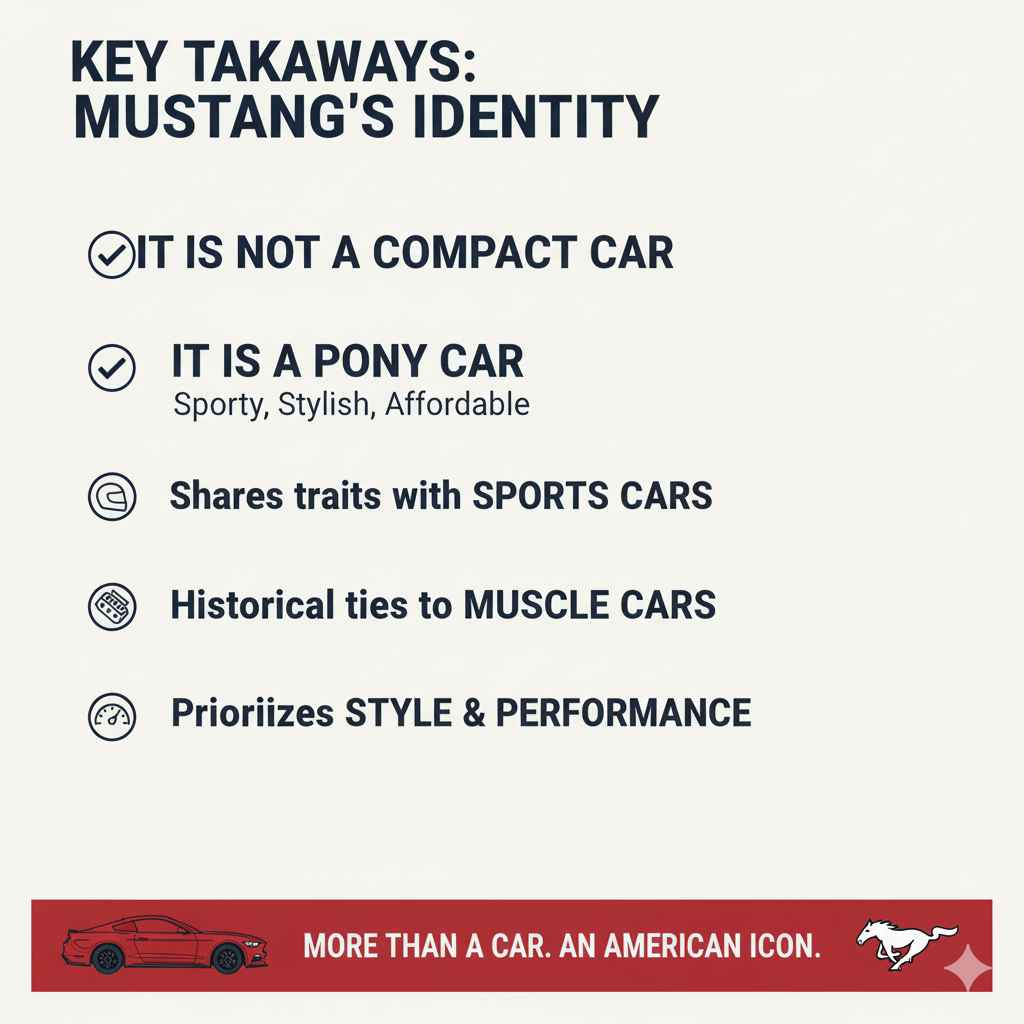
- It is NOT a compact car.
- It IS a pony car. This is its primary classification, originating from its unique mix of sportiness, styling, and affordability.
- It shares traits with sports cars due to its performance and handling.
- It has historical ties to muscle cars because of its powerful V8 engine options.
- Its design prioritizes style, performance, and driving enjoyment over maximum practicality.
FAQ: Your Ford Mustang Questions Answered
Q1: Is the Mustang a sports car, a muscle car, or a compact car?
The Ford Mustang is most accurately classified as a “pony car.” While it shares performance characteristics with sports cars and is often discussed alongside muscle cars due to its powerful V8 options and American heritage, its compact size and sporty styling at its inception defined the pony car segment. It is definitively not a compact car.
Q2: How does the Mustang compare in size to a typical compact car?
A Mustang is generally larger than a typical compact car. It’s wider, often longer, and designed with a sportier, more aggressive stance. While compact cars prioritize small dimensions for urban maneuverability and efficiency, the Mustang’s size is geared towards its performance-oriented design and styling.
Q3: Can a Mustang be a practical daily driver?
Yes, many people use Mustangs as their daily drivers. Modern Mustangs offer features like advanced safety systems, comfortable front seats, and even more fuel-efficient EcoBoost engine options. However, its sporty nature, 2+2 seating, and less emphasis on cargo space mean it’s less practical for families or those needing to haul a lot compared to a sedan or SUV.
Q4: Are all Mustangs rear-wheel drive?
Historically and traditionally, all Ford Mustangs are rear-wheel drive (RWD). This is a core characteristic that contributes to their sporty handling and performance feel. No Mustang has ever been manufactured with front-wheel drive (FWD) or all-wheel drive (AWD) as a standard production model.
Q5: Why is it called a “pony car”?
The term “pony car” was coined to describe the Ford Mustang when it debuted in 1964. It referred to a new class of affordable, sporty, and stylish American cars with a compact body, a long hood, a short rear deck, and a focus on personal transportation with a sporty flair. The “pony” name reflects the Mustang’s galloping horse emblem and its spirited nature.
Q6: Does the Mustang have a lot of cargo space?
The Mustang offers a decent-sized trunk for a coupe, generally enough for a couple of weekend bags or groceries. However, compared to a compact car’s trunk or hatchback cargo area, its storage capacity is more limited. The rear seats also fold down in some models, offering a bit more versatility for longer items, but it’s not its strong suit.
Conclusion: The Mustang’s Enduring Appeal
So, to definitively answer your question: no, a Ford Mustang is not a compact car. It’s a proud member of the pony car family, a class it helped create. This distinction is important because it highlights the Mustang’s core identity: a car built for style, performance, and the sheer joy of driving.
While compact cars focus on efficiency and everyday practicality, the Mustang appeals to a different desire – the feeling of freedom on the open road, the roar of an engine, and the head-turning looks of an automotive icon. Understanding these differences helps you appreciate what makes each type of car special. Whether you’re considering owning a Mustang or just admiring one from afar, knowing its place in the automotive world adds to its legendary status. It’s a car designed to make you feel something, and that’s a powerful thing for any vehicle to achieve.