Is a Volkswagen Jetta a Good Car? Best Years, Trims
Yes, if you want a quiet, fuel-saving compact sedan and pick the right year, the Volkswagen Jetta is a smart buy. Start with 2019 or newer, and aim for the SE or higher instead of the base trim. Pick the wrong model year or trim, and you can give up value, reliability, and resale. This guide sorts the Jetta by year and trim for commuters, first-time buyers, teen drivers, winter use, and rival cross-shopping.
Verdict: is a Volkswagen Jetta a good car?

Yes, for the right buyer. The current Jetta is a sensible commuter with a low starting MSRP of $23,995, EPA-estimated 29 city/40 highway mpg, and standard safety-enhancing technology. It is less convincing if you want the sharpest compact-sedan chassis, the strongest resale, or the best all-around winter setup.
Short answer for new-car shoppers
As a new car, the Jetta makes the most sense if you care about price, fuel economy, and easy commuting more than sporty hardware. The current 1.5L turbocharged engine and 8-speed automatic focus on everyday drivability, not thrills, and that is exactly why many shoppers consider it. The best value usually sits above the base trim.
Short answer for used-car shoppers
As a used buy, the Jetta becomes more year-sensitive. Recent models are the safer bet, while older cars can bring more variation in maintenance exposure, transmission history, and prior-owner care. A used Jetta can be a bargain, but year and trim matter more here than they do on many rivals.
Where the Jetta fits against rival compact sedans
The Jetta competes as an efficiency-first compact sedan with decent space and a calm highway personality. A Honda Civic, Toyota Corolla, or Mazda3 may suit buyers who want broader trim strength, better resale, or a more engaging chassis. The Jetta’s edge is value in the right trim, not class-leading excitement.
📊 Car and Driver says the Jetta has a 10.3-inch Digital Cockpit screen. Source: 2019 Volkswagen Jetta First Drive: New Platform Does a World of….
What you get in the current Jetta
The current Jetta is a compact sedan with a 1.5L turbocharged engine, standard driver-assist tech, and a cabin that can feel more upscale in mid trims than its price suggests. The catch is that the best version is not always the cheapest one. Equipment choice matters.
1.5L turbocharged engine and 8-speed automatic
The current Jetta is commonly described as using a 1.5L turbocharged engine paired with an automatic transmission in common automatic form. That setup is about easy torque delivery in traffic, relaxed cruising, and good fuel economy rather than hard-edged performance. It suits daily driving well, especially if you spend most of your time in stop-and-go commuting.
MQB architecture, ride quality, and packaging
The modern Jetta rides on VW’s MQB architecture, the same basic small-car foundation used across much of the brand’s lineup. That matters because MQB brought better packaging efficiency and a more refined structure than older Jetta generations. It also helped VW keep weight and space under control without turning the car into a crossover.
One tradeoff remains: the Jetta’s standard torsion-beam rear suspension is cost-efficient and helps the car stay affordable, but it does not deliver the same rear-end composure as more sophisticated independent setups when roads get rough or speeds rise.
Digital Cockpit, safety tech, and cabin features
On cited review coverage, the available Digital Cockpit uses a 10.3-inch screen in place of a traditional gauge cluster. That gives the cabin a more modern feel and improves how driving data is presented. VW also lists the Jetta with standard safety-enhancing technology, which is important in a car aimed at commuters and newer drivers.
Pros and cons of the Volkswagen Jetta
The Jetta’s strengths are clear if you shop it for the right reasons. Its weaknesses show up when you compare it with rivals that do a few things better for similar money, especially in performance trims and long-term value.
Pros
- Good fuel economy for a gas compact sedan.
- Low starting price relative to many rivals.
- Useful trunk and practical dimensions for commuting.
- Calm, easy everyday drivability.
- Mid trims can bring better value than the base model.
Cons
- Base-trim value can look thin next to rivals.
- Torsion-beam rear suspension limits enthusiast appeal.
- Older used examples can bring more maintenance exposure.
- GLI performance is strong, but cost and insurance can rise.
- Snow performance still depends more on tires than badge.
Where the GLI changes the equation
The Jetta GLI is the answer if you want the sedan’s shape with much more pace. VW rates it at 228 hp and 258 lb-ft of torque, and says it can reach 0–60 in 6.2 seconds. That makes it a performance-focused trim, not a simple trim upgrade. You pay more, and you may feel more ride firmness and higher insurance costs.
Who the Jetta is for
The Jetta suits commuters who want a small sedan, not a crossover, and who value efficiency, simple daily use, and a reasonable purchase price. It is less ideal if you want the most engaging chassis in the class, the lowest long-term running costs, or the strongest used resale.
Best for commuters and budget-focused buyers
If your driving is mostly solo commuting, grocery runs, and highway miles, the Jetta makes sense. The current car’s efficiency and easygoing power delivery fit that role well. Buyers who want a refined, low-drama sedan will also find the Jetta easier to live with than many sportier compact cars.
Best for shoppers who want a small sedan without a crossover
Some buyers simply do not want a taller vehicle. For them, the Jetta offers sedan packaging, a decent trunk, and lower running costs than many larger vehicles. It is a practical answer when cargo needs are moderate and the buyer wants to stay in a traditional car.
When a Civic, Corolla, or Mazda3 may fit better
If you care most about resale, broad trim strength, or all-around polish, rivals may be better choices. The Civic and Corolla usually make stronger default cases for mainstream buyers. The Mazda3 can feel better tied together from a driving standpoint, especially if you want a more premium feel.
Is a Volkswagen Jetta a good used car to buy?
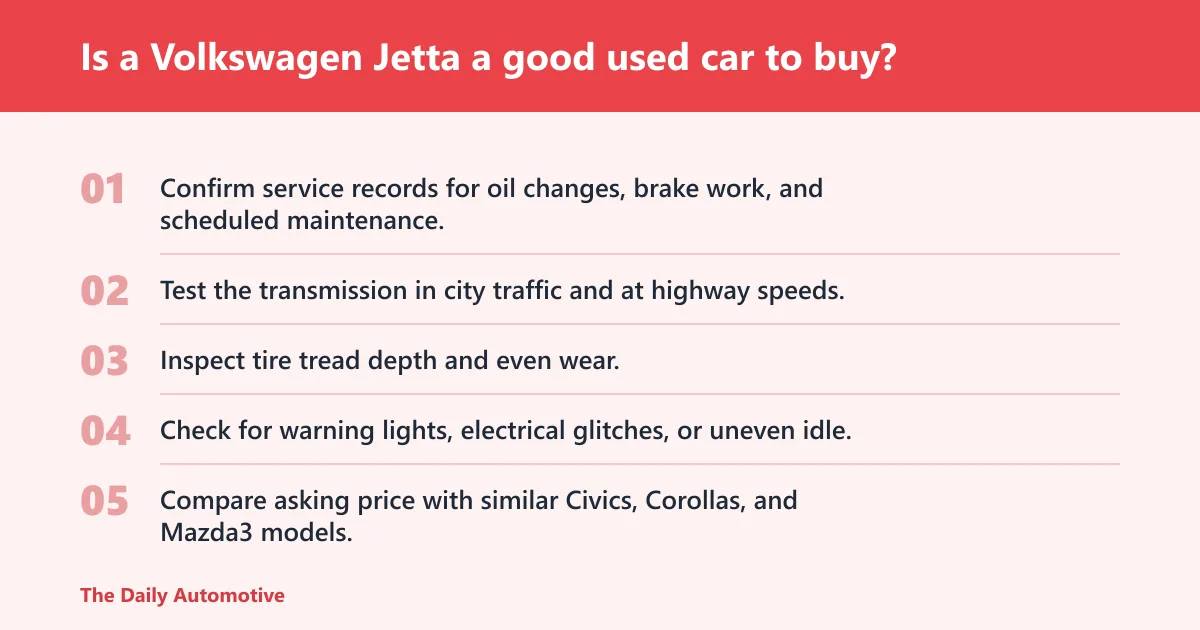
Yes, but only with a year-by-year approach. A used Jetta can be a strong buy if you target the better modern generations and inspect maintenance history carefully. Older cars can still be worthwhile, but they are more dependent on prior care, mileage, and drivetrain condition.
Which model years deserve a closer look
The 2019 Jetta is a cleaner starting point than many older examples. Car and Driver noted a starting price of $19,395, the shift to Volkswagen’s MQB architecture, the move to an 8-speed automatic, and a turbocharged 1.4-liter inline-four. That generation is the right place to start for used shopping. (caranddriver.com)
The 2014 Jetta sits in a different risk zone. It can be a budget buy, but buyers should be careful about maintenance history, especially if the car has lived a hard life or has incomplete records. The 2015 and 2017 models deserve the same cautious approach: not automatic noes, but not blind buys either.
Where maintenance and repair exposure matters most
Used Jettas tend to reward careful inspection. You should pay close attention to service records, transmission behavior, brake wear, tire condition, and signs of neglected fluid changes. A lower purchase price does not erase deferred maintenance.
What to check before you buy
- Confirm service records for oil changes, brake work, and scheduled maintenance.
- Test the transmission in city traffic and at highway speeds.
- Inspect tire tread depth and even wear.
- Check for warning lights, electrical glitches, or uneven idle.
- Compare asking price with similar Civics, Corollas, and Mazda3 models.
Buyer-fit scorecard: first car, teen driver, winter commuter, and used-car buyer
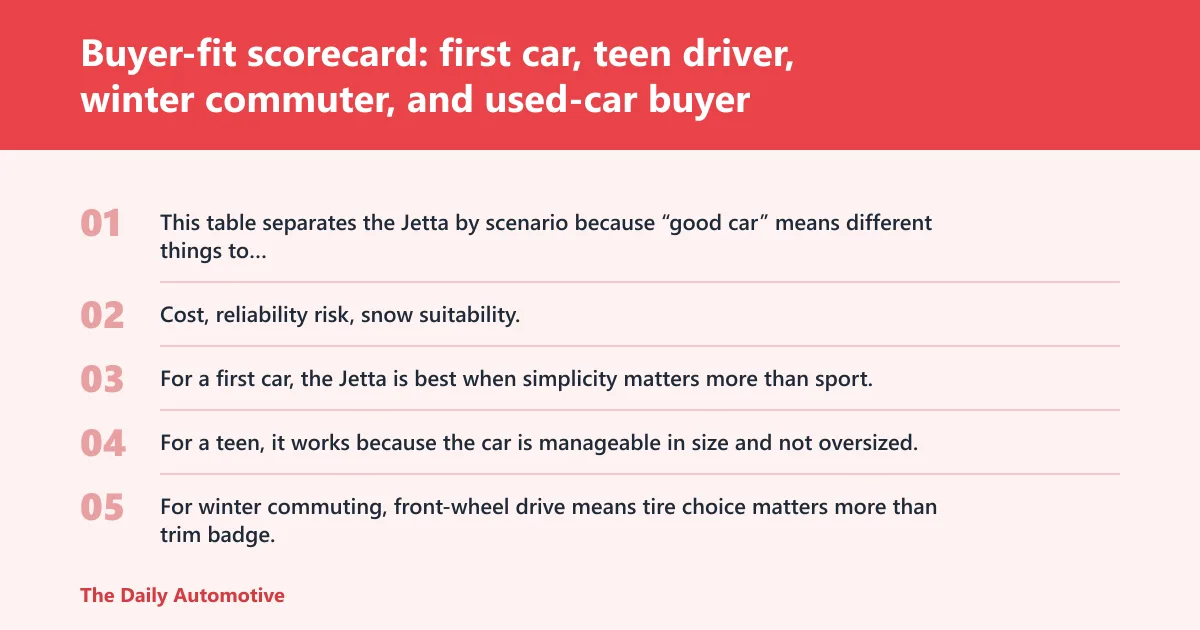
This table separates the Jetta by scenario because “good car” means different things to different shoppers. Cost, reliability risk, snow suitability, and value do not land the same way for a first car, a teen driver, a winter commuter, or a used-car buyer.
| Scenario | Generation or trim | Cost | Reliability risk | Snow suitability | Value | Recommendation |
|---|---|---|---|---|---|---|
| First car | 2019+ S or SE | Moderate | Moderate-low | Fair with winter tires | Good | Good pick if you want a simple sedan and can stretch past base trim. |
| Teen driver | 2019+ SE, not GLI | Moderate | Moderate-low | Fair with winter tires | Good | Best choice for a calm, manageable sedan; avoid the extra speed of the GLI. |
| Winter commuter | 2019+ SE or R-Line | Moderate | Moderate-low | Fair to good with snow tires | Good | Works well if you fit proper winter tires and accept front-wheel drive limits. |
| Used-car buyer | 2019+ preferred; 2014, 2015, 2017 only with history | Low to moderate | Variable | Fair with winter tires | Moderate to good | Focus on documented maintenance and skip the cheapest rough example. |
How the Jetta changes by scenario
For a first car, the Jetta is best when simplicity matters more than sport. For a teen, it works because the car is manageable in size and not oversized. For winter commuting, front-wheel drive means tire choice matters more than trim badge. For used shoppers, model-year condition matters more than the odometer alone.
Picture a 17-year-old driver facing a snowy school lot on worn all-seasons. A Jetta will not fix bad tires. Put proper winter rubber on it, and the car becomes much more predictable; leave the tires alone, and the badge does very little for traction.
How the Jetta compares with the GLI and key rivals
The Jetta and Jetta GLI answer different questions. The standard car is for value and commuting. The GLI is for buyers who want real punch and accept higher costs. Rivals can be better if you want a more balanced package without moving all the way to a performance trim.
When the GLI is worth the extra money
Choose the GLI if you genuinely want a sport sedan and will use the extra power. With 228 hp and 258 lb-ft of torque, it is far more entertaining than the regular Jetta. It is not the best choice if your priority is cheapest ownership, softest ride, or lowest insurance pressure.
When a base or R-Line Jetta makes more sense
The R-Line is mainly a sport-appearance trim with select features and available torque vectoring, not a full mechanical step toward the GLI. That makes it a smart middle ground for buyers who want a better look and some added polish without paying for full performance hardware. Base trims make sense only if the discount is large enough to justify the stripped equipment.
What rival sedans do better for similar money
Civic, Corolla, and Mazda3 shoppers should think in terms of priorities. The Civic often has broader appeal, the Corolla leans hard into durability-minded ownership, and the Mazda3 can feel more upscale or rewarding to drive. The Jetta’s role is simpler: good commuter value, especially when the trim is right.
Frequently asked questions
Is a Volkswagen Jetta a good car to buy?
Yes, if you want an efficient compact sedan and choose the right trim. The current Jetta starts at $23,995 MSRP, returns 29 city/40 highway mpg, and includes standard safety-enhancing technology. It is a stronger buy for commuters than for shoppers chasing the sportiest chassis in the class.
Is a Volkswagen Jetta reliable car?
The answer depends on model year and maintenance history. Recent Jettas are the safer bet than older used examples, which can bring more variation in repair exposure. A well-kept car is always safer to recommend than a cheaper one with missing service records.
Is a Volkswagen Jetta a good used car to buy?
Yes, especially if you focus on 2019 and newer examples with documentation. Car and Driver’s 2019 review points to the MQB platform, an 8-speed automatic, and a turbocharged 1.4-liter inline-four. Older years can work, but they deserve a deeper inspection before you commit.
Is a 2019 Volkswagen Jetta a good car?
Yes, it is one of the better modern Jetta starting points. It introduced the MQB architecture, a smaller trunk at 14 cubic feet, and an 8-speed automatic in Car and Driver’s review, while still delivering strong mpg. That makes it a practical used target if the price is right.
Is a Volkswagen Jetta a good car for snow?
It can be, but tires matter more than trim. The Jetta is front-wheel drive, so winter tires make a far bigger difference than badging or appearance packages. It is a fair snow commuter, not a substitute for all-wheel drive.
Is a Jetta a good first car?
Usually yes, if you buy a recent model and keep the trim sensible. The Jetta’s size, predictable road manners, and efficient engine fit a first-time owner well. A used one with a clean service history can be a smarter first-car buy than a flashy sport compact.
Products related to this article
Sponsored / affiliate links. As an Amazon Associate I earn from qualifying purchases. I may earn additional commission from eligible campaigns.
 ACARLUOY Portable Air Compressor Tire Inflator - 3X Faster Inflation, Fit for Volkswagen Jetta 2000-2005,tire air Pump,150PSI 6000mAh Cordless Air Pump for Car Tires, LCD Display
 ACARLUOY Tire Inflator Portable Air Compressor, Fit for Volkswagen Jetta GLl 2019-2021, 3X Faster Inflation 6000mAh Batt,LCD Display & Emergency Flashlight