DashMat Dashboard Cover Review: Is It Worth It Today?
DashMat is worth the money when you need a custom-fit dash cover for a curved, vent-heavy, or sensor-filled dashboard; on a simple flat dash, a cheaper universal cover can do the same basic job. A poor fit can block vents, lift at the edges, or reflect into the windshield. This review covers fit, install friction, material quality, and which dashboards justify the custom patterning.
This guide is part of our Car terms explained series.
Verdict

Based on the spec sheet and owner feedback patterns, DashMat makes the most sense for buyers who want OEM-like coverage and are willing to verify fit before ordering. It is less appealing if your dash already has stubborn residue, unusual speaker placement, or a trim-specific sensor layout that may need a different pattern.
Pros and cons
- Pros: Custom made for a specific dashboard; soft Foss Fibre carpet material; claims to cut windshield glare; claims to reduce haze from dashboard gases; limited lifetime warranty that covers fading.
- Cons: Fit depends on exact year/make/model/trim; install prep matters more than with a universal mat; curved or highly textured dashboards can create edge-lift risk; sensor and speaker openings may not suit every trim.
Who it’s for
DashMat suits drivers who want a vehicle-specific cover instead of a generic rectangle, especially on dashboards with vents, curves, or factory openings that make universal mats look improvised. It is a weaker fit for buyers who want the easiest possible install or who already know their dash surface is oily, overtreated, or dimensionally odd.
📊 The page claims more than 1,750,000 people choose DashMat. Source: DashMat Dashboard Covers.
Specs at a glance
| Spec | DashMat claim | Buyer takeaway |
|---|---|---|
| Material | Soft Foss Fibre carpet | Soft-touch finish, more OEM-like than a shiny universal mat |
| Fit | Custom made to fit a specific dashboard | Patterning matters; year/make/model/trim accuracy matters too |
| Install hardware | Hook-and-loop fasteners | Secure enough for a proper install, but prep still affects hold |
| Glare claim | Claims to cut hazardous windshield glare | Useful if reflection is your main complaint |
| Haze claim | Claims to reduce windshield haze caused by dashboard gases | Relevant for older interiors that leave film on the glass |
| Protection claim | Claims to protect against cracking and warping | Best viewed as sun-shielding insurance, not a cure for damage already done |
| Durability claim | Durable, color fast, non-shrinking material | Helpful for long-term appearance, though the brief provides no independent durability test |
| Warranty | Limited lifetime warranty covering fading | Good on paper, but it does not solve a bad fit or poor prep |
Who it is for
DashMat is for buyers who want a tailored dashboard cover that follows the factory shape instead of floating over it. If your priority is a cleaner look, fewer windshield reflections, and a cover that accounts for vents or sensors, it is a sensible shortlist choice.
It is also aimed at owners dealing with dashboard sun exposure, especially where cracking, warping, or glossy reflections are a concern. It is less compelling for anyone who wants the lowest-cost cover and does not need vehicle-specific cutouts.
Suppose your sedan has a center speaker grille, two defrost vents, and a rain sensor mount near the mirror. A universal mat may need trimming that leaves exposed edges or blocks an opening. A custom pattern is more likely to sit cleanly, but only if you buy the exact right trim match.
What works
DashMat’s main advantage is custom-made patterning. The company says each cover is made to fit a specific dashboard, with vent and sensor cutouts matched to the vehicle application. That is the part buyers are paying for, and it is the main reason the product can look more integrated than a universal cover.
The material choice also lines up with its purpose. DashMat uses soft Foss Fibre carpet material, and the brand describes it as durable, color fast, and non-shrinking. It also backs the material with a limited lifetime warranty covering fading. Those claims do not equal proof of performance, but they do explain why the product is positioned above no-name universal mats.
The functional claims are straightforward. DashMat says it helps cut windshield glare, reduce windshield haze caused by dashboard gases, and protect against cracking and warping. That fits the category: a dash cover can reduce direct sun load on the top surface and limit reflective glare bouncing into the glass.
Speaker and sensor accommodation
DashMat’s FAQ says speaker coverage will not distort sound. That is helpful, but it should not be read as a free pass for every trim. Speaker grilles, center-channel openings, and sensor cutouts can vary by year and option package, so compatibility still depends on the exact vehicle.
Picture a dashboard where the speaker sits near the windshield base and the cover’s cut line lands half an inch off. The result is edge lift, a partial opening, or a cover that interferes with a sensor housing. That is the kind of mismatch universal mats hide poorly and custom mats only avoid if the part number is right.
What does not
DashMat’s biggest weakness is fit risk at the margins. The cover is custom made, but custom does not mean universal across all trims. Curved dashboards, heavily textured dash tops, unusual speaker placement, and sensor-packed layouts can all create friction during install or leave visible gaps.
There is also no independent performance data in the brief for glare reduction, heat reduction, or fade resistance. That matters because buyers are often comparing claims, not just construction. Without side-by-side testing, you are buying on pattern accuracy and material promise, not verified numbers.
Another drawback is installation prep. The FAQ says adhesive issues can be caused by Armor All protectant, and it recommends cleaning with mild detergent or rubbing alcohol. That is a practical warning, but it also means the product is less forgiving than a throw-on mat if your dash has dressing residue, dust, or film.
A common first-timer mistake is ordering by model name only and ignoring the trim. A 2024 sedan with a speaker grill, camera module, or different upper-dash mold can need a different pattern than the base car. That is where buyers can end up with lifted edges or blocked openings.
Install friction in plain terms
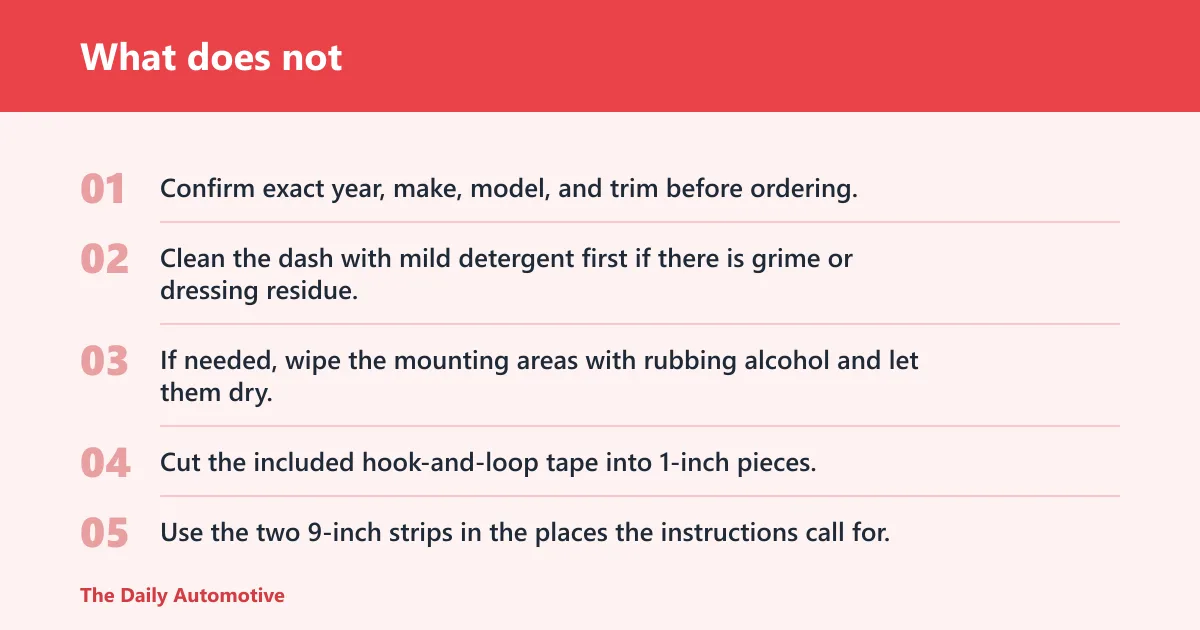
- Confirm exact year, make, model, and trim before ordering.
- Clean the dash with mild detergent first if there is grime or dressing residue.
- If needed, wipe the mounting areas with rubbing alcohol and let them dry.
- Cut the included hook-and-loop tape into 1-inch pieces.
- Use the two 9-inch strips in the places the instructions call for, then press the cover into position.
- Check vent openings, speaker openings, and sensor clearance before calling the install finished.
Buyer-fit decision table
This table is the quickest way to decide whether DashMat is a buy, a skip, or a case for alternatives. If your dashboard has odd openings or cleanup problems, fit matters more than the material name on the box.
| Dashboard situation | Sensor openings | Speaker placement | Cleanup / prep condition | Recommendation |
|---|---|---|---|---|
| Simple, mostly flat dash | No unusual cutouts | Standard grille placement | Clean, dry surface | Buy |
| Curved dash with many vents | Camera or sensor near the windshield base | Center speaker or dash-top audio openings | Some dust, no dressing residue | Consider alternatives |
| Heavily textured dash with deep contours | Mixed trim-specific openings | Speaker cover sits close to edge | Previously treated with protectant | Skip until cleaned and verified |
| OEM dash with clear vent and sensor map | Exact year/make/model/trim confirmed | Openings line up on the pattern sheet | Mild detergent or rubbing alcohol prep completed | Buy |
| Dash with unknown trim or nonstandard mods | Possible mismatch | Aftermarket audio or custom speaker pods | Unknown residue or past adhesive marks | Skip |
Alternatives

If DashMat feels too trim-specific, compare it with lower-cost covers only after you accept the tradeoff: easier buying and simpler install, but less precise coverage. The two products below are vehicle-specific too, yet each still has its own fit limits and install compromises.

KUST Black Dash Cover for Honda Civic 2022-2026 is the cleaner choice if you drive a Honda Civic in that exact range and want a lower-priced custom-fit option. Based on the spec sheet, it offers a non-slip bottom with silicone patterns and a foldable design, which should make handling easier. The drawback is obvious: it is limited to one vehicle family, so anyone outside that range needs a different part.

Fcovergurus Dash Cover Mat for Hyundai Elantra Sedan is a fit-first option for Hyundai Elantra sedan owners who want pre-cut defrost and AC vents plus simple velcro installation. That can reduce install friction compared with a more generic cover. The honest downside is that it is tightly vehicle-specific and aimed at left-hand driving vehicles, so it is not a flexible choice for mixed markets or unusual trims.
Should you buy it?
DashMat is worth it for buyers who care most about exact fit, glare control, and a cleaner OEM-style look. If your dashboard has vents, sensors, or curves that would make a universal mat look sloppy, the vehicle-specific patterning earns its keep.
It is not the best fit for every car. If your dash is simple, your budget is tight, or your trim has unusual openings that are hard to verify, a cheaper universal cover can be the smarter purchase. That is especially true when the main goal is basic sun protection, not a near-factory appearance.
When to choose DashMat
Choose it if you can verify the exact pattern for your year, make, model, and trim, and if the dash is clean enough for the hook-and-loop strips to hold. It also makes sense if you want the softer carpeted finish instead of a shiny vinyl look.
When to skip it
Skip it if your dashboard already has heavy protectant residue, if sensor locations are unclear, or if you do not want to spend time checking cutouts before ordering. In those cases, the fit risk can erase the value of the custom pattern.
Frequently asked questions
Is DashMat dashboard cover worth it?
DashMat may be worth considering when a precise fit matters more than a lower entry price. It makes the most sense for dashboards with vents, curves, or sensor openings where a universal cover would look loose or need trimming. If your dash is simple and flat, the extra cost is harder to justify.
Does DashMat really stop windshield glare?
DashMat claims to cut hazardous windshield glare, but the brief does not provide independent test data. The idea is sound: a carpeted dash cover can reduce reflective shine from the dashboard surface. That said, buyers should treat glare reduction as a claimed benefit, not a measured result.
Will a DashMat fit my exact car model?
Only if the year, make, model, and trim match the pattern DashMat made for. The cover is custom made, and that is both its strength and its risk. Small changes in speaker placement, sensor openings, or dash contours can affect fit, so confirm the exact application before buying.
Do DashMat covers block speakers or sensors?
They should not, if the correct pattern is ordered. DashMat says speaker coverage will not distort sound, and the fit is supposed to account for vents and sensor cutouts. Problems usually come from mismatch, not from the material itself, so double-check the exact opening layout on your dash.
How hard is it to install a DashMat dashboard cover?
It is not difficult, but it is more involved than throwing down a universal mat. The package includes two 9-inch strips of hook-and-loop tape, which the FAQ says to cut into 1-inch pieces. Clean prep matters, and residue on the dash can make installation frustrating.
Will DashMat damage my dash when removed?
There is no claim in the brief that it damages the dash on removal. The main risk is residue transfer or adhesive pull on a poorly cleaned surface, especially if dashboard dressing was left behind. A mild detergent wash, followed by rubbing alcohol where appropriate, lowers that risk before installation.
What if the adhesive strips won’t stick to my dashboard?
DashMat says Armor All protectant can cause adhesion problems. If the strips will not hold, clean the mounting areas with mild detergent or rubbing alcohol and let them dry fully before trying again. If the dash remains oily, textured, or unusually coated, consider an alternative with a different attachment method.
Products related to this article
Sponsored / affiliate links. As an Amazon Associate I earn from qualifying purchases. I may earn additional commission from eligible campaigns.