Is Automotive Technology a Good Major for Tech Jobs?
Yes—automotive technology can be a good major in 2026 if the program teaches diagnostics, high-voltage safety, and EV service skills; choose it only if it has employer ties and current lab equipment. Pick a weak program and you may graduate with debt and paper credentials that do not translate into technician work. Here’s what the major prepares you to do and how to judge program quality before you enroll.
Is automotive technology a good major in 2026?


Yes. It can be a strong major in 2026 because employers still need people who can diagnose modern vehicle systems, follow service procedures, and work safely around electrical and high-voltage components. The major works best when it leads to verifiable job-readiness, not just classroom familiarity with cars.
What the major is designed to prepare you for
An Automotive Technology associate degree is usually built for entry-level career prep. A solid program should include service-sequence training, diagnostic thinking, and hands-on repair of mechanical, hydraulic, electrical, and thermodynamic systems. That matters because employers hire for the first job, not for hobby knowledge.
The automotive industry is large and varied. It includes design, development, manufacturing, marketing, selling, repairing, and modification. The global automotive market was about $2.75 trillion in 2025, which is one reason schools keep treating this as a serious workforce major rather than a narrow shop certificate. (en.wikipedia.org)
Why 2026 job skills look different from older shop training
Older shop training could focus on basic mechanical repair. A graduate also needs computer diagnostic equipment skills, especially scan tool and oscilloscope use, because modern vehicle troubleshooting often starts with data, signal patterns, and fault codes rather than visible wear alone.
Say your check-engine light returns after a thermostat replacement. A basic parts-changer may stop there. A better-trained graduate checks live data, compares sensor behavior, and uses a scan tool plus oscilloscope readings to trace the fault instead of guessing.
📊 The global automotive market was about $2.75 trillion in 2025. Source: Automotive industry.
What do automotive technology programs actually teach?
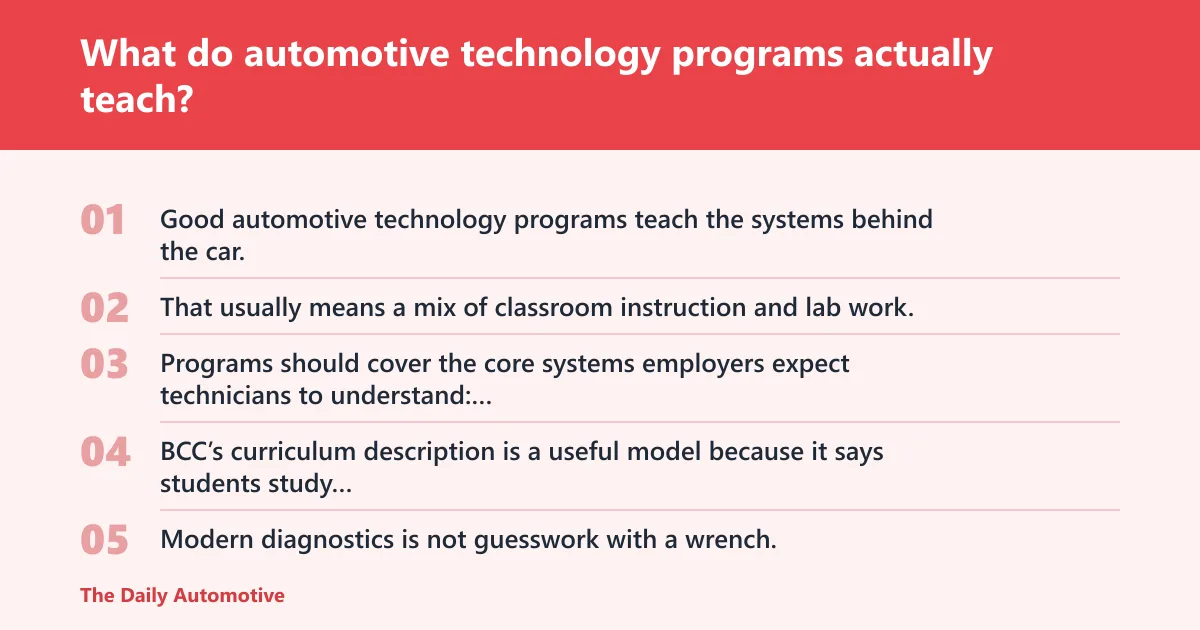
Good automotive technology programs teach the systems behind the car, the procedures for diagnosing them, and the sequence for repairing them. That usually means a mix of classroom instruction and lab work, with emphasis on how one fault can affect several systems at once.
Mechanical, hydraulic, electrical, and thermodynamic systems
Programs should cover the core systems employers expect technicians to understand: brakes, steering, engines, transmissions, charging and starting systems, heating and cooling, and climate control. BCC’s curriculum description is a useful model because it says students study development, testing, diagnosis, and service of mechanical, hydraulic, electrical, and thermodynamic systems.
Diagnostics with scan tools and oscilloscopes
Modern diagnostics is not guesswork with a wrench. Students should learn how to read trouble codes, inspect live data, interpret sensor behavior, and verify electrical signals with an oscilloscope. These tools help with intermittent problems, communication faults, and issues that do not leave a visible trail.
Service procedures, troubleshooting, and repair sequence
Employers care whether a graduate can follow the correct service sequence. That includes safe disassembly, inspection, testing, repair, reassembly, and confirmation that the fault is fixed. A strong program trains that discipline early, because skipping steps wastes time and creates repeat failures.
| Program feature | What employers want it to prove | Why it matters |
|---|---|---|
| Scan tool training | Ability to read data and fault codes | Required for modern troubleshooting |
| Oscilloscope use | Signal interpretation on electrical systems | Helps diagnose hidden or intermittent faults |
| Hands-on labs | Repair sequence and tool discipline | Shows readiness for entry-level work |
| Late-model vehicles | Exposure to current components and software | Matches what shops service today |
Which jobs can you get with this degree?

An automotive technology degree can lead to entry-level technician work, but that is not the only path. Depending on the program and local market, graduates may move into diagnostic roles, service roles, test roles, or adjacent positions tied to vehicle condition, customer service, and training.
Entry-level technician and service technician roles
Entry-level technician and service technician jobs are the most direct outcome. These roles often involve inspection, maintenance, basic repairs, fluid service, brake work, tire work, and documentation. Employers value graduates who can work through a checklist without creating rework.
Diagnostician, test technician, and service writer paths
As skill grows, graduates may move toward diagnostician or test technician work, where troubleshooting and verification matter more than routine service. Service writer roles are also common because the major teaches enough systems knowledge to explain repairs clearly and write accurate work orders.
BCC says graduates can work as test technicians, diagnosticians, equipment sales and service, and service managers. That range matters because it shows the major can support more than one career lane, especially for students who like the industry but do not want to stay under a hood forever.
Beyond the bay: service management, appraisal, insurance, and training
There is upside outside the repair bay. Graduates sometimes move into service management, vehicle appraisal, insurance inspection, parts support, fleet maintenance, and training support. Those paths still reward systems knowledge, clear documentation, and the ability to explain defects or repairs in plain language.
How do employers judge an automotive tech program?
Employers usually look for signs that a program matches current shop practice, not just classroom coverage. The strongest signals are accreditation, access to real vehicles, current diagnostic tools, and employer-linked work experience that puts students near actual service operations.
ASE Education Foundation accreditation
ASE Education Foundation accreditation is often a useful quality signal to look for. BCC lists the ASE Education Foundation as its program accreditor, and that matters because program accreditation tells employers the school meets an industry-recognized standard rather than inventing its own. (bcc.cuny.edu)
Dealer partnerships, internships, and paid work-based learning
Dealer partnerships and internship pipelines matter because they connect school training to actual shop conditions. BCC says its program includes salaried internships at service centers, which is the kind of work-based learning students should look for if they want a path into the first job.
Access to late-model vehicles and current tools
Late-model vehicles matter because today’s cars are software-heavy and sensor-driven. A program that only uses outdated training units can miss current procedures, diagnostics, and safety practices. Students should ask what model years the lab uses, whether hybrid or EV units are included, and how often tools are updated.
Suppose a student trains only on older fuel-injected engines and never sees a late-model vehicle with networked modules. That graduate may know theory, but a dealer service lane can still feel unfamiliar on day one. Access to current equipment reduces that gap.
Do automotive technology majors learn EV and hybrid systems?
They should, and in 2026 that training matters. A modern automotive technology major that ignores EV and hybrid systems leaves a gap in high-voltage awareness, system isolation, and component-level troubleshooting. The best programs add this training as a real option, not a marketing line.
High-voltage awareness and safety basics
EV and hybrid work requires high-voltage awareness, lockout procedures, and careful handling of batteries, cables, and related components. Students do not need to become specialists immediately, but they do need safety habits that prevent mistakes around energized systems.
Why EV and hybrid training matters for first jobs
Even if a graduate starts in conventional service, shops increasingly see hybrids, plug-in hybrids, and battery-electric vehicles. Early exposure helps with inspection, basic diagnostics, and safe handoff to more advanced technicians. BCC offers an electric vehicle option degree map, which is the kind of feature worth asking about.
What to look for in a modern EV option
Look for modules on battery safety, inverter basics, high-voltage disable procedures, thermal management, and scan-based diagnostics. A useful EV option should connect theory to actual vehicle service, not just explain electric propulsion in abstract terms.
ISO 26262 is a best-practice framework for automotive functional safety. Students do not need to memorize the standard on day one, but they should understand why safety thinking now reaches into software, sensors, control systems, and the design choices that prevent failures before they reach customers.
How hard is the first job after automotive tech school?
The first job is often the hardest part, because employers want proof that a new hire can follow procedures, handle tools correctly, and keep learning under supervision. A degree helps, but hiring managers still expect humility, stamina, and the ability to start in entry-level work.
Why entry-level roles matter
Most graduates do not begin as master diagnosticians. They start with inspection, maintenance, cleaning parts, documenting service, and basic repair tasks. That is normal. The question is whether the program prepared them for the pace and expectations of a real shop.
Certification pressure and testing expectations
Many students underestimate how much testing sits behind technician work. Programs may require quizzes, lab checkoffs, and certification prep. Some employers also look for ASE-aligned training or a clear plan to earn certificates after graduation. Comfort with testing is part of job readiness.
What hiring managers want beyond classroom grades
Hiring managers usually want punctuality, safe work habits, accurate notes, and a willingness to ask for help before making an expensive mistake. They also want graduates who can use diagnostic data rather than replace parts at random. Grades matter less than usable proof.
Is an automotive technology degree worth it compared with a trade certificate?
It depends on your goal. A trade certificate can be faster and more focused on immediate shop skills, while an Automotive Technology associate degree usually adds broader systems knowledge, diagnostics, and more formal preparation for advancement. The degree is worth more when it includes current labs and employer ties.
When a certificate may be the better fit
A certificate can work well if you already know you want fast entry into basic service work and the school has strong shop connections. It may also suit students who need a shorter, lower-cost route and plan to stack credentials later.
When the degree is the better fit
The associate degree is often better for students who want diagnostics, dealership work, or room to move into supervision, training, or service roles later. It may also suit career changers who need a fuller reset and want proof of broader technical competence.
How to compare the two honestly
Compare time, cost, lab quality, employer links, and EV access. Do not compare the name of the credential alone. A strong certificate from a dealer-linked program can beat a weak degree, but a strong degree usually opens more doors over time.
What certifications should an automotive technology program have?
The main credential to look for is ASE Education Foundation accreditation. That is the clearest program-quality signal in this field because it shows the curriculum has been reviewed against an industry-recognized standard. It is not the only factor, but it should be near the top of the list.
What else should you ask the school
Ask whether the program includes ASE-aligned coursework, access to late-model vehicles, current diagnostic tools, and employer-linked internships. Ask whether students work on real customer vehicles, whether paid internships exist, and whether there is an EV or hybrid training option.
Why recalls matter when judging quality
Product recalls are a reminder that defects and quality issues still matter in manufacturing and service. A technician or diagnostician must understand that a problem may come from design, assembly, software, or service history. That is why safety standards and careful diagnosis belong in the classroom.
Can automotive technology lead to a career outside the repair shop?
Yes. Automotive technology can lead into service management, parts, sales support, appraisal, insurance, test work, and training roles. The degree is most flexible when it gives students real diagnostic skill, a strong safety mindset, and enough exposure to speak confidently about vehicle systems.
Paths that use technical knowledge without full-time wrench work
Service management needs scheduling, estimates, and workflow knowledge. Appraisal and insurance work need damage assessment and system familiarity. Training roles need clear communication. These jobs still depend on automotive literacy, but they shift the work from repair execution to judgment, coordination, or review.
Use this checklist to decide if the major fits you
Score each factor from 0 to 2. A score of 0 can mean weak fit, 1 uncertain fit, and 2 strong fit. Add the total score out of 10. This is a practical way to judge whether the major matches your work style and career goals.
- Hands-on preference: 2 if you want lab work and tool use most weeks; 1 if you can tolerate it; 0 if you want mostly classroom learning.
- Tolerance for certification and testing: 2 if quizzes, lab checks, and later ASE prep do not bother you; 1 if you can manage them; 0 if testing drains you.
- Comfort with diagnostics: 2 if you like scan data, electrical testing, and troubleshooting; 1 if you are willing to learn; 0 if you want only simple maintenance.
- Interest in EV and hybrid systems: 2 if high-voltage training interests you; 1 if you are neutral; 0 if you want to avoid those systems entirely.
- Willingness to start in entry-level shop work: 2 if you are fine beginning with basic service and support tasks; 1 if you can accept it; 0 if you expect advanced work immediately.
Score guide: 8-10 points means the major likely fits well. 5-7 points means the major could work, but only if the program has strong labs, accreditation, and internships. 0-4 points means a different major or a shorter certificate may be the better move.
Frequently asked questions
What jobs can you get with an automotive technology degree?
Common jobs include entry-level technician, service technician, diagnostician, service writer, and test technician. Some graduates also move into service management, appraisal, insurance support, parts work, or training-related roles, depending on the local market and the strength of the program.
How hard is it to get a first job after automotive tech school?
It can be harder than students expect if the program lacks employer ties or current lab equipment. The first job often starts with basic service work, so hiring managers look for safe habits, reliability, and the ability to use diagnostic tools under supervision.
Products related to this article
Sponsored / affiliate links. As an Amazon Associate I earn from qualifying purchases. I may earn additional commission from eligible campaigns.