ABS vs Traction Control
ABS manages brake pressure so the wheels keep rolling under heavy braking; traction control trims drive-wheel spin during acceleration and corner exit. Mix them up, and you can lengthen stops, lose traction, or misread a fault light when the car needs attention. This guide compares ABS vs traction control by braking, launching, cornering, and warning-light triage.
| Factor | ABS | Traction Control | Winner |
|---|---|---|---|
| Main job | Prevents wheel lock during hard braking. | Limits drive-wheel spin during acceleration. | Tie |
| What you feel | Brake pedal pulse or chattering when brake pressure is modulated rapidly. | Brief throttle cut, power reduction, or a mild braking feel at a spinning wheel. | Tie |
| Best fit use case | Panic stops, downhill braking, and evasive braking. | Pulling away on wet, icy, or loose pavement. | Tie |
| Warning-light meaning | A steady light points to an ABS fault if it stays on. | A flashing light often means active intervention; a steady light may indicate a fault. | Tie |
| Relation to stability control | Provides the wheel-speed data and brake control foundation that ESC-type systems use. | Feeds into ESC/DSC logic for drive-wheel grip and side-slip control. | Tie |
Braking versus acceleration: how the systems act
ABS is about stopping cleanly while keeping steering control. Traction control is about putting power down without spinning the drive wheels. They share wheel speed sensors, but they act in different moments, and the driver feels them in different parts of the car.
What ABS does in braking
ABS stands for Anti-lock Braking System. It keeps wheels from locking up during hard braking by rapidly releasing and reapplying brake pressure, which can make the pedal vibrate or chatter. That behavior is normal when the system is working, and Mazda specifically advises drivers to keep pressing the brake pedal rather than pumping it.
What traction control does in acceleration
Traction control is designed for acceleration, not braking. It helps control drive-wheel spin by reducing engine torque and, in some cases, applying braking to a slipping wheel. That is why it shows up most clearly when you pull away on snow, wet pavement, or loose gravel.
Where the two systems overlap
Both systems use wheel speed sensors that measure how fast each wheel is turning and send that data to the control units. Both can step in when a wheel slows or spins in a way the car did not expect. Stability control works with ABS and traction control to control side slip, and NHTSA describes stability control as computer-controlled braking of individual wheels.
What is the difference between ABS and traction control?
ABS reacts to wheel lock during braking. Traction control reacts to wheelspin during acceleration. The first preserves steering control when you are on the brake pedal; the second helps keep the tires hooked up when you are on the throttle.
Wheel lock vs wheelspin
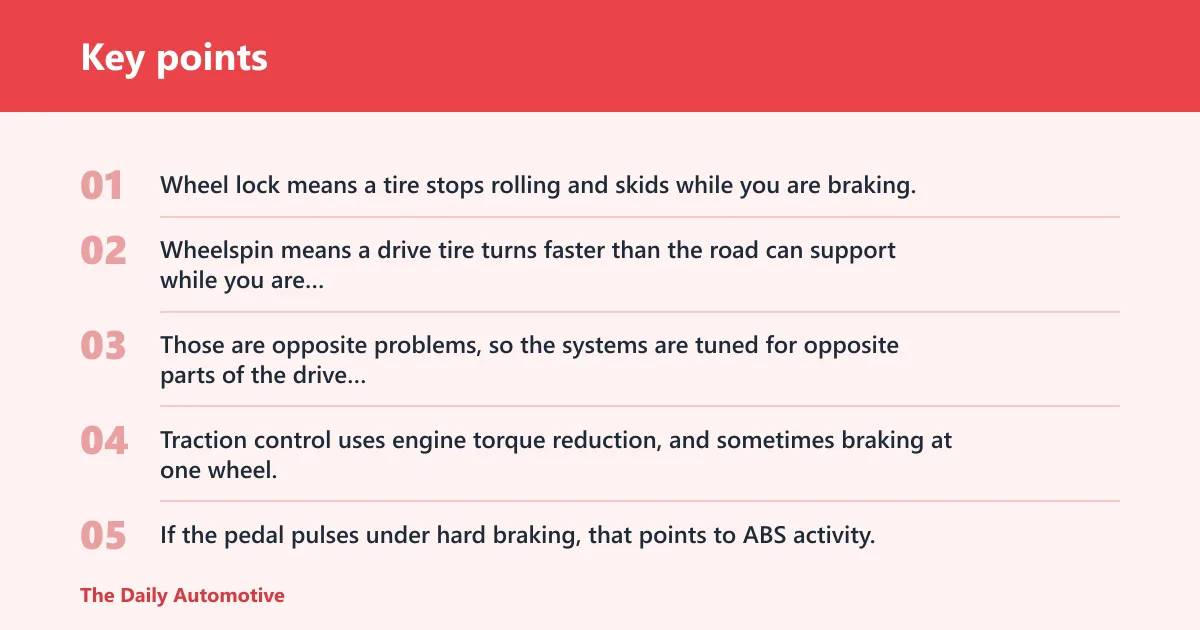
Wheel lock means a tire stops rolling and skids while you are braking. Wheelspin means a drive tire turns faster than the road can support while you are accelerating. Those are opposite problems, so the systems are tuned for opposite parts of the drive cycle.
Brake pressure modulation vs engine torque reduction
ABS uses brake pressure modulation. Traction control uses engine torque reduction, and sometimes braking at one wheel, to regain grip. If the pedal pulses under hard braking, that points to ABS activity; if the engine falls flat for a moment on launch, that points to traction control.
Why wheel speed sensors matter to both
Wheel speed sensors are the shared input. If one wheel slows too fast under braking, ABS can react. If one drive wheel spins too fast on takeoff, traction control can react. That shared hardware is one reason the warning systems sometimes overlap on the dashboard.
ABS traction control matrix
This decision matrix separates the most common situations drivers ask about. It tells you which system should intervene, what you should feel, what to do with your feet, and when service is needed.
| Situation | System that intervenes | What you feel | Driver action | When to get service |
|---|---|---|---|---|
| Hard braking | ABS | Pedal pulse or chattering; possible rapid brake pressure changes | Keep steady pressure on the brake pedal; do not pump it | If the ABS warning light stays on after startup or after the drive |
| Pulling away on snow | Traction Control | Throttle cut, brief power reduction, or a light brake intervention | Ease off the throttle and let the tire regain grip | If the traction-control light stays on instead of flashing only during slip |
| Mid-corner slip | Stability control, with ABS and traction control working together | Brake tug at one wheel, engine power reduction, or a brief correction feel | Reduce steering angle and speed; avoid sudden throttle input | If the stability or traction warning stays on, or the car keeps feeling uncontrolled |
| Dashboard warning lights | ABS fault light or traction-control fault light | Light stays on steadily, or flashes during active intervention | Check whether the light is steady or flashing before you worry | Steady ABS light: service soon. Steady traction light: service soon. Both steady: service now |
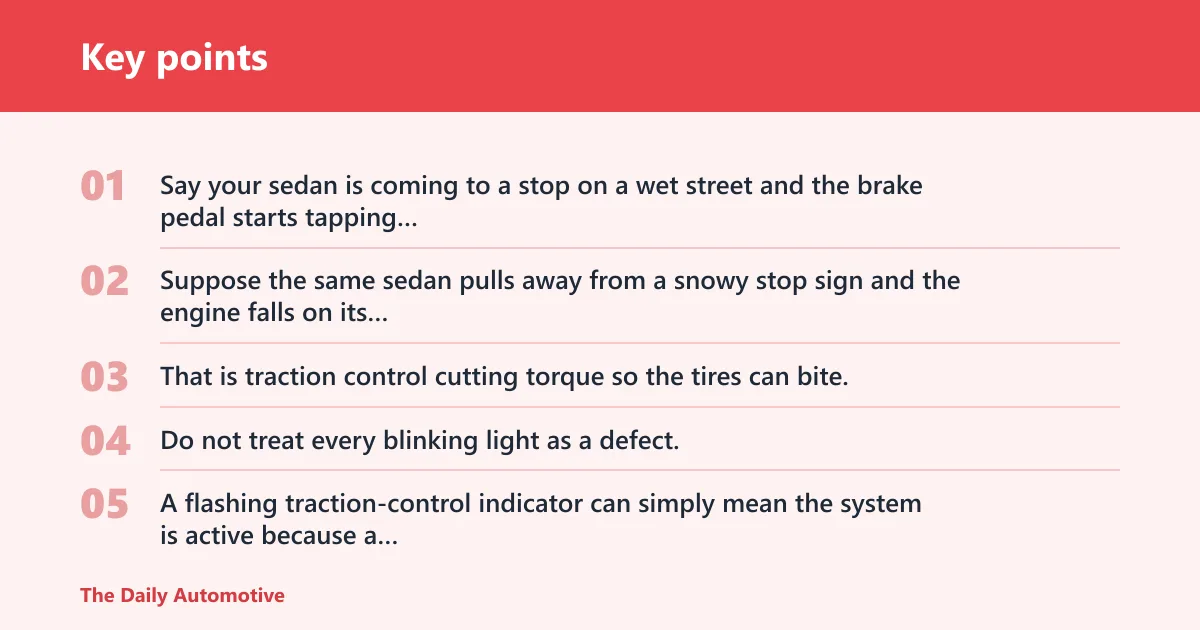
Say your sedan is coming to a stop on a wet street and the brake pedal starts tapping back at your foot. That is the ABS doing its job. Suppose the same sedan pulls away from a snowy stop sign and the engine falls on its face for a second. That is traction control cutting torque so the tires can bite.
How the matrix separates normal flashing from faults
Do not treat every blinking light as a defect. A flashing traction-control indicator can simply mean the system is active because a wheel is slipping. A persistent light is different. That usually points to a fault and deserves diagnosis, especially if it stays on after the car has restarted.
How ABS feels when you brake hard
Hard braking is where ABS is easiest to recognize. The pedal can pulse, buzz, or chatter because the system is rapidly releasing and reapplying brake pressure to keep the tires rolling. That helps preserve steering control, so you can still point the car around an obstacle while braking hard.
Keep steady pressure on the brake
Keep pressing the pedal with firm, steady force. Do not pump the brakes. Pumping can interfere with the control logic and can lengthen the stop compared with letting ABS manage pressure itself.
When ABS cannot fix poor grip
ABS cannot create traction that is not there. Poor tires, worn tread, ice, and loose surfaces still limit stopping distance. The system helps you keep control, but it does not turn bad tires into good ones.
How traction control feels when you accelerate
Traction control is most obvious when the car is trying to move off the line and one drive wheel starts to slip. The system can cut engine torque, and on some cars it may also apply braking to the spinning wheel. The result can feel like a brief hesitation or a short loss of power.
When to ease off the throttle
If the car is cutting power on a slippery launch, ease off the throttle slightly. That gives the tire a chance to hook up. A gentle right foot usually works better than asking for full torque on snow, wet paint, or polished ice.
Why it helps on snow or wet pavement
Traction control helps on wet or icy starts because spinning a tire wastes available grip. By controlling engine torque and, when needed, braking a slipping wheel, it keeps the car moving with less wheelspin. It is useful, but it still depends on tire condition and surface grip.
Does ABS work when traction control is on?
Yes. They are separate functions that can operate at the same time. ABS handles braking, traction control handles acceleration, and stability control can use both systems when the car starts to yaw or slide.
Shared sensors, separate jobs
Both systems read the same wheel speed sensors, but they do different things with the data. ABS reacts to a wheel that is decelerating too quickly under braking. Traction control reacts to a drive wheel that is accelerating too quickly relative to road speed.
How stability control ties them together
Stability control works with ABS and traction control to control side slip and evasive maneuvers. It often needs ABS hardware as a prerequisite because it uses individual wheel braking to help steer the car back in line. That is why a fault in one system can affect the others.
Can you drive with a warning light on?
You can often still move the car with an ABS or traction-control light on, but the meaning is not the same for each light. A steady ABS light means the anti-lock function is disabled even though normal brakes still work. A flashing traction light usually means the system is intervening, not failing.
ABS light steady vs flashing traction-control light
An ABS warning light that stays on means the ABS control unit has detected a malfunction. The base brakes still operate, but without ABS assistance. A flashing traction-control indicator usually means the system is actively managing slip, while a steady traction light may point to a fault or, on some cars, a related DSC or brake-assist issue.
When to get service right away
Get the car checked soon if the ABS light stays on after startup, or if the traction-control light stays on when the road is dry and the car is not spinning a wheel. If both lights stay on together, treat that as a more serious loss of electronic brake support and have the system diagnosed promptly.
What a persistent light usually means
Persistent light means a fault state, not active protection. The system may still leave the hydraulic brakes intact, but the car no longer has the electronic help you expected. That matters most in rain, snow, or panic stops.
Choose ABS if… / Choose Traction Control if…
Choose ABS if your biggest concern is hard braking and steering control under panic stops. Choose traction control if your biggest problem is launch grip, especially on wet or icy takeoffs. If a car has neither system, the driver has to do more of the work with smoother inputs, longer following distances, and better tires.
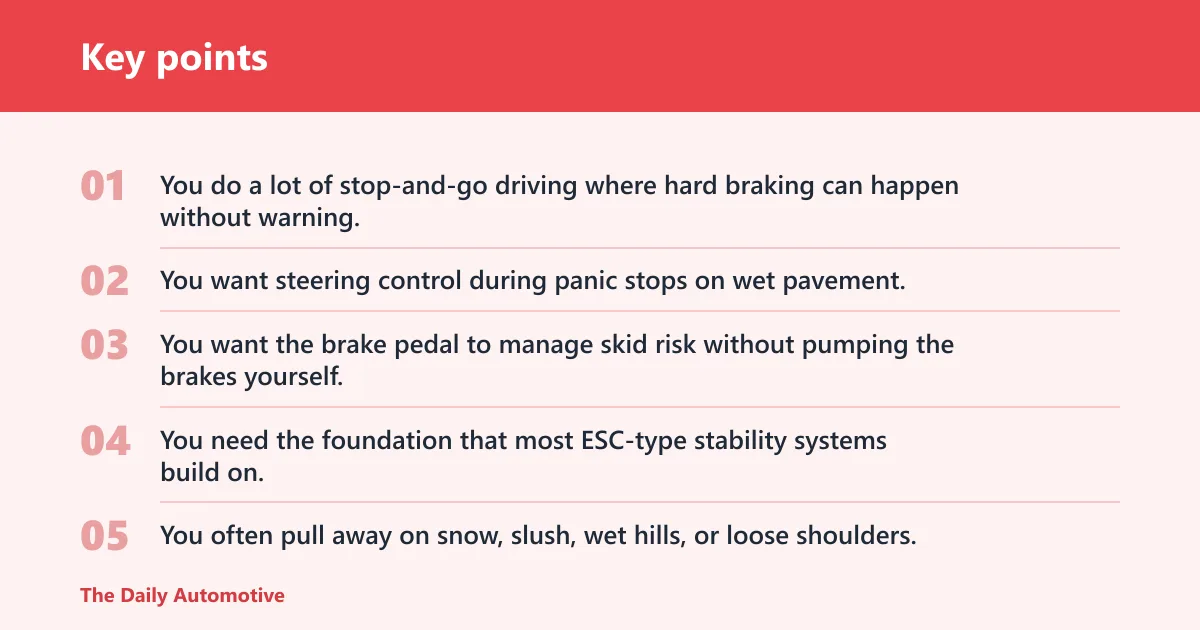
Choose ABS if…
- You do a lot of stop-and-go driving where hard braking can happen without warning.
- You want steering control during panic stops on wet pavement.
- You want the brake pedal to manage skid risk without pumping the brakes yourself.
- You need the foundation that most ESC-type stability systems build on.
Choose traction control if…
- You often pull away on snow, slush, wet hills, or loose shoulders.
- Wheelspin on launch is the main problem, not stop distance.
- You want help calming a spinning drive wheel before the car surges forward.
- You also want a system that can support stability control during side slip.
What older cars without either system need from the driver
Older used cars without ABS or traction control can still be safe when maintained well, but they ask more of the driver. Brake earlier, press the pedal smoothly, accelerate gently on slippery roads, and leave more space. Good tires matter even more because there is no electronic backup to trim wheel lock or wheelspin.
Frequently asked questions
What is the difference between ABS and traction control: aBS works during braking?
ABS works during braking to prevent wheel lock. Traction control works during acceleration to limit drive-wheel spin. The driver feels ABS through the brake pedal and traction control through reduced engine power or a short brake intervention at a slipping wheel. They solve different problems.
Is ABS and traction control the same?
No. They use some of the same sensors, but they are not the same system. ABS manages brake pressure so the wheels keep rolling while you stop. Traction control manages torque and, in some cases, braking so the tires can grip while you accelerate.
Dual channel ABS vs traction control
Dual channel ABS refers to the brake control layout, not traction control. It describes how the ABS can manage brake pressure in separate circuits. Traction control is a different function that uses wheel speed data to reduce spin on acceleration. One term is about brake hardware; the other is about slip control.
What does the ABS or traction control light mean?
A steady ABS light usually means the ABS control unit has found a fault, so anti-lock help is unavailable. A flashing traction-control light often means the system is active and catching slip. A steady traction light is different; it may mean a fault, and on some cars it can also relate to DSC or brake-assist logic.
Can you drive with an ABS or traction control warning light?
You can usually keep moving if the base brakes still work, but you should not ignore the light. A steady ABS light means you have normal braking without anti-lock help. A steady traction-control light can mean the same kind of loss of electronic support. If either light stays on, schedule diagnosis soon.
Should traction control be turned off in snow?
Sometimes, but only in specific low-speed situations where the car needs a little wheelspin to get moving. Many drivers leave it on for normal winter driving because it helps on slippery starts. If you turn it off, do it briefly and only if the owner’s manual allows it for stuck or deep-snow conditions.
Products related to this article
Sponsored / affiliate links. As an Amazon Associate I earn from qualifying purchases. I may earn additional commission from eligible campaigns.