
Is Material Engineering a Good Career: Proven Success
Yes, material engineering is a truly good career with proven success. It offers stable job prospects, excellent earning potential, and the chance to make a real impact on various industries by developing innovative materials.
Ever wondered what makes a car lighter yet stronger, or how to create electronics that are more durable? The answer often lies with material engineers. These brilliant minds are the unsung heroes behind many of the products we use every day. If you’re curious about how things are made and love solving problems, material engineering might be your perfect match. It’s a field where you get to shape the future, one molecule at a time. Let’s dive into why this profession is so rewarding and how you can embark on this exciting journey.
What is Material Engineering?
Material engineering is a fascinating field that involves understanding and transforming raw materials into an incredible array of useful products. Think of it as the science of “stuff” – how it’s made, how it behaves, and how we can make it better. Material engineers don’t just discover new materials; they also figure out how to process existing ones to give them specific, desirable properties. This could mean making metal stronger for airplanes, creating biocompatible plastics for medical implants, or developing more efficient semiconductors for your phone.
It bridges the gap between basic science (like physics and chemistry) and practical application. These engineers are crucial in industries ranging from aerospace and automotive to medicine and electronics, constantly pushing the boundaries of what’s possible with the building blocks of our world.
Why is Material Engineering a Good Career?
So, is material engineering a good career? The short answer is a resounding yes! Let’s break down why it stands out as a promising and fulfilling career path:
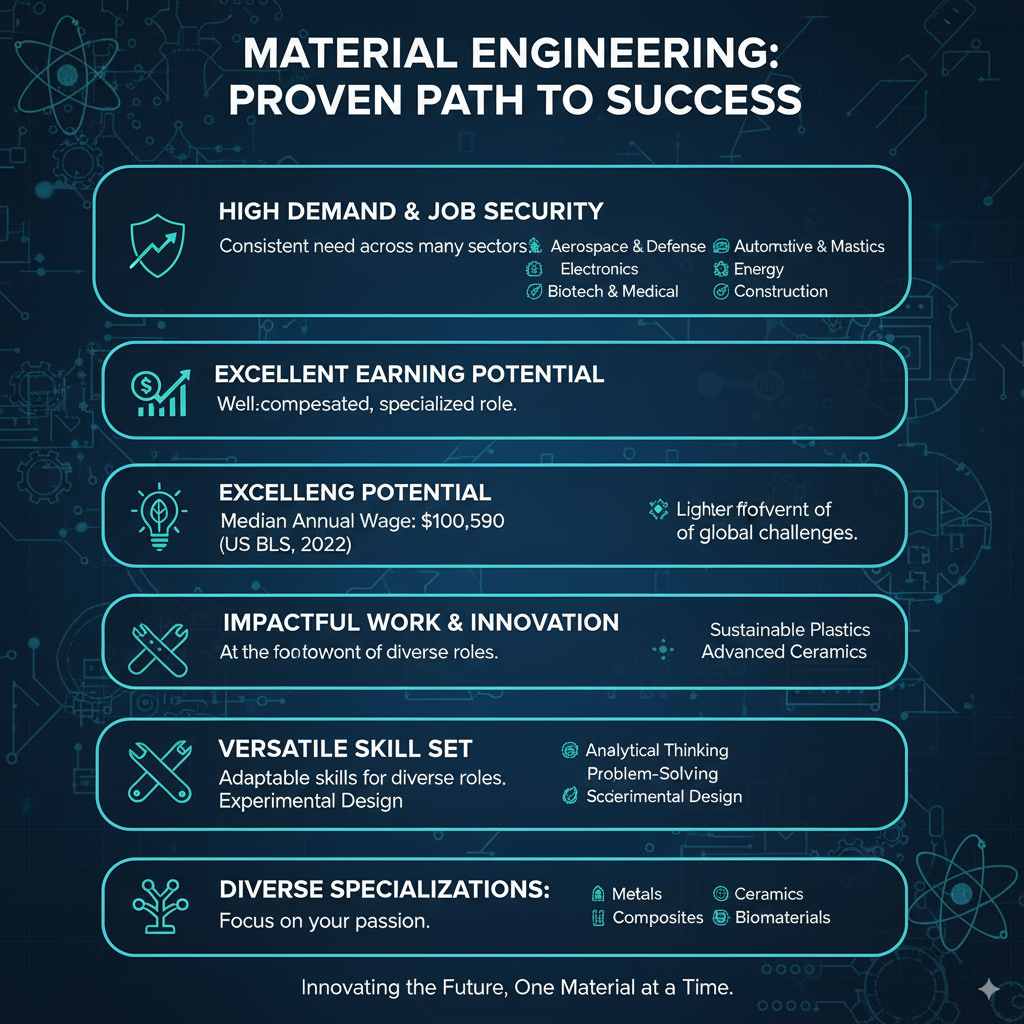
High Demand and Job Security
The need for skilled material engineers is constantly growing across many sectors. As industries innovate and strive for better performance, sustainability, and cost-effectiveness, they rely heavily on the expertise of material engineers. This consistent demand translates into excellent job security. Major industries that continually hire material engineers include:
- Aerospace and Defense
- Automotive Manufacturing
- Electronics and Semiconductors
- Biotechnology and Medical Devices
- Energy (Renewable and Traditional)
- Construction and Advanced Materials
Excellent Earning Potential
Material engineering is a well-compensated field, reflecting the specialized knowledge and critical role these professionals play. Entry-level salaries are competitive, and with experience and specialization, earning potential can increase significantly. According to the U.S. Bureau of Labor Statistics, the median annual wage for materials scientists and engineers was $100,590 in May 2022. This figure is considerably higher than the median wage for all occupations, indicating a strong return on investment for education and training in this field.
Impactful Work and Innovation
Material engineers are at the forefront of innovation. They have the opportunity to develop groundbreaking materials that can solve some of the world’s biggest challenges. This could involve creating lighter, more fuel-efficient materials for vehicles, developing sustainable and biodegradable plastics to combat pollution, or designing advanced ceramics for extreme environments. The work is intellectually stimulating and offers a profound sense of purpose.
Versatile Skill Set
A career in material engineering equips you with a broad and adaptable skill set. You’ll develop strong analytical and problem-solving abilities, a deep understanding of scientific principles, and proficiency in experimental design and data analysis. These skills are transferable to various roles and industries, offering flexibility and opportunities for career growth and transitions throughout your working life.
Diverse Specializations
The field of material engineering is vast, offering numerous avenues for specialization. Whether you’re fascinated by metals, polymers, ceramics, composites, or biomaterials, there’s a niche for you. This allows you to focus on areas that truly ignite your passion and align with your career goals.
Types of Materials Engineers
Material engineering isn’t a one-size-fits-all discipline. Professionals often specialize in particular types of materials or focus on specific aspects of material science and engineering. Here are some of the common specializations:
| Specialization | Focus | Examples of Applications |
|---|---|---|
| Metallurgical Engineers | Metals and alloys, their properties, processing, and applications. | Aircraft components, high-strength steel for construction, superalloys for jet engines. |
| Polymer Engineers | Plastics, rubbers, and elastomers, focusing on their synthesis, structure, properties, and processing. | Food packaging, medical tubing, automotive parts, synthetic fibers. |
| Ceramic Engineers | Ceramics, glass, cement, and refractories, including their design, manufacturing, and use. | Spark plugs, tiles for space shuttles, dental implants, heat-resistant components. |
| Composite Engineers | Materials made from two or more constituent materials with significantly different physical or chemical properties. | Lightweight car bodies, wind turbine blades, sporting goods (e.g., tennis rackets, bicycle frames). |
| Biomaterial Engineers | Materials used in medical devices and implants. | Artificial joints, stents, contact lenses, drug delivery systems. |
| Nanomaterial Engineers | Materials engineered at the nanoscale (typically 1 to 100 nanometers). | Advanced electronics, catalysts, targeted drug delivery, stronger coatings. |
Education and Training for Material Engineers
To enter the field of material engineering, a strong educational foundation is essential. The journey typically involves:
Undergraduate Studies
A bachelor’s degree in Materials Science and Engineering, Metallurgical Engineering, or a closely related field is usually the minimum requirement. These programs provide a comprehensive understanding of:
- The relationship between a material’s structure, properties, processing, and performance.
- Fundamental principles of physics, chemistry, and mathematics.
- Properties of various material classes (metals, polymers, ceramics, composites).
- Materials testing, characterization, and manufacturing processes.
Many universities offer specialized tracks within their materials science programs, allowing students to explore areas like biomaterials, electronic materials, or computational materials science.
Graduate Studies
For research-oriented roles, advanced positions, or specialization in niche areas, a master’s or Ph.D. in Material Science and Engineering is often beneficial. Graduate studies involve in-depth research and coursework, leading to a dissertation or thesis. This further hones problem-solving skills and contributes new knowledge to the field.
Professional Certifications and Licensure
While not always mandatory, professional certifications or licensure (such as becoming a Professional Engineer or PE) can enhance career prospects and demonstrate a commitment to professional standards. The requirements for licensure vary by region and country.
Common Career Paths and Job Roles
Once you have the necessary education, a range of exciting career paths opens up. Here are some typical job roles material engineers might take on:
- Materials Scientist: Focuses on fundamental research to discover and understand new materials or phenomena. Often works in R&D departments of companies or academic institutions.
- Materials Engineer: Applies scientific and engineering principles to design, develop, and test materials for specific applications. This role is very common in manufacturing and product development.
- Research and Development (R&D) Engineer: Works on developing new materials, improving existing ones, or creating innovative applications. This often involves cutting-edge technologies.
- Process Engineer: Oversees and optimizes the manufacturing processes for materials. Ensures efficiency, quality, and cost-effectiveness in production.
- Quality Control/Assurance Engineer: Responsible for ensuring that materials and products meet specified standards and performance criteria.
- Failure Analyst: Investigates material failures to determine causes and recommend solutions to prevent recurrence. Critical in industries where safety is paramount.
- Materials Inspector: Examines raw materials and finished products to ensure they meet quality and safety specifications.
- Technical Sales Engineer: Uses their technical expertise to sell specialized materials or equipment and advise customers on their use.
- Computational Materials Scientist/Engineer: Uses computer simulations and modeling to predict material behavior and design new materials, speeding up the discovery process. Tools like computational modeling are vital here.
Skills Essential for Material Engineers
Beyond a strong academic background, several key skills contribute to success as a material engineer:
- Analytical Skills: The ability to break down complex problems, analyze data, and draw logical conclusions is paramount.
- Problem-Solving: Material engineers are constantly faced with challenges, from optimizing a material’s performance to troubleshooting manufacturing issues.
- Scientific Knowledge: A firm grasp of physics, chemistry, and engineering principles is fundamental.
- Technical Skills: Proficiency in using laboratory equipment, testing apparatus, and relevant software (like CAD, simulation tools).
- Communication Skills: The ability to clearly explain technical concepts to colleagues, clients, and management, both in writing and verbally.
- Attention to Detail: Precision is crucial in material science, where small variations can have significant impacts.
- Teamwork: Many projects involve collaboration with scientists, engineers from other disciplines, and production staff.
- Creativity and Innovation: Developing new materials and solutions often requires thinking outside the box.
The Impact of Material Engineering on Modern Life
It’s hard to overstate the influence of material engineering on the world we live in. Consider these examples:
- Transportation: Lighter and stronger composite materials in cars and airplanes reduce weight, leading to significant fuel efficiency improvements and reduced emissions. High-performance alloys are critical for engine components that endure extreme temperatures and pressures.
- Electronics: Advances in semiconductor materials, polymers, and ceramics have enabled the miniaturization of devices, the development of flexible displays, and improved battery technology for everything from smartphones to electric vehicles. The development of semiconductors by material scientists is foundational to the digital age.
- Healthcare: Biocompatible materials are essential for countless medical advancements, including artificial joints, pacemakers, stents, and advanced wound healing products. Research into novel biomaterials continues to improve patient outcomes and quality of life.
- Energy: Material engineers are developing more efficient materials for solar cells, advanced batteries for energy storage, and robust components for nuclear reactors and wind turbines, playing a vital role in the transition to sustainable energy sources.
- Construction: New alloys, composites, and advanced concrete formulations allow for stronger, lighter, and more durable buildings and infrastructure, often with improved sustainability profiles.
Challenges and Future Trends in Material Engineering
While material engineering is a rewarding career, it also faces evolving challenges and exciting future trends:
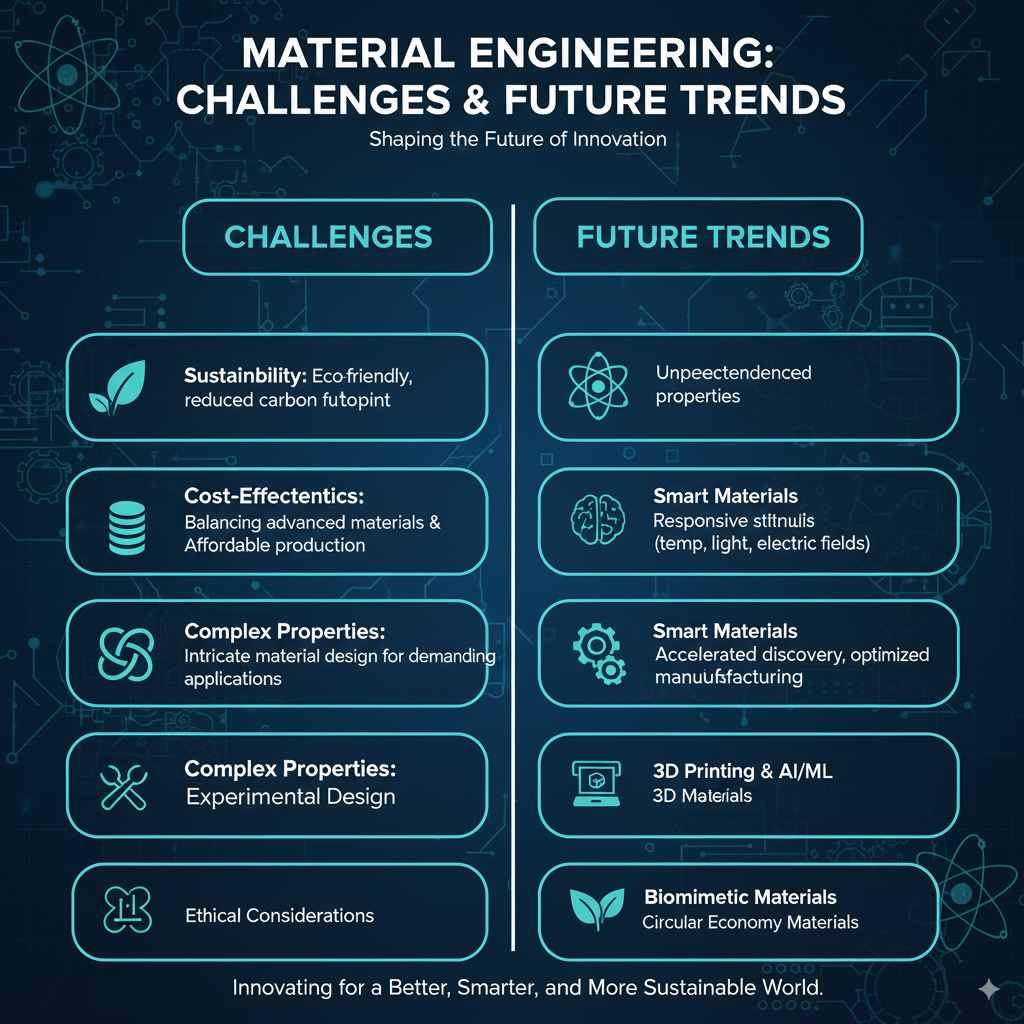
Challenges:
- Sustainability: Developing materials that are environmentally friendly, recyclable, and have a reduced carbon footprint throughout their lifecycle is a major focus.
- Cost-Effectiveness: Balancing the development of advanced materials with the need for affordable production and implementation.
- Complex Properties: Designing materials with intricate combinations of properties to meet increasingly demanding application requirements.
- Ethical Considerations: Particularly in biomaterials and advanced manufacturing, addressing ethical implications related to safety, accessibility, and environmental impact.
Future Trends:
- Nanotechnology: Harnessing materials at the nanoscale to create products with unprecedented properties.
- Smart Materials: Developing materials that can respond to external stimuli like temperature, light, or electrical fields.
- 3D Printing/Additive Manufacturing: Creating complex geometries and custom materials directly from digital designs, revolutionizing prototyping and production across industries.
- Artificial Intelligence (AI) and Machine Learning (ML): Using AI/ML to accelerate material discovery, predict material properties, and optimize manufacturing processes.
- Biomimetic Materials: Designing materials inspired by nature’s own designs to achieve superior performance and sustainability.
- Circular Economy Materials: Focusing on materials designed for reuse, repair, and recycling from the outset.
The field is constantly evolving, driven by the need for better, more sustainable, and higher-performing materials.
Frequently Asked Questions (FAQs)
Q1: What kind of person makes a good material engineer?
A good material engineer is typically curious, analytical, and enjoys solving complex puzzles. They have a strong foundation in science and math, are detail-oriented, and enjoy hands-on work with materials. Teamwork and clear communication are also important.
Q2: Do I need a Ph.D. to work in material engineering?
Not always. A bachelor’s degree is often sufficient for many engineering roles, especially in industry. A master’s or Ph.D. is typically required for advanced research positions or specialized roles in academia or cutting-edge R&D.
Q3: What is the difference between a material scientist and a material engineer?
A material scientist often focuses more on the fundamental understanding of materials at a molecular or atomic level, while a material engineer applies this knowledge to design, develop, and implement materials for practical applications and products.
Q4: How much do material engineers typically earn?
Salaries in material engineering are generally competitive. In the U.S., the median annual wage for materials scientists and engineers was around $100,590 as of May 2022, with earning potential increasing significantly with experience and specialization.
Q5: What industries hire material engineers?
Material engineers are hired across a wide range of industries, including aerospace, automotive, electronics, medical devices, energy, manufacturing, construction, and consumer goods. Their expertise is valued wherever materials innovation is key.
Q6: Is material engineering a difficult field to study?
Like any engineering discipline, material engineering requires a solid understanding of mathematics and science. It can be challenging, but for those with a genuine interest in how things are made and a knack for problem-solving, it is a very rewarding and manageable field to pursue.
Q7: What are some of the biggest challenges material engineers face today?
Key challenges include developing sustainable and environmentally friendly materials, improving the cost-effectiveness of advanced materials, and designing materials with increasingly complex performance requirements. Balancing innovation with environmental responsibility is a major focus.
Conclusion
When weighing your career options, it’s clear that material engineering is a field brimming with opportunities and impact. It’s a career path that offers intellectual stimulation, financial security, and the chance to be at the forefront of technological advancement. From creating the next generation of lightweight vehicles to developing life-saving medical devices, material engineers are shaping our present and future. If you have a passion for science, a drive for innovation, and enjoy problem-solving, a career in material engineering promises proven success and a deeply rewarding journey.