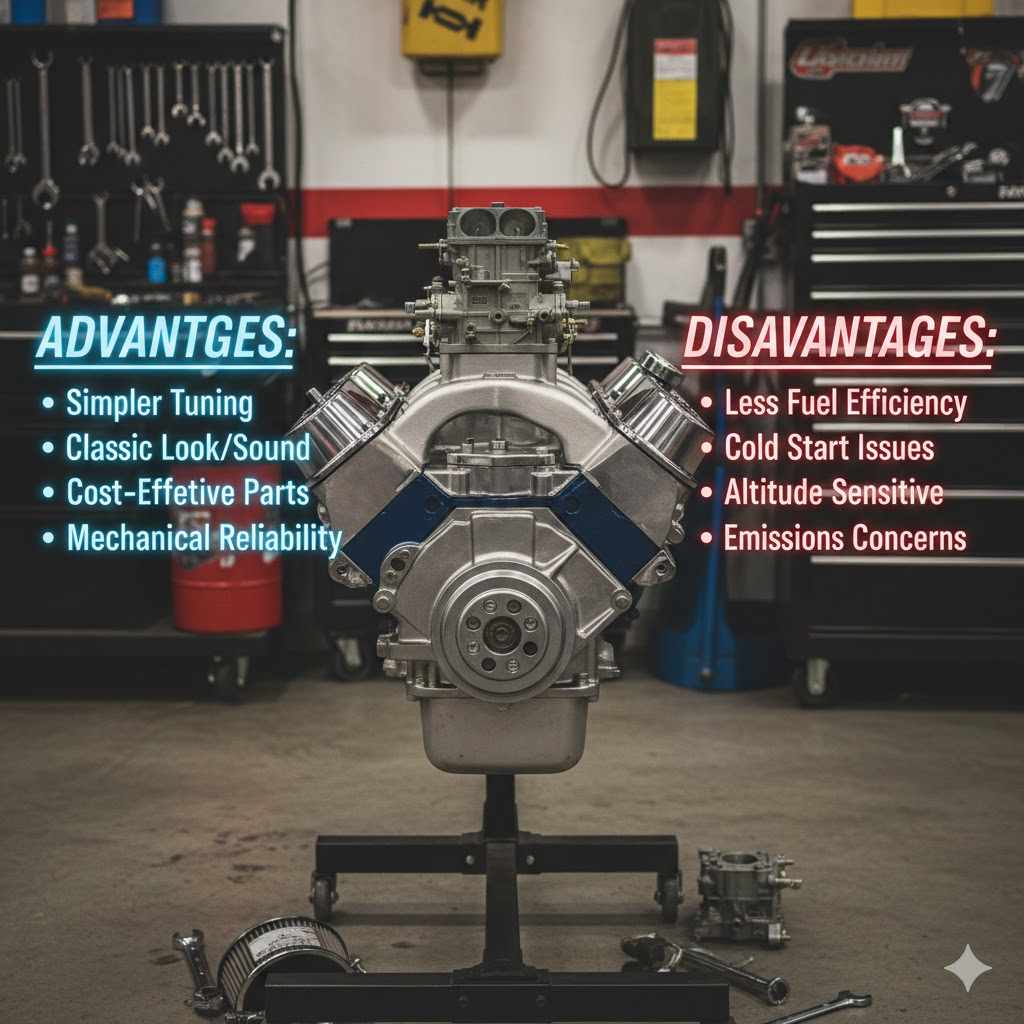
LS Engine With Carburetor: Examining Its Advantages and Disadvantages
Thinking about putting an LS Engine With Carburetor: Pros & Cons in your car? It’s a popular choice for many, but it can seem a bit tricky if you’re just starting out. Don’t worry, though! This is all about breaking down the basics so that it’s easy to grasp. We’ll explore why people choose this setup and what you should know before starting. Get ready because we’re about to make things super clear, step by step.
What’s the Big Deal About LS Engines?
LS engines have become favorites in the car world. They’re praised for being powerful and fitting well in lots of different cars. These engines can handle lots of power, and they’re also pretty compact. This makes them a great pick if you want to swap an engine. People love to modify these engines, too, because there are tons of parts available, which helps to increase power. The engines are often found in modern cars, but many enthusiasts put them into older vehicles, giving them a big upgrade in performance and efficiency.
Power and Performance Advantages of LS Engines
The LS family of engines, produced by General Motors, is celebrated for its remarkable power output and performance characteristics. From the outset, these engines were built to deliver impressive horsepower and torque figures. The specific output varies across the different LS engine models, but the overarching theme is a significant power boost compared to older engine designs.
This makes LS engines ideal for those looking to enhance their vehicle’s acceleration, top speed, and overall driving experience. Furthermore, the robust construction of the LS engine contributes to its durability and ability to withstand the stresses of high-performance driving. This means that, when properly maintained, LS engines can offer reliable power for an extended period.
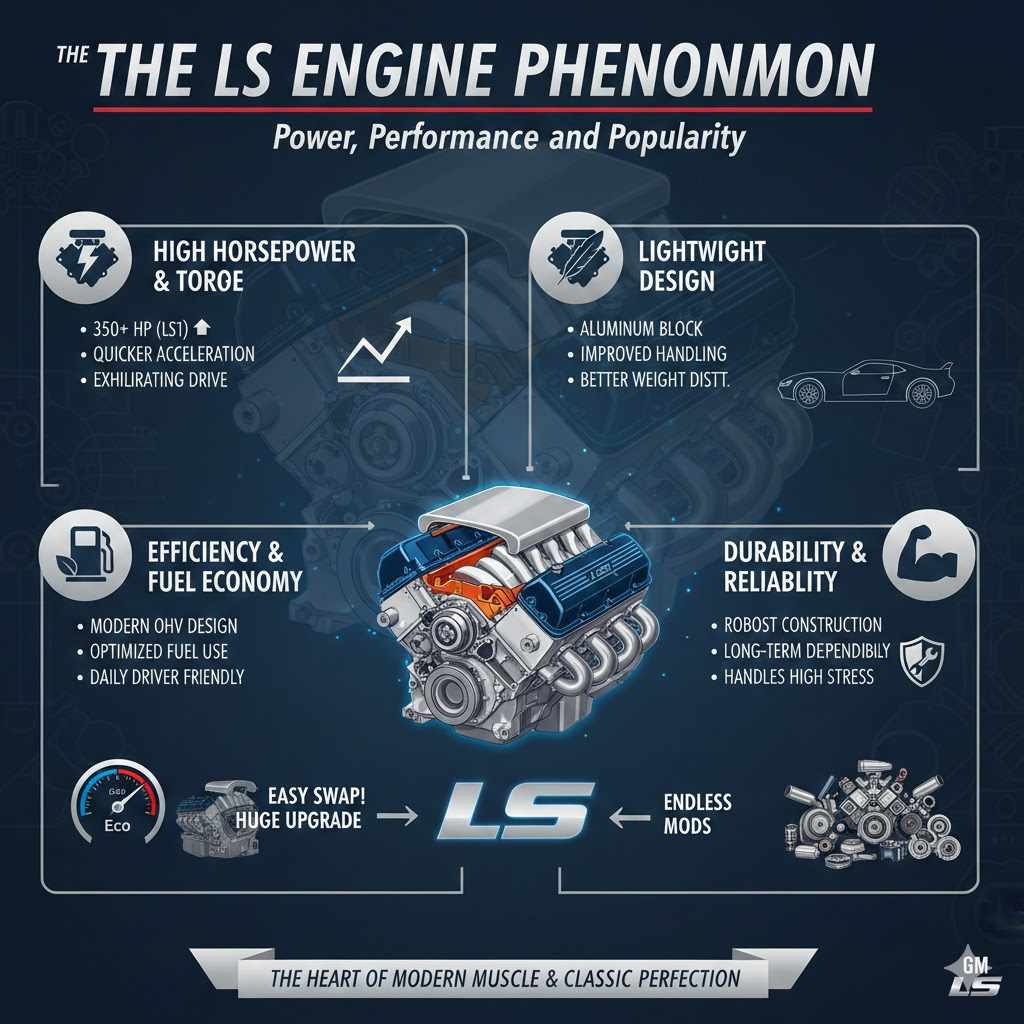
High Horsepower and Torque: LS engines, such as the LS1, LS3, and LS7, are known for their high horsepower and torque figures, leading to quicker acceleration and improved responsiveness. For instance, the LS1, a popular choice, can produce around 350 horsepower, providing a significant upgrade over many older engine designs. This increase in power directly translates to a more exhilarating driving experience, allowing for faster acceleration and better performance in various driving conditions.
This boost in power makes the LS engines very attractive for performance enthusiasts.
Lightweight Design: Compared to older engine designs, many LS engines are lighter, which helps improve vehicle handling and overall performance. The use of aluminum in the engine block and other components significantly reduces weight, contributing to better weight distribution and handling. A lighter engine also can improve fuel efficiency, as the vehicle requires less energy to accelerate and maintain speed.
This lightweight design is key to better overall vehicle performance.
Efficiency and Fuel Economy: While not the primary focus, many LS engines offer improved fuel economy compared to older, less efficient engine designs. Technologies like overhead valve (OHV) configurations and advanced combustion strategies help optimize fuel usage. The improved fuel efficiency is a significant advantage, particularly for daily drivers who want to balance performance with reasonable running costs.
LS engines also offer improved fuel economy in certain situations.
Durability and Reliability: The LS engine is generally known for its robust construction, contributing to its long-term reliability and ability to withstand high levels of stress. The robust build and quality of materials used in LS engines have contributed to their reputation for durability and longevity.
This durability makes them a long-term reliable choice.
The Carburetor Connection: What Does It Bring?
When you put a carburetor on an LS engine, you’re mixing new and old technology. Carburetors are simple devices that have been around for a long time, while LS engines are known for their advanced design. Adding a carburetor lets you get rid of a lot of computer parts that are needed for fuel injection. This can make the engine easier to work on and cheaper, especially if you’re on a budget. However, it means giving up some of the modern technology that makes LS engines run smoothly and efficiently. This way you’re choosing performance and a hands-on experience in the vehicle.
Simplicity and Cost Savings With Carburetors
A major draw of using a carburetor on an LS engine is the increase in simplicity. Carburetors are mechanical devices, making them easier to understand, adjust, and repair compared to the complex fuel injection systems. This simplicity can be especially appealing to car enthusiasts and mechanics who prefer a more hands-on approach to engine tuning.
Because carburetors use basic principles, diagnosing and fixing issues can be simpler, requiring fewer specialized tools and less dependence on electronic diagnostic equipment. Additionally, the initial cost of installing a carburetor setup is typically lower than the cost of converting an LS engine to fuel injection, making it a good choice for those working with a budget. This often results in a lower overall cost for the engine setup.
Easier Tuning and Maintenance: Carburetors are mechanically based. This makes them easier to adjust and maintain compared to fuel injection systems, which rely on electronic control units (ECUs) and sensors. The basic adjustments, like idle speed and air-fuel mixture, can be made using simple tools. Because you don’t need to be skilled with electronics, this lets you make changes and fine-tune your engine’s performance relatively quickly.
This direct control over the engine’s settings is favored by many enthusiasts.
Lower Initial Cost: The initial cost of installing a carburetor on an LS engine is often lower compared to converting to or maintaining a fuel injection system. Carburetors are generally more affordable than fuel injection systems, and the supporting components needed for a carburetor setup (fuel lines, regulators, etc.) are also less expensive. This is a big win for people who are on a budget and want to upgrade their engine.
This affordability is a key factor in making carburetors an attractive option.
Simplified Wiring: Using a carburetor removes the need for complex wiring associated with fuel injection systems, which rely on ECUs and a network of sensors. This reduction in wiring complexity makes the installation process easier. The removal of many electronic components simplifies troubleshooting.
Reduced complexity makes the installation and maintenance processes easier.
DIY-Friendly: Carburetor setups are well-suited for do-it-yourself projects. Their mechanical nature makes them accessible to home mechanics and car enthusiasts who enjoy working on their own vehicles. The simpler design, combined with a wealth of available resources (manuals, online tutorials, and forums), allows people to learn about and maintain their engines.
Carburetors often provide a more tangible, hands-on experience, and there is a lot of information available on how to work on the engines.
Drawbacks of Combining Carburetors and LS Engines
Although using a carburetor on an LS engine has advantages, there are also some downsides to think about. One big issue is that you lose the great fuel efficiency and smooth running that fuel injection gives you. This can result in poor gas mileage. Also, carburetors can be tough to get right. You’ll likely spend time trying to get the engine running well. You could also be giving up on the best performance because fuel injection can be more exact than carburetors. It’s a balance of old versus new, so you need to look at both the good and bad parts to see if it’s the right choice.
Performance and Efficiency Challenges
One of the key challenges of combining a carburetor with an LS engine is the potential reduction in performance and fuel efficiency. Carburetors are less precise at delivering fuel compared to the modern fuel injection systems that LS engines were originally built for. This lack of precision can lead to less optimal combustion, resulting in a loss of horsepower and torque compared to a fuel-injected LS engine.
Fuel efficiency also suffers, as carburetors can be less efficient at delivering fuel across different driving conditions. They can often run rich (excessive fuel) at certain points, leading to wasted fuel and higher emissions. This is in contrast to fuel injection systems, which precisely meter fuel based on engine demands and conditions.
Reduced Fuel Economy: Carburetors are less efficient than fuel injection systems. This will often lead to poorer fuel economy, resulting in higher running costs for the vehicle. Fuel injection systems are more precise in metering fuel, they provide fuel only when necessary, improving miles per gallon. Carburetors, however, often deliver a less precise amount of fuel, leading to excess fuel use.
The reduced fuel economy is a factor to consider for any daily driver.
Difficulties in Tuning: Tuning a carburetor for optimal performance on an LS engine can be tricky, needing skills and patience. It involves adjusting the jets, needles, and other components to achieve the right air-fuel mixture across various driving conditions. It can take time and require several adjustments to get the engine running correctly, and some situations might be challenging.
Setting up a carburetor setup properly can be time-consuming, and require a lot of testing.
Cold Start Issues: Carburetors can have a harder time starting in cold weather. Fuel injection systems are designed to provide the correct fuel mixture for a cold engine quickly. Carburetors, on the other hand, can require more cranking and may stumble before starting. The engine will often need time to warm up before it runs smoothly.
Cold weather issues with a carburetor are common.
Emissions Concerns: Carburetors generally produce more emissions compared to fuel injection systems. The less-precise fuel delivery of carburetors often leads to richer air-fuel mixtures, resulting in higher levels of unburned hydrocarbons and carbon monoxide in the exhaust. This can make it difficult to meet environmental standards and requirements, especially in regions with strict emissions testing.
Meeting emissions requirements is an important thing to check for.
Choosing the Right Carburetor for Your LS Engine
If you’re going for a carburetor setup with your LS engine, choosing the right one is key to getting the best performance. There are a few important things to think about. You’ll need to know how big your engine is, how much power you want, and how you plan to use the car. A bigger engine needs a bigger carburetor. Also, you’ll need to think about features like a choke to help the engine start easily when it’s cold. You will also need to pick the style and brand. It can be like a puzzle, but with the right research, you’ll be able to find the carburetor that fits your LS engine.
Selecting the Proper Carburetor: Size, Type, and Features
When selecting a carburetor for an LS engine, the key factors are size, type, and features to ensure compatibility and achieve the desired performance. The first consideration is the carburetor’s size, measured in cubic feet per minute (CFM). The CFM rating indicates how much air and fuel the carburetor can supply to the engine.
The size of your engine determines the correct CFM rating; too small and the engine will be restricted, while too large and it will cause poor performance. The type of carburetor—such as a single-barrel, two-barrel, or four-barrel—affects performance. Four-barrel carburetors are generally preferred for LS engine swaps due to their ability to provide the needed air and fuel for high performance. Finally, consider features such as electric chokes for easy starting, and adjustable jets for fine-tuning the air-fuel mixture. Choosing the correct carburetor involves matching its specifications to the specific needs of your LS engine.
Matching CFM to Engine Size: CFM (cubic feet per minute) is the measurement of the carburetor’s airflow capacity. The engine size (cubic inches or liters) will determine the CFM rating. Use an online calculator to figure out your carburetor CFM to get it right. It’s important to do this right, because a carburetor that’s too small will restrict airflow and hurt performance. A carburetor that is too big will often cause a loss of low-end torque.
Knowing the correct CFM is vital for engine performance.
Carburetor Type: There are single-barrel, two-barrel, and four-barrel carburetors. Four-barrel carburetors are a good choice for LS engines because of their ability to deliver the right amount of air and fuel needed for strong performance. The four-barrel design features two primary barrels for normal driving and two secondary barrels for more fuel when the engine needs extra power, like during acceleration.
Selecting the correct type of carburetor helps maximize engine performance.
Choke System: Consider a choke, which enriches the fuel mixture to make starting easier. There are different types of chokes, including manual and electric. Electric chokes are generally easier to use. They automatically adjust the fuel mixture when the engine is cold, making for easier start-ups. Manual chokes need manual adjustment and can require more expertise.
An electric choke system can make starting the engine easier.
Adjustability and Tuning: Look for a carburetor that offers adjustments for jetting and other settings, so you can fine-tune the air-fuel mixture. Adjustable carburetors give you the ability to get the best performance for your engine and driving conditions. Being able to adjust the jets lets you make changes for better performance and fuel economy.
Adjustable carburetors can help you improve performance and fuel economy.
The LS Engine Swap Process with a Carburetor
Putting an LS engine into a car with a carburetor needs careful planning and good skills. You’ll start by checking the engine and the car. You’ll need to see if it all fits. Then you will need to get the right parts, like a new engine mount and fuel system. The next step is to put the engine into the car, hook up all the parts, and make it run. Finally, you have to adjust the carburetor and check everything to make sure it runs correctly. Because this is a project, taking your time will ensure success. Always double-check every step.
Step-by-Step Guide to the LS Engine Swap
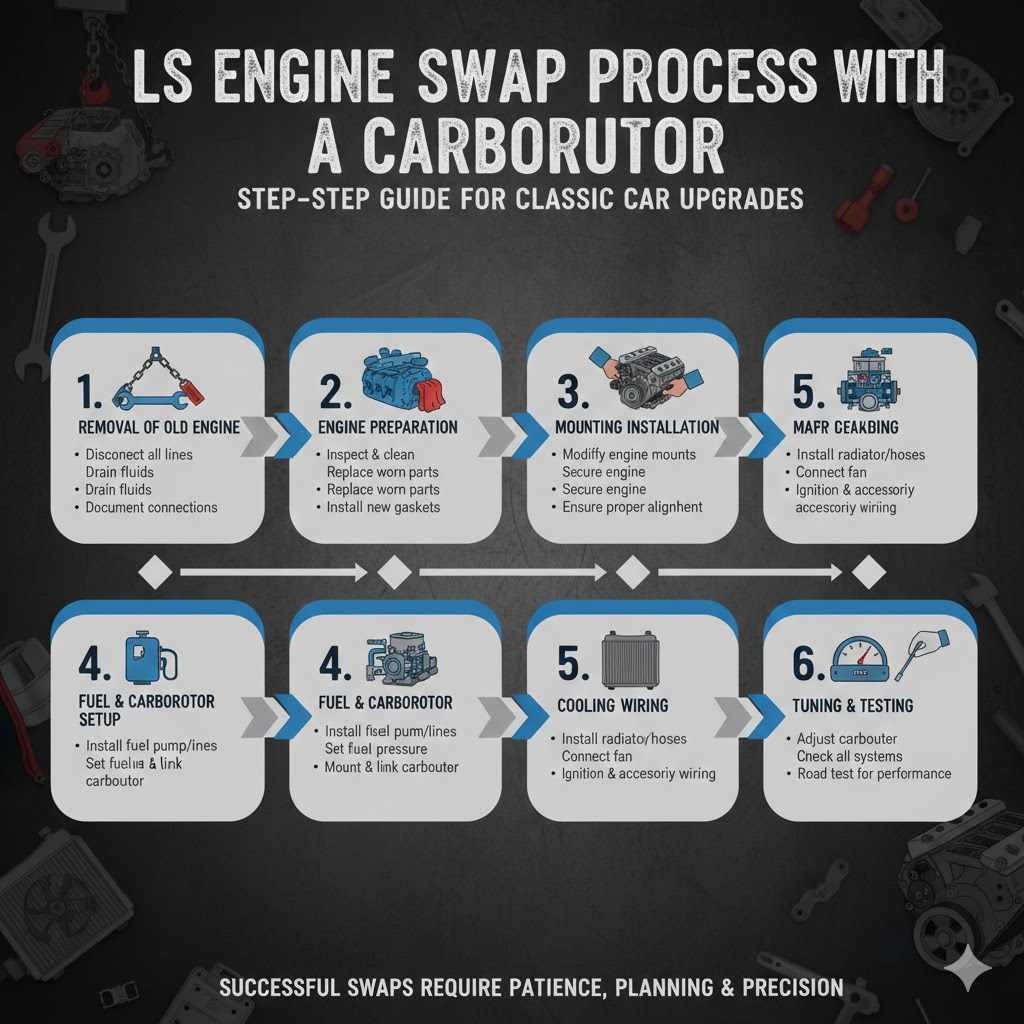
The LS engine swap process with a carburetor involves several steps, needing time, planning, and attention to detail. First, remove the original engine. This includes disconnecting all the components and removing the engine from the vehicle. Next, prepare the LS engine. This involves cleaning the engine, replacing any worn parts, and verifying all the components are in good condition. Then comes the fitting of the engine. This may require modifications to the engine bay or the use of specific engine mounts to ensure the LS engine fits correctly.
After that, set up the fuel system, which typically involves installing a fuel pump, fuel lines, and fuel regulator. Then, you’ll need to set up the cooling system, which includes a radiator, hoses, and fan. Connect the wiring for the ignition system and other accessories. Finally, install and tune the carburetor. This entire process takes many steps.
-
- Removal of the Original Engine: This is the first and often most physically demanding part of the process. Start by disconnecting all electrical connections, fuel lines, and any other parts that are attached to the original engine. Drain all fluids (oil, coolant, etc.) and remove the engine from the engine bay. It’s often helpful to document the engine bay and connections as you go to remember where things go for the installation.
Safe removal of the old engine is the first step.
-
- Engine Preparation: Before putting the LS engine in, get it ready. Check the engine and make sure all the parts are working correctly. Inspect the engine for any problems or leaks. Make sure you replace any parts that are worn or damaged. It’s often a good idea to refresh the engine, which can include new gaskets, seals, and other parts.
Preparing the engine is important for reliability.
-
- Engine Mounting and Installation: This step involves getting the LS engine to fit into the engine bay. This might need modifications, such as changing engine mounts to match the chassis. Make sure the engine sits securely and in the right position. It is critical to align the engine properly to prevent any problems with the transmission and other parts.
Correct positioning of the engine is critical.
-
- Fuel System and Carburetor Installation: Set up the fuel system and put in the carburetor. This includes installing the fuel pump, fuel lines, and regulator. Ensure you have the right pressure. Next, install the carburetor, ensuring it is properly mounted to the intake manifold. Install all the linkage, such as throttle and choke cables.
Properly installing the fuel system is key for engine operation.
Frequently Asked Questions
Question: Is it easier to work on a carburetor or fuel-injected LS engine?
Answer: Carburetors are typically easier to work on because they are simple mechanical devices. Fuel-injected engines have more complicated electronic systems that might need special diagnostic tools.
Question: Does using a carburetor reduce the horsepower of an LS engine?
Answer: Yes, in many cases, a carburetor setup can result in lower horsepower compared to a fuel-injected LS engine because of less precise fuel delivery.
Question: Are LS engines with carburetors more fuel-efficient?
Answer: Generally, LS engines with carburetors are less fuel-efficient than fuel-injected ones. Carburetors often deliver fuel less precisely, leading to increased fuel consumption.
Question: Can I use a carburetor on any LS engine?
Answer: Yes, you can use a carburetor on most LS engines, but you’ll need the right parts, such as an intake manifold made for a carburetor. You might also need some other parts like a distributor.
Question: What’s the main benefit of using a carburetor on an LS engine?
Answer: The primary benefit is the simplification and lower cost compared to maintaining or converting to fuel injection.
Final Thoughts
Considering the LS Engine With Carburetor: Pros & Cons is an interesting choice for anyone modifying their vehicle. It’s a combination of modern power with classic mechanical simplicity. The main plus is a chance to keep your costs down and have a hands-on experience, making engine work easier to understand. The drawbacks, however, include possible performance drops and fuel economy issues.
The selection of a carburetor is very important, as is ensuring you use the best fit. Putting in an LS engine with a carburetor involves following the steps carefully and ensuring you have the right setup. The right choice depends on your needs and skill level. Don’t be afraid to do some research and ask for help if you need it. Taking your time, planning carefully, and knowing what you want will help make your LS engine project a big success!